
Effective remote team management is defined by outcome-driven leadership, deliberate communication structures, and workflows that function across time zones. The traditional model of supervising presence no longer applies when your engineers are in Buenos Aires, your DevOps team is in Bogotá, and your product lead is in São Paulo. The real discipline here is distributed team leadership: building systems where results are visible, accountability is shared, and collaboration happens without constant meetings. For US and European tech managers hiring LATAM talent, this model also delivers up to 40% cost savings compared to domestic hiring, with nearshore timezone alignment that keeps EST and PST overlap intact.
How to manage remote teams: the foundational framework
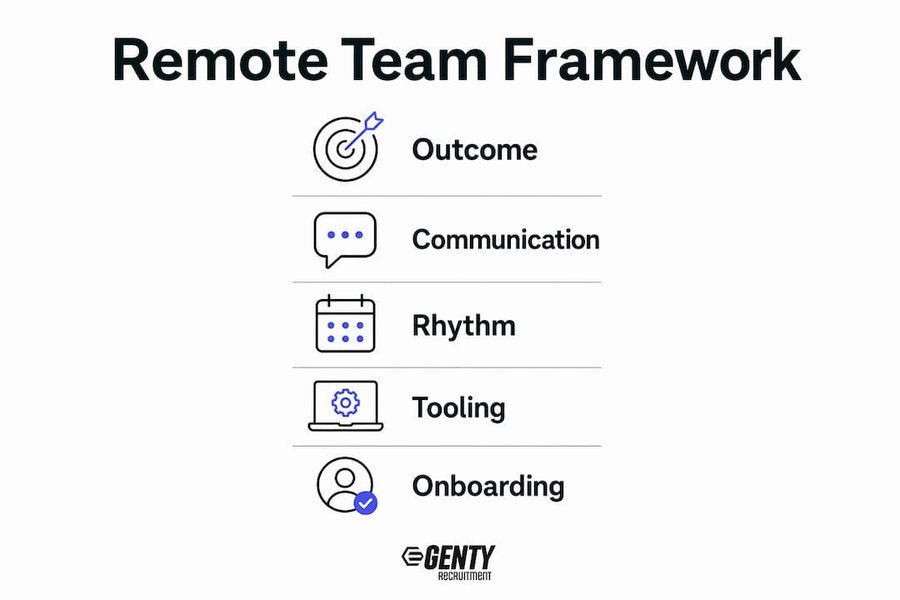
Managing distributed teams effectively starts with one shift in mindset: stop measuring time and start measuring outcomes. Outcome-based KPIs like goal completion rates and cycle time replace ineffective time tracking and give managers real visibility into performance. That shift moves you from “supervisor of time” to “manager of results,” which is the only role that scales across borders.
The second pillar is communication architecture. You need to decide, in advance, which channel handles which type of message. Slack or Teams for quick async updates, Loom or Notion for documentation, and video calls reserved for complex decisions. Without this structure, teams default to excessive meetings that waste up to 45% of productive time. That number reflects a real cost: a senior engineer in Mexico City losing four hours a week to unnecessary syncs is losing four hours of deep work.
The third pillar is rhythm. Weekly team syncs, biweekly one-on-ones, and monthly retrospectives create predictability. Predictability builds trust. And trust is the operating system for every high-performing remote team.
Need help hiring?
See the next step after this guide
If this topic is relevant to your team, these are the most useful pages to check next.

Essential tools for distributed team operations
The right tooling does not replace good management, but bad tooling makes good management impossible. The table below maps tool categories to their function in a distributed LATAM team context.
Pro Tip: Use an online planning tool to map your team’s working hours visually before scheduling any recurring meeting. A 10:00 AM EST standup lands at 11:00 AM in Bogotá and 12:00 PM in Buenos Aires. That overlap window is your synchronous gold.
How to onboard remote team members in LATAM successfully
Structured onboarding is the single highest-leverage activity in remote team management. Successful onboarding requires a buddy system, explicit tooling setup, and a tangible milestone delivered within the first two weeks. Without that structure, new hires drift, disengage, and leave. With it, they build connection and process clarity fast.
A 14-day onboarding framework for LATAM hires looks like this:
- Day 1: Complete tooling setup (Slack, Jira, Notion, GitHub access). Assign an onboarding buddy from the existing team, ideally someone in the same or adjacent time zone.
- Days 2–5: Shadow existing workflows. Attend one team sync. Read the team’s communication playbook and documentation standards.
- Days 6–10: Take ownership of a well-scoped first task. The task should be real work, not a tutorial. It should have a clear definition of done.
- Days 11–14: Deliver the first milestone. Hold a buddy check-in to surface blockers and calibrate expectations.
Cultural adaptation matters here too. Engineers from Argentina and Brazil often bring strong opinions and direct communication styles. Engineers from Colombia and Mexico may default to more formal registers initially. Neither is wrong. Your job as a manager is to make the team’s communication norms explicit so no one has to guess.
Pro Tip: Pair your staffing strategy workflow with a written onboarding checklist shared on Day 1. The checklist removes ambiguity and gives new hires a concrete sense of progress from the first hour.
First major delivery within 14 days is the clearest predictor of long-term engagement and retention in remote teams. That finding holds across LATAM markets. It means the onboarding investment pays back in lower turnover, not just faster ramp time.
What communication strategies reduce meeting overload in remote teams?
The most effective remote teams invert the default. High-performing distributed teams treat asynchronous communication as the standard and reserve synchronous meetings for complex or relationship-driven discussions only. That inversion protects deep work time, which is where engineers, data scientists, and DevOps professionals produce their best output.
“Managers should design communication deliberately like a product, standardizing rules to avoid chaos and missed updates. Over-communication is preferable in virtual teams to prevent misunderstandings, emphasizing clarity and full context in every message.”
Practical rules that make this work:
- Every meeting needs a written agenda shared at least 24 hours in advance. No agenda means no meeting.
- Meetings cap at 60 minutes. Meeting efficiency and accountability require documented outcomes assigned the same day the meeting ends.
- End-of-day reports replace status meetings. A structured 2-minute update covering progress, blockers, and next steps eliminates micromanagement while keeping managers informed.
- Channel definitions are non-negotiable. Slack is for async updates with a 4-hour response window. Email is for external stakeholders. Video calls are for decisions that require real-time discussion.
Teams adopting async-first cadences achieve 25% faster project delivery and cut wasted meeting time by 45%. That is not a marginal gain. For a team of eight engineers, that is roughly 15 hours of recovered productive time per week.
The most common mistake managers make is defaulting to sync because it feels faster. It rarely is. A 30-minute meeting with six people costs three hours of collective time. A Loom video with a Notion comment thread costs 20 minutes total.
How do you build trust and accountability in a distributed LATAM team?
Trust in remote teams is built through consistency, not surveillance. Outcome-driven management requires trusting internal systems rather than relying on physical presence. That means setting visible OKRs at the team and individual level, reviewing them weekly, and adjusting them when context changes.
Accountability follows visibility. When every team member can see what everyone else is working on and how it connects to the team’s goals, peer accountability replaces manager oversight. Tools like Linear or Jira make this visible by default. The manager’s job shifts from checking in to removing blockers.
Culture-building across physical distance requires deliberate effort:
- Run a 10-minute “wins and blockers” segment at the start of every weekly sync.
- Create a dedicated Slack channel for non-work conversation. Teams in Argentina and Brazil tend to engage heavily with these channels. It matters.
- Rotate who facilitates team retrospectives so every voice shapes the process.
- Prevent groupthink by encouraging dissent and having leaders speak last in decision discussions. Outlier voices disappear fastest in remote settings.
Burnout prevention is a specific risk in LATAM remote teams. Engineers in Colombia and Mexico often work across US time zones and their local business hours simultaneously. Set explicit boundaries: no Slack messages after 7:00 PM local time, no weekend pings unless the system is down. Protecting those boundaries is a management responsibility, not a personal one.
For deeper guidance on retaining LATAM talent long-term, recognition practices and process clarity matter as much as compensation. The benefits of remote teams extend well beyond cost savings when the culture is built intentionally.
Key Takeaways
Managing remote teams effectively requires outcome-based KPIs, async-first communication, structured 14-day onboarding, and deliberate culture-building practices that prevent burnout and groupthink.
What I’ve learned managing remote teams across LATAM
The conventional wisdom says remote management is about tools. It is not. Tools are table stakes. The real work is building a culture where people do not need to be watched to do good work.
I have seen teams in Buenos Aires and Bogotá outperform co-located teams in San Francisco, not because they worked harder, but because their managers gave them clear goals, removed blockers fast, and trusted them to deliver. The managers who struggled were the ones who scheduled daily standups to feel in control. That behavior signals distrust, and engineers read it immediately.
The LATAM timezone advantage is real and underused. A team in Colombia or Argentina overlaps with US EST by 4–6 hours. That window is enough for one focused sync, one decision, and one round of feedback. The rest of the day is deep work time. Managers who protect that structure get better output than managers who fill the overlap with meetings.
Onboarding is where I see the most preventable failures. A new hire who does not deliver anything real in the first two weeks starts to feel invisible. Invisible people disengage. The fix is simple: give them a real task with a clear definition of done on Day 3, not Day 30.
The last thing I would tell any manager transitioning from co-located to distributed leadership: write everything down. Decisions, context, rationale. Not for compliance. For clarity. A team that can read why a decision was made does not need a meeting to re-litigate it.
— Eugene
GENTY recruitment: building your remote LATAM team faster
Tech managers who apply these remote management practices need one more thing: the right people to manage.
GENTY recruitment places pre-vetted software engineers, DevOps specialists, data professionals, and sales teams from Argentina, Brazil, Mexico, and Colombia into US and European tech companies. The process delivers curated shortlists within 7 days, with fixed-fee pricing per seniority level and a 3-month replacement guarantee. Clients save up to 40% compared to domestic hiring while gaining nearshore timezone alignment and strong English proficiency. If you are ready to build a remote team that performs from Day 1, GENTY recruitment’s IT recruitment in LATAM service is the fastest path to pre-vetted, interview-ready candidates.
FAQ
What is the most effective way to manage remote teams?
The most effective approach combines outcome-based KPIs with async-first communication and structured weekly rhythms. Teams using these cadences deliver projects 25% faster and cut wasted meeting time by 45%.
How do you onboard remote employees successfully?
Assign an onboarding buddy, complete tooling setup on Day 1, and ensure the new hire delivers a tangible first milestone within 14 days. That sequence builds trust and prevents early disengagement.
What tools do remote teams need to collaborate effectively?
Remote teams need a project management platform (Jira or Linear), a documentation hub (Notion or Confluence), an async video tool (Loom), and a channel-based messaging platform (Slack or Teams). Each tool should have a defined purpose and response-time expectation.
How do you prevent burnout in remote LATAM teams?
Set explicit no-contact hours for engineers working across US and local time zones, and enforce them at the manager level. Engineers in Colombia and Mexico frequently work across multiple time zones simultaneously, making boundary-setting a management responsibility rather than a personal one.
How do you build accountability without micromanaging remote employees?
Use visible OKRs reviewed weekly and end-of-day progress reports covering progress, blockers, and next steps. That structure gives managers full visibility without requiring constant check-ins.