
115,200 annual openings. That's the U.S. Bureau of Labor Statistics' projected demand for software developers, including growth and replacement vacancies, in its 2024–2034 employment outlook. Software engineer recruiting is a continuous pipeline problem, not a requisition-by-requisition exercise. Your job as CTO is to define the capability you need, keep qualified candidates moving, and measure where decisions stall. Use realistic work samples, publish an AI-use policy, and judge hiring options by engineering capacity delivered, not applicant volume or headline rates.
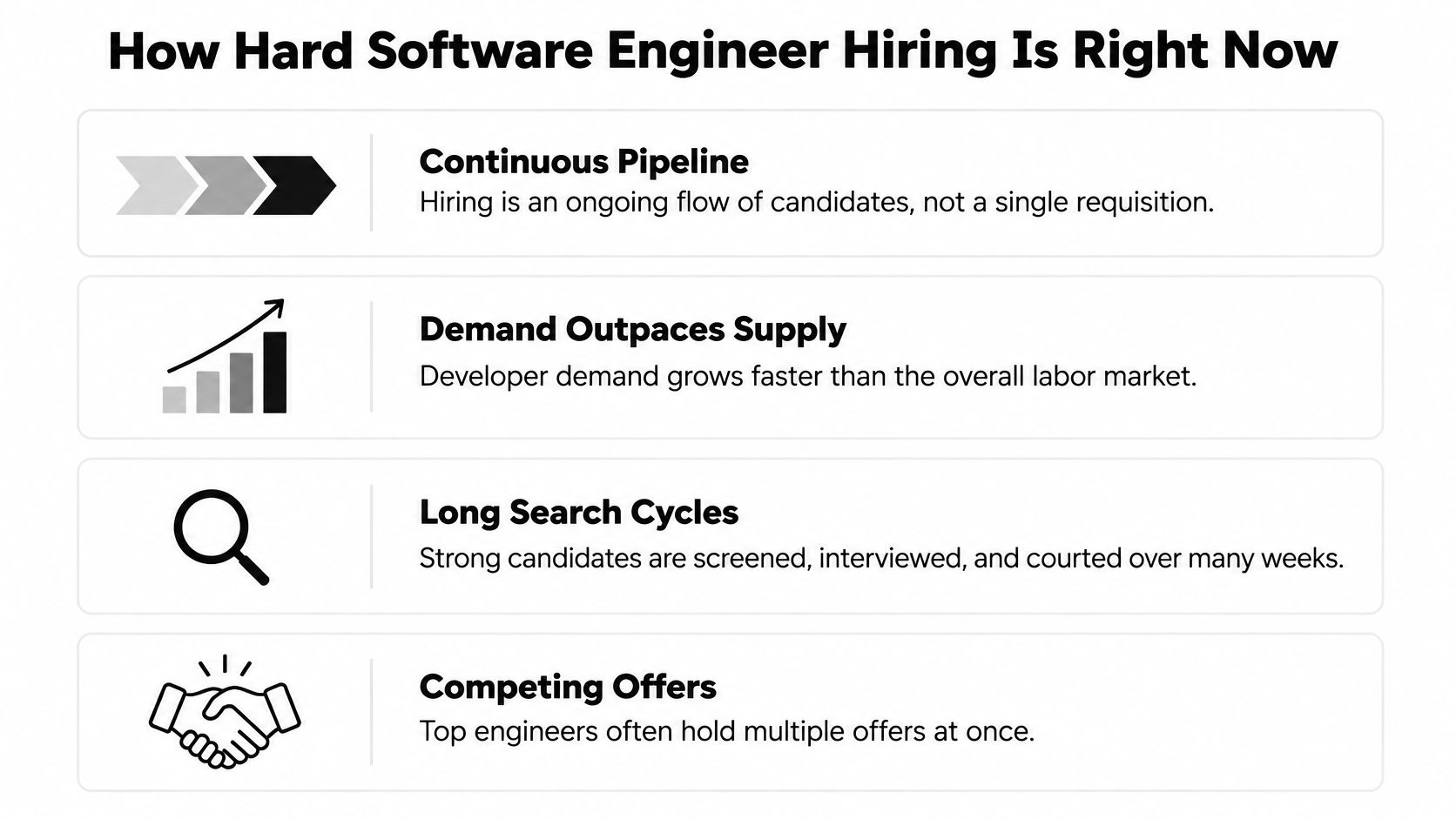
How Hard Software Engineer Hiring Is Right Now
The BLS projects 17.9% growth in software developer employment from 2023 to 2033, compared with 4.0% across all occupations, in its software-developer employment projection. That signals sustained demand, but employment projections do not measure how long a role takes to fill or how many qualified applicants you can reach.
Software developer employment benchmarks, 2023 to 2033
The newer BLS outlook cited earlier uses a different projection window. Treat the two growth rates as separate forecasts, not evidence that hiring has become easier or harder.
Planning a hire?
Talk through the best hiring option
This article usually leads to one practical question: should you use it recruitment or rpo? We can help you choose quickly.
Simple next step
Start with it recruitment and we will help you pick the best hiring setup.
For a Series A–C company, a vacancy creates competing demands: the remaining engineers must keep delivery on track while spending time on interviews. Track time to fill and qualified-candidate throughput from role approval. If either slips, find the bottleneck before adding more sourcing effort.
Practical rule: Assign one owner to the hiring pipeline, just as you would to a delivery dependency.
These projections cover U.S. employment. Use them as a demand signal, then assess local compensation and hiring conditions for each role.
Record every open engineering role and its approval date. That baseline separates a slow internal process from a search that needs a different approach.
Sourcing Channels Compared for Engineering Roles
Engineering sourcing channels compared
The assessments below are planning judgments, not measured channel benchmarks. Validate speed and quality against your own funnel.
Define speed as approval to first qualified shortlist, and signal quality as shortlist performance at the first technical screen. Don't accept submitted resumes as evidence of either.
Match channels to the search
Use referrals for scarce experience, but reward qualified introductions rather than volume. Apply an evidence filter before interviewing job-board applicants, particularly for junior and high-volume searches.
For GitHub sourcing, review maintained repositories, tests, and commit explanations rather than star counts. Prioritize this work for platform, infrastructure, and data specialists.
Agencies suit urgent searches; embedded recruiting suits recurring demand. Nearshore partners should demonstrate their screening method and working-hour fit for distributed roles.
Use a consistent candidate-sourcing process, and keep at least two active channels for each critical role as an operating safeguard.
Writing a Role Brief Before You Source
Approve the role before outreach. Treat the brief as the specification for a hiring pipeline: it sets what the team needs, what evidence counts, and how quickly candidates can move through decisions. A recruiter should not discover halfway through interviews that the CTO expects production ownership while the hiring manager prioritizes implementation speed.
Define the outcome in 90 days. Name a deliverable and its ownership boundary. For example, the engineer could own the payments retry service end to end. A clear result gives interviewers a shared basis for evaluating candidates.
Specify must-have evidence. Ask for relevant examples of production ownership, incident response, cloud deployment, and stakeholder communication. Evidence of past behavior is more useful than a list of technologies.
Remove proxy requirements. Drop unnecessary degree, employer-brand, and exact-framework-tenure filters. Tenure is a weak proxy for the ownership evidence the role needs; require candidates to show what they built, operated, or improved instead. A skills-first hiring approach makes those capabilities explicit.
State the operating model. Specify whether the role is remote, hybrid, or location-bound, and name the required overlap hours. Candidates need the actual working arrangement, not an ambiguous promise of flexibility.
Calibrate seniority. Set the level by scope, autonomy, system complexity, and business impact. Titles alone do not show whether someone can own the target system.
Approve compensation by level. Set the band before opening the requisition and name who can approve exceptions. An affordability mismatch found after assessment wastes candidate and engineering time.
Assign evidence to interview stages. Record the decision question for each stage. That keeps the process focused and makes pipeline throughput easier to manage.
Use a signable brief
Keep the technical-hiring retrospective in view as you define role requirements, then record the decisions in a one-page brief:
The hiring manager and CTO should sign the brief before sourcing starts. Use it to track whether the search is producing qualified candidates against the agreed criteria.
Screening With Work Samples and an AI-Use Policy
Measure screening as pipeline throughput: publish the sequence, track time to fill, and use consistent evidence at every gate. Clear rules make assessments easier to run and hiring decisions easier to defend.
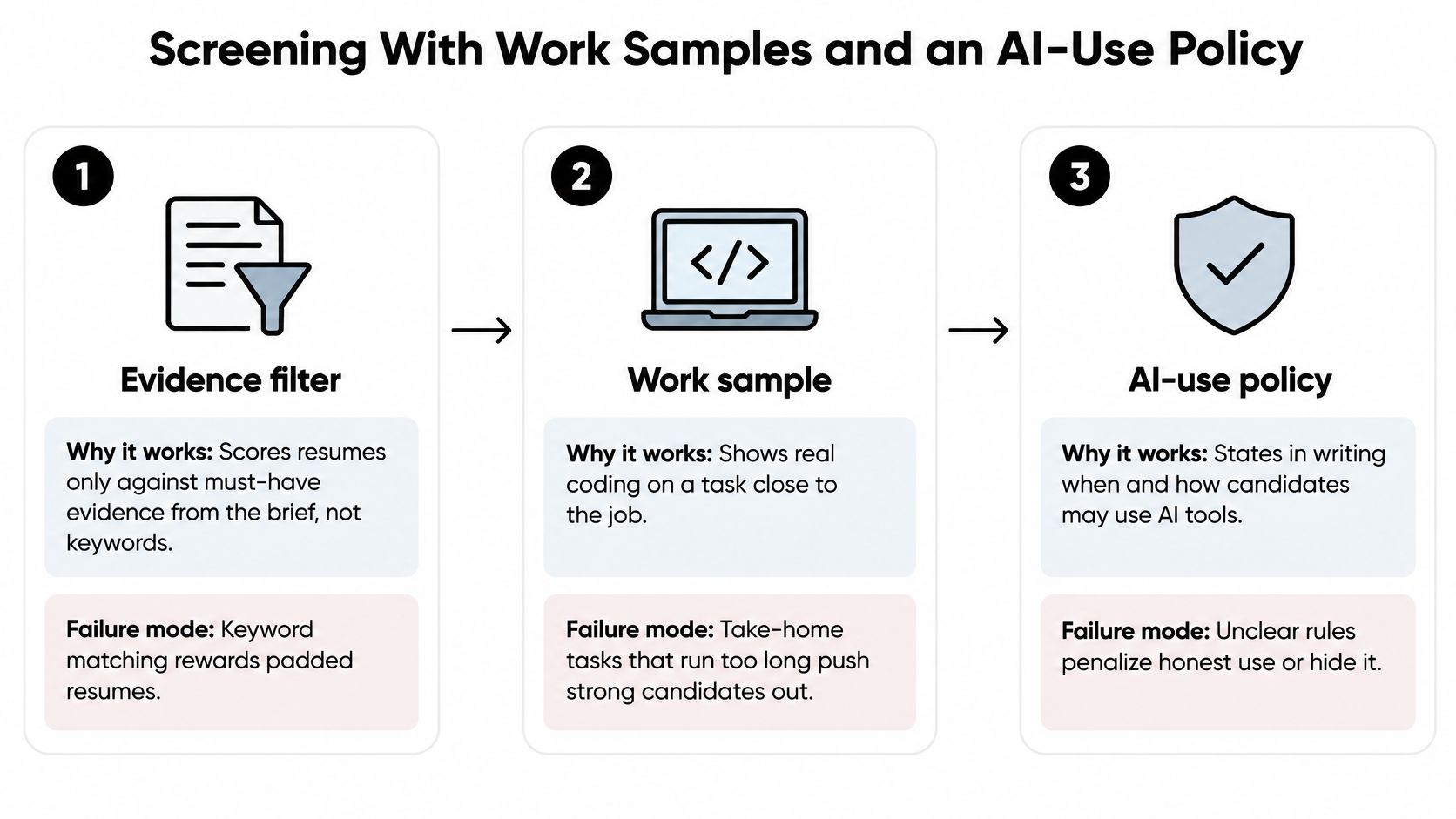
Use the diagram's three assessment stages after the initial screen:
Apply an evidence filter. Score resumes against the approved capabilities, not keyword density. Advance candidates who show relevant ownership, rather than relying on polished presentation alone.
Run a 25-minute recruiter screen. Check compensation alignment, notice period, time zone, and, for roles requiring English, a short spoken answer. This catches practical mismatches before they consume engineering time.
Assign a bounded work sample. Cap the exercise at two hours. Pay candidates if you request longer work, and never ask for an unpaid production deliverable. For example, ask them to fix a rate-limiter bug, add a regression test, and write a design note.
Hold a 45-minute walkthrough. Ask candidates to explain their decisions and modify their implementation. This verifies understanding and authorship, which a polished submission alone cannot establish.
A technical-skills assessment review reports predictive-validity coefficients of approximately 0.54 for work samples and 0.38 for unstructured interviews. Treat these as validity coefficients, not hiring-success percentages, and use the figures as directional context rather than a precise forecast.
Score correctness, testing, complexity, security, maintainability, and communication on a recommended 1-to-4 scale. Define anchored examples and the pass threshold before reviewing the first submission.
Make AI use explicit
HackerRank's 2025 Developer Skills Report reports that 73% of surveyed developers consider losing opportunities to AI-assisted candidates unfair. The figure describes respondents' views on fairness, not evidence that banning AI improves hiring decisions. Set a policy that reflects the tools engineers will use on the job:
Allow tools: Permit AI assistance when it matches the role.
Require disclosure: Ask what the candidate generated and how they checked it.
Verify judgment: Ask for an explanation, debugging, and a live modification.
Score ownership: Reward verified reasoning, not output polish alone.</li>
For example, favor a candidate who catches a missing idempotency check in an AI-scaffolded retry queue over one who cannot explain the submission.
Use a pair-programming interview approach to verify reasoning live. The accompanying video demonstrates a shared coding exercise, giving interviewers a practical way to observe how candidates explain decisions and respond to changes:
Designing an Interview Loop With Distinct Signals
Post-walkthrough interview loop
These are recommended session allocations, not mandatory additional rounds for every candidate.
A software-developer hiring benchmark summary cites approximately 62 days to fill engineering roles, versus 42 days across roles generally. Treat that comparison as context, not an acceptable internal service level.
My recommended target is two weeks from first screen to decision. Reserve interviewer availability before launching sourcing, rather than asking qualified candidates to wait while you find calendar space.
Buy new evidence with every session
If the walkthrough already established code-review capability, remove the separate pairing round. For a platform role, retain operational judgment; for a junior implementation role, don't require staff-level architecture evidence.
Every additional interview should answer a question the existing evidence cannot answer.
For an incident exercise, ask how the candidate would distinguish an application regression from a dependency failure. For collaboration, assess whether their design note identifies risks, decisions, and unresolved questions without requiring verbal rescue.
Use a scorecard containing signal, observed evidence, score, and whether the candidate raises the team bar. Evidence should be a code reference or an actual interview observation, not an impression such as confident or good fit.
Require independent scorecards before the debrief. The most senior interviewer speaks last so other interviewers don't just adopt the CTO's judgment.
Closing Offers and Setting Pay Bands
Approve the band before opening the role. Benchmark base pay, equity, and bonus against the relevant U.S. or European market and seniority level so the eventual offer follows an agreed business case.
Set an offer deadline internally. I recommend issuing the offer within 48 hours of the final debrief, because preventable approval delays give candidates another reason to continue competing processes.
Sell the actual operating model. Name the system ownership, on-call expectations, overlap requirements, and office cadence so the candidate can make an informed decision.
Compare total loaded cost. Include employer social charges, benefits, and any employer-of-record fee for cross-border hires so finance compares equivalent employment costs rather than salaries alone.
Define the counteroffer rule. Specify whether the band can move and who authorizes changes so the hiring manager doesn't negotiate exceptions independently.
Code every decline. Record compensation, scope, operating model, process length, or competing offer so offer acceptance becomes diagnostic rather than merely descriptive.
Don't change the level to justify a higher salary unless the evidence supports that level. The CTO approves above-band exceptions, and the authorized recruiting owner signs the offer letter.
Hiring LATAM Engineers on Cost, Time Zones and English
Assess LATAM hiring as a capacity decision: compare the full cost of an equivalent hire with the overlap hours your team needs. Choose this route when shared working time and sustained ownership matter. It is a weaker fit if the schedule leaves production responders without timely access to the core team.
Compare candidates by seniority, not country label or headline salary. For each target role, itemize salary, employer taxes, benefits, and any employer-of-record fee. Match scope, autonomy, and system complexity before comparing totals. Then check the candidate's actual daily availability against your U.S. or European team, including daylight-saving changes and on-call handoffs.
LATAM hiring checks before you commit
Set the overlap requirement before sourcing. Confirm the proposed schedule directly with each candidate, and test spoken English against the team's real work, such as incident handoffs and design discussions.

Request a written, itemized loaded-cost quote for one target role and seniority level. Use this salary, time-zone, and productivity comparison to structure the review, then calculate the total using your actual employment arrangement. Compare that figure with the hours of overlap the role requires before choosing a hiring route.
Hiring Metrics That Show Pipeline Health
Engineering hiring metrics and formulas
Directions below are operating preferences, not universal benchmark claims.
Cut every metric by source and seniority. A channel with strong pass rates but slow delivery needs a different intervention from one that sends unsuitable candidates quickly.
Read conversions and waiting time together
Track applicants → screen → work sample → interview loop → offer → acceptance, recording conversion between each pair. Early losses warrant a brief-and-sourcing review; assessment losses warrant rubric review; offer losses warrant checking the recorded decline reasons.
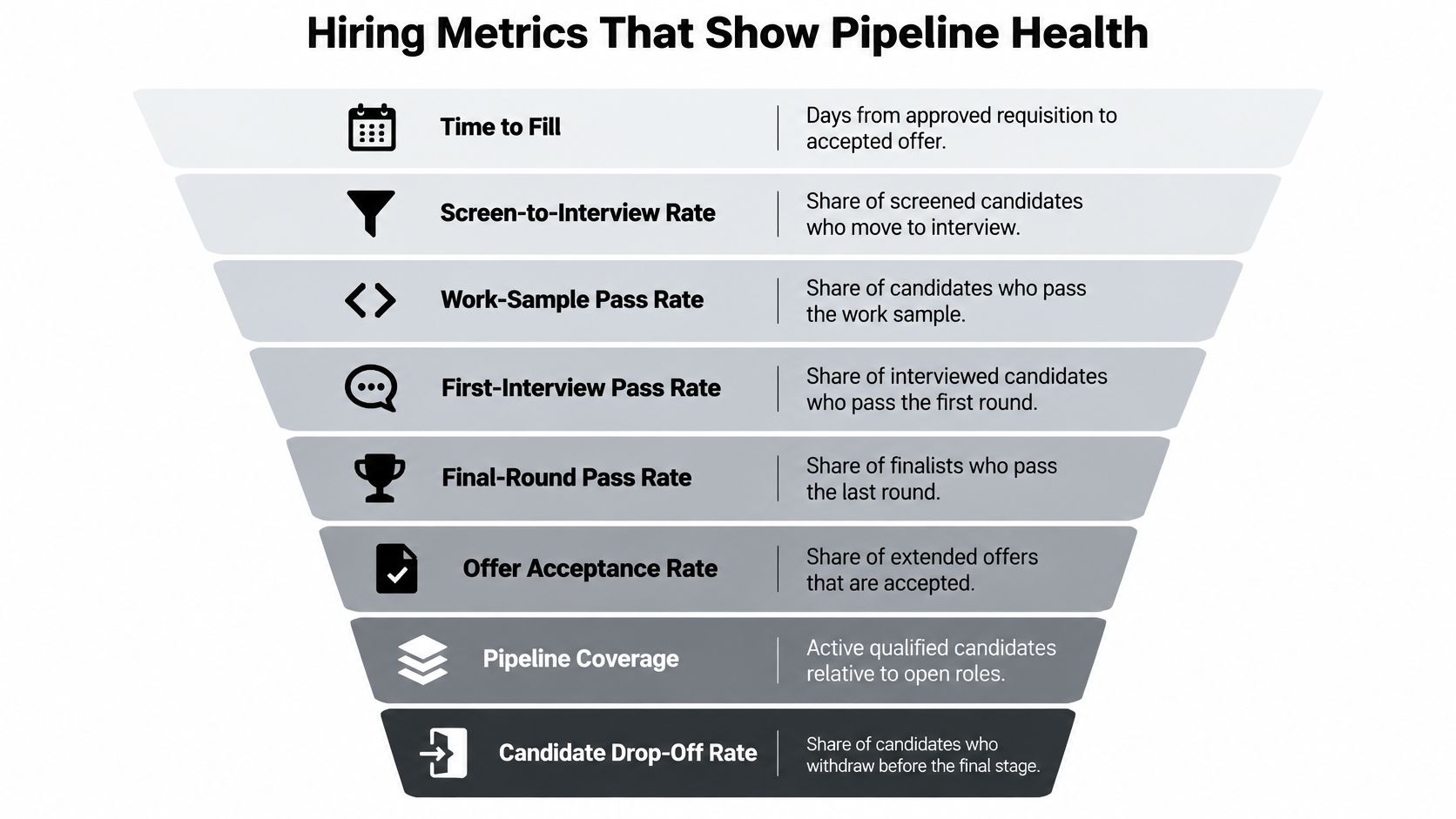
Review these weekly:
Time to fill: Locate avoidable waits using consistent time-to-fill definitions.
Work-sample pass rate: Check whether sourcing matches the approved capability.
Offer acceptance: Test package and operating-model fit.</li>
Use the earlier engineering benchmark as context, but investigate your stage-level delays before blaming market conditions.
Confirm the Hiring Owner and Pipeline This Quarter
Use this 30-day implementation checklist to turn software engineer recruiting into an owned operating process.
Name accountable owners. Assign a hiring owner for each critical role, typically the CTO for senior searches or VP Engineering for team leads, plus a recruiting owner responsible for candidate movement.
Sign the next role brief. Use the approved fields above and resolve disagreements before anyone contacts candidates.
Prepare assessment and sourcing together. Build the scorecard and activate the recommended channel coverage before applications arrive.
Publish screening rules. Give interviewers the work-sample rubric, AI disclosure requirement, and pass threshold so candidates face consistent expectations.
Start measurement immediately. Log opening dates, stage transitions, assessment outcomes, and offer decisions from the first candidate onward.
Don't open a critical search without identifying who will review the next qualified candidate.
If your team can't cover four to six weeks of sourcing and screening for each critical role, compare an RPO partner for ongoing pipeline ownership with a specialist IT recruitment service for targeted cross-border searches.
This week, the hiring manager should book a 60-minute working session with the CTO. Leave with a signed brief, an assessment owner, and reserved decision time.
GENTY recruitment offers specialist technology recruitment, RPO, and salary benchmarking for companies building nearshore engineering teams. Bring your next role brief and ask how its skills-first screening and curated shortlists would fit your interview process, ownership requirements, and approved loaded-cost budget.