
A senior engineer in São Paulo can submit an excellent take-home, then freeze when asked to explain a design choice during a live coding call. That result doesn't necessarily indicate weak engineering. It may indicate an interview that measures performance under artificial pressure rather than the way your team builds software.
A pair programming interview is a live, collaborative technical assessment. The candidate and interviewer share an IDE or editor, work through a realistic coding problem, and use driver and navigator roles to expose reasoning, communication, debugging, and judgment. The final code matters, but the process matters more. For distributed teams hiring across the US, Europe, and LATAM, a well-designed session can become a practical calibration tool, not just another technical screen.
What a Pair Programming Interview Actually Tests
The format is simple. The candidate writes and modifies code while the interviewer asks questions, offers context, and occasionally steers the work. The pair may switch roles during the session, depending on the exercise. Shared tools such as an IDE, browser, terminal, or collaborative editor let both people see how the candidate approaches an unfamiliar problem.
That makes the format different from a silent take-home or a whiteboard algorithm. A take-home can show the quality of a finished artifact, but it often hides how the engineer clarified requirements, handled uncertainty, and reacted to feedback. A whiteboard exercise can reveal algorithmic knowledge, yet it may reward polished performance more than day-to-day engineering habits. A pair programming interview keeps the technical task while adding the human interaction that production work requires. Technical screening guidance is useful when deciding where this format belongs in a broader hiring process.
Need help hiring?
See the next step after this guide
If this topic is relevant to your team, these are the most useful pages to check next.
The three signals that matter most
Hypothesis formation is the first signal. Strong candidates don't jump immediately into code. They identify assumptions, propose a likely cause when something fails, and design a small test to confirm or reject that idea. This is the same behavior you need during production debugging, incident response, and ambiguous product work.
Feedback uptake is the second. The interviewer should be able to redirect the candidate without taking over. A candidate who listens, adjusts the plan, and explains the resulting trade-off demonstrates coachability without passive compliance. The signal isn't whether the candidate follows every suggestion. It's whether they can evaluate input and respond deliberately.
Trade-off articulation is the third. Candidates should explain why they chose a data structure, accepted a complexity cost, delayed an optimization, or introduced a test boundary. A finished solution reached through unexplained guesses tells you less than a partial solution supported by clear engineering judgment.
Practical rule: Score how the candidate thinks with another engineer in the room, not how quickly they type when nobody interrupts.
This distinction matters for distributed LATAM hiring. Remote engineers need to make reasoning visible in calls, pull requests, and asynchronous discussions. Accents, local internet conditions, or familiarity with a particular editor shouldn't determine the result. The session should reveal whether the candidate can communicate technical decisions clearly across distance, documentation, and time zones.
Formats and Structures Compared Side by Side
No single format fits every hiring stage. Use live pairing when you need direct evidence of collaboration. Use a take-home review when the role requires sustained implementation and the candidate needs space to work. Use a pull-request simulation when code review is central to the job.
Pick the format by the signal you need
Live IDE pairing is the most direct choice when the job requires frequent collaboration, fast clarification, or interactive debugging. A common structure uses the candidate as driver and the interviewer as navigator. This model also works well when you need a consistent experience across a large pipeline, provided the task and environment stay standardized.
Take-home plus live review gives candidates more room to demonstrate architecture, tests, and written communication. It also creates more preparation work and raises fairness questions about available time, coaching, and external assistance. Keep the assignment tightly scoped and discuss the candidate's decisions rather than treating the repository as a complete representation of their ability.
Pull-request simulation is valuable for senior engineers because it mirrors how teams review production code. Ask the candidate to respond to comments, defend a change, and revise one part of the implementation. Don't use it to test whether their formatting preferences match yours.
Remote sessions depend on more than a meeting link. Candidates should understand how browser screen sharing works before the call, while interviewers should test permissions, shared terminals, cursor visibility, and copy-paste behavior in advance. Teams formalizing multiple assessment stages can also use structured hiring examples for tech startups to keep the format consistent.
A practical nearshore variant combines a 3-hour async take-home capped at 4 hours with a 60-minute live session. It balances uninterrupted implementation time with direct collaboration evidence, and it can reduce the disadvantage created by unstable bandwidth or inconvenient interview windows for engineers in LATAM.
Interviewer Checklist for Running a Fair Session
A fair session starts before the candidate joins. The interviewer owns the environment, the instructions, and the consistency of the scoring process. Candidate performance should not depend on whether the panel remembered to install an extension or explain the role of the navigator.
Before the call
Confirm access 24 hours ahead. Test the shared editor, repository, terminal, language runtime, permissions, and screen-sharing flow. This protects the tooling and execution dimensions from unrelated friction.
Send the problem in writing 15 minutes before the start. Include the objective, available documentation, expected output, and rules for external tools. A written statement tests interpretation without turning the opening minutes into a memory exercise.
Define the driver and navigator cadence. Tell the candidate when roles will switch, then follow that plan. Role clarity gives you evidence about collaboration instead of creating confusion that you later penalize.
Publish the AI policy. State whether autocomplete, documentation search, chat assistants, or code-generation tools are allowed. If assistance is permitted, require disclosure and score the candidate's verification and judgment rather than pretending the environment is tool-free.
Calibrate with a second interviewer. Review the task, expected solution paths, acceptable hints, and rubric anchors. A hiring manager checklist for technical hiring can support this operational discipline.
During the call
Spend the first 5 minutes on a human check-in. Explain the session, ask whether the candidate needs clarification about the environment, and create enough space for normal conversation. Remote candidates often need a moment to settle into a shared screen.
Present the task without leading. Watch how the candidate frames the problem, breaks it into pieces, reads existing code, and chooses a first experiment. Don't reward typing speed. If the candidate goes quiet, ask, “Walk me through your thinking,” instead of filling the silence with hints.
Intervene only after an agreed stuck threshold. Ask one trade-off question in the middle of the session, and switch roles at least once. The switch reveals whether the candidate can work with another person's code and give useful direction without turning the exercise into a performance contest.
After the call
Write observations within 30 minutes. Separate evidence from inference. “At 18 minutes, the candidate proposed testing the parser with an empty input” is evidence. “The candidate is naturally methodical” is an inference.
Flag connection lag, crashes, missing dependencies, keyboard problems, or unclear instructions before scoring. Debrief with the panel before sharing a decision, and require each interviewer to point to observed behavior rather than personality impressions.
Scoring Rubric That Reduces Subjectivity
A rubric turns competing impressions into comparable evidence. Score four dimensions from 1 to 4, with behavior anchored to each score. Use the same definitions across distributed LATAM interview panels, then record whether connectivity, tooling, language, or AI-use rules affected the evidence. Candidate evaluation guidance offers useful guidance for applying consistent evaluation standards.
Make calibration measurable
Before scoring candidates, have interviewers rate the same recorded mock session independently. Compare their evidence and resolve different interpretations by documenting concrete examples. The goal is consistent meaning, not identical opinions. This matters when one interviewer is in Bogotá and another is in São Paulo, with different communication norms and technical setups.
Require two scores per dimension before the debrief. Add timestamps and short candidate quotes, but avoid creating a transcript. Each note should identify the behavior, the interviewer prompt, and the candidate's response. Score only what the session allowed the candidate to demonstrate.
Apply the same remote fairness rules to every candidate. Mark connection lag, crashes, missing dependencies, keyboard problems, unclear instructions, or unfamiliar pairing tools before assigning a score. If the process permits AI assistance, record whether the candidate used it, what they asked it to do, and whether they verified its output. Do not penalize approved tool use. Score the candidate's reasoning, verification, and ownership of the resulting code.
Keep dimensions separate during the debrief. Strong code does not cancel refusal to collaborate, and polished communication does not replace untested assumptions. Discuss each score against the role's actual needs, then document the hiring decision with observed behavior rather than personality impressions.
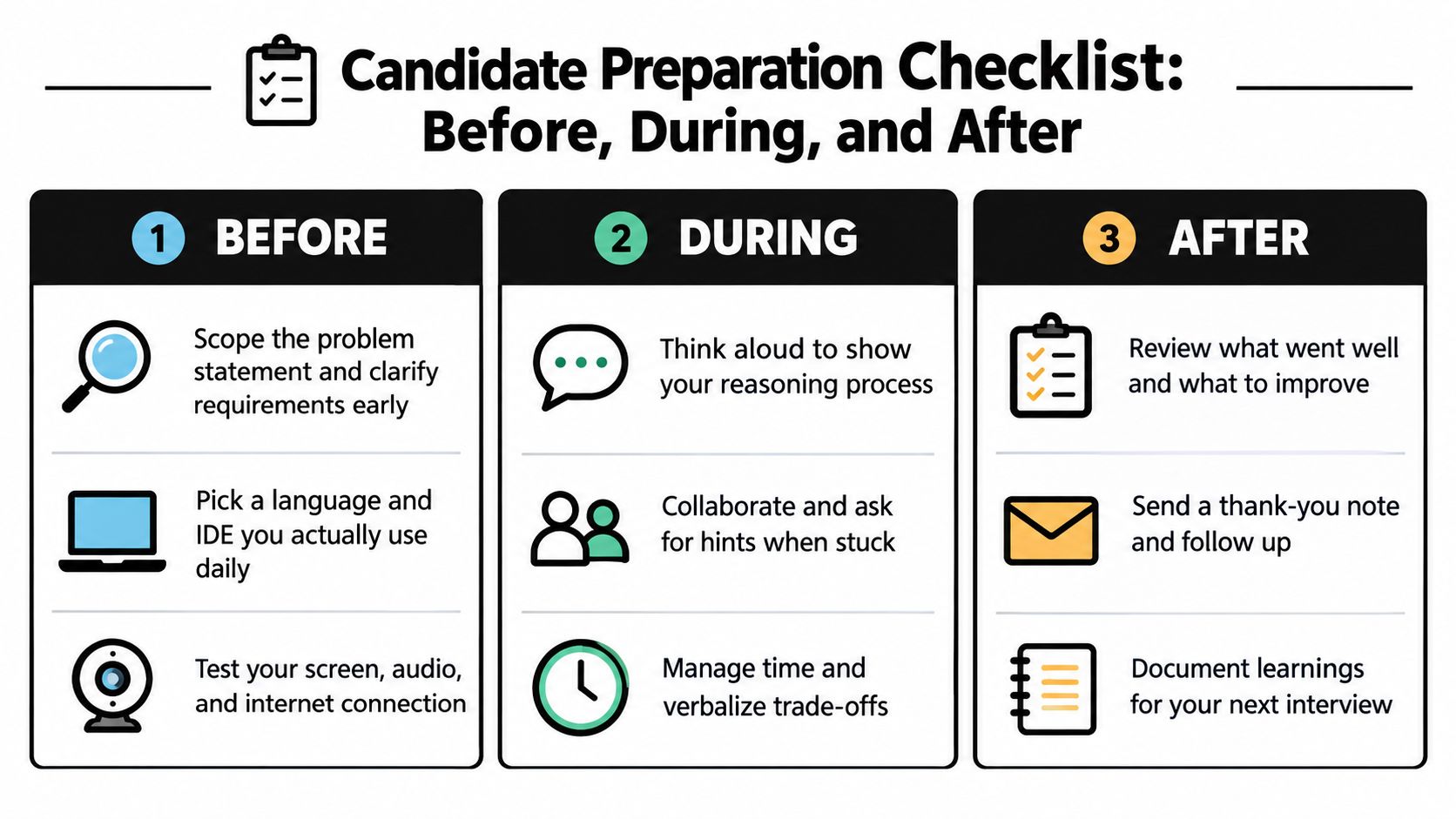
Candidate Preparation Checklist Before During and After
Candidates perform better when they treat the session as collaborative engineering rather than a speed contest. The preparation target isn't memorizing puzzle solutions. It's making a repeatable process visible.
Before the interview
Start by scoping the problem statement. Write down the inputs, outputs, constraints, and questions you need answered. Pick a language and IDE you use, then verify the runtime, formatter, test command, microphone, screen share, and pairing tool, such as CodeTogether.
Rehearse narration out loud for 10 minutes on a small kata. Explain the plan, state an assumption, write a test, and describe one trade-off. Practice with the same editor and screen layout you'll use in the interview.
For extra practice, use interview practice with AI to rehearse explanations and receive prompts. Treat that tool as a communication practice aid, not as a substitute for understanding the code you write.
During the session
Use this sequence:
Restate the task: Confirm the goal and ask about ambiguous requirements before coding.
Propose a short plan: Describe a 2–3 step approach, then say what you'll test first.
Share control: Accept the driver or navigator role deliberately, and ask before assuming a hidden requirement.
Narrate trade-offs: Explain why you chose a data structure, deferred an optimization, or added a test.
Ask for help productively: State what you've tried, what you expected, and what result surprised you.</li>
You don't need to finish every feature to demonstrate competence. A clear partial implementation with sound tests and a credible next step can be stronger than rushed code that happens to pass one example.
After the interview
Send a short follow-up within 24 hours. Mention one thing you learned and ask one specific question about the team's workflow, such as how engineers review changes or coordinate across time zones. The message gives you another signal about curiosity and fit, while helping you decide whether the team's process suits you.
Candidates should evaluate the interviewer too. Watch for these red flags:
Unclear expectations: The interviewer can't explain the task, tools, or AI policy.
Unequal participation: The interviewer takes over the keyboard or refuses to answer reasonable questions.
Moving standards: The success criteria change after you make a defensible choice.
Tool-first judgment: Connection issues or editor quirks receive more attention than engineering reasoning.
No feedback path: Nobody can explain the next step or how the session will be assessed.</li>
Running Pair Programming Interviews Across LATAM Time Zones
Nearshore hiring fails when companies treat remote logistics as an administrative detail. The interview environment is part of the assessment, so standardize it with the same care you apply to the rubric.
Use a low-bandwidth-friendly setup. VS Code Live Share or CodeTogether may be more practical for a distributed pipeline than JetBrains Code With Me when candidates use different environments, but choose one primary workflow and test it with real hardware. Keep a backup phone hotspot available, and record locally only with explicit consent.
Set a schedule people can actually use
Anchor interviews to a 3-hour overlap block that covers CDMX, Bogotá, São Paulo, Buenos Aires, and the US East Coast. Rotate the early slot quarterly so candidates in one region aren't always asked to absorb the inconvenience. Publish the local time in every invitation and confirm daylight-saving changes instead of assuming calendar software handled them correctly.
This approach makes LATAM a practical hiring solution for teams that need meaningful working-hour overlap with US operations. It also avoids treating geography as a proxy for availability, commitment, or communication quality.
Write the AI rules before sourcing
Your policy should answer three questions:
What is allowed? Specify autocomplete, documentation search, standard library lookup, and other permitted assistance.
What isn't allowed? State whether code-generation assistants, external chat tools, or copied solutions are prohibited.
How must candidates disclose use? Ask candidates to identify assistance and explain how they checked the result.</li>
Fairness requires consistent execution. Keep the same problem per slot, set a latency budget under 200ms, and document any outage or tool failure. Send a post-session survey in Spanish and Portuguese so candidates can report barriers that interviewers may miss. Teams comparing nearshore operating models can also review US and LATAM developer hiring considerations.
Common Pitfalls and How to Avoid Them
Speed isn't the signal. Silence isn't automatically confusion. A candidate who challenges your design isn't necessarily difficult. In a strong pair programming interview, the candidate should have room to question assumptions, test alternatives, and explain why a proposed direction may create problems.
The tooling failure is especially common in remote sessions. Shared cursors can lag, terminals can prevent ordinary copy-paste, and an unfamiliar IDE can consume attention that should go toward the problem. Give candidates a tested environment and a clear fallback path.
Distributed LATAM hiring adds another layer. Don't penalize a Brazilian, Colombian, or Mexican candidate for an accent, and don't assume a quiet candidate is disengaged. Ask a direct question, record the answer, and score the behavior against the rubric.
A 60-minute session is too short to outsmart a deliberate candidate and too long to fake competence consistently.
Run the interview with a non-hire peer before using it in production. Review where the interviewer spoke too much, where the task created accidental ambiguity, and where the rubric failed to distinguish syntax slips from reasoning problems. Then fix the process, not just the candidate pipeline.
GENTY recruitment provides skill-first IT recruitment, RPO, staffing, and salary benchmarking for companies building technical teams across Latin America. Visit GENTY recruitment to discuss a structured pair programming interview process and a curated nearshore engineering shortlist.