

Candidate sourcing is defined as the proactive identification, research, and initial engagement of potential candidates before they submit an application. Also called talent sourcing, it sits at the very front of the recruitment funnel and feeds qualified prospects to recruiters who then manage screening, interviews, and offers. Unlike waiting for inbound applications, sourcing uses tools like LinkedIn Recruiter, Boolean search, GitHub, and applicant tracking systems to find people who match a role’s requirements, whether or not those people are actively looking. Understanding this distinction is the first step toward building a hiring pipeline that does not stall every time a role opens.
What is candidate sourcing and how does it differ from recruiting?
Candidate sourcing is the proactive discipline of identifying, researching, and initially engaging potential candidates before they apply, with a specific focus on targeting passive candidates who have not submitted an application. Recruiting, by contrast, covers the entire hiring lifecycle: job posting, screening, interviewing, offer management, and closing. Sourcing is the front-end work that makes recruiting faster and more targeted.

The distinction matters because sourcing is the front-end work of discovering and reaching out to candidates, while recruiting covers the full process from screening to closing. When companies blur this line, they lose time. Sourcers who are pulled into scheduling and offer calls stop building pipelines, and recruiters who spend hours searching LinkedIn have less time to qualify and close candidates.
Dedicated sourcing teams produce measurable results. Companies with specialist sourcers fill roles 40% faster than those relying solely on inbound applications. That speed advantage compounds over time: a sourcer who builds a talent pool for a recurring software engineer role means the next hire takes days, not weeks. For tech companies hiring across FinTech, AI, and SaaS, that difference directly affects product velocity.
Before you start hiring
Check location, salary, and hiring fit
If you are moving from research to action, start with the market basics so your hiring plan is clearer.
Here is how the two functions divide in practice:
- Sourcers map talent markets, run Boolean searches, build candidate lists, write outreach messages, and hand off shortlists with contextual notes.
- Recruiters receive those shortlists, conduct qualification calls, manage the interview process, and close offers.
- Sourcing managers set channel strategy, define ideal candidate profiles, and track pipeline metrics.
- Talent acquisition leaders align sourcing capacity with workforce planning and headcount forecasts.
Pro Tip: Confusing sourcing with recruiting causes teams to delay outreach, losing candidate engagement opportunities before a role is even posted. Define the handoff point clearly: a sourcer’s job ends when a named, contactable, plausibly qualified candidate with context notes enters the recruiter’s queue.
What is passive candidate sourcing and why does it matter?
Passive candidate sourcing involves building relationships with people who are currently employed and not actively searching for a new role. It supplements active sourcing, which targets candidates who have posted resumes on job boards or applied directly, and it consistently yields higher-quality hires because the talent pool is larger and less competitive.
The numbers make the case clearly. 70% of the global workforce is passive, meaning they are not browsing job boards today. Yet 87% of that same group is open to new opportunities when approached with the right message at the right time. That means the vast majority of your best potential hires will never find your job posting on their own.
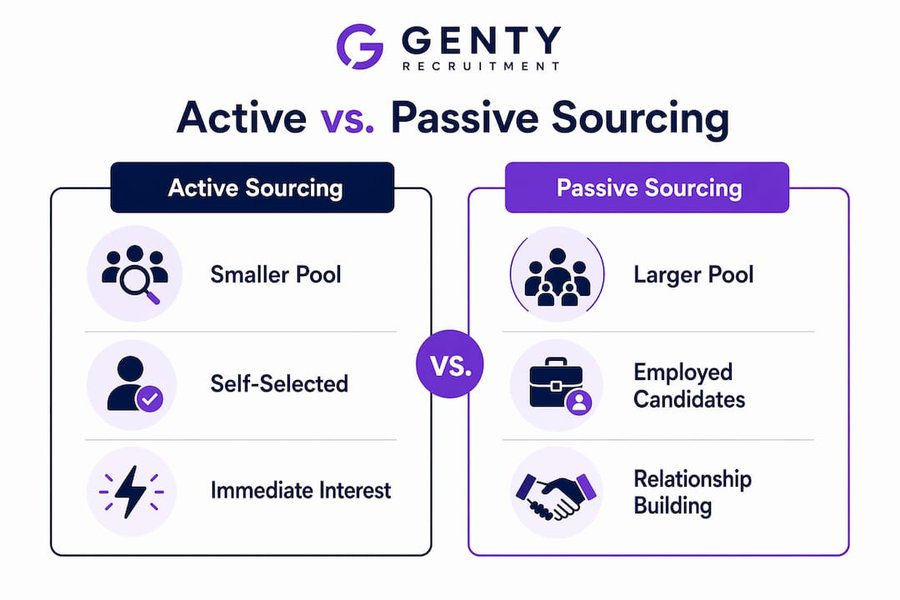
The challenge with passive sourcing is timing and relevance. Effective passive sourcing anticipates demand instead of reacting to it, which means building relationships before a role opens rather than scrambling once a vacancy appears. A sourcer who has already spoken with three strong senior engineers in Colombia has a significant advantage over one who starts searching the day a role is approved.
Pro Tip: Do not treat passive candidates as a homogeneous group. Filter by career trajectory, tenure, and recent activity to identify likely engagement windows. A software engineer who just passed their two-year mark at a company and recently updated their GitHub profile is far more receptive than someone who started a new role three months ago.
Candidate sourcing strategies and tools that actually work
Effective talent sourcing separates strategy from tactics. Mixing channel strategy with tactical execution leads to optimizing for volume over quality, which produces large lists of poorly matched candidates and wastes recruiter time. Strategy answers the question of where to find candidates. Tactics answer how to reach and qualify them.
A practical sourcing process for remote tech hiring follows these steps:
- Define the ideal candidate profile. Go beyond job titles. Specify required technologies, years of experience in specific domains, industry background, and English proficiency level if hiring across borders.
- Map the talent market. Use LinkedIn Recruiter, GitHub, Stack Overflow, and professional associations to understand where qualified candidates concentrate. For LATAM tech roles, communities in Argentina, Brazil, Mexico, and Colombia each have distinct talent densities by skill set.
- Build a long list using Boolean search. Construct search strings that combine role-specific keywords, technology stacks, and location filters. A string like "“Python” AND “machine learning” AND “Buenos Aires”` on LinkedIn surfaces a workable candidate set quickly.
- Qualify down to a short list. Review profiles for role fit, career trajectory, and tenure signals. Remove candidates who show signs of recent job changes or mismatched seniority.
- Write personalized outreach. Personalized messages with at least three role-specific details show an average InMail acceptance rate of 26%, compared to significantly lower rates for generic templates. Reference the candidate’s specific experience, the role’s technical challenge, and one concrete reason the opportunity fits their trajectory.
- Use multi-channel follow-up. LinkedIn InMail, email, and GitHub messages each reach different segments of the passive talent pool. A candidate who ignores an InMail may respond to a direct email found through a tool like Hunter.io or Apollo.io.
- Track and iterate. Log response rates by channel, message type, and candidate segment. Adjust search strings and outreach copy based on what converts.
For tooling, the most widely used platforms include LinkedIn Recruiter for professional network search, GitHub and Stack Overflow for technical talent, Greenhouse and Lever as applicant tracking systems, and Gem or Beamery as candidate relationship management tools. Each serves a different stage of the candidate sourcing process, and combining them produces better coverage than relying on a single channel.
How to integrate sourcing into your talent acquisition workflow
Sourcing does not operate in isolation. Its value depends entirely on how well it connects to the rest of the recruiting process. Sourcers deliver shortlists of named, contactable, plausibly qualified candidates with relevant context, enabling recruiters to proceed directly to qualification without duplicating research. That handoff is where most sourcing programs break down.
A well-structured workflow looks like this:
- Intake meeting: Sourcer and recruiter align on the ideal candidate profile, must-have qualifications, and deal-breakers before any searching begins.
- Sourcing sprint: Sourcer builds a long list, qualifies it to a short list of 10 to 20 candidates, and adds contextual notes on each profile.
- Handoff: Sourcer delivers the shortlist in the ATS with notes on why each candidate was included, not just their contact details.
- Recruiter qualification: Recruiter conducts screening calls and advances candidates to the hiring manager.
- Feedback loop: Recruiter reports back on which sourced candidates advanced and why, allowing the sourcer to refine the next search.
Always-on sourcing outperforms reactive sourcing in both speed and quality. Teams that build scalable hiring pipelines before roles open can present candidates within days of a vacancy being approved. Reactive sourcing, which starts from scratch each time, consistently adds two to four weeks to time-to-fill.
The metrics that matter most for sourcing effectiveness are pipeline conversion rate (what percentage of sourced candidates advance to a recruiter call), outreach response rate by channel, time from sourcing start to shortlist delivery, and sourced-to-hire ratio. Tracking these numbers monthly reveals whether the sourcing function is improving or stagnating.
Pro Tip: Passive sourcing requires thoughtful, targeted outreach rather than mass messaging. Set a weekly outreach cap per sourcer, around 50 to 75 personalized messages, rather than blasting hundreds of generic notes. Quality of engagement predicts pipeline quality far better than volume.
Key takeaways
Candidate sourcing is the proactive front-end function that builds qualified talent pipelines before roles open, and separating it clearly from recruiting is what makes both functions perform at their best.
Why most sourcing programs underperform (and what I’ve seen fix them)
The most common failure I observe is treating sourcing as a task rather than a function. A recruiter who spends two hours searching LinkedIn between screening calls is not sourcing. They are multitasking, and the output reflects it: shallow lists, generic outreach, and low response rates that get blamed on “the market.”
The teams that source well do one thing differently. They protect sourcing time. A dedicated sourcer who spends four focused hours building a Boolean-qualified list of 30 candidates in Bogotá will outperform a recruiter who spends the same four hours split across five other tasks. The output is not just more candidates. It is better-contextualized candidates with notes that actually help the recruiter have a smarter first conversation.
The second mistake I see consistently is ignoring the feedback loop. Sourcers who never learn which of their candidates advanced, and why, keep making the same qualification errors. The fix is simple: a weekly 15-minute sync between sourcer and recruiter to review which sourced candidates moved forward and which did not. That single habit compounds into dramatically better shortlists within two or three hiring cycles.
For hiring managers specifically, the most effective thing you can do is invest 30 minutes in a detailed intake conversation with your sourcer before any search begins. The more specific you are about what “good” looks like, including the technical context, team dynamics, and growth trajectory, the less time gets wasted on candidates who look right on paper but would not survive a first-round interview.
— Eugene
How Gentyrecruitment accelerates your sourcing and hiring
Gentyrecruitment specializes in sourcing pre-vetted, English-speaking tech talent across Latin America for US and European companies in FinTech, AI, SaaS, and adjacent sectors. Rather than starting from scratch each time a role opens, Gentyrecruitment maintains active talent pools across Argentina, Brazil, Mexico, and Colombia, covering engineering, sales, and executive profiles.
For teams that need to move fast, the IT recruitment in LATAM service delivers technically qualified candidates up to five times faster than traditional hiring processes. Gentyrecruitment also offers sales recruitment in LATAM for SDR and account executive roles, along with staffing, executive search, and salary benchmarking services. If your sourcing pipeline is stalling, Gentyrecruitment’s structured assessment process and regional market expertise are built to fix that.
FAQ
What is candidate sourcing in simple terms?
Candidate sourcing is the proactive process of finding and engaging potential candidates before they apply for a job. It targets both active job seekers and passive candidates who are currently employed but open to new opportunities.
How does sourcing differ from recruiting?
Sourcing covers the front-end work of identifying and initially contacting candidates, while recruiting manages the full hiring lifecycle from screening through offer acceptance. Specialist sourcers hand off qualified shortlists to recruiters, who then conduct interviews and close hires.
What percentage of the workforce are passive candidates?
70% of the global workforce is passive, meaning they are not actively searching for jobs. However, 87% of passive candidates are open to new roles when approached with a relevant and well-timed message.
What tools are used for candidate sourcing?
The most widely used sourcing tools include LinkedIn Recruiter for professional network search, GitHub and Stack Overflow for technical talent, and platforms like Gem or Beamery for candidate relationship management. Applicant tracking systems such as Greenhouse and Lever support pipeline tracking and sourcer-to-recruiter handoffs.
What makes a candidate sourcing outreach message effective?
Personalized outreach messages that include at least three role-specific details achieve an average InMail acceptance rate of 26%, significantly higher than generic templates. Referencing the candidate’s specific experience, the role’s technical challenge, and a clear reason the opportunity fits their career trajectory drives the strongest response rates.