
Your pipeline looks busy, but the shortlist still feels uncertain. Hiring managers are debating titles, Finance wants a salary number that holds up, and your team is trying to tell whether a candidate is close to the work or just well written on paper. Talent intelligence is the discipline that turns that mess into evidence about where talent exists, what it costs, how scarce it is, and whether the role definition itself is still right. It shifts hiring from résumé reading and instinct toward demonstrable capability and changing demand, which is why it matters before a serious hiring push, not after one goes sideways (OECD Skills for Jobs Database).
A Clear Definition for Hiring Leaders
Hiring leaders already have dashboards full of names. What they need is a way to judge whether a shortlist, a salary band, or a location choice rests on real market evidence. Talent intelligence is that evidence layer. It combines labor-market, workforce, skills, and organizational data so leaders can make better decisions about attracting, selecting, developing, deploying, and retaining people.
Why the definition matters in practice
A DevOps hire for a US team is a good test case. If LATAM is on the table as a nearshore option, the title alone says little. The same role can map to different skill availability, compensation pressure, and seniority by country, so the useful question is whether the market can support the work you need. A working definition has to combine skills, supply, demand, geography, compensation, and role requirements into one decision layer.
That also separates talent intelligence from search and reporting. Search helps you find people. HR dashboards describe what already happened. Talent intelligence helps leaders choose between hiring, reskilling, redeploying, or redesigning work, using evidence rather than title matching.
Need help hiring?
See the next step after this guide
If this topic is relevant to your team, these are the most useful pages to check next.
Practical rule: if a system cannot explain why a role is scarce, where supply sits, and what supports the salary range, it is a list, not intelligence.
For leaders shaping a broader operating model, the talent acquisition guide for SMB leaders gives a useful view of how recruiting functions are usually organized. For remote hiring, GENTY's remote tech hiring overview applies the same logic to matching role requirements with the market, especially when teams are hiring across borders.
The sentence to give a CEO is straightforward. Talent intelligence helps us make hiring and workforce decisions using verified market and capability evidence, not just titles and gut feel.
The Four Components That Make It Actually Work
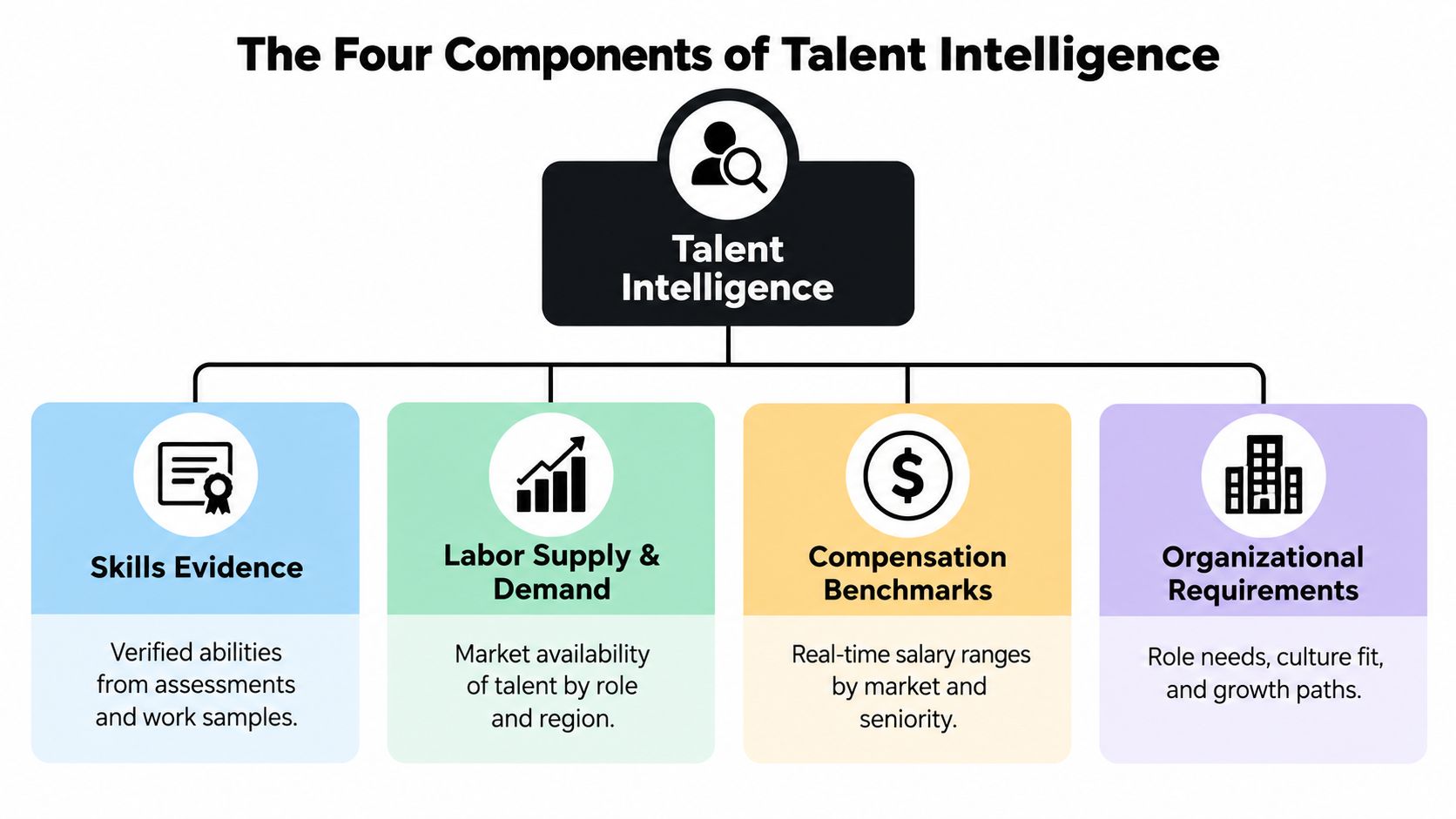
A hiring decision only gets better if the inputs are trustworthy and connected. A technically sound talent-intelligence implementation should use a normalized skills taxonomy rather than job titles or keyword matching, and frameworks like O*NET describe occupations through knowledge, skills, abilities, tasks, and work activities across almost 1,000 occupations (U.S. Department of Labor O*NET). That structure matters because each component solves a different decision problem.
Skills evidence
Skills evidence answers the question, “Can this person do the work?” It should come from assessed or otherwise verified capability, not just résumé language. If two candidates both call themselves full-stack developers, the useful distinction is whether they've shown the competence you need in the stack you run.
Labor supply and demand
Supply and demand answer, “Can we hire this capability in the market, and how hard will it be?” The OECD model makes this concrete by showing how shortage means employers can't recruit the required skills in the accessible market at prevailing pay and working conditions (OECD Skills for Jobs Database). For a nearshore program, that means comparing where the right talent pool exists before you commit to a location.
Compensation benchmarks
Compensation answers, “What will it take to win the offer?” Supply without pay data creates fantasy pipelines. You may find candidates, but they won't accept, or they'll accept and churn later because the market was never priced correctly.
Organizational requirements
Organizational requirements answer, “What does this role need here, in this company, at this stage?” A startup's DevOps engineer often needs a broader scope than a later-stage one. If the system ignores culture, team topology, and growth path, it can produce a technically strong hire who still doesn't fit the operating model.
Inside GENTY's talent intelligence platform thinking, the same logic shows up as a decision stack, not a database. If one of these four inputs is missing or stale, the output is at best incomplete and at worst misleading.
Skills Taxonomy versus Job Title Matching
The biggest mistake in hiring tech talent is pretending that titles are stable units of meaning. They're not. Two people can both be called “full-stack developer” and still differ in stack depth, seniority, and adjacent skills that matter to your roadmap. That's why a skills-taxonomy approach beats title matching when you need repeatable decisions.
A skills layer only works if it has hierarchy. Core skills need to be separated from adjacent skills, and adjacent skills need to be distinguishable from true gaps. That keeps you from rejecting a strong candidate because they don't use your preferred label.
What a better model looks like
A useful taxonomy doesn't just say “has Kubernetes.” It records evidence, context, and confidence. If a candidate built and operated infrastructure under real incident pressure, that means something different from having listed the tool on a profile.
Decision standard: if you can't explain the evidence behind the match in plain language, you're matching strings, not capabilities.
If you want to see how a skills-first approach changes sourcing logic, GENTY's skills-first hiring guide maps the same idea to practical recruitment workflows. And if you've seen call-routing systems use skill maps to route requests more intelligently, SnapDial's skills routing best practices show the same principle in another operational setting, compare the underlying capability first, then assign the work.
The core point is simple. Job titles compress reality. Skills taxonomies preserve it.
From a Hiring Snapshot to a Forward Capability Model
A CTO approves a hiring plan because today's pipeline looks healthy, then six months later the roadmap shifts, the stack changes, and the team is short on the capabilities that matter most. That is the failure a forward capability model is meant to prevent. The World Economic Forum's Future of Jobs Report 2025, based on more than 1,000 employers, estimates that 39% of workers' core skills will change by 2030 and that 63% of employers see skill gaps as a major barrier to business transformation over 2025 to 2030 (WEF Future of Jobs Report 2025).
Why forward-looking planning matters
A shortlist is current inventory. It is not a workforce plan.
If skills are changing that fast, hiring leaders need a system that answers a harder question than “Who can fill this role now?” They need to know which capabilities will be required to keep shipping over the next 12 to 24 months, how scarce those capabilities are likely to be, and whether the lower-risk response is to hire, reskill, redeploy, or redesign the work. The same Future of Jobs Report 2025 shows that 85% of employers plan to prioritize upskilling, 70% expect to hire people with new skills, and 50% plan to move workers from declining to growing roles. Talent intelligence only becomes decision-grade when it supports those choices across external hiring and internal reconfiguration, not when it stops at market visibility.
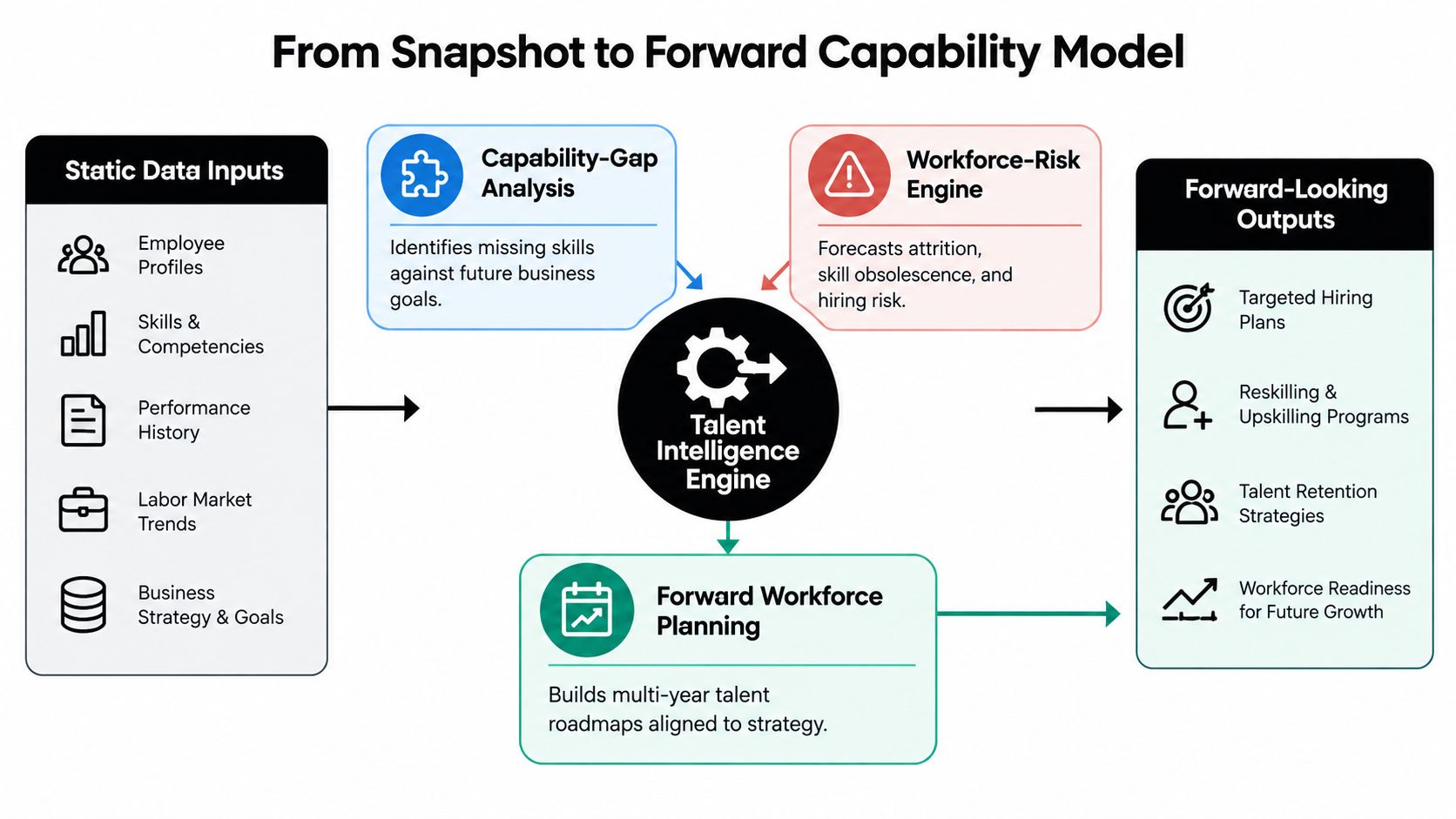
A capability-gap model is simple in concept and demanding in practice. Compare the required competency level with current demonstrated capability, then rank responses by urgency, scarcity, cost, and time to productivity. That is how a startup evaluating LATAM hiring can compare nearshore recruiting with local upskilling on one evidence layer rather than on manager preference. For a deeper view of how capability mapping supports that decision, see GENTY's talent mapping guide for tech startups.
What the model should answer
What is missing now? Identify the gap between role requirements and current demonstrated capability.
What is likely to change? Give more weight to emerging demand than to static historical demand.
What is the cheapest safe response? Compare hiring, reskilling, redeployment, and role redesign against the same capability need.
Where do we still have optionality? Early visibility creates better choices and lowers execution risk.</li>
The shift is in decision quality. Talent intelligence is a workforce-risk model built around future capability, and hiring leaders act on it only when the evidence is clear enough to trust.
Why More Data Is Not the Same as Better Decisions
More dashboards do not fix weak inputs. They can make weak inputs look more authoritative. In one recent view of enterprise practice, 34% of teams still use static spreadsheets to track capabilities, and 43% review skills data only quarterly, which shows how quickly a talent picture can go stale (Joveo).
What trust requires
Disconnected, biased, or outdated inputs can create faster false confidence. Stronger definitions of talent intelligence put data freshness, provenance, validation, and human review ahead of raw volume, as the same Joveo analysis argues. That is the difference between a system that supports decisions and a system that only decorates them.
A practical test is whether the number on screen can survive a recruiter's challenge. If the system says a market is “hot,” it should show where the signal came from, how recent it is, and how confident the model is. If it cannot, the team is still relying on intuition, just with better charts.
Four controls every hiring leader should demand
FreshnessAsk when the underlying evidence was last updated. Stale labor data can mislead even if it looks clean.
ProvenanceAsk where the signal came from. Internal ATS data, market data, and recruiter judgment should not be mixed into one opaque number.
ConfidenceAsk whether the system gives a range or a score with context. A single hard number often hides uncertainty.
Human validationAsk where recruiter judgment still overrides the model. Good systems preserve room for review, especially for scarce roles.
That is also why internal visibility matters as much as external sourcing. If leaders cannot see the skills already inside the company, they will keep paying to rediscover them outside. For how assessment evidence feeds that internal view, see GENTY's talent assessment guide for HR teams. A system that cannot show its work is not intelligence, it is polished guesswork.
Three Core Hiring Use Cases to Prioritize
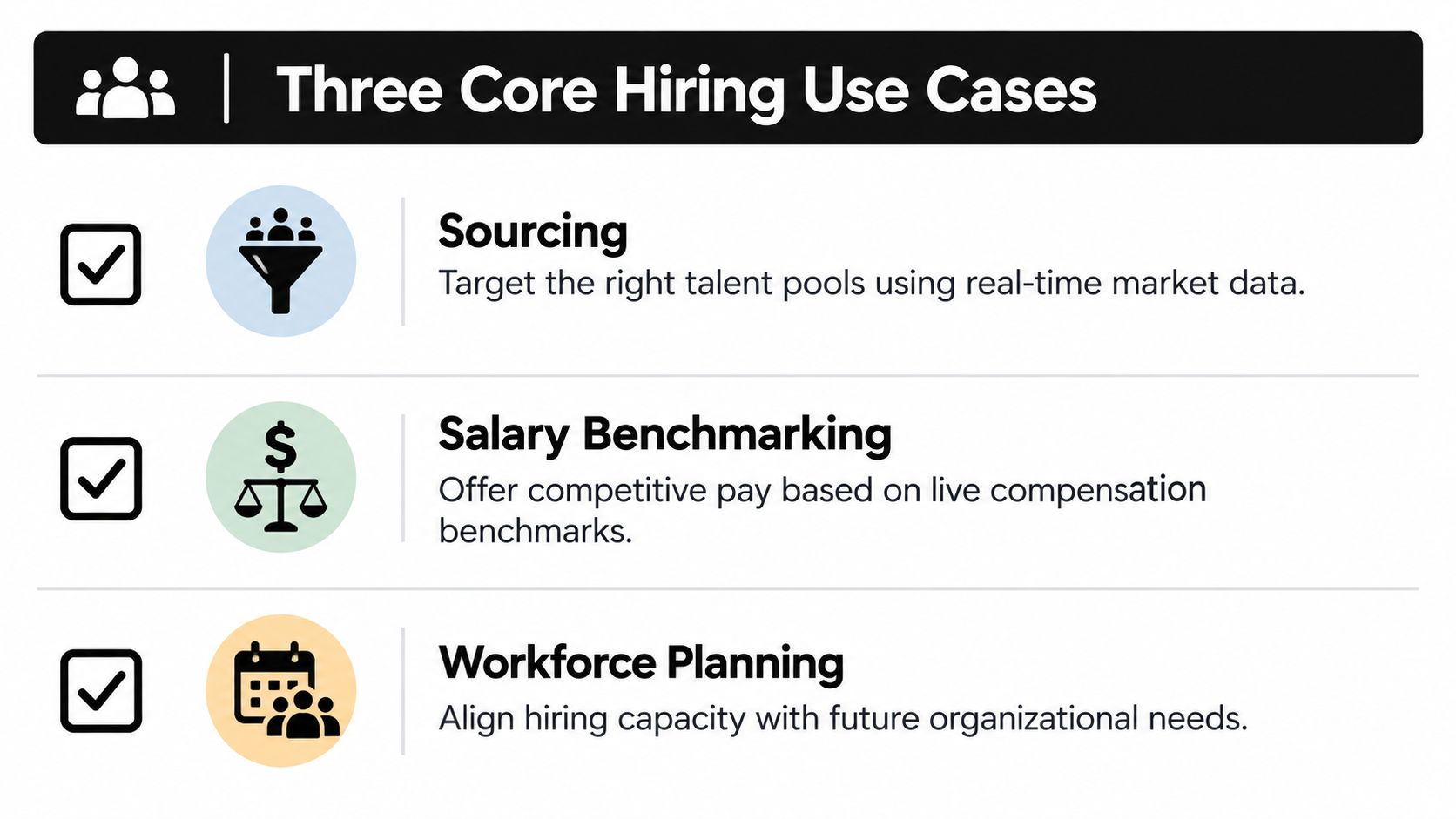
The value of talent intelligence shows up in three places first: sourcing, salary benchmarking, and workforce planning. Everything else is secondary until these are working. Recruitment systems can process structured and unstructured data such as CV content, skills, education, and previous placements, compare it against job descriptions or historical hiring data, and generate candidate rankings or fit categories, but the scores only matter if the evidence is preserved and validated against job-relevant outcomes (European Commission AI Act Service Desk).
Sourcing
Sourcing gets smarter when it targets skill clusters rather than job boards. The point isn't to pull in more applicants, it's to find the right capability set faster. A strong sourcing process should tell you which talent pools are realistic before you open the role.
Salary benchmarking
Salary benchmarking only works when you compare against comparable markets and comparable scope. National occupational data can help with standardized definitions, but it should not be treated as a precise salary quote for a specific city or LATAM market (U.S. Department of Labor O*NET data collection). That caution matters because title similarity can hide real compensation differences.
Workforce planning
Workforce planning is where the model stops being reactive. Instead of asking who's available for this quarter's requisition, you ask what capability the business needs across the next planning horizon, and whether the answer is hire, reskill, or redesign.
A simple signal check is this:
Sourcing signal: Are you finding candidates through skill proximity, not only title search?
Benchmarking signal: Are offers grounded in comparable market data rather than global averages?
Planning signal: Are hiring decisions tied to 12 to 24 month capability needs, not just current vacancies?</li>
If your current “talent intelligence” can't answer those questions, it's not driving decisions yet.
Applying Talent Intelligence to LATAM Hiring

LATAM is where talent intelligence becomes visible fast because the decision isn't just “Can we hire?” It's “Can we hire the right capability, at the right cost, in the right country, with a stable enough market to scale on?” In a nearshore model, the same role can carry very different availability and pricing by country, so the evidence layer matters more than it does in a single-market search.
What a disciplined LATAM process looks like
A practical workflow maps roles such as DevOps engineer or full-stack developer to a competency layer, then benchmarks supply and compensation across countries like Argentina, Mexico, Brazil, Chile, Colombia, Peru, and Uruguay. That gives hiring leaders a realistic shortlist strategy before the first interview is booked.
The market isn't static either. One 2025 LATAM recruitment report estimated IT salaries could rise 12 to 18% during the year while still describing LATAM developers as substantially less expensive than US counterparts, which is exactly the kind of trade-off a decision layer should surface early (Outsource Accelerator). The point isn't to assume a permanent discount. It's to understand the current value equation before you commit.
Operational rule: the better LATAM hiring model is the one that makes salary surprise less likely, not the one that promises the cheapest labor.
For teams that need other service models, GENTY's IT recruitment overview shows how a skill-first shortlist can be built across roles with different market conditions. If your team also hires medically adjacent support roles, MedicalVirtual is a relevant example of a specialized staffing resource in a different domain, which is useful as a reminder that market intelligence is always role-specific.
The end result should be measurable, not vague, faster shortlists, clearer offer ranges, and post-hire tracking that tells you whether the market assumptions were right.
A Hiring Leader's Self-Assessment Checklist
Use this against your current stack before the next hiring push.
Do we know which skills are required for the role, or are we still hiring by title?
Can we explain where our salary benchmark came from and how recent it is?
Do we separate core skills from adjacent or transferable skills in our candidate assessment?
Are we tracking whether sourced candidates become strong first interviews, or only whether they were submitted?
Do we know which markets have real supply for the capability we need?
Can we show what changed in the market since the last time we opened this role?
Do we have data freshness, provenance, and validation controls on the numbers we use?
Are hiring outcomes tied back to retention, time to proficiency, or other business results?
If most answers are no, start with an evidence-backed skills layer. If the skills layer is already in place, add outcome tracking so the system can prove whether it improved hiring quality rather than just speeding up the process. And if your team would rather delegate the operating layer than build it, GENTY's RPO service page is the right place to see how that can be structured around a skill-first hiring motion.
GENTY recruitment helps US and European tech companies hire in LATAM with skill-first shortlists, salary benchmarking, and recruiting support built around actual market evidence. If you're planning a nearshore hiring push and want a faster, lower-risk way to source talent, visit GENTY recruitment and see how the team supports IT recruitment, RPO, and talent intelligence-led hiring across Latin America.