
The right talent intelligence platform depends on whether you need sourcing execution, labor-market data for planning, or both. With the market estimated at USD 5.73 billion in 2025 and projected to reach USD 15.46 billion by 2031, most Series A to C teams still need one practical tool from each side rather than a single enterprise suite.
The popular advice is to buy the broadest platform available. That's usually the wrong starting point. A sourcing team needs a system that finds, qualifies, and engages candidates. A CTO planning several hiring hubs needs supply, skills, salary, and location data. A larger People function may need both, but a small team can waste budget and implementation time paying for workforce features recruiters never use.
The three jobs are distinct: sourcing execution, market and skills intelligence, and workforce planning. LATAM can be a practical hiring option when time zones, English proficiency, and cost matter, but market data should come before opening a search. It can show whether a region has the required skills and compensation profile. A recruiter prospecting platform may then handle the execution.
1. Eightfold AI
Best for: Enterprise TA and People teams that need one skills layer across external recruiting, internal mobility, and workforce planning. Limitation: It's too broad and commercially opaque for most Series A teams buying their first sourcing system.
What do you need?
Choose the hiring path that fits
After reading "Talent Intelligence Platforms: 10 Tools Compared for 2026", most teams compare these options before deciding how to hire.
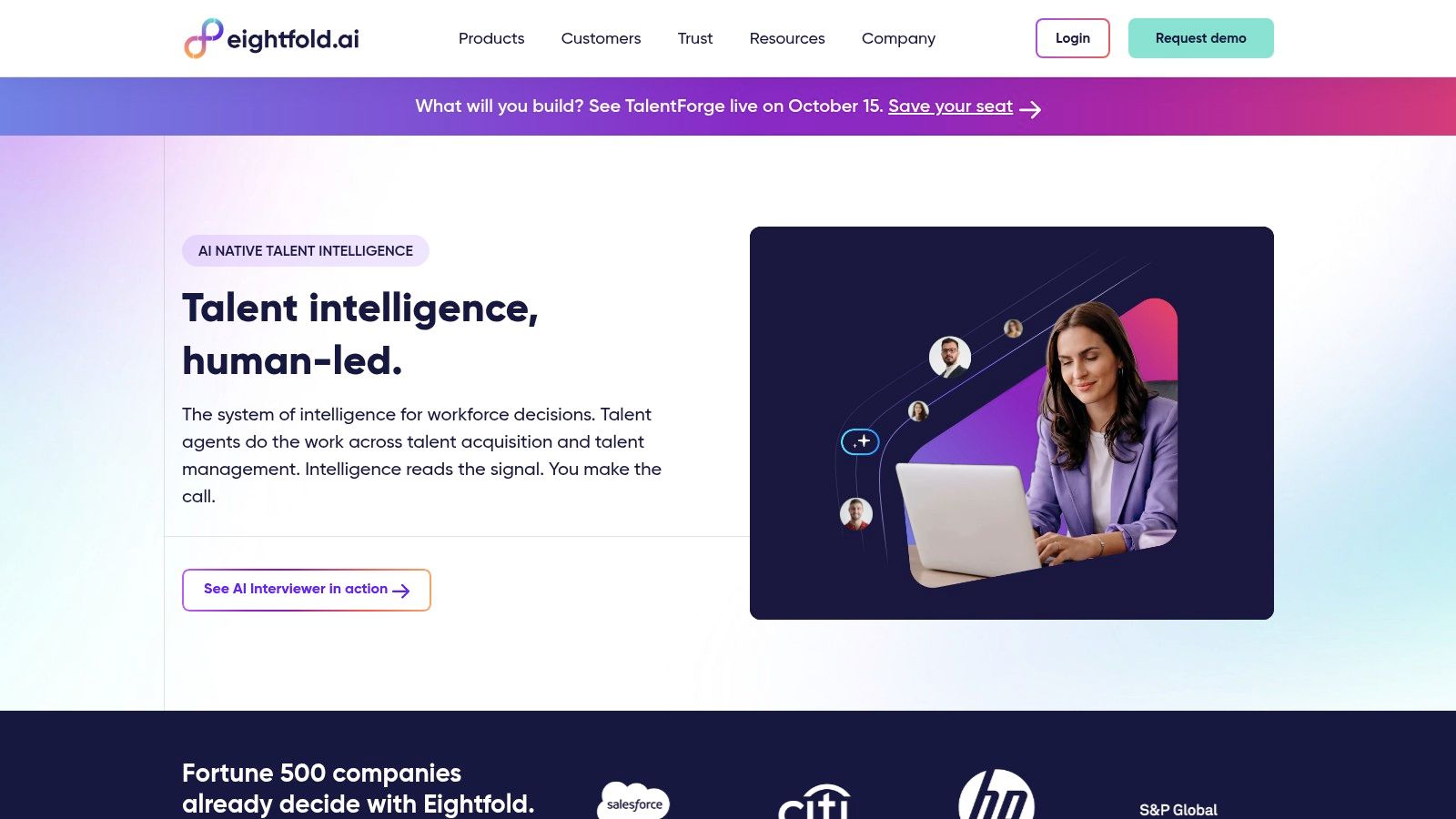
Eightfold AI combines a skills graph with matching across internal employees and external talent. The platform supports market and salary insights, candidate rediscovery from an ATS, internal mobility, resource planning, and assistant-style workflows. Its integrations with ATS and HRIS systems make it a serious option when recruiting and talent management share data rather than operate as separate functions.
The practical advantage is rediscovery. A large company may already have qualified people in its ATS, but recruiters can't find them through basic filters. Skills-based matching can surface adjacent experience that a keyword search misses. That's useful for technical hiring where a candidate's capability may be described through projects, tools, and career history rather than one exact title.
Buyer test: Ask Eightfold to explain which skills and signals produced a shortlist, then test whether recruiters can override or audit the recommendation.
Public pricing isn't transparent, and implementation takes real work. Mercer's survey of 477 organizations found that systems integration was the leading AI adoption barrier, cited by 47% of respondents, which is directly relevant to a platform that spans ATS, HRIS, and talent management data (Mercer survey PDF). Before signing, define the data owners, skills taxonomy, and success metrics. GENTY's analysis of AI-powered workforce management software is useful context for that operating model.
2. Beamery
Best for: Larger organizations aligning skills, workforce scenarios, recruiting, and HRIS data. Limitation: Its scope creates change-management work that a lean Series A or B team may not be ready to absorb.
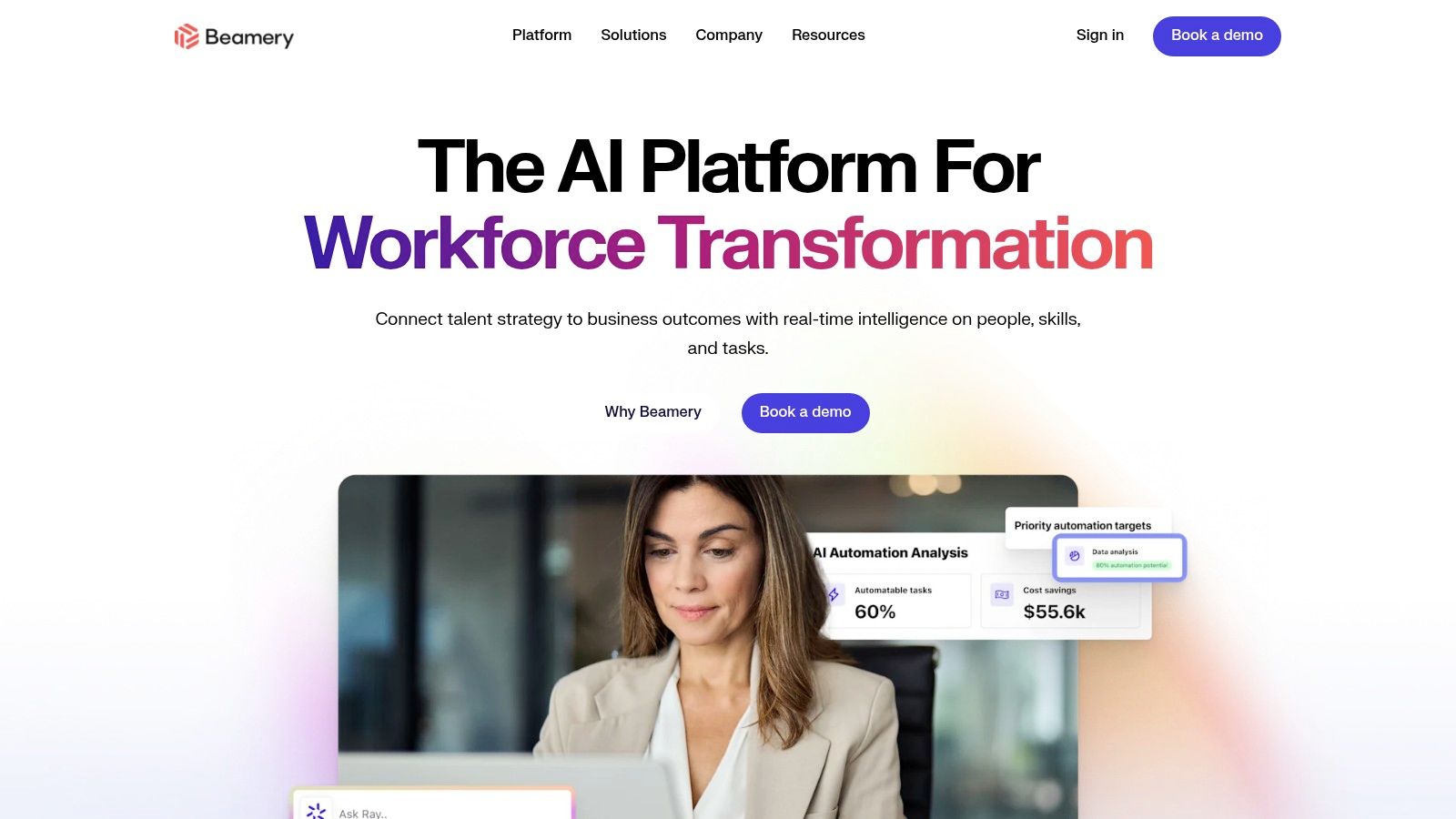
Beamery is built around a broad talent operating model. It combines skills and task intelligence, market insights, talent CRM, sourcing, matching, analytics, and planning. Its connection to systems such as Workday and SAP makes it more suitable for a People function trying to align external market signals with internal workforce data.
The strongest use case is strategic planning. A VP Engineering can use market information to compare available skills and compensation across locations before deciding whether to hire locally, open a new hub, or distribute work across regions. The platform's planning orientation also supports scenario discussions that a recruiter-focused sourcing tool can't answer.
Beamery uses custom, demo-based pricing. That's normal for enterprise software, but it makes comparison difficult. Request a written breakdown of licenses, implementation, integrations, data refreshes, support, and renewal terms. Don't accept a feature tour as proof of value.
For a Series C company hiring across several functions and countries, Beamery can justify a central skills and planning layer. For a smaller team with one recruiter and a few urgent engineering roles, the limitation is operational. You may need a sourcing workflow first, then add planning intelligence when hiring volume and organizational complexity justify it.
3. LinkedIn Talent Insights
Best for: TA leaders and executives sizing talent pools, comparing locations, and understanding skills movement. Limitation: It's a market intelligence product, not a complete sourcing and outreach workflow.
LinkedIn Talent Insights is useful before a requisition reaches a recruiter. It provides supply and demand views, skills trends, employer movement, geographic breakdowns, and migration signals through LinkedIn's professional data. The interface is familiar, and teams already using LinkedIn Recruiter can connect market analysis to their existing workflow.
A CTO deciding between cities can use it to investigate whether the relevant engineering skills exist, which employers compete for them, and how the talent pool changes by geography. That's a better starting point than asking a recruiter to search blindly and report that the market feels difficult.
“Use market intelligence to decide where to search. Use a sourcing tool to decide whom to contact.”
Pricing isn't publicly listed. Teams should ask whether Talent Insights is licensed separately from Recruiter, how many users can access it, what geography and skills filters are included, and whether exports are available. Also test counts against the actual Recruiter workflow. Different products can produce different estimates because they answer different questions and use different filters.
For a Series A team, this can be more capability than needed unless location strategy is a major decision. For Series B or C companies comparing several hiring hubs, it can provide planning evidence. A LATAM search should still be validated against live candidates, because a regional supply estimate doesn't prove that the available professionals match your seniority, language, salary, or employment requirements.
4. SeekOut
Best for: Technical recruiting teams that need skill-based search, ATS rediscovery, and guided sourcing workflows. Limitation: Full capability can sit behind enterprise pricing, and the platform won't replace a weak hiring brief.
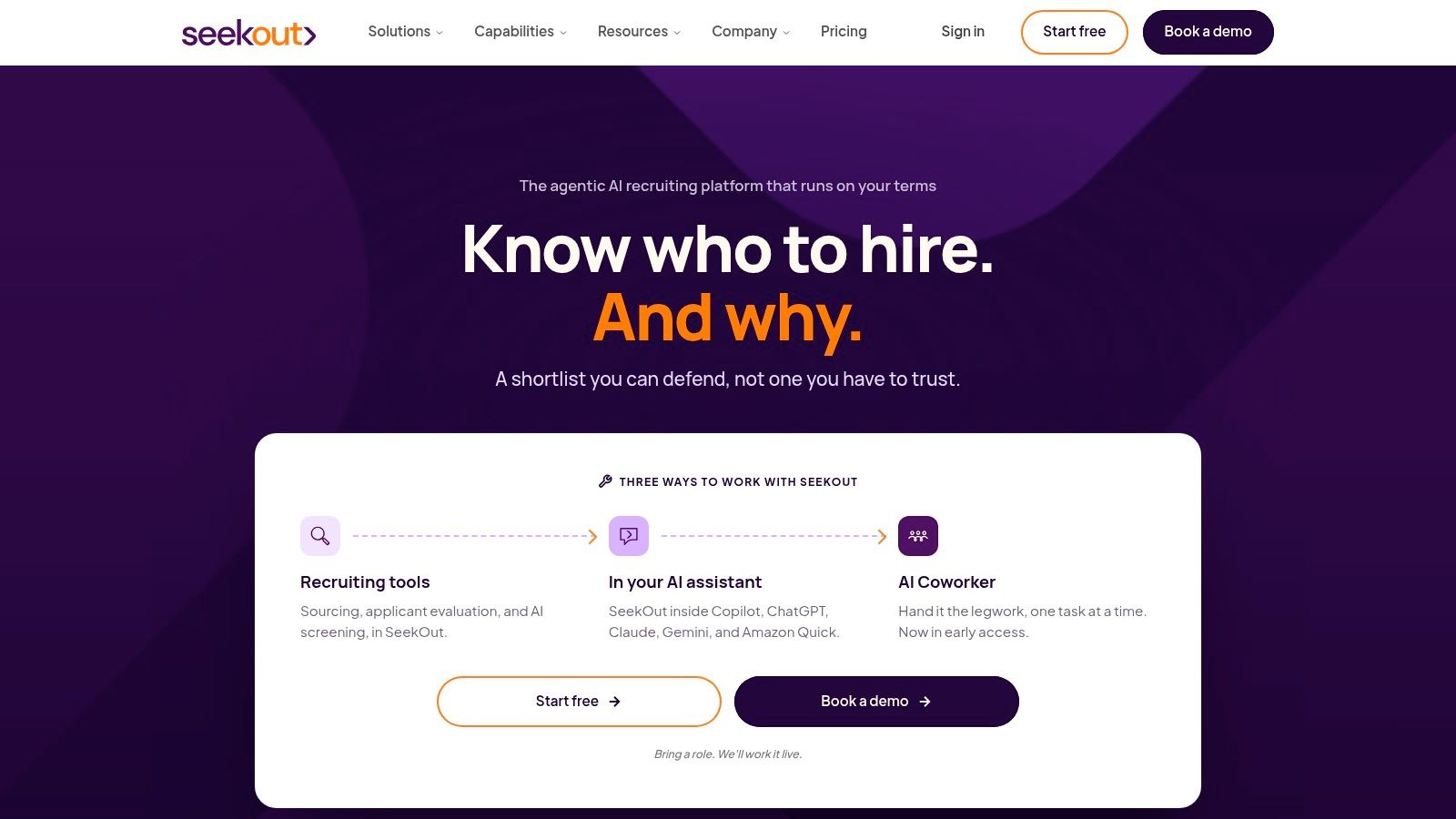
SeekOut focuses more directly on sourcing execution than Beamery or TalentNeuron. Natural-language search and guided skill workflows help recruiters search beyond exact job-title matches. The platform also supports ATS rediscovery, diversity analytics, competitive talent intelligence, and collaborative projects.
That combination fits a Series B company with a small internal team handling difficult technical roles. Recruiters can search for capability, revisit previous applicants, and organize work without stitching together separate systems. Technical signals, including public coding-related information where available, can add useful context, but they still need human validation.
The limitation is not only price. Natural-language matching can produce a polished list that still reflects an unclear role definition. Test the platform with a real hard-to-fill requisition and inspect false positives, false negatives, seniority, location, and evidence for each match. GENTY's guide to candidate search reflects the same principle. Search quality depends on the definition of success, not just the size of the database.
Some tiers may offer a free trial, but availability can change. Ask for current pricing in writing and separate core seats from add-ons, contact data, analytics, and integrations. For a Series A buyer, SeekOut may be justified when one technical hire has high business impact. For a larger team, the collaboration and rediscovery features become more valuable.
5. hireEZ
Best for: Growing recruiting teams that want sourcing, CRM, outreach, scheduling, and pipeline analytics in one layer over the ATS. Limitation: Pricing has moved upmarket and advanced features require training and adoption.
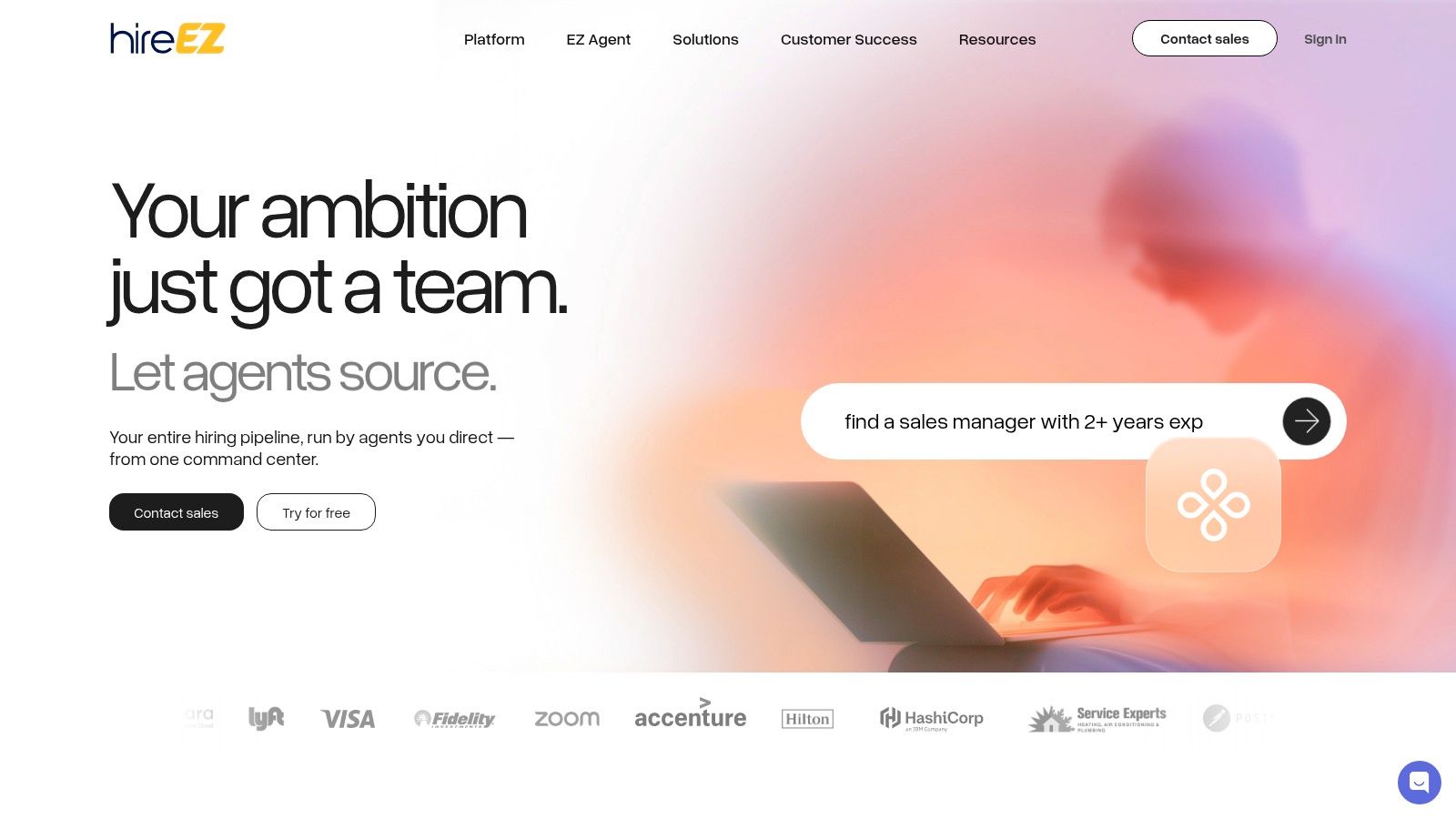
hireEZ is designed to consolidate top-of-funnel recruiting work. Its AI and agentic workflows support sourcing, email and phone discovery, engagement sequences, scheduling, ATS overlays, and pipeline reporting. Hiring Intelligence dashboards add market views for role and location planning.
That makes it a practical choice for a Series B or C company with several recruiters and recurring technical hiring. A team can use market information to shape the search, then manage outreach and pipeline activity without moving between as many point solutions. The analytics are more useful when leaders want to understand not only how many candidates entered the funnel, but where the funnel slows.
The commercial trade-off is transparency. Users report higher costs and complex seat structures, so ask for pricing by recruiter, hiring manager, contact credits, automation volume, and data access. Don't compare the headline license with a competitor's base tier if the workflows require several paid modules.
The platform can reduce tool sprawl, but consolidation only helps when recruiters use the full workflow. Run a pilot with one role and measure qualified-candidate rate, first-interview conversion, time-to-shortlist, and geographic coverage. Those are better signals than the number of AI features in the demo.
6. Gem
Best for: High-growth teams that already have an ATS and need better sourcing CRM, nurture, rediscovery, and funnel reporting. Limitation: Gem isn't a full labor-market data provider, and sourcing depth may depend on integrations.
Gem sits on top of the ATS. It unifies candidate rediscovery, outbound campaigns, events, nurture workflows, calendar connections, and analytics. DEI insights and talent-market heat maps add context, but the core job remains recruiting execution and relationship management.
This fits a Series A or B company that has enough hiring activity to lose candidates in spreadsheets, inboxes, or disconnected campaigns. The clean reporting is useful for executive updates because leaders can see pipeline movement and source performance without asking recruiters to build manual reports.
Pricing is custom and requires a sales conversation. Ask whether the quoted package includes ATS integration, contact enrichment, email and calendar functionality, analytics, events, and historical candidate migration. Also test the workflow with your existing sourcing channels. Gem's CRM strength doesn't automatically provide the same external search depth as a dedicated sourcing database.
Practical rule: Choose Gem when your bottleneck is candidate relationship management. Choose market intelligence when your bottleneck is deciding which location or skill pool to target.
Teams can compare the broader workflow against GENTY's overview of sourcing tools. The important question is whether the platform makes follow-up consistent and measurable, not whether it carries the broadest talent intelligence label.
7. TalentNeuron
Best for: Workforce leaders evaluating locations, skills supply, compensation, and future hiring demand. Limitation: It does not source or message candidates.
TalentNeuron is a planning tool. It provides talent supply and demand analytics by role, skill, and location, along with salary bands, competitive hiring patterns, scenario modeling, and advisory support. The platform is designed for decisions about workforce footprint and capability, not daily recruiter activity.
That distinction matters for a Series C company considering several engineering hubs. A team can compare markets before committing to recruiting operations, office investment, or a regional hiring plan. LATAM may appear in that analysis, but the output should inform a live search rather than replace one.
TalentNeuron uses an enterprise pricing model, and onboarding is necessary to get value from the analysis. Ask for a sample market map using your actual role definitions. Generic titles can hide important differences between software engineering, platform engineering, DevOps, data, and security work.
The buyer should be a CTO, VP Engineering, HR Director, or workforce planning lead. A recruiter who needs candidate names today will find the product frustrating. Pair it with a sourcing execution platform or an external recruiting partner. The platform can explain where a market looks promising, but it won't conduct outreach, assess communication, or close the candidate.
8. Lightcast
Best for: Analytics and workforce teams building skills architectures, location benchmarks, and learning or hiring plans. Limitation: It's not designed for sourcing or recruiter messaging.
Lightcast supports talent pool analysis, location benchmarking, skills taxonomy mapping, gap analysis, and market-informed skills architecture. Its data is useful when a company wants to compare external supply with internal capability and design hiring or learning paths around skills rather than job titles.
For a Series B or C organization, this can help translate a workforce question into an operating plan. Instead of asking only how many backend engineers are available, the team can examine adjacent competencies, such as cloud delivery, data quality, security, product judgment, and communication. That matters as AI changes job descriptions and creates keyword inflation. Dice reported that 36% of technology job postings required AI skills in 2025, while postings mentioning AI-agent skills rose 2,043% year over year and retrieval-augmented generation skills rose 475%, all in its AI jobs hiring guide.
Pricing varies by solution bundle. Ask which modules cover labor-market data, skills architecture, learning, salary benchmarking, and API access. The platform is strongest when analysts or workforce specialists can interpret the output. Everyday recruiters may need a simpler execution layer.
For compensation decisions, connect the analysis to local evidence. GENTY's salary benchmarking services provide a useful reference point for turning market data into a hiring decision.
9. Revelio Labs
Best for: People analytics and strategy teams researching talent flows, attrition, skills, pay signals, and competitor movement. Limitation: It requires analytical skill and doesn't provide an outreach workflow.
Revelio Labs offers a broad workforce dataset, APIs, analytics applications, and Revelio Terminal, including an AI chat interface for labor-market questions. Its coverage spans profiles, job postings, sentiment, filings, talent flows, attrition, skills, and pay signals.
The platform is a strong fit when the question is bigger than one requisition. A CTO might investigate how competitors are building a capability, where talent is moving, or whether a regional labor pool is expanding. An HR Director might use it to study workforce movement and emerging skills before changing headcount plans.
Pricing depends on data scope and product selection. Request a demonstration using a real strategic question, not a generic dashboard tour. Then ask who will maintain queries, validate definitions, and turn findings into action. An AI chat interface can speed exploration, but it doesn't remove the need to check source coverage and interpretation.
Revelio is best for a Series C company with an analytics owner or an external strategy function. It's a poor first purchase for a Series A team that needs to contact candidates. Pair it with a sourcing workflow, or use headcount forecasting methods to connect market signals to an approved hiring plan.
10. Horsefly Analytics
Best for: Recruiters and HR business partners who need quick market maps, salary and competition signals, location analysis, and DEI benchmarking. Limitation: It has no sourcing or outreach capability, and depth varies by role and region.
Horsefly Analytics combines external and internal talent data for workforce planning, location analysis, DEI benchmarking, and employer-branding work. Its interface is aimed at recruiters and HR partners rather than specialist analysts. The platform also supports multilingual, multi-country analysis, which is relevant for companies comparing several hiring markets.
A Series A or B company may use Horsefly to make a focused decision without buying a large workforce suite. For example, the team can map a role, compare salary signals, and assess competition before deciding whether to search in a new location. That's useful when the company lacks an internal labor-market analyst.
Pricing is quote-based. Ask for a role-by-region demonstration and clarify how coverage changes for uncommon skills, smaller markets, and senior roles. Don't assume a clean dashboard means the underlying data answers every compensation question.
Horsefly won't produce a shortlist or run an outreach sequence. The buyer needs a separate sourcing tool, internal recruiter, or recruiting partner. Its value is speed of analysis and accessibility, not end-to-end hiring execution.
Top 10 Talent Intelligence Platforms Comparison
Matching Your Stack to Company Size and Hiring Model
A Series A company usually needs one reliable sourcing workflow before it needs a full workforce planning suite. SeekOut, Gem, and hireEZ are the more relevant options when the immediate job is finding and engaging technical candidates. Eightfold AI, Beamery, and Revelio Labs can answer broader questions, but their implementation and pricing models may be disproportionate to a lean team.
Start with the constraint that is blocking hiring. If recruiters can't find qualified candidates, test a sourcing execution platform. If the team can find candidates but doesn't know where to hire, test LinkedIn Talent Insights, Horsefly Analytics, Lightcast, or TalentNeuron. If the company is planning multiple hubs, skills programs, or internal mobility, the business case for a broader platform becomes stronger.
A Series B company often sits between these needs. It may have recurring hiring in several functions, a growing recruiting team, and pressure to report on funnel quality. Gem or hireEZ can organize execution, while a market intelligence product supplies location and compensation evidence. A Series C company comparing several countries or planning significant headcount may justify Beamery, Eightfold, TalentNeuron, Lightcast, or Revelio Labs, but only with clear ownership and integration plans.
Use this buying path:
Name the job to be done: Write whether the tool must source candidates, map markets, forecast skills, support internal mobility, or combine those jobs.
Shortlist two tools: Pick one execution option and one planning option when the business has both problems.
Request written pricing: Include implementation, integrations, seats, credits, data access, support, renewal terms, and cancellation conditions.
Run a 30-day pilot: Use one hard-to-fill role, not a prepared demo requisition.
Measure the funnel: Track qualified-candidate rate, first-interview conversion, time-to-shortlist, offer acceptance, and geographic coverage.
Audit recommendations: Check explainability, human override, privacy, consent, subgroup outcomes, and whether nontraditional experience is being penalized.</li>
The pilot should use a defined clock. SHRM benchmarks cited in available reporting place average U.S. time-to-fill at roughly 41 to 44 days, while professional and technical roles are commonly reported at a median of 52 to 60 days (SHRM benchmark reporting). Use those figures as external context, not as a promise that software will solve every delay. Your internal baseline should show whether the problem comes from sourcing, compensation, scheduling, interviewer feedback, or unclear requirements.
AI adoption also needs operational support. SHRM research summarized from 1,908 HR professionals reported that 39% of organizations had implemented AI in at least one HR activity, with recruiting the leading use case at 27%, while 74% lacked capabilities needed for adoption (SHRM research summary). That's why a smaller, well-owned workflow often beats a larger suite that nobody maintains.
LATAM salary and supply data should be checked against live candidate pools before a hiring decision is finalized. Market maps can identify promising regions, but recruiters still need to validate skills, English proficiency, time-zone fit, compensation expectations, and availability. Teams that want that work handled can review GENTY's IT recruitment services and RPO services. For broader vendor research, compare this category with other best B2B research tools for 2026.
GENTY recruitment combines skill-first IT and sales recruitment, RPO, and salary benchmarking for companies building nearshore teams across Latin America. Its fixed-fee model, curated shortlists, and regional market knowledge can complement talent intelligence software when you need qualified candidates rather than another dashboard. Visit GENTY recruitment to discuss a hard-to-fill role or a LATAM hiring plan.