
A shortlisted candidate has passed a structured filtering stage based on explicit job criteria and is ready for deeper evaluation, not just to become the next name in a resume pile. In one multinational technology company, limiting HR-created shortlists to a maximum of seven profiles per job queue increased the proportion of women hired by 5.9 percentage points, while candidate-pool size didn't change significantly (Sarabi and Lehmann's 2024 study).
Your team probably has a different problem today. The hiring manager has forwarded a stack of plausible resumes, engineering wants interviews scheduled immediately, and nobody can explain why these particular people advanced. The process feels fast, but it's only moving the ambiguity downstream.
Treat shortlist status as a contractual agreement on value. The employer is saying, “This person has demonstrated enough job-relevant evidence to justify structured assessment.” The candidate is giving time and attention in return for a transparent process. If your team can't define the evidence behind the decision, you don't have a shortlist. You have a queue.
What Defines a Shortlisted Candidate
A shortlisted candidate is an applicant who has survived a deliberate comparison against the requirements of a specific role. Shortlisting reduces a broad applicant pool to a manageable group for interviews and final selection. It isn't the same as opening a resume, liking the candidate's background, or moving someone into an applicant tracking system stage called “review.”
Planning a hire?
Talk through the best hiring option
This article usually leads to one practical question: should you use staffing or salary guide? We can help you choose quickly.
Simple next step
Start with staffing and we will help you pick the best hiring setup.
The distinction matters because applicants create volume, while shortlisted candidates create an actionable hiring decision. Screening asks whether a person meets the minimum key selection criteria. Shortlisting ranks those who meet the threshold against the requirements for progression to the next stage, as explained in this overview of candidate evaluation.
The four tests of shortlist status
Use four tests before scheduling an interview:
Role relevance: Can you point to evidence that the candidate has handled the work your team needs? “Worked with Kubernetes” is weaker than documented experience diagnosing deployment failures, improving observability, or operating production services.
Minimum feasibility: Can the candidate satisfy essential requirements such as location, work authorization, working hours, language, compensation alignment, or contract model? These criteria must be directly job-related, not convenient preferences.
Comparative strength: Did the candidate rank well against the same criteria used for everyone else? A person shouldn't advance only because their resume arrived first or because one interviewer recognized a previous employer.
Assessment readiness: Is there enough evidence to justify the next evaluation step? A shortlist shouldn't contain people whose basic technical fit still needs to be discovered in a full interview loop.
A strong shortlist is therefore small enough to evaluate seriously and broad enough to avoid premature exclusion. The 2024 study above used a ceiling of seven profiles per job queue, which offers a useful operating principle for interview shortlists. It isn't a universal rule, but it demonstrates the value of curating candidates before managers spend scarce interview time.
Shortlist status also isn't a promise of employment. It means the candidate has earned a structured assessment, not that the employer has validated every skill or decided to make an offer.
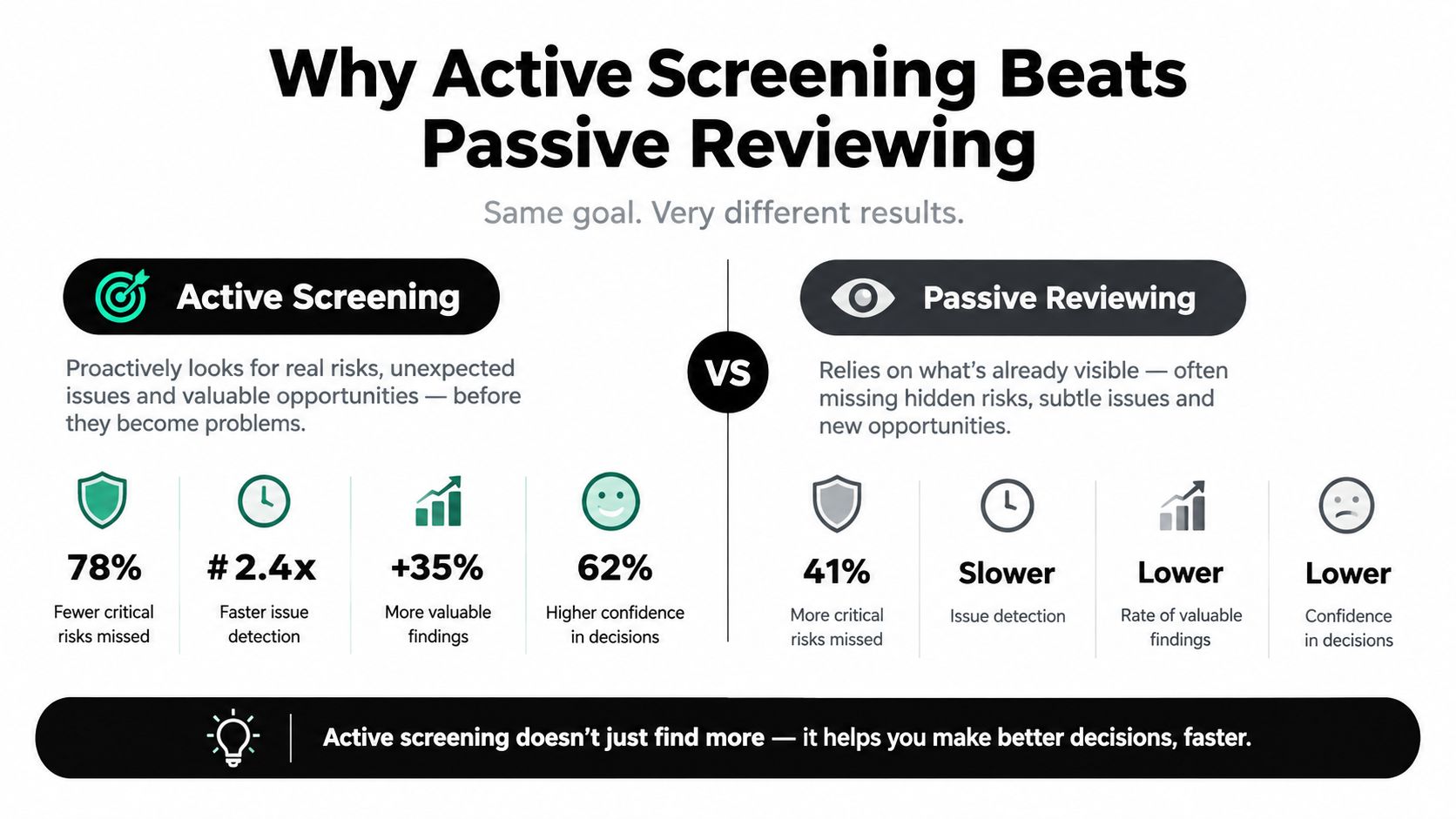
Why Active Screening Beats Passive Reviewing
A CTO opens the interview calendar and sees twenty names. The recruiter selected them from keyword matches, familiar employers, and polished titles, but the hiring team still cannot explain what evidence justified each invitation. That calendar is busy, not useful.
Active screening treats a shortlist as an agreement about value. The recruiter and hiring manager define the work, separate required capabilities from trainable preferences, and record evidence against the same standard before contacting candidates. The employer then owes each shortlisted person a structured evaluation, not an improvised conversation shaped by interviewer preference.
The Victorian Public Sector Commission guidance separates screening from shortlisting in practical terms. Screening checks minimum selection criteria. Shortlisting ranks candidates for progression. The guidance cites Recruiting Roundtable research estimating that a shortlist built on sound job analysis contributes 8% to a successful hire. That figure describes a contribution to hiring success, not the probability that any shortlisted candidate will receive an offer.
Model the real sourcing problem
Sourcing and interviewing require separate lists. Recruiter behavior research summarized in the guidance describes a practice of identifying approximately 20 relevant candidates before outreach, partly because customized outreach historically produced responses of around 10%. Those figures concern sourcing volume and response rates, not the separate analysis of how shortlist quality contributes to hiring success.
Record two stages:
Sourcing shortlist: Relevant people who could be contacted, with evidence, availability signals, and outreach context documented.
Interview shortlist: Candidates who meet the recorded threshold and have agreed to the assessment process.</li>
Putting twenty people into interviews consumes engineering time and encourages rushed scoring. Sourcing only seven people assumes universal availability and interest, so the process stalls when candidates decline, lack compensation alignment, or fail a closer fit check.
Make the filter job-related
For a DevOps hire, examine production incident response, infrastructure ownership, deployment practices, and security awareness. For sales, assess territory relevance, sales motion, deal complexity, and consistent execution. Treat prestige as context, never as proof.
Ask one question: what evidence shows this person can perform the work under the conditions being offered? Apply the same discipline with the practical candidate-screening steps for 2026. A shortlist earns interview access through evidence, and the employer must provide the structure that makes that evidence comparable.
Building a Structured Evaluation Framework
A shortlisted candidate should enter a system your company has already agreed to run. Without that structure, each interviewer reshapes the role, asks different questions, and rewards personal communication preferences. The shortlist becomes a scheduling label instead of an evidence-based agreement about the value the candidate may deliver and the evaluation the employer must provide.
Start with a scorecard covering the competencies that matter to the job. A technical scorecard might assess debugging, system design, cloud operations, testing strategy, security, and stakeholder communication. Tie every competency to an observable behavior or work outcome, then define the minimum evidence required to progress.
Set behavioral anchors before interviews
Use the same questions, scoring rubric, and evaluation criteria for every candidate. The widely cited Schmidt–Hunter evidence reports predictive validity of approximately r = 0.51 for structured interviews against job performance, compared with about r = 0.38 for unstructured interviews (structured interview scorecard guidance).
A five-point scale works when every point has a defined meaning:
Write the anchors before reviewing interviews. Defining them afterward lets favorable impressions reshape the rubric and weakens comparisons between candidates.
Add a bounded work sample
Resume evidence and conversation cannot establish capability for many technical roles. Meta-analytic benchmarks place work-sample tests at approximately r = 0.54 predictive validity and structured interviews at approximately r = 0.51 (work-sample and structured-assessment benchmarks).
Keep the exercise close to the target job and limited in scope. Ask a candidate to repair a failing service, write tests for an existing module, diagnose a deployment failure from logs, or propose an architecture under explicit latency, security, and cost constraints. Score correctness, observability, security controls, maintainability, and trade-off reasoning separately from speed.
Advance candidates who clear the minimum threshold on both the scorecard and work sample. Record critical failures, such as insecure credential handling or an inability to validate assumptions. A polished interview must not erase them. For a wider operating model, use this structured hiring guide for startups.
Distributed teams also need consistent evaluation across educational systems, communication styles, and local labor-market conventions. Teams scaling evaluation capacity can find SEM consultants in 2026 to support high-risk recruitment workflows, while retaining ownership of hiring decisions. In Europe, inventory automated application filtering and candidate-evaluation steps, and preserve human review. The EU AI Act classifies targeted job advertising, application analysis or filtering, and candidate evaluation as high-risk recruitment applications under Annex III, point 4(a) (EU AI Act recruitment guidance).
Comparing Effective and Ineffective Shortlisting
The easiest way to diagnose shortlist quality is to compare the decision your team made with the evidence it can produce. An effective shortlist makes the next stage more informative. An ineffective shortlist merely transfers uncertainty to interviewers.
Watch for attractive but weak signals
A recognizable employer can indicate useful experience, but it doesn't prove the candidate can solve your current problem. A senior title can reflect ownership, or it can reflect a company's internal leveling system. A fluent interview can show communication skill, but it can't replace evidence of technical correctness.
Your scorecard should expose those gaps. Ask what the candidate owned, what constraints they faced, what changed because of their work, and how they validated the result. For technical roles, require the candidate to explain trade-offs rather than repeat tool names.
Don't over-filter unconventional talent
A smaller shortlist isn't automatically better. Excessive filtering can remove capable candidates from less represented markets or unconventional career paths, especially when employers confuse “has used our exact stack” with “can perform the underlying work.”
Classify requirements as must-have, preferred, or trainable. Apply hard filters only to genuine constraints, such as a required security clearance or a legally necessary work arrangement. Assess capabilities that transfer across tools, including debugging discipline, systems thinking, written communication, and ownership.
Practical rule: If a rejection reason can't be tied to a task, constraint, or documented requirement, it doesn't belong in the shortlist decision.
For international hiring, include time-zone overlap, communication expectations, compensation alignment, and employment feasibility without treating geography as a quality shortcut. LATAM can be a practical nearshore hiring option when those operating requirements are defined in advance, not used as an afterthought.
Outreach Templates for Securing Candidate Interest
A shortlist can fail after the evaluation work is complete. Candidates withdraw when the employer hides the compensation range, adds unexplained interview rounds, or takes too long to clarify the contract and working model.

Send the first message with enough information for a serious decision. Include why the profile is relevant, what the role owns, the interview stages, the expected timeline, the salary range and currency when available, the contract model, benefits, equipment, and time-zone expectations.
Initial outreach template
Subject: Engineering leadership role focused on platform reliability
Hi [Name],
Your experience with [specific system, responsibility, or outcome] appears relevant to a role where you'd own [defined responsibility]. The team is hiring for [employment model], with expected overlap across [working hours or time zone].
The process includes [assessment format], [interview stages], and a final conversation with [decision-maker]. The compensation range is [range and currency], and the company provides [relevant benefits or equipment].
Would you be open to a short conversation about the scope and working model?
Best,
[Name]
The message should be personalized around evidence, not flattery. “Your background is impressive” tells the candidate nothing. “You've operated services through production incidents, and this role owns reliability for a similar platform” gives them a reason to respond.
For additional examples, consult these 2026 recruitment outreach template resources, then adapt the language to your company's actual process. Don't copy a polished template and leave placeholders that contradict the job.
Give candidates a practical way to prepare. Explain whether the work sample is live or asynchronous, what competencies you'll score, how long the evaluation should take, and when they'll receive an update. Talent sourcing guidance can help teams organize the sourcing side, but the hiring manager still owns the candidate promise.
After the candidate replies, confirm the next action quickly and assign one accountable contact. The contact should answer questions about compensation, employment structure, benefits, and interview expectations rather than redirecting every question to another department.
A shortlisted candidate may evaluate benefits and progression as part of the offer, not just salary. Research covering 243 engineers across multiple countries found remote work was universal among surveyed participants, while vacation or PTO appeared in 88% of compensation packages and career growth in 46% (Latin American technology compensation research).
Track where candidates disengage. Shortlist-to-interview attendance, interview-to-offer progression, offer acceptance, and early retention tell you whether the process is credible. Speed helps, but unexplained speed creates uncertainty, so publish the evaluation logic instead of compressing interviews blindly.
Key Takeaways for Hiring Leaders
A shortlist is a contractual agreement on value. It commits your team to test a candidate against defined evidence and gives the candidate enough information to judge whether the role merits their time. Treating it as a scheduling label produces inconsistent interviews and weak decisions.
Use this operating checklist:
Define the work first: Separate required capabilities from preferred or trainable skills.
Screen actively: Rank candidates against the role before outreach. Do not forward every plausible résumé.
Keep lists distinct: Maintain a broad sourcing list and a focused interview shortlist.
Standardize assessment: Use consistent questions, scoring anchors, and role-specific competencies.
Test the work: Add a bounded, realistic work sample for technical roles.
Document decisions: Record evidence and rejection reasons another reviewer can understand.
Communicate the deal: State compensation, contract model, benefits, working hours, interview format, and timelines.
Audit automation: For EU-related hiring, preserve decision logs, define human oversight, and review vendor documentation. The EU AI Act entered into force on August 1, 2024, with general application from August 2, 2026. The principal obligations for standalone Annex III recruitment systems are currently projected for December 2, 2027 under the amended timetable reported in available sources (EU AI Act implementation guidance).
Check contractor reality: US companies engaging remote technical contractors should assess the actual economic relationship under the Department of Labor's six-factor analysis, rather than relying on the contract label. The rule was published on January 10, 2024, and became effective on March 11, 2024 (Department of Labor FAQ).</li>
Every shortlisted candidate should have documented relevance, a fair evaluation path, and enough information to decide whether the opportunity works for them. Use this hiring manager checklist for 2026 tech hiring to make that standard repeatable.
GENTY recruitment builds curated shortlists for technical and sales hiring through skill-focused screening and structured evaluation for distributed teams. Visit GENTY recruitment to discuss role requirements and give your interview team evidence it can assess consistently.