
Technical recruitment is the specialized process of finding, assessing, and hiring people for technology roles where both general employability and role-specific technical capability must be validated. In the United States, software developers held approximately 1.69 million jobs in 2024, with projected employment reaching about 1.96 million by 2034, an increase of 267,700 jobs, or 15.8%, and approximately 115,200 openings annually during that period, according to the Bureau of Labor Statistics.
You're likely dealing with the practical version of this problem already. An engineering manager has a crowded applicant list for a backend role, but only a small group has the required stack, and fewer still can reason through the production constraints the job involves. Résumés create volume. Technical recruitment creates evidence.
What Technical Recruitment Actually Means in 2026
Suppose an engineering manager at a Series B fintech receives 240 applications for a backend position. Twelve candidates appear to have the right stack, and only three can handle a serious system-design conversation. That gap is the reason technical recruitment exists. The process isn't about matching job titles to keywords. It's about determining whether someone can perform the work your product and operating environment demand.
A technical recruiter performs three connected jobs:
Before you start hiring
Check location, salary, and hiring fit
If you are moving from research to action, start with the market basics so your hiring plan is clearer.
Translate the business need into a technical profile. “Senior backend engineer” isn't specific enough. The profile might require production experience with Postgres, event-driven architecture, observability, cloud infrastructure, and incident response, while treating a particular framework as trainable.
Assess demonstrated capability. Recruiters combine work samples, coding exercises, debugging tasks, system-design discussions, structured interviews, and portfolio evidence instead of treating résumé language as proof.
De-risk the hire. A candidate can interview smoothly and still struggle with production debugging, written communication, ownership, or collaboration across time zones. The process must expose those risks before an offer.</li>
That distinction applies across software development, quality assurance, cybersecurity, data, infrastructure, product management, and IT leadership. A strong technical recruitment process gives the hiring manager comparable evidence for every finalist rather than a collection of impressions.
Practical rule: Define the work before defining the candidate. If the team can't describe what successful performance looks like, no recruiter can source accurately.
The market scale makes this an operating function, not occasional administrative support. The BLS projection cited above describes a large and expanding labor market, so companies need repeatable methods for translating requirements, evaluating capability, and learning from post-hire outcomes.
Recruiters can also improve interview consistency with tools that capture real-time interview answers, provided the organization uses them transparently and keeps human judgment accountable. For a broader view of the operating discipline, see this guide to IT recruiting.
The Skills-First Scorecard That Replaces Résumé Screening
The most useful artifact in a technical hire is a competency matrix. It converts a vague requisition into a definition of successful performance, then gives recruiters and interviewers the same standard.
For a senior backend engineer, the matrix might separate API design, database performance, production debugging, testing discipline, communication, and ownership. It should distinguish must-have capabilities from trainable tools. Experience with reliable distributed systems may be essential, while familiarity with a specific observability platform may be learned after joining.
The scorecard also needs observable evidence. “Strong communicator” isn't scorable. “Explains an incident timeline in writing, identifies uncertainty, and proposes a clear next action” is observable. “Knows databases” is vague. “Chooses indexes, explains query-plan trade-offs, and identifies when Postgres differs materially from MySQL” gives an interviewer something concrete to evaluate.
Build the scorecard before opening the role
Start with production outcomes. Write what the person must deliver, such as improving service reliability, shipping an API, or diagnosing performance regressions. Don't begin with a list of technologies copied from another job description.
Separate fundamentals from stack specificity. Relational database experience matters, but Postgres and MySQL aren't interchangeable in every production context. Record which differences matter for this role and which can be learned.
Calibrate seniority through autonomy. A senior candidate should demonstrate scope, judgment, trade-off analysis, and ownership, not familiarity with more tools.
Choose weighted competencies. Agree on the relative importance of technical execution, problem-solving, communication, reliability, and domain knowledge before interviews begin.
Define pass thresholds. A candidate might need to pass production debugging and system design while meeting, rather than exceeding, the threshold for a framework-specific skill.
Map each competency to an assessment. If a requirement can't be tested through a realistic task or structured question, reconsider whether it belongs on the scorecard.</li>
A work sample has a reported predictive-validity coefficient of 0.54 for job performance, compared with 0.18 for résumé screening alone, according to the EEOC guidance on selection procedures. The same guidance treats job requirements, applications, interviews, performance tests, and written tests as selection procedures. That means a scorecard helps with both signal quality and defensibility because it ties assessment content to actual job behaviors.
Skills-First Scorecard Template for a Senior Backend Role
Use the skills-first hiring framework to pressure-test whether each requirement measures capability or merely repeats a conventional résumé filter.
Assessment Methods Compared and What Each One Actually Measures
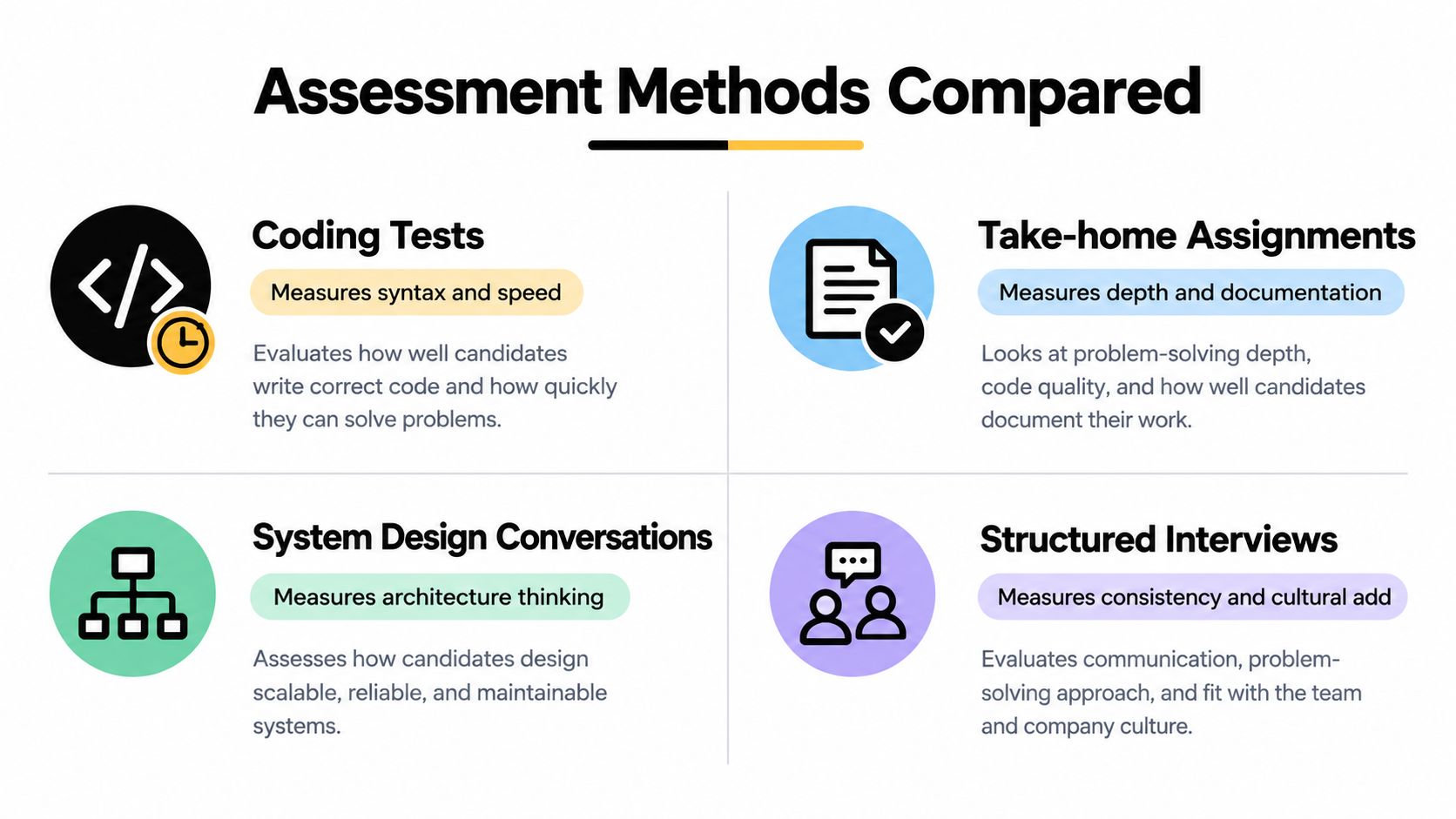
Coding tests are useful, but only for the capability they measure. A timed exercise can reveal algorithmic reasoning, syntax, and speed. It usually says much less about architectural judgment, production debugging, documentation, or asynchronous collaboration.
Take-home assignments offer more room to inspect structure, tests, explanations, and trade-offs. They can also introduce candidate burden, inconsistent conditions, and questions about outside assistance. System-design conversations expose architectural reasoning, but interviewers can overrate polished storytelling if they don't use common prompts and scoring anchors. Structured interviews provide consistency for judgment, communication, and collaboration, especially when every candidate receives the same job-related questions.
The evidence favors standardization over conversational chemistry. A 2022 update to the Schmidt and Hunter interview research reported structured-interview validity at 0.42 against job performance, compared with 0.19 for unstructured interviews, according to this analysis of structured interview questions. The same source cites the U.S. Office of Personnel Management's Assessment Decision Guide, which places structured-interview validity at 0.51 when used alone and 0.63 when combined with a cognitive-ability measure.
The objective isn't to identify who is most familiar with interview puzzles. It's to measure whether the candidate can perform representative work.
A defensible interview loop can fit inside one week if the team makes deliberate choices:
Use a short initial screen for constraints. Confirm location, compensation expectations, work authorization, communication requirements, and motivation before consuming engineering time.
Choose one realistic work sample. A code review, debugging task, API design, or small repository exercise usually gives more relevant evidence than several unrelated puzzles.
Run a structured technical conversation. Give each candidate the same core questions and scoring anchors, then allow limited follow-ups for clarification.
Score independently before discussion. Interviewers should record evidence before hearing the panel's overall recommendation.
Reserve the final conversation for unresolved risks. Don't repeat the entire process. Test the competency where the evidence remains weakest.</li>
More examples of how teams compare methods are available in this guide to technical recruitment assessment tools.
AI Fluency, Communication, and the New Engineering Hiring Stack
Technical recruitment now has to evaluate more than programming languages. A developer may use AI tools to generate code quickly, yet still make poor decisions about security, testing, architecture, data quality, or operational risk. The useful question isn't whether someone has used an AI assistant. It's whether they can direct it responsibly and verify what it produces.
More than 275,000 active job postings referenced AI skills in January 2026, including roles where AI wasn't the primary function, according to CompTIA's 2026 technology workforce insights. The same source reports that communication appeared across all 25 AI and data career paths analyzed, while AI skills appeared in 22. Python, SQL, and computer-science fundamentals remained core requirements.

Test judgment, not buzzwords
Ask candidates to explain an AI-assisted change. What did they delegate? How did they validate the output? Which tests did they add? What would they refuse to automate? A strong answer connects the tool to code quality, privacy, security, maintainability, and delivery risk.
Then test the surrounding engineering behavior. Give the candidate an ambiguous requirement and ask for a written clarification. Use a debugging scenario that requires separating symptoms from causes. Ask how they'd communicate a failed deployment to a nontechnical stakeholder. For distributed teams, verify written communication, asynchronous collaboration, English proficiency where required, production debugging, cloud or DevOps practice, and working-hour overlap.
The operating rule is simple: evaluate durable engineering foundations, applied AI literacy, and collaboration skills together. The absence of any one is a meaningful hiring signal, not automatically a gap that can be ignored because a résumé contains AI keywords.
For more practical examples of using AI without weakening evaluation quality, see this discussion of AI in recruitment for technology startups.
Running the Funnel as a Measurable Hiring Pipeline
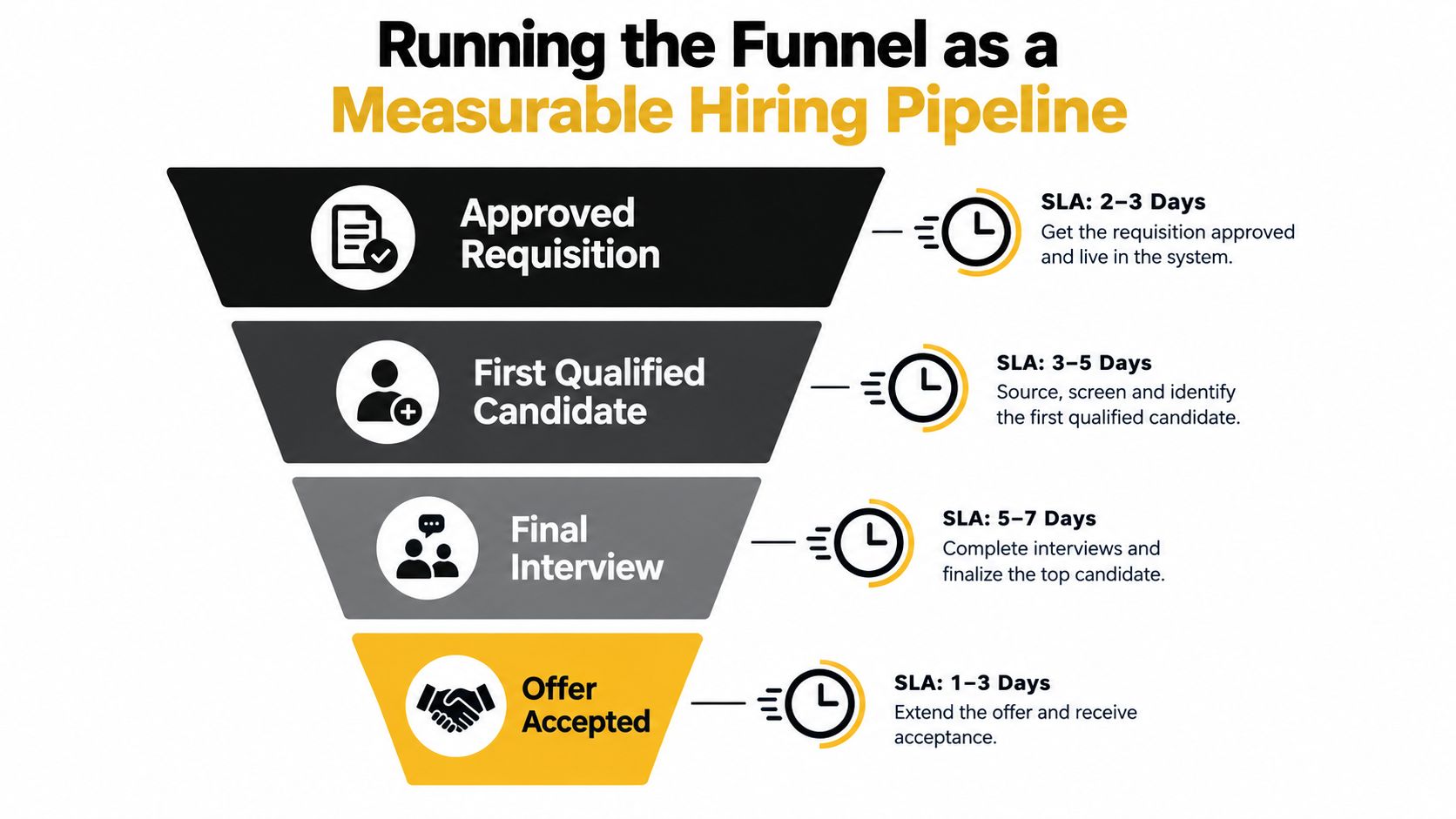
Recruiting teams should manage technical hiring like a production pipeline. A single time-to-hire number hides the stage that is failing, so divide the process into four segments:
Approved requisition to first qualified slate: Measures whether the scorecard is specific enough and whether sourcing reaches the right talent pool.
First screen to technical assessment: Shows whether recruiter screening is calibrated to the engineering requirement.
Assessment to final interview: Exposes scheduling delays, unclear ownership, slow feedback, or an assessment that filters too aggressively.
Final interview to signed offer: Reveals decision latency, compensation misalignment, competing offers, and candidate experience problems.</li>
Ashby recruiter-productivity data for the second and third quarters of 2025 reported a median of 40 days from application to accepted offer for technical roles, with an average of approximately 48 days. The same source reported about 18 days from screen to final interview for technical positions, as summarized in this software developer hiring timeline analysis.
Diagnose the leak instead of chasing speed
Track pass-through rates alongside time. A short screen-to-final period is not a success if interviewers are rejecting poorly qualified candidates after spending hours on panels. A fast funnel that produces weak finalists creates more engineering workload without improving hiring.
The diagnostic patterns are straightforward:
First slate is slow: Revisit sourcing channels, stack specificity, location constraints, and compensation assumptions.
Assessment pass rate is low: Check whether the task reflects the job or tests an unnecessary niche.
Final interviews are frequent but offers are rare: Recalibrate the scorecard and interviewer thresholds.
Offers are declined: Review compensation, role clarity, process speed, and the candidate's interaction with the team.
Acceptance is healthy but retention is weak: Compare interview evidence with post-hire performance and identify what the process missed.</li>
Every stage needs an owner and a feedback expectation. Recruiters own candidate movement and evidence quality. Hiring managers own requirements and decisions. Interviewers own timely, anchored feedback.
RPO, Agencies, and In-House Recruiters Compared
The operating model should match hiring volume and management capacity. An in-house recruiter gives the company continuity and institutional knowledge, but the business carries fixed cost and must maintain technical sourcing capability. A project-based agency trades a per-hire fee for speed, market reach, and a curated shortlist. RPO embeds recruiting capacity into the company's workflow and can own sourcing, coordination, reporting, and process improvement across multiple roles.
The choice matters because technical recruitment is also risk management. The BLS projects 10% employment growth for software developers, quality-assurance analysts, and testers from 2025 to 2035, faster than the average for all occupations, according to its software development occupational outlook. Teams competing in that environment need a selection model that scores technical execution, problem-solving, communication, reliability, and role-specific knowledge against agreed thresholds.
Technical Hiring Models by Company Stage
A small startup with three open requisitions usually benefits from focused external curation rather than building a full function too early. A scale-up with recurring engineering demand may need RPO because the problem is no longer finding one person. It's operating the funnel consistently. A larger company generally gains more from an internal team, supported by specialist partners for hard-to-fill roles.
Recruiting technology can support any model, but it doesn't replace calibration. Teams comparing automation options may find this overview of AI recruiting tools for agencies useful when evaluating sourcing and workflow capabilities. The tool or provider still needs to work from a precise scorecard and produce evidence the hiring team trusts.
Why LATAM Is a Serious Nearshore Technical Hiring Region
A LATAM hire can reduce total engineering cost without lowering the bar, but only when the role, country, and employment model are evaluated together. A 2025 LATAM technology salary survey reported median current salaries of approximately $60,000 and median expected salaries of $72,000 across the included roles. It listed many roles as 45% to 70% more affordable than US counterparts. Backend engineers had a listed LATAM median of $78,000, compared with a $187,000 US average, according to the 2025 LATAM salary survey.
Treat those figures as directional, not as a universal discount. Country, seniority, specialization, English proficiency, employment model, benefits, compliance, and competition from foreign remote employers all affect total cost. The survey says its included respondents had upper-intermediate or advanced English. Hiring teams should still test communication during selection, because geography does not prove writing or collaboration ability.
The supply picture also requires a better filter than “there aren't enough developers.” HackerRank's 2025 global developer research, based on 13,732 respondents across 102 countries, found that 74% of developers still struggled to land jobs, with early-career developers most affected as employers favored experienced candidates, according to HackerRank's 2025 global developer research. A rigid seniority filter can leave specialist roles open while excluding adjacent-skilled or high-potential engineers.
For distributed hiring, assess written communication, asynchronous collaboration, required English, production debugging, and working-hour overlap. A skills-first scorecard makes the trade-off explicit: experienced specialists may need less onboarding, while strong fundamentals can justify investing in a capable, less conventional candidate. For practical context, review IT recruitment across Latin America.
A 90-Day Operating Plan for Technical Recruitment
A CTO, VP Engineering, or HR Director can establish a working system in 90 days.
Weeks 1 to 2: Build the scorecard for the next two roles. Define must-have and trainable skills, agree on weighted thresholds, select representative assessments, and assign decision ownership. Ask engineering and recruiting to approve the same evidence standard before candidates enter the funnel.
Weeks 3 to 6: Run the first requisitions through the process while instrumenting every stage. Track approved requisition to first qualified slate, screen to assessment, assessment to final interview, and final interview to signed offer. Record why candidates fail, not only where they exit.
Weeks 7 to 13: Compare the results, improve the scorecard, and choose the operating model. The company may keep sourcing in-house, use a project agency for specialist searches, or adopt RPO for recurring demand. The decision should follow workload and funnel evidence rather than habit.
Use this checklist at the end of the period:
Time to shortlist
Assessment pass rates
Interview-to-offer conversion
Offer acceptance
Six-month retention
Hiring-manager satisfaction
These metrics create the feedback loop that separates technical recruitment from résumé forwarding. Treat hiring as a measurable production process, and the answer to what is technical recruitment stops being abstract. It becomes a set of decisions your team can run on Monday morning.
GENTY recruitment provides skills-first IT recruitment, RPO, salary benchmarking, and curated technical shortlists for companies hiring across Latin America. If your team needs help turning a role requirement into assessed, nearshore-ready candidates, visit GENTY recruitment to discuss the hiring model and scorecard that fit your next role.