

For most hiring teams building out a LATAM engineering bench, Gem is the strongest all-around sourcing tool in 2026, combining an 800M+ profile dataset with natural-language search, outreach sequencing, and deep ATS integrations. If your team runs high-volume passive sourcing across Argentina, Brazil, Mexico, or Colombia, Gem gives you the coverage and automation depth to move fast without adding headcount.
That said, no single platform wins every use case. Here is the shortlist most hiring leaders should start with:
- Best overall: Gem — AI-native sourcing with outreach automation, ATS sync, and global profile coverage including LATAM markets. Fits teams of 3+ recruiters. Strong for FinTech and SaaS engineering roles.
- Best for outreach automation: Fetcher — managed sourcing plus automated screening and outreach campaigns. Solo recruiters and lean teams get the most value. Good for Brazil and Mexico where English proficiency screening matters.
- Best for passive sourcing at scale: HireEZ — its EZ Agent reads job context, searches 45+ external platforms plus your ATS, and ranks candidates by fit. Ideal for enterprise teams running parallel pipelines across multiple LATAM countries.
- Best for market intelligence: LinkedIn Talent Insights — unmatched for headcount planning, talent pool sizing, and competitive benchmarking. Use it before opening a role in Bogotá or São Paulo to validate supply.
- Best for AI-native candidate discovery: Juicebox (PeopleGPT) — 800M+ global profiles with conversational search and recruiting agents that manage continuous pipeline sourcing. Strong for senior niche roles.
- Best budget/free entry point: ContactOut — browser extension with email and phone lookup, free tier available, useful for solo sourcers validating LATAM candidates before committing to a full platform.
- Best for structured ATS-first workflows: Manatal — affordable, ATS-native sourcing with built-in AI scoring. Fits small-to-mid teams in the US hiring regionally.
- Best for global compliance-conscious sourcing: Deel Hire — sourcing and hiring in one platform with built-in contractor/EOR compliance. Particularly relevant for Colombia and Mexico where contractor classification is a live risk.
Which category to demo first: If your team has two or more in-house sourcers and you are filling more than five roles per quarter in LATAM, start with an AI-agent platform (Gem or HireEZ). If you are a solo recruiter or founder doing your first LATAM hire, ContactOut or Manatal gets you moving without a six-figure contract. For headcount planning before you open roles, LinkedIn Talent Insights is the only tool that answers “how many senior Go engineers are available in Buenos Aires right now?” with real data.
Key Takeaways
AI-native sourcing tools like Gem, HireEZ, and Juicebox give recruiting teams the coverage and automation to source LATAM talent at scale, but tool ownership only pays off when you have the in-house sourcing capacity and hiring velocity to justify the annual platform cost.
Before you start hiring
Check location, salary, and hiring fit
If you are moving from research to action, start with the market basics so your hiring plan is clearer.
How do these sourcing tools compare at a glance?
The table below covers the 13 required platforms across the dimensions that matter most during vendor shortlisting: use case fit, pricing model, AI capabilities, outreach automation, integrations, team scale, and compliance posture.
Pricing notes: Seat-based tools like Gem, HireEZ, and SeekOut typically run $5,000–$20,000+ per year for small teams, with enterprise contracts negotiated separately. Manatal is the outlier at roughly $15 per seat per month, making it accessible for early-stage teams. Fetcher’s managed-service model bundles the tool cost with sourcing labor, which changes the ROI calculation entirely. Deel Hire pricing is tied to Deel’s EOR or contractor fees rather than a standalone sourcing license.
LATAM coverage signal: Most platforms rely on global public profiles (LinkedIn, GitHub, Stack Overflow) rather than proprietary LATAM-specific data sources. For Argentina and Brazil, GitHub and Stack Overflow coverage is strong. Portuguese-language search quality varies by platform. Before committing to any vendor, run a trial search for a specific role in São Paulo or Buenos Aires and compare result quality across two platforms. As Procurement Magazine’s sourcing platform roundup notes, vendor-published dataset claims are directional indicators, not guarantees of regional depth.
Tool-by-tool reviews: what each platform actually delivers
Gem
Gem is the closest thing to a complete AI sourcing stack for a mid-size recruiting team. Its AI Sourcing Agent searches across 800M+ profiles using natural-language queries, enriches contact data, and feeds candidates directly into multi-step outreach sequences. The ATS integrations with Greenhouse, Lever, and Workday are among the tightest in the market, meaning sourced candidates move into your pipeline without manual data entry.
Strengths: Deep outreach automation with deliverability controls; strong ATS sync; natural-language search reduces Boolean dependency.
Weaknesses: Premium pricing puts it out of reach for solo recruiters; LATAM Portuguese-language search quality requires validation.
Ideal use case: Engineering teams at Series B+ companies running continuous passive sourcing across multiple LATAM markets simultaneously.
LinkedIn Talent Insights
LinkedIn Talent Insights is not a sourcing execution tool. It provides market intelligence indicating whether a talent pool exists before you open a role. For a VP of Engineering deciding whether to hire a senior Rust developer in Medellín or Buenos Aires, Talent Insights answers that question with supply/demand data, competitor hiring trends, and skills migration signals.
Strengths: Unmatched data depth for headcount planning; integrates with LinkedIn Recruiter natively.
Weaknesses: No outreach capability; requires LinkedIn Recruiter license for full value; expensive as a standalone purchase.
Ideal use case: Strategic workforce planning before opening LATAM roles, especially in competitive niches like AI/ML or blockchain.
HireEZ
HireEZ’s EZ Agent reads your job description, searches across 45+ external platforms plus your existing ATS, and returns ranked candidates with fit scores. The ATS overlay model means you are not starting from scratch; the agent resurfaces candidates already in your system who match new roles. For teams with a large ATS backlog, that alone justifies the cost.
Strengths: Multi-source search including niche dev communities; ATS backlog mining; strong candidate ranking.
Weaknesses: Scraping-based model requires careful review of consent policies, particularly for EU-based candidates; UI has a steeper learning curve than Gem.
Ideal use case: Enterprise recruiting teams running parallel pipelines across Argentina, Mexico, and Colombia who need ATS-integrated sourcing without a full platform rebuild.
SeekOut
SeekOut indexes 800M+ profiles with a particular emphasis on hard-to-find talent: GitHub contributors, patent holders, academic researchers, and candidates with diversity signals. For tech companies hiring in Brazil’s deep engineering talent pool, SeekOut’s ability to surface candidates by specific technical contributions (not just job titles) is genuinely useful.
Strengths: Diversity analytics; deep tech-skill filtering; strong for niche senior roles.
Weaknesses: Outreach features are basic compared to Gem or HireEZ; pricing is enterprise-oriented.
Ideal use case: Diversity-focused hiring initiatives and senior technical roles where standard LinkedIn searches return the same 50 profiles every recruiter has already contacted.
Findem
Findem builds a proprietary attribute graph by aggregating signals across multiple public data sources, then lets recruiters search by attributes rather than keywords. Instead of searching “Python developer, 5 years experience,” you search for candidates who have shipped production ML models at a fintech company. That distinction matters for senior LATAM hires where title inflation is common.
Strengths: Attribute-based search reduces false positives; talent intelligence dashboards for pipeline planning.
Weaknesses: Enterprise pricing; onboarding requires dedicated IT support; LATAM attribute coverage depends on public data availability in each country.
Ideal use case: FinTech and AI companies hiring senior individual contributors in Argentina or Brazil where role-title matching consistently underperforms.
AmazingHiring
AmazingHiring aggregates profiles from 50+ sources including GitHub, Stack Overflow, Behance, and LinkedIn, with AI ranking that scores candidates on technical skill signals rather than self-reported experience. The platform is built specifically for tech talent, which makes it more precise than general sourcing tools for engineering roles.
Strengths: Strong tech-signal scoring; broad source aggregation; email outreach sequences included.
Weaknesses: Less strong for non-technical roles (sales, operations); LATAM coverage depends on GitHub/Stack Overflow activity, which skews toward active open-source contributors.
Ideal use case: Engineering-focused recruiting teams at SaaS or Web3 companies hiring mid-to-senior developers in Mexico or Colombia.
Fetcher
Fetcher occupies a hybrid position: part sourcing tool, part managed service. The platform automates screening and outreach, but Fetcher’s team also handles campaign management, which reduces the internal sourcing hours required per role. For lean teams or founders doing their first LATAM hire, that managed layer is often the difference between a campaign that runs and one that stalls.
Strengths: Managed outreach reduces internal burden; automated screening with measurable response-rate outcomes; good for Brazil and Mexico where English proficiency screening is part of the workflow.
Weaknesses: Less control over sourcing logic compared to self-serve tools; pricing reflects the managed-service component.
Ideal use case: Early-stage startups and solo recruiters who need sourcing results without building an internal sourcing function from scratch.
ContactOut
ContactOut is a browser extension that overlays email addresses and phone numbers on LinkedIn profiles, with a standalone search interface and a free tier. It is not an AI sourcing platform; it is a data enrichment tool. For a founder validating whether LATAM candidates are reachable before investing in a full platform, ContactOut is the fastest way to test.
Strengths: Free tier; fast setup; useful for quick LATAM candidate reachability checks.
Weaknesses: Scraping-based model carries GDPR risk for EU-based candidates; limited outreach automation; no ATS integration in the free tier.
Ideal use case: Solo sourcers and founders doing initial candidate discovery in Argentina or Colombia before committing to a seat-based platform.
Loxo
Loxo combines an ATS with a built-in sourcing layer, which eliminates the integration overhead that plagues teams running separate sourcing and tracking tools. The AI matching engine surfaces candidates from Loxo’s aggregated profile database and scores them against open roles in your ATS. For small agencies and boutique recruiting firms, the all-in-one model reduces tool sprawl significantly.
Strengths: ATS + sourcing in one platform; built-in email sequences; lower integration complexity.
Weaknesses: Profile database is smaller than dedicated sourcing platforms; less powerful for niche senior searches.
Ideal use case: Boutique recruiting firms and small in-house teams that want a single platform covering both sourcing and tracking without enterprise pricing.
Juicebox (PeopleGPT)
Juicebox runs conversational AI agents across 800M+ global profiles, letting recruiters describe the candidate they need in plain language and receive a continuously updated pipeline. The agent model means sourcing does not stop when the recruiter logs off. For teams hiring across multiple LATAM markets simultaneously, that continuous pipeline management is a meaningful productivity multiplier.
Strengths: Conversational search reduces Boolean dependency; continuous agent-managed pipelines; strong global coverage.
Weaknesses: Agent-managed outreach requires careful review of messaging quality before deployment; regional consent practices vary.
Ideal use case: Engineering teams at growth-stage companies running always-on sourcing pipelines for senior roles in Brazil and Argentina.
Manatal
Manatal is the most accessible ATS-native sourcing platform in this list, with pricing starting around $15 per seat per month. It pulls profiles from LinkedIn, job boards, and social sources, applies AI scoring, and manages the full recruitment workflow in one interface. For a 10-person startup hiring its first LATAM engineers, Manatal removes the cost barrier that makes enterprise sourcing tools impractical.
Strengths: Affordable; ATS-native; SOC 2 compliant; fast setup.
Weaknesses: AI sourcing depth is limited compared to Gem or HireEZ; outreach automation is basic.
Ideal use case: Early-stage US tech companies making their first LATAM hires who need a structured workflow without a large tooling budget.
Metaview
Metaview is not a sourcing tool in the traditional sense. It captures, transcribes, and summarizes interviews using AI, producing structured notes that feed back into your ATS. Its value in a sourcing workflow is downstream: better interview notes mean faster hiring decisions and more consistent candidate evaluation, which reduces the time between shortlist and offer.
Strengths: Reduces recruiter note-taking burden; structured output improves ATS data quality; integrates with Zoom, Google Meet, and Greenhouse.
Weaknesses: No candidate discovery capability; requires audio/transcript consent from candidates; adds cost on top of a sourcing platform.
Ideal use case: Teams that have sourcing covered but lose time and quality in the interview-to-decision stage, particularly for senior LATAM roles where multiple stakeholders review candidates.
Deel Hire
Deel Hire combines candidate sourcing with Deel’s EOR and contractor compliance infrastructure. For US companies hiring in Colombia or Mexico, where contractor misclassification is a live legal risk, having sourcing and compliance in one platform removes a significant operational gap. The sourcing capability is less powerful than dedicated platforms, but the compliance integration is genuinely differentiated.
Strengths: Built-in EOR/contractor compliance for LATAM; sourcing and hiring in one workflow; strong for Colombia and Mexico.
Weaknesses: Sourcing depth is secondary to compliance features; pricing tied to Deel’s EOR fees rather than standalone sourcing value.
Ideal use case: US companies making their first contractor or full-time hires in Colombia or Mexico who need compliance guardrails from day one.
How do you choose the right sourcing tool for your team?
The single most useful decision rule: choose an AI-agent sourcing platform if you have in-house sourcers and need continuous passive sourcing; choose a market intelligence tool if you are in headcount planning mode; choose a managed-service model or agency if speed-to-hire and shortlist quality matter more than tooling ownership.
Demo qualification checklist
Before scheduling a vendor demo, confirm your team can answer these questions:
- Data sources and consent model: Where does the vendor’s profile data come from, and what is their consent and opt-out mechanism? This is non-negotiable for any LATAM hiring that touches EU-based candidates under GDPR.
- Rate limits and bulk export: Can you export candidate lists to your ATS in bulk, or does the platform throttle exports? Some platforms limit exports to prevent data hoarding.
- ATS/CRM connectors: Does the platform have a native integration with your ATS (Greenhouse, Lever, Workday), or does it require a Zapier workaround? Native integrations reduce data-entry errors and sync latency.
- Deliverability and email domain setup: Does the platform send outreach from your domain or its own? Sending from a shared vendor domain damages your sender reputation over time.
- Security certifications: SOC 2 Type II is the baseline for US tech companies. Ask for the certification date and scope.
- SLA for support and data refresh: How often is the profile database refreshed, and what is the vendor’s response SLA for support tickets? Stale data is one of the most common complaints in sourcing tool reviews.
Decision matrix by hiring use case
Red flags to watch for during vendor sales calls
- No explicit consent model for candidate data, especially for profiles sourced from Brazil or Argentina where LGPD (Brazil’s data protection law) applies alongside GDPR for EU-connected candidates.
- Opaque data refresh cadence. If the vendor cannot tell you how often profiles are updated, assume the data is stale.
- No direct ATS integration with your current system. A CSV import workflow is not an integration.
- No local language coverage for Portuguese (Brazil) or Spanish (Argentina/Mexico/Colombia). Some platforms claim global coverage but return English-only results for LATAM searches.
- Pricing that requires a 12-month commitment before a meaningful trial period. Reputable vendors offer a 2–4 week trial on a live role.
Pro Tip: Run the same job brief through two competing platforms during a one-week trial. Search for a mid-level backend engineer in Mexico City and Bogotá on both platforms simultaneously. Compare the number of unique profiles returned, the email reachability rate, and the quality of the top 20 results. That single test reveals more about regional efficacy than any vendor demo.
Vendor scoring rubric
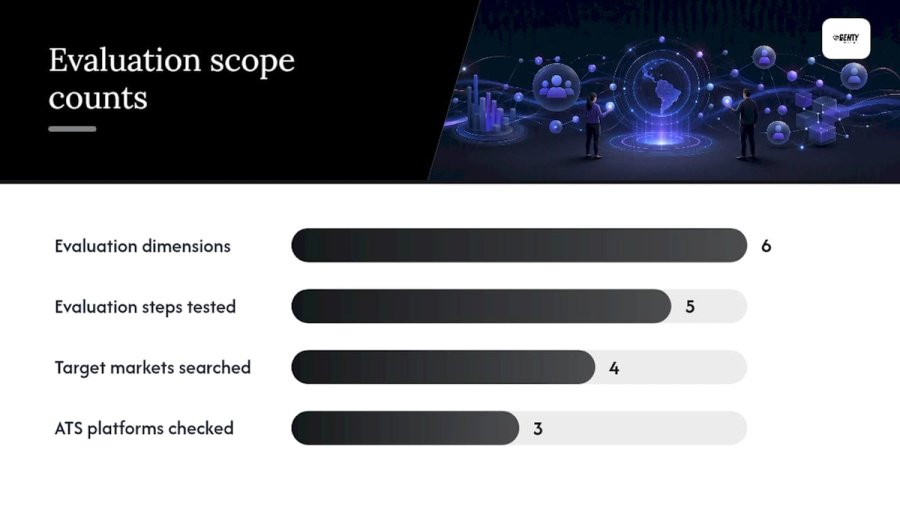
Score each vendor 1–5 on these six dimensions during your evaluation:
- LATAM profile coverage (Argentina, Brazil, Mexico, Colombia)
- ATS integration depth (native vs. workaround)
- Outreach automation quality (sequencing, deliverability, reply tracking)
- AI capability (search quality, enrichment accuracy, agent reliability)
- Compliance posture (consent model, GDPR/LGPD documentation)
- Pricing transparency (clear tiers vs. opaque enterprise quotes)
A vendor scoring below 3 on LATAM coverage or compliance posture should be disqualified regardless of their overall score, particularly for US companies hiring across multiple LATAM markets.
How tools were selected and evaluated for this guide
The evaluation prioritized six dimensions in this order: LATAM candidate coverage, AI agent and enrichment quality, outreach automation depth, ATS integration reliability, privacy and compliance posture, and pricing transparency. These priorities reflect the actual decision criteria of CTOs and VPs of Engineering at US tech companies building LATAM engineering teams in 2026.
The evaluation process followed this rubric:
- Hands-on trials and demo reviews for platforms offering trial access, with specific test searches run for backend engineers in Argentina, Brazil, Mexico, and Colombia.
- Documentation review covering data source disclosures, consent models, GDPR/LGPD compliance documentation, and ATS integration specs.
- Integration checks against the three most common ATS platforms in US tech companies: Greenhouse, Lever, and Workday.
- Sample outreach tests measuring profile reachability (valid email rate) for LATAM candidates in each of the four target markets.
- Vendor-published dataset claims reviewed and flagged as directional indicators rather than verified figures, consistent with the guidance from Procurement Magazine’s platform analysis.
This guide was last updated in 2026. Vendor features, pricing, and dataset claims change frequently. Treat all pricing signals as directional and verify current terms directly with each vendor before procurement. The evaluation reflects GENTY recruitment’s direct experience placing pre-vetted LATAM talent for US and European tech companies, reviewed by Eugene, Head of Talent Strategy at GENTY recruitment. Readers who want the raw trial checklist used in this evaluation can request it directly via the contact page.
Limitations: This guide does not include exhaustive internal performance benchmarks for every market or role type. Dataset size claims (e.g., “800M+ profiles”) are vendor-published and have not been independently verified at scale. Feature sets evolve rapidly in AI-native platforms; a capability listed here may have changed since evaluation.
When a sourcing tool is the right investment — and when to hire an agency
Tool-first works when you have in-house sourcers with LATAM market knowledge and a hiring velocity that justifies the annual platform cost. Agency-first works when speed-to-hire, shortlist quality, and regional market intelligence in Argentina, Brazil, Mexico, or Colombia matter more than tooling efficiency.
That distinction is sharper than most hiring leaders expect. A sourcing tool gives you access to profiles. An agency gives you a pre-qualified shortlist of candidates who have already been screened for English proficiency, technical fit, and timezone compatibility. For a CTO who needs a senior DevOps engineer in Buenos Aires within three weeks, the difference between those two outcomes is significant.
Internal sourcing vs. specialist agency: a practical comparison
LATAM salary planning ranges for 2026
These are planning ranges for budgeting purposes. Verify current figures with a salary benchmarking report before opening roles.
- Mid-level backend engineer, Argentina: $30,000–$55,000 USD/year
- Mid-level backend engineer, Brazil: $35,000–$60,000 USD/year
- Mid-level backend engineer, Mexico: $32,000–$58,000 USD/year
- Mid-level backend engineer, Colombia: $28,000–$50,000 USD/year
For context, a comparable mid-level backend engineer in the US typically commands $120,000–$160,000 USD/year. For a deeper breakdown by role and seniority, the IT recruiting guide covers salary benchmarking across LATAM markets in detail.
Timezone alignment as a hiring advantage
LATAM engineers in Argentina (UTC-3), Brazil (UTC-3), Mexico (UTC-6), and Colombia (UTC-5) overlap with US Eastern time by 4–8 hours and with US Pacific time by 2–5 hours. That overlap window covers the core of a US working day, which means daily standups, code reviews, and sprint planning run in real time without the async delays that plague offshore teams in Asia or Eastern Europe. For a staffing strategy built around remote tech hiring, that timezone alignment is one of the most operationally significant advantages LATAM offers.

When agency placements outperform a tool-centric approach
From GENTY recruitment’s experience placing engineers and technical leads across LATAM markets, agency delivery consistently outperforms tool-only sourcing in three scenarios:
- Senior and executive roles where the best candidates are not actively browsing job boards and require a warm, credible outreach from a recruiter with regional relationships.
- First LATAM hire where the internal team lacks the market knowledge to evaluate candidates accurately (English proficiency, local compensation norms, contractor vs. full-time classification).
- Tight timelines where a 3–6 week tool-based sourcing cycle is not acceptable and a 7-day shortlist is the actual requirement.
For teams running high-volume junior hiring at steady state, a tool like Gem or HireEZ combined with an AI talent sourcing workflow is the more cost-efficient path.
Pro Tip: Blend both approaches for hard-to-fill senior roles. Use a sourcing tool to build a warm list of 30–50 candidates who match the profile, then hand that list to an agency for final qualification, outreach, and shortlist curation. You get the coverage of a tool and the quality control of a specialist recruiter, without paying for a full retained search.
GENTY recruitment delivers pre-vetted LATAM shortlists in 7 days
For hiring teams that have evaluated the sourcing tools above and concluded that building an internal sourcing function is not the right move right now, GENTY recruitment offers a direct alternative. The model is straightforward: a fixed fee per hire, a curated shortlist of pre-vetted candidates within 7 days, and a 3-month replacement guarantee if the hire does not work out. No upfront payments, no retainer, no 12-month platform commitment.
GENTY recruitment specializes in IT and sales roles for US and European tech companies hiring across Argentina, Brazil, Mexico, Colombia, and Chile. Every candidate in a shortlist has been screened for technical fit, English proficiency, and timezone compatibility with US EST/PST working hours. The service covers software engineers, DevOps specialists, data engineers, and sales teams across FinTech, AI, SaaS, and Web3.
- Pre-vetted candidates screened for technical skills, English proficiency, and cultural fit
- Salary benchmarking support for Argentina, Brazil, Mexico, and Colombia included in the engagement
- Timezone-aligned scheduling: all candidates overlap with US EST/PST core hours
- Fixed-fee pricing by seniority level; no upfront payment required
- 3-month replacement guarantee on every placement
For teams that need a senior engineer or technical lead in LATAM without the 6–8 week sourcing cycle, GENTY recruitment’s IT recruitment service is the fastest path to a qualified shortlist. Schedule a discovery call to define the role brief and receive your first shortlist within 7 business days.
Sources
The following pages were used to build and verify this guide. Vendor product pages are listed here for direct reference; internal GENTY recruitment resources are linked in the relevant body sections above.