
Most advice on technical product manager vs product manager treats the technical role as a promotion, a product manager who learned to read a stack trace and got a better title. That framing wastes hiring budget. The split isn't seniority, it's scope. A product manager owns the customer problem and the roadmap that answers it: who buys, what they need, what ships first. A technical product manager applies the same discipline to a surface where the hard part is the technology itself, such as APIs, developer platforms, data systems, infrastructure or ML capabilities, usually for users who are engineers.
Both roles define outcomes, prioritize work and align teams around a launch. Companies pay for the difference in judgment, not the difference in vocabulary.
Titles won't settle this for you. The same job at three companies carries three different names, and the work decides which seat you need. Compare the product surface the hire will own, then match the candidate's demonstrated decisions to it.
Technical Product Manager vs Product Manager at a Glance
Read the table by column, not by row. The left column describes a role whose risk sits in the market. The right column describes a role whose risk sits in the system.
Need help hiring?
See the next step after this guide
If this topic is relevant to your team, these are the most useful pages to check next.
The right-hand column carries obligations the left column never has to meet. A technical product manager signs off on an API contract that forty internal services depend on, and the cost of getting versioning wrong lands months later as a migration nobody budgeted for. A product manager signs off on an onboarding flow that either converts or doesn't, and the feedback arrives within a week.
Use the table as a screening lens, not a job description. Ask one question about the role: is the primary user a developer, or does the main failure mode look like an outage, a breaking integration or a cost spike? If yes, you're hiring in the technical column and should screen accordingly. If the failure mode is a weak value proposition or a stalled launch, the general column applies.
Products that sit in both worlds need both readings of the role. Crypto and web3 teams hit this faster than most, because their users are often developers and their commercial surface is consumer-facing at the same time. If you're calibrating a technical hire for that kind of platform, these Web3 PM interview prep tips from Blockchain Jobs cover the questions that expose real judgment rather than buzzword fluency.
One caution before you write the requisition. The label on the offer letter matters less than the decisions you'll hand over in the first ninety days. Write those decisions down first, then pick the title.
Where Each Role Owns the Product

Ownership follows the decision that carries the most risk. In the general role, that decision is usually about the customer: which segment to serve, which problem to solve first, which launch message lands. In the technical role, the same discovery cycle continues into architecture, integrations, scalability, reliability, latency, security and technical debt, and the person holding it still has to defend user value and business impact while doing so.
The Coursera guide to the technical product manager role puts the boundary where most experienced hiring managers put it: the two roles overlap heavily because both define outcomes, prioritize work and align cross-functional teams, but the technical product manager's customer is often technical, and success is measured through developer adoption, system performance, cost or integration speed rather than conversion alone. Product management as a whole is an integrative function that links technical, design and business perspectives, and a Springer chapter on agile product management counts vision creation, lifecycle management, roadmapping, release planning and requirements engineering among its core recurring activities. The technical variant doesn't escape that list. It deepens it.
Two decisions make the difference concrete.
Consumer onboarding. A product manager at a subscription app decides which onboarding flow to build, tests a three-step version against a five-step version, and reads the activation curve. The technical question (which component renders the screen) belongs to engineering.
Public API versioning. A technical product manager decides whether a public endpoint gets a versioned contract before a partner integration ships. That's a product decision with a commercial consequence: version now and slow the integration by two weeks, or skip it and carry a breaking change later. Nobody in marketing can make that call.
Titles aren't standardized, so hire against the surface. A SaaS product manager search looks different from a platform search even when both briefs say "own the roadmap", and our SaaS product manager hiring track starts by naming that surface before any candidate is screened.
Metrics That Separate Each Role's Success
The scorecard settles arguments that the job description can't. A general product manager tracks customer and business indicators: activation, conversion, retention, engagement, revenue, satisfaction and adoption of what shipped. A technical product manager connects those same outcomes to platform indicators, including uptime, latency, error rate, infrastructure cost per transaction, API reliability, deployment frequency, change-failure risk, time to restore service, technical-debt reduction and instrumentation coverage, as laid out in this technical product manager role breakdown.
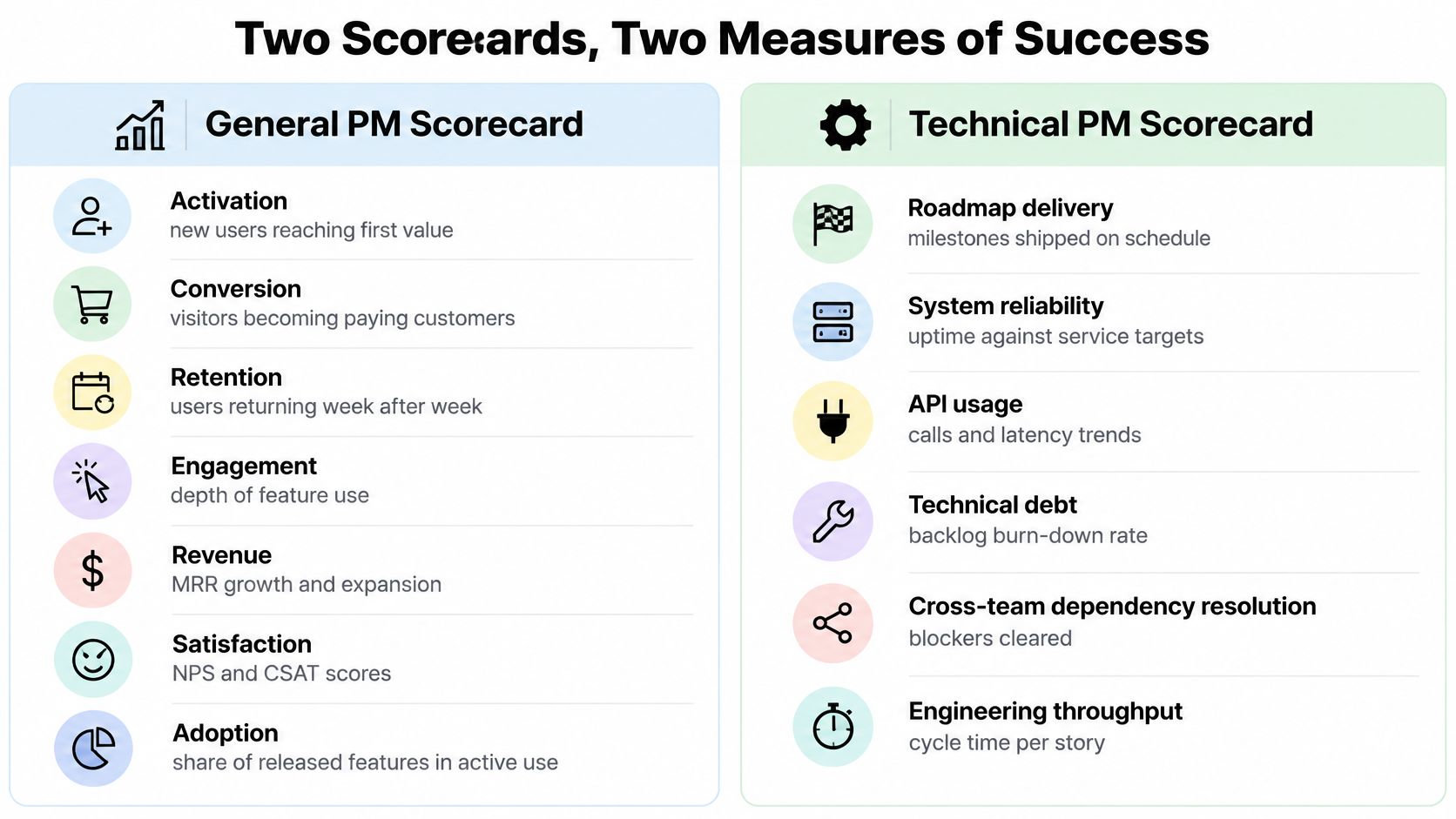
One feature, two scorecards
Take a payments API and write the requirement twice.
The product manager's version reads like a business case: checkout completion rate, revenue per session, drop-off at the card step, and a target for how many merchants adopt the endpoint in two quarters. Perfectly sound, and completely insufficient for the team building it.
The technical product manager's version keeps the adoption target and adds acceptance criteria the engineers can test: p95 response time, error-budget consumption, idempotency behavior on retries, the monitoring alerts that fire before customers notice, and recovery objectives if the endpoint degrades. Same feature, same company, two different definitions of done.
Practical rule: if a requirement can't fail a technical test, it isn't ready for a platform team.
Without the second scorecard, a feature can post strong adoption while degrading reliability and operating cost. Nobody notices until the invoice or the incident review.
The case to run in the interview
Give every candidate the same test. Present a scenario where they must choose between shipping a feature on the roadmap and funding a reliability investment, then ask them to name the leading and lagging metrics for both paths and explain the trade-off once to an executive and once to an engineering lead.
You'll learn three things at once: how they reason about risk, whether their metrics are real or borrowed, and whether they can translate between the two audiences. For a shared goal structure you can hand the candidate and the hiring panel, these goal setting frameworks work for both scorecards.
Technical Fluency Every PM Needs Now
Every product manager now owns a slice of technical risk. Staffing one specialist and leaving the rest of the team non-technical fails, because the hard questions land in roadmaps, pricing, and support tickets, not only in architecture reviews.
The 2026 Product Focus industry survey report reports that 69% of product professionals use AI frequently, up from 49% the prior year, and that 85% use their expertise to validate AI output. If most of the function is already checking model output, data fluency, evaluation, and failure modes belong on the general PM bar.
Product management began as a market-facing business discipline and now has to join commercial strategy to engineering execution. Technical product management grew because products depend on APIs, distributed systems, cloud infrastructure, and data platforms, as this ServiceNow product management explainer describes. The specialist seat does not replace the general role. It carries the layer a generalist should not hold alone: system design choices, implementation-ready requirements, and standards that keep the product operable.
Put a model inside the workflow and every PM has to reason about evaluation, failure modes, data quality, privacy, latency, cost, and human oversight. You cannot hand those calls to the colleague who "does the technical parts."
Screen the layers separately. Foundational fluency is a pass or fail for any PM you hire this year. Specialist depth is a decision about where technical risk sits. A platform, a data path, or a model on the critical path calls for a technical product manager. Vocabulary and dashboard literacy can be taught after the offer. Judgment on trade-offs, precise requirements, and how someone works with engineers cannot, so those stay in the interview.
A Western Governors University career guide to the technical product manager role lists that specialist craft plainly: translating ideas into actionable technical requirements, writing detailed specifications, working with QA, enforcing technical standards, defining product-success criteria, and troubleshooting technical challenges alongside engineers. A general product manager may cover some of this in a small startup. On a technical product, that list is the job.
Screen for demonstrated technical judgment and collaboration, not for an engineering degree. A product manager without a coding background can clear a fluency bar if you write the bar as the first row of that table. When the specialist row is the open seat, our technical product manager hiring track screens on that judgment rather than on job titles.
Team Contexts That Favor Each Role
Stop asking which title is more senior. Ask where the role's decision risk sits. That reframing, argued in this EICTA knowledge hub guide to the technical product manager, is the only one that produces a defensible hiring decision, because both roles can own discovery, prioritization and outcomes.
When risk sits in customer discovery, commercial strategy or go-to-market, a generalist wins. When it sits in platform reliability, architecture or vendor choices, the technical role earns its premium. IBM's overview of product management makes the same point from a different angle: the technical variant runs the same outcome cycle but carries explicit responsibility for technical constraints and implementation risk, and companies should compare candidates against the product surface rather than the label.
Remote and nearshore hiring exposes the weak signal fastest. A CV that says "Technical Product Manager" tells you nothing about whether the candidate has ever made a versioning call under commercial pressure. That's why LATAM talent pools work well for either seat when you screen on demonstrated judgment rather than title: the interview case does the filtering, and geography stops being the proxy for capability.
Scale-ups past Series B usually need both roles, not a compromise hire. Let the technical product manager own the platform decisions and the product manager own the customer outcomes, then write down which one breaks a tie when the two conflict.
Interview Checklist for Each Role
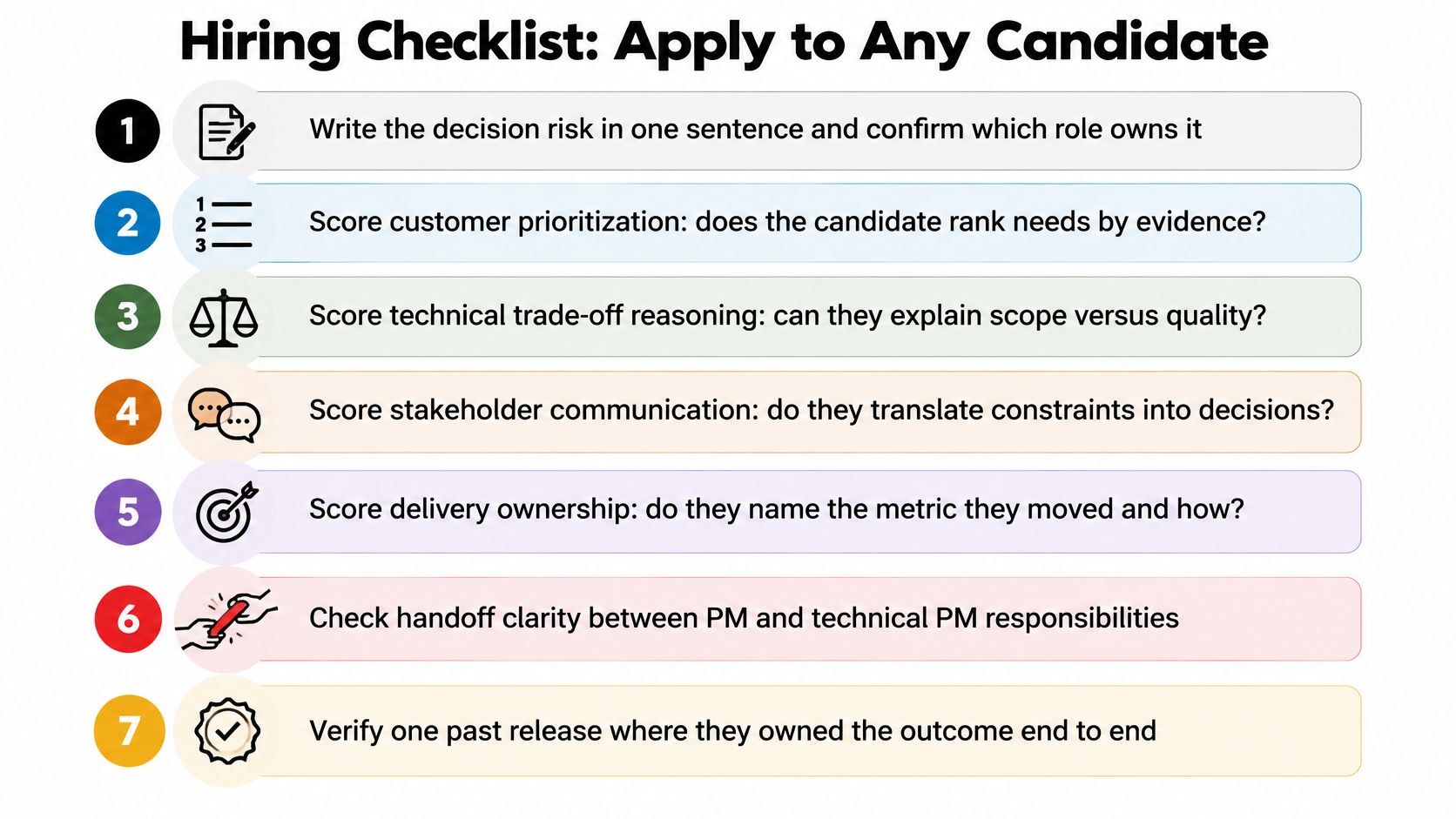
Run these seven steps against any candidate, and record scores before the debrief so one loud interviewer can't rewrite the outcome.
Name the decision risk in one sentence. Write it into the panel brief. If nobody can say which decisions the hire owns, no interview will tell you whether they can own them.
Score customer prioritization, PM candidates. Use a case that forces a choice between two features with limited engineering capacity, and see whether they rank by evidence or by enthusiasm.
Score technical trade-off reasoning, TPM candidates. Brief the case with scope against reliability, and put p95 latency, error budget and recovery objectives in the room.
Test systems thinking, both roles. Ask how a data-quality failure or an API version change would hit users, support and downstream teams.
Test translation. Have them explain the same trade-off to a fictional CFO, then to an engineering lead, and watch what changes.
Check foundational fluency. Metrics, API contracts, and AI risks such as evaluation gaps and privacy exposure. Every PM should hold this, not just the technical one.
Ask for one launch where they defined both leading and lagging metrics. A candidate who only names the lagging ones watched the launch rather than ran it.</li>
A candidate with no engineering background can clear steps four through seven and still be the right hire. The reverse is also true, and more common than teams expect.
If your team has no recruiting specialist to build and calibrate this scorecard, that's the gap our IT recruitment service fills, and we assign each role a dedicated consultant matched to it, with IT or Sales expertise. Our product manager interview question bank gives the panel a starting set to adapt.
Write the Role Brief Before You Post
Five actions, in this order, produce a brief you can screen against.
Name the surface. Customer features, a public API, a data platform, infrastructure or shared services. One phrase, written at the top.
Pick the role from the context table. Carry the decision risk into the interview case rather than leaving it in the job description.
State the trade-off. Describe the specific tension the hire will face in their first six months, such as scope against reliability, and attach the case you'll use to test it.
Split the skill list. Separate the foundational fluency every PM must bring from the specialist depth only the technical hire needs.
Run the intake properly. Every search we run starts with a detailed intake session covering tech stack, seniority, team structure, culture, working style, timezone requirements, LATAM compensation benchmarks, success criteria and interview process design.</li>
For Series A to C teams hiring across time zones, LATAM candidates fill either seat without changing the bar, provided the brief describes the decisions instead of the title.
The first action this week, before any job post goes live: write the product surface and the decision risk in a single sentence. If that sentence names an outage or a breaking integration, you're hiring a technical product manager. If it names a buyer or a launch, you're not.
Our product manager recruitment service covers the full search from intake to offer.
GENTY recruitment places product managers and technical product managers across Latin America, and we screen both seats on the decisions the role owns. Every search starts with a detailed intake on your tech stack, seniority, team structure and success criteria, and each role gets a dedicated consultant matched to it. If you're hiring for a platform, API or data product and want a shortlist built on demonstrated judgment rather than job titles, visit GENTY recruitment and tell us what the hire needs to decide.