

A recruiter runs a repeatable hiring pipeline for open roles, while a headhunter proactively approaches passive candidates who aren't applying, usually for scarce, senior or confidential hires. Default to contingent recruiting at 20–25% of candidate compensation for repeatable hiring, and retained search at 30–35% for assignments that require dedicated market research and discretion.
The popular advice, use recruiters for applicants and headhunters for passive talent, is too simplistic for a Series A–C technology company. A capable technical recruiter also does outbound sourcing. The real buying decision is who owns the quality signal between outreach and your first interview, and whether you're purchasing additional hiring capacity or a dedicated advisory search.
Recruiter vs Headhunter at a Glance
The U.S. Bureau of Labor Statistics defines recruitment specialists, also called recruiters or talent acquisition specialists, as professionals who find, screen and interview applicants for organizational openings. Recruiter is the broader functional category, not shorthand for someone who only processes applications.
Headhunter describes a more targeted mandate: identify specific people, approach them directly and persuade them to consider an opportunity. That distinction matters when your ideal candidate isn't browsing job boards.
Need help hiring?
See the next step after this guide
If this topic is relevant to your team, these are the most useful pages to check next.
Recruiter vs headhunter at a glance
The difference is the mandate, not the job title.
Use these distinctions to evaluate the work you're buying, not to rank practitioners. An internal recruiter can run excellent targeted outreach. An external headhunter can still submit weak candidates if nobody has defined what qualified means.
Run the one-minute test
Write the role title and its nonnegotiable requirements, then ask whether qualified people are already applying. If they are, a recruiter's pipeline fits. If they aren't, the assignment needs a headhunter's outbound approach, whether a specialist recruiter or retained search firm delivers it.
Don't confuse a weak applicant pool with an impossible search. First check whether your requirements describe a coherent job and your compensation matches the responsibility.
Who Sources and Who Screens Before Interview
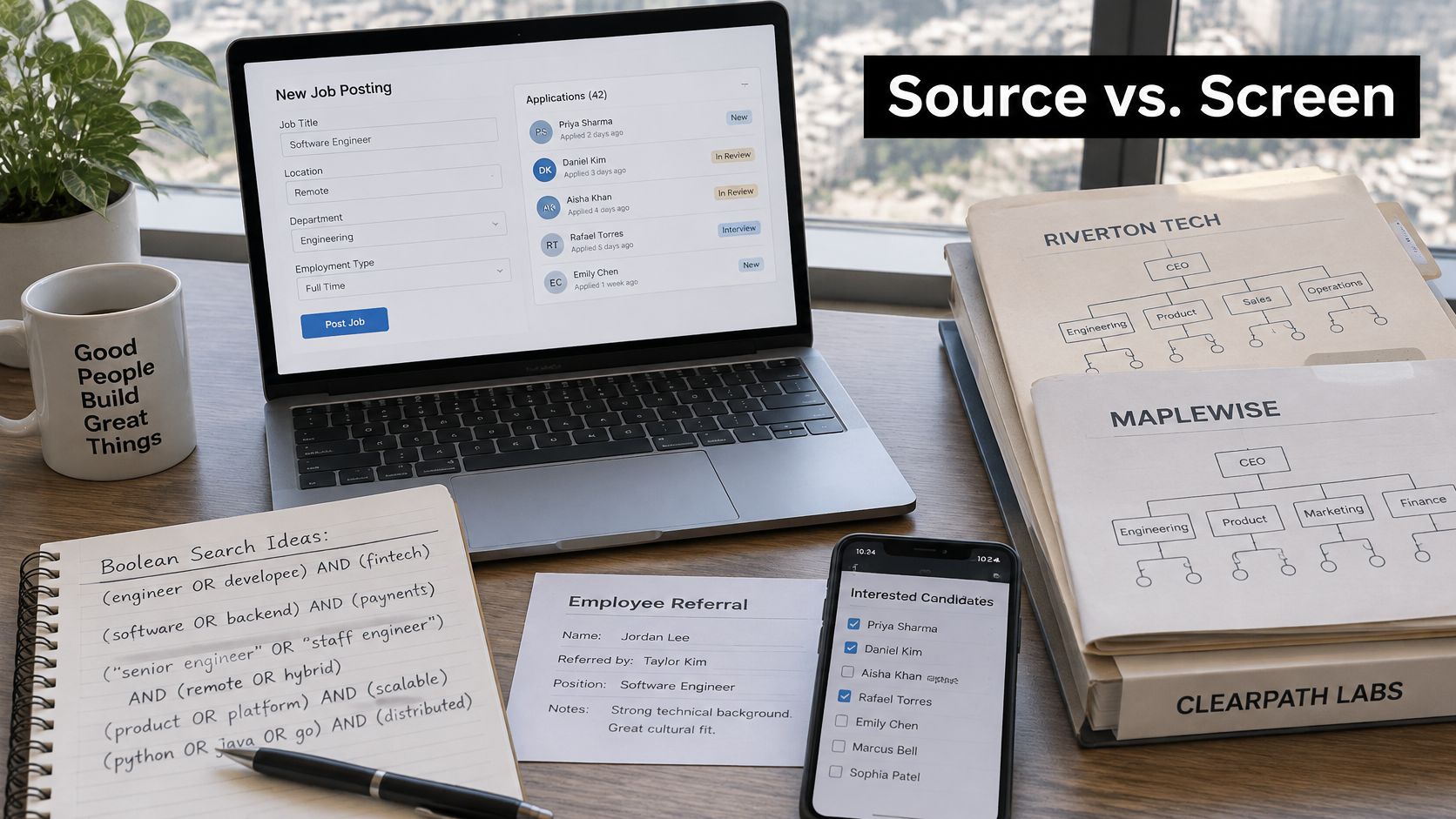
A recruiter typically combines job-board postings, referrals, Boolean searches and outreach to people who've already shown interest. A headhunter starts with target employers and named individuals, then builds an approach around why those people might move.
Both workflows need organized records, not disconnected résumés and messages.
Separate sourcing from forwarding applicants
The Equal Employment Opportunity Commission's employment-agency guidance includes procuring prospective applicants even when no interview or offer follows. That's a useful operational distinction: finding and engaging prospective candidates is different from forwarding applications received through your careers page.
For a DevOps, security or data search, request an anonymized outreach funnel from a comparable assignment. Examine target employers, people contacted, replies, qualified conversations and eventual hires. Contacts per hire and response share help you distinguish genuine market access from a large, stale database.
Our candidate sourcing guide for hiring teams helps separate identification, engagement and qualification. For evaluating outreach discipline, DMpro's lead generation strategies for recruiters is a supplementary resource. Use outreach tactics to improve relevant conversations, not to justify sending more messages to poorly matched engineers.
Make the screening owner explicit
The quality signal sits between outreach and the first interview. Your engineering team shouldn't have to discover that a submitted infrastructure candidate has never owned production incidents, can't meet the working-hour requirements or expects compensation outside the approved range.
A recruiter should document technical depth, working-language proficiency, availability and motivation against an agreed scorecard. For a leadership assignment, the headhunter should calibrate the mandate before sourcing: team scope, decision rights, organizational changes and evidence of comparable leadership outcomes.
At GENTY recruitment, our recruiters check technical depth, English and availability before an offer is made. Final hiring decisions remain with the client. Set the required screening gates explicitly in your engagement rather than assuming that pre-vetted means engineering-approved.
Use the same ownership lens when evaluating recruitment workflows.
Candidate communication belongs in that scorecard too. Across more than 2.5 million hiring experiences, Starred's candidate-experience benchmark found candidate Net Promoter Scores of +43 for direct recruiter interaction, compared with +20 for job-posting sites. Human contact is useful, but only when someone explains the role accurately and maintains expectations.
A shortlist isn't qualified because someone attached résumés. It's qualified when the recruiter can explain the evidence behind each recommendation.
Give specific rejection feedback. Write that the candidate described maintaining Terraform modules but couldn't explain state recovery, rather than saying the candidate wasn't technical enough. That lets the sourcing partner adjust the search instead of guessing what your interviewer disliked.
Close your partner evaluation with these questions:
Screening gates: Which screening steps happen before a candidate reaches our team?
Approval owner: Who approves the shortlist?
Outreach efficiency: How many outreach contacts produced each qualified candidate?</li>
Which Roles Suit Each Model
Choose the model against the hiring situation, not the seniority implied by a title. A specialist individual contributor may require more market research than a familiar management role.
Which model fits which hiring situation
Buy advisory capacity only when you need it
SHRM's comparison of recruiting models describes retained search as an exclusive extension of internal talent acquisition, with stakeholder involvement before sourcing. It positions contingency recruiting for fast turnaround and earlier-career hiring, rather than intensive leadership advisory work.
For a VP Engineering appointment, agree whether the business needs an architecture leader, a manager of managers or an executive who can reorganize delivery. Those aren't interchangeable profiles. Our Executive Search service includes confidential and targeted headhunting, leadership and culture-fit assessment, and board-ready candidate shortlists; the remote leadership search walkthrough provides process context.
The founder's first engineering hire needs similar discipline, even without an executive title. Don't source a founding engineer while expecting the person to function as an experienced CTO, hands-on developer and recruiting department.
Keep repeatable selection repeatable
For standardized roles, use a shared scorecard and a job-relevant exercise. Tools such as Form Timer's timed hiring assessments in Google Forms can support a bounded assessment, but speed shouldn't substitute for evaluating reasoning. Set reasonable accommodations and avoid exercises that resemble unpaid production work.
Default rule: if the job description is ready to post and the market is understood, use a recruiter. If the mandate still needs definition or the market requires mapping, buy a headhunter's advisory search.
What Each Model Costs and How Long It Takes
Fees, payment timing and time to offer by model
SHRM's recruitment pricing overview gives contingent fees of 20–25% and retained fees of 30–35%, with retained payments divided into thirds. Under that structure, the employer commits two-thirds of the fee before a hire.
The Articuler benchmark compilation places the broad hiring baseline near 42 days and retained searches around 90–120 days to offer. As a cross-check, Employ's 2024 Recruiter Nation findings reported average time to fill of 41 days in 2024, down from 48 days in 2023. Time to fill, time to offer and time to shortlist aren't interchangeable measures.
Compare total cost, not just the invoice
Our fixed-fee IT placements start at $2,999 per hire, with no upfront payment and curated shortlists within 7 days. Executive Search is custom priced, and timing remains unknown until scoped in the quote. Our recruitment agency fee guide provides additional commercial context.
For a Series A–C budget, retained installments require earlier cash commitment and potentially procurement approval. Pay-on-result recruitment shifts more search-payment risk to the provider, but doesn't eliminate your vacancy cost or interview workload.
Budget rule: Compare the fee plus vacancy days multiplied by the daily cost of the open role, plus interview hours multiplied by internal hourly cost.
Then assess replacement exposure and the likelihood of an accepted offer. A lower invoice isn't a saving if your engineering managers repeatedly interview unsuitable candidates.
Use Cases From Scale-Up Tech Hiring
A Series B CTO needs five DevOps engineers this quarter
Say a CTO has approved infrastructure headcount, a consistent stack and a clear on-call model. A contingent or fixed-fee recruiter is the default because the team needs parallel execution against a repeatable profile, not a leadership-market study.
Nearshore hiring in Latin America can support overlap with US working hours, provided English proficiency and actual availability are verified individually. Agree on infrastructure ownership, incident response and deployment responsibilities before candidates enter interviews. Our guide to how recruiters support tech-startup growth connects hiring execution with expansion planning.
A Series C company must replace its Head of Engineering
Consider an incumbent replacement that can't become public before the transition is agreed. Use a retained headhunter, with restricted stakeholder access, a defined disclosure sequence and confidential outreach.
The partner should establish why the current structure isn't working before copying the incumbent's job description. Our Executive Search includes market mapping, competitor analysis, confidential targeted headhunting, leadership and culture-fit assessment, and board-ready shortlists. Those deliverables fit an organizational decision, not merely a vacancy.
A sales leader is building an eight-person SDR team
For a hypothetical SDR expansion, use a recruiter or fixed-fee partner and assess each candidate against the same prospecting and qualification criteria. Test a sample account-research task, objection handling and written outreach rather than relying on interview confidence.
Specify territory, working hours, quota assumptions and variable compensation before sourcing. Otherwise, recruiters will bring candidates who accept the title but reject the actual operating conditions.
Compensation can overturn the sourcing plan
In global salary-planning research collected during August–September 2025, only 45% of organizations displayed pay ranges on every job advertisement, according to SHRM's Talent Trends coverage. Don't copy that opacity into your search.
Assign an owner to benchmark pay by country, role and remote arrangement, and share the range before interviews. Our custom Salary Benchmarking service provides country- and role-specific salary data, percentile-based compensation bands and a report. Confirm currency, benefits and contractor-versus-employee status too: a headhunter can reach candidates, but can't make an underpriced role competitive.
Choose the Right Model Before You Brief a Firm
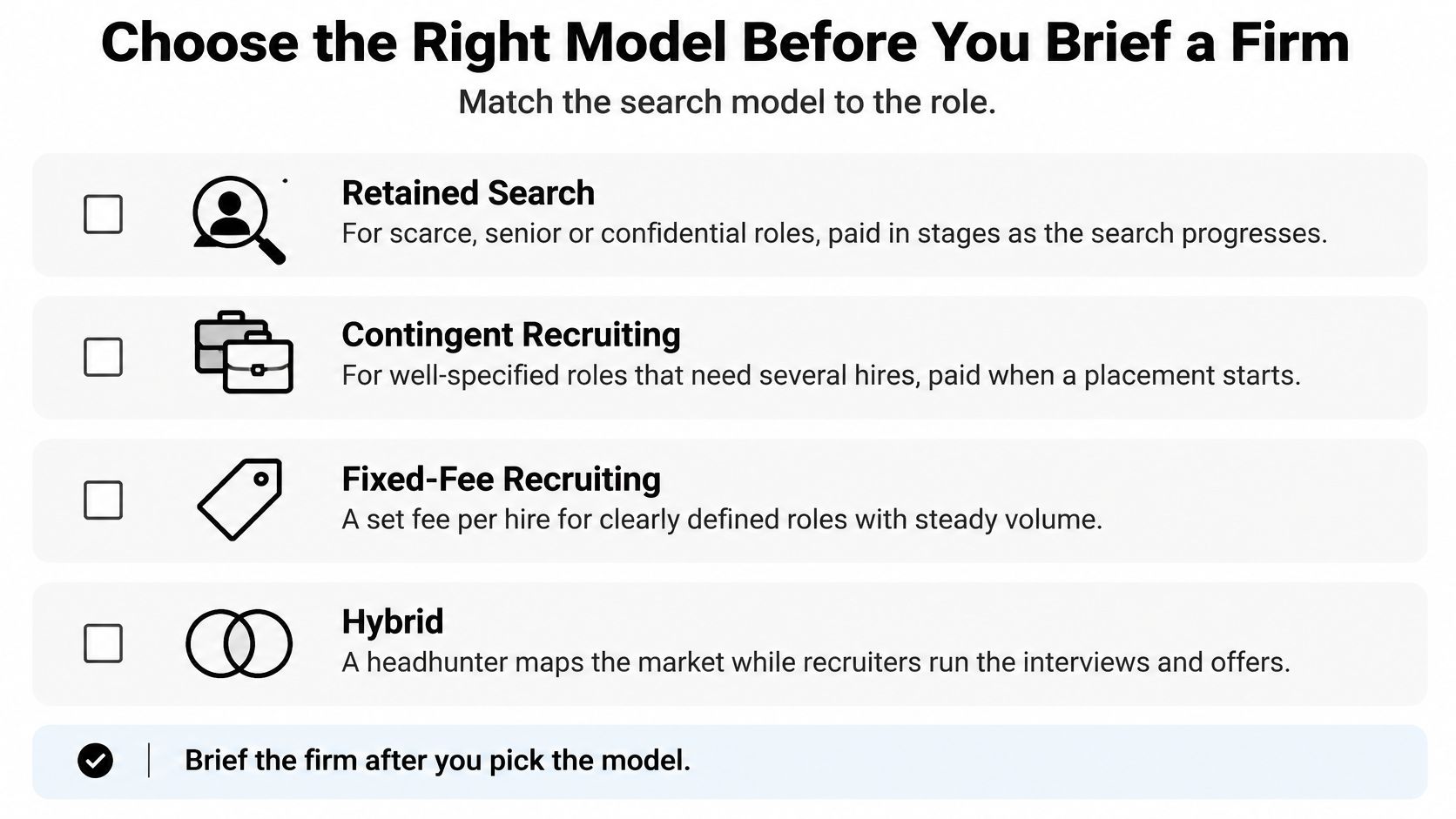
Choose retained search for scarce, senior or confidential assignments, and contingent or fixed-fee recruiting for well-specified roles requiring several hires. Use a hybrid when a headhunter must define the profile before a recruiter executes the pipeline.
Make the engagement choice before commissioning candidate introductions.
Put the operating agreement in writing
Write the mandate. Decide whether the partner is filling a defined vacancy or mapping an uncertain market.
Calculate expected cost. Include vacancy days, internal interview hours and replacement exposure, not just the placement fee.
Require source-level metrics. Track qualified-candidate yield, submission-to-interview conversion, interview-to-offer conversion, offer acceptance, time to first qualified slate, 90-day retention and cost per hire; the Washington recruitment process study supports measuring recruitment outcomes and costs by applicant source.
Assign compensation ownership. Establish who calibrates ranges and when candidates receive them.
Confirm decision rights and replacement terms. Keep hiring authority explicit and document what happens if the placement doesn't work out.
Record fees and exclusivity. Specify payment triggers, candidate ownership and the scope of any exclusive mandate.</li>
Our Recruitment service assigns a dedicated recruiter. The standard placement fee covers sourcing across LATAM, English evaluation, motivation and culture-fit screening, hard and soft skills testing, interview-ready shortlists and a 3-month replacement guarantee.
If you need an entire hiring function rather than individual placements, distinguish recruitment outsourcing from agency introductions. Our IT recruitment and RPO services address different levels of execution ownership.
Send the same role brief to two potential partners, then compare their proposed screening evidence, reporting and commercial terms. Choose the engagement model before authorizing the search, and assess the selected partner's first slate against the agreed metrics.
GENTY recruitment offers fixed-fee recruitment with a dedicated recruiter, RPO for end-to-end hiring management, and Executive Search for confidential leadership assignments. Visit GENTY recruitment with your role brief, approved compensation range and hiring deadline to discuss which model fits your team's needs.