
Voluntary turnover typically costs 0.5x to 2x of annual salary per departure, and roughly three-quarters of recent exits are preventable. The biggest lever in turnover reduction comes from fixing manager quality, onboarding, and root-cause diagnosis, not from adding perks.
That changes the operating question for a Series A to C technology company. You shouldn't ask, “Which benefit will make people stay?” Ask, “Where are people leaving, what failed before they left, and which manager, hiring, or work-design decision created the conditions for that exit?”
The answer belongs in the operating plan, not just the HR plan. A 2015 review of 30 case studies found a typical median replacement cost of 21% of annual salary, with estimates ranging from 5.8% to 213% depending on role and skill level, according to the Center for American Progress turnover-cost review. For a senior engineer, the financial damage includes recruiting, lost context, delayed delivery, manager time, and the productivity gap while a replacement ramps.
The practical playbook has five moves: diagnose where churn concentrates, improve hiring quality, harden the first 90 days, choose the right retention lever, and review the signals quarterly. Perks come later, if they belong at all.
Planning a hire?
Talk through the best hiring option
This article usually leads to one practical question: should you use staffing or salary guide? We can help you choose quickly.
Simple next step
Start with staffing and we will help you pick the best hiring setup.
Why Turnover Reduction Is Mostly a Management Problem
Turnover becomes expensive long before someone submits a resignation. A team loses delivery capacity, interrupts roadmap work, redistributes ownership, and asks existing employees to absorb uncertainty. The replacement bill can reach 0.5x to 2x an employee's annual salary, according to Cogn-iQ's summary of turnover research. That range is wide because a departure's cost depends on the role, scarcity of the skills, replacement process, and time to productivity.
The preventability figure is more important than the price tag. Work Institute's 2025 Retention Report found that 75% of 2025 departures were preventable, while its prior analysis attributed 63% of 2024 exits to career stagnation, work-life balance issues, and management failures, as reported in the 2025 Retention Report. Those findings point toward operating conditions, not office snacks.
Practical rule: If your retention response starts with a perk before you identify the highest-exit manager, tenure band, and role family, you're spending before diagnosing.
A technically strong employee can tolerate a demanding quarter when priorities are clear, feedback is direct, and the manager removes obstacles. The same employee may leave a generous employer if the role was misrepresented, onboarding was chaotic, or every decision requires political navigation. The guide to managing remote teams is useful here because distributed management makes ambiguity visible faster. Remote teams need explicit ownership, communication norms, and reliable manager routines.
The sequence matters:
Diagnose the loss. Segment exits by role, tenure, manager, team, and reason.
Raise hiring quality. Stop adding people who are technically capable but poorly matched to the role or manager.
Protect early tenure. Define what good onboarding looks like and measure whether new hires reach useful contribution.
Choose the lever. Use pay, career paths, flexibility, or engagement programs only after locating the actual failure mode.
Review quarterly. Give every metric an owner, threshold, and intervention.</li>
A manager who creates unclear priorities or weak feedback can undo a carefully designed compensation package. Turnover reduction starts by fixing that management system.
Diagnose Where Turnover Actually Hurts
A company-wide turnover percentage is a blunt instrument. It can look acceptable while one engineering manager loses three critical people, or while junior hires leave before they complete onboarding. Start with three axes: job family, tenure band, and team or manager.
Segment the exits before choosing an intervention
Separate voluntary and involuntary turnover. Voluntary turnover includes resignations and other employee-initiated departures. Involuntary turnover includes dismissals, layoffs, and role eliminations. Combining them makes a compensation problem look like a performance problem, or a management problem look like a labor-market issue.
Then cut the data in practical slices:
Job family: Engineering, product, customer success, sales, support, and operations have different labor markets and replacement costs.
Tenure band: Use 0 to 6 months, 6 to 18 months, and 18 months or more to expose onboarding, role-fit, and career-growth patterns.
Manager and team: Compare teams with similar roles and workloads. A spike concentrated under one manager deserves a management intervention before a pay adjustment.
Criticality: Weight each exit by delivery risk, system ownership, hiring difficulty, and knowledge concentration.</li>
Don't use unsupported precision to make a dashboard look scientific. A senior backend engineer may cost materially more to replace than a junior support hire because the recruiting market, project dependency, and ramp requirements differ. Build that logic into your cost model rather than assigning a universal replacement multiplier.
The feature engineering for churn models resource can help analytics teams decide which tenure, team, manager, and engagement variables belong in a diagnostic model. A model should prioritize investigation, not label employees as certain flight risks.
Use benchmarks as prompts, not verdicts
Historical benchmarking from SHRM emphasizes consistent turnover definitions, segmentation, and external comparison. A government benchmarking study cited in turnover analysis guidance reported monthly benchmark rates of 0.8% for large departments, 1.9% for medium departments, and 2.6% for small departments. Those figures are useful context, but they don't replace an internal baseline.
Don't fill this table with invented industry targets. Your healthy range is the level that supports delivery, preserves critical knowledge, and remains explainable after segmentation. For planning discipline, use headcount forecasting to connect expected departures, replacement lead time, and delivery commitments.
The most useful rule is simple: the team with the worst manager usually owns the exit spike, not the team with the worst compensation band. Test that assumption with segmented data before approving a company-wide retention program.
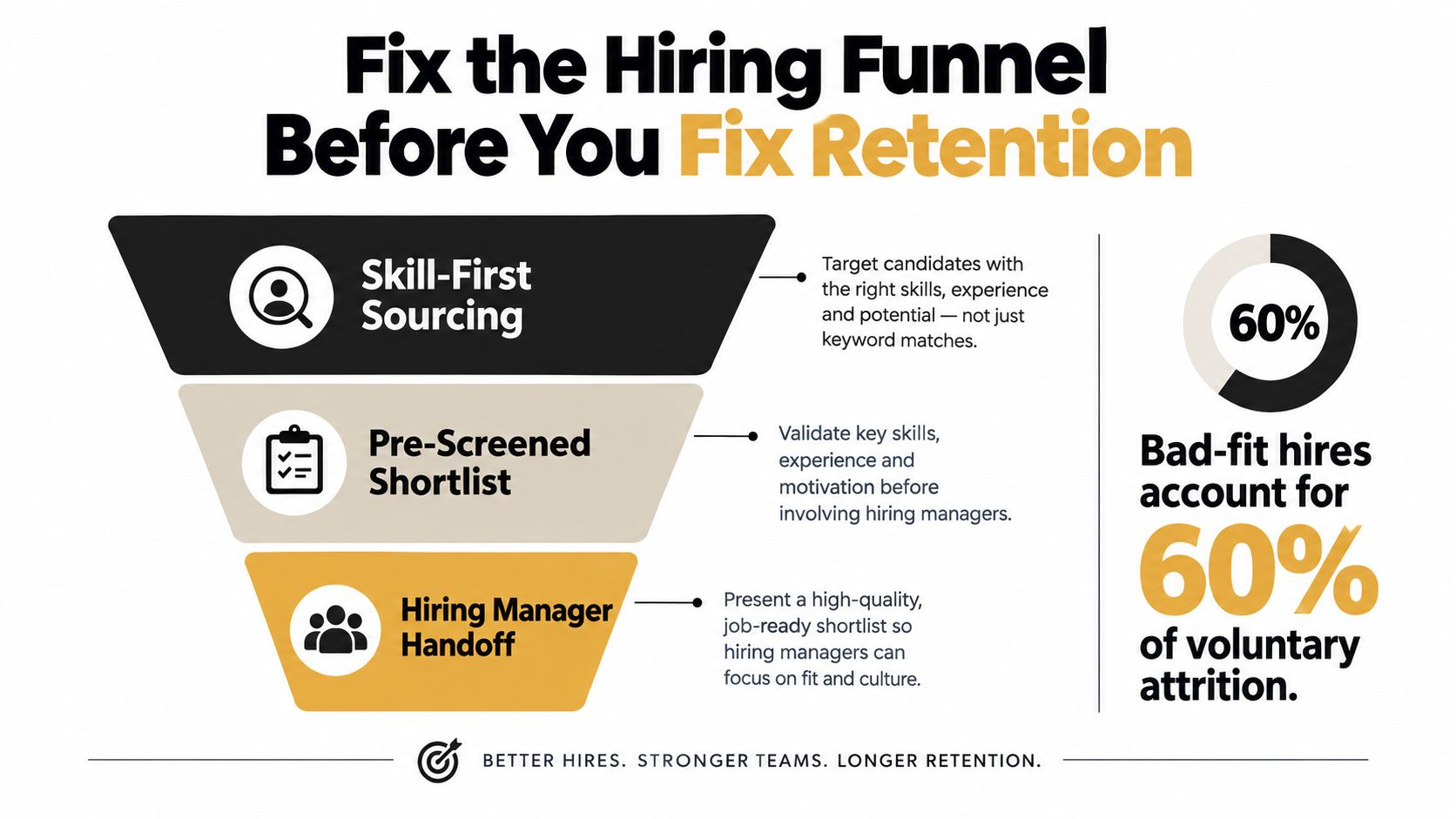
Fix the Hiring Funnel Before You Fix Retention
Bad-fit hiring creates retention work that no engagement program can repair. If a role scorecard says “build scalable services,” but the actual job is mostly incident response and stakeholder negotiation, the candidate may accept the offer, perform well in interviews, and still leave once the truth becomes clear.
Replace résumé matching with evidence
Start with a role scorecard that names the outcomes, technical constraints, collaboration expectations, and essential skills. A scorecard for a DevOps engineer should distinguish infrastructure ownership, incident judgment, cloud experience, and communication under pressure. A keyword match doesn't establish any of those things.
Make three changes:
Write the role around outcomes. State what the person must own and how the team will recognize progress.
Add a short work sample. Use a realistic, paid or tightly scoped 30-minute technical exercise before the full interview loop. Evaluate reasoning, trade-offs, and communication, not trivia.
Limit manager interviews. Use two structured scorecard sessions at most, with separate interviewers assigned to specific competencies.</li>
This approach gives the hiring manager fewer but better decisions. It also exposes a role mismatch before the offer, when changing the process costs less than replacing the hire.
For US-based teams, LATAM nearshore hiring can widen the pool for senior engineering roles in Brazil, Mexico, Colombia, and Argentina while preserving meaningful timezone overlap. GENTY recruitment describes transparent fixed-fee recruitment, pre-vetted technical and cultural assessments, and candidate pools that can often arrive within three to seven days, according to the publisher information. Treat any cost comparison as a role-specific benchmark, not an automatic saving. A credible structured hiring guide for startups can help your team formalize the handoff.
The point isn't to outsource judgment. It's to make the hiring manager judge evidence against a stable standard.
The retention strategies for HR leaders resource is a useful companion when you connect hiring decisions to the employee experience that follows. Candidates need an accurate view of management style, workload, growth expectations, and flexibility before they accept.
Cut Early-Tenure Exits With Manager Quality
The first 90 days should be treated as a delivery system, not a welcome ceremony. New hires need context, a credible first assignment, access to decision-makers, and a manager who notices confusion before it becomes disengagement.
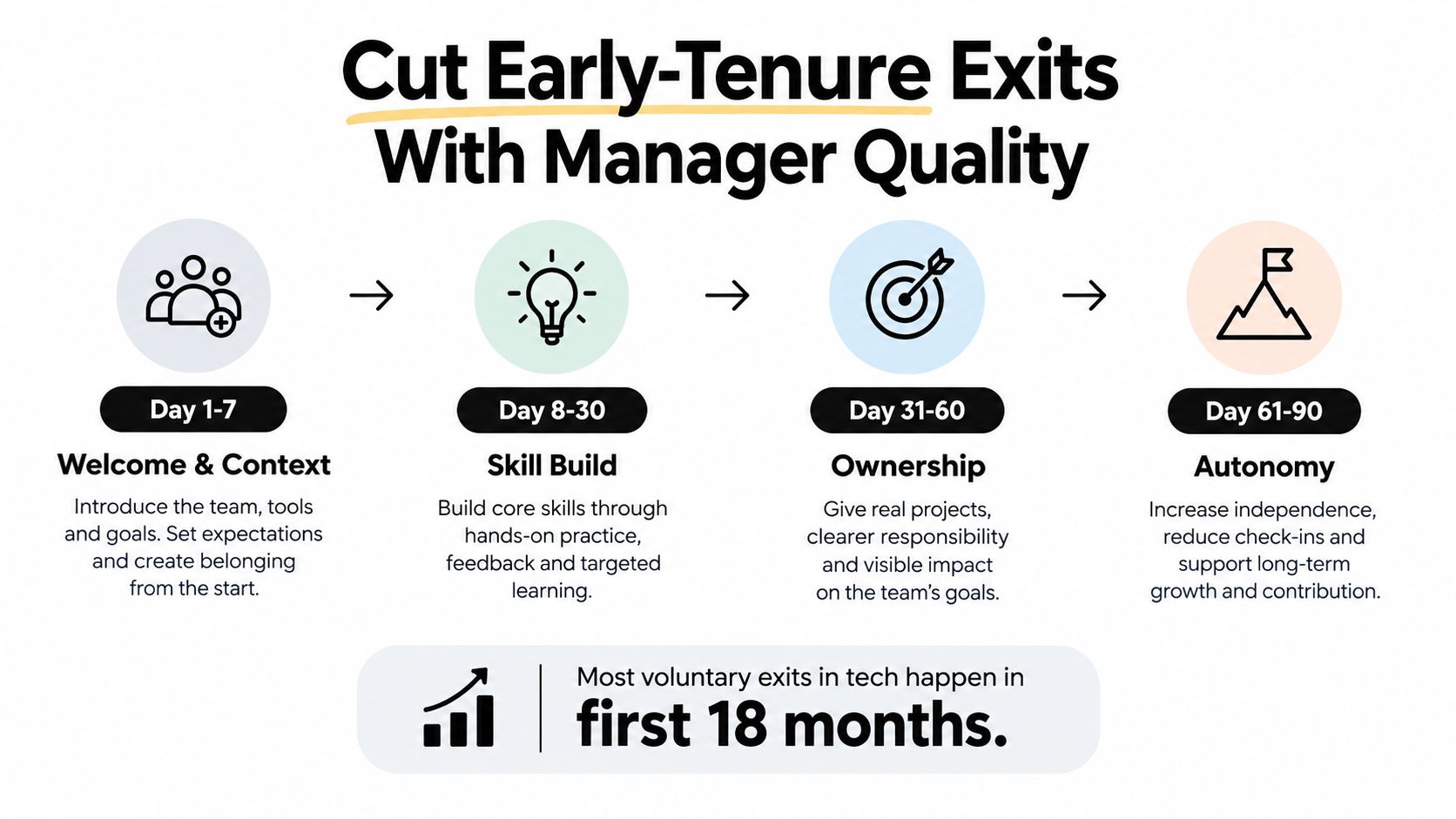
Use a written plan that the manager and new hire sign during the first week. It should define the first meaningful deliverable, required relationships, documentation to read, and decisions the person can make independently. Hold weekly one-to-ones for the first six weeks, then move to biweekly only when the relationship and workload support it.
Make onboarding measurable
Assign a buddy who can answer practical questions without turning the manager into the only source of context. Run pulse surveys at day 30 and day 90, and attach each survey to an action trigger. If a new hire reports unclear priorities, the manager must rewrite the near-term plan. If access or dependency issues recur, the engineering leader owns the fix.
Track outcomes that show whether onboarding works:
90-day survival rate: Did the person remain through the initial operating window?
Time to first pull request: How quickly did the engineer contribute useful work?
Week-eight new-hire NPS: Would the new hire recommend the onboarding experience?
Manager follow-through: Did scheduled one-to-ones and feedback conversations happen?</li>
Don't place a struggling existing employee beside a new hire and call it peer learning. Separate performance management from onboarding quickly enough that the new person doesn't absorb poor habits, resentment, or unclear standards.
Managers also need training in coaching, feedback, and skip-level conversations. Management training for accountable teams offers a useful frame for connecting manager behavior to measurable team commitments rather than treating leadership as a soft competency.
GENTY recruitment can support the upstream fit problem by supplying curated shortlists aligned to the role and team profile. That won't replace manager accountability, but it can reduce the number of mismatched candidates entering the process.
A short video can help managers rehearse the conversation habits that onboarding requires:
A good onboarding process doesn't guarantee retention. It does make role confusion, weak management, and missing support visible while the company can still intervene.
Compensation, Career Paths, and Engagement Levers Compared
Once hiring and management basics work, retention spending should follow the attrition pattern. Compensation is necessary when pay is materially misaligned or employees distrust the process. It isn't the right answer for a mid-tenure engineering group that can't see how to progress.
Gallup reports that highly engaged business units have 18% less turnover in high-turnover organizations and 43% less turnover in low-turnover organizations, according to its engagement and culture research. Engagement matters, but an engagement survey won't fix a manager who avoids feedback or a career framework that makes promotion arbitrary.
For LATAM hiring, salary comparisons must be current and role-specific. Senior React or data engineers in Mexico, Brazil, and Argentina may sit below US bands, but local competition and specialized skill demand have compressed those differences since 2023. Use a salary benchmarking service before setting an offer range, and compare total role expectations, not just currency conversion.
Pick the lever that matches the exit
A career framework needs levels, examples of expected behavior, and promotion criteria that managers can apply consistently. Internal mobility and project rotation work when employees can see actual paths, not just a slide describing possibilities.
Work-life design and mental-health support deserve operational treatment. HR Dive reported that two-thirds of surveyed US employers were concerned about stress and burnout in 2025, while only a quarter provided mental-health training to managers, HR, or leaders, as described in its 2025 retention and burnout coverage. If workload is the issue, adding a wellness subscription without changing staffing, escalation, or manager behavior is an expensive distraction.
Choose one intervention for the dominant segment, define the expected change, and review it against departures and early warning signals. Don't launch all four levers at once. You'll lose the ability to tell what worked.
Build a Quarterly Turnover Monitoring Cadence
Annual retention is a lagging summary. It tells you what happened after the company has already lost the employee, the context, and often the manager who could have intervened.
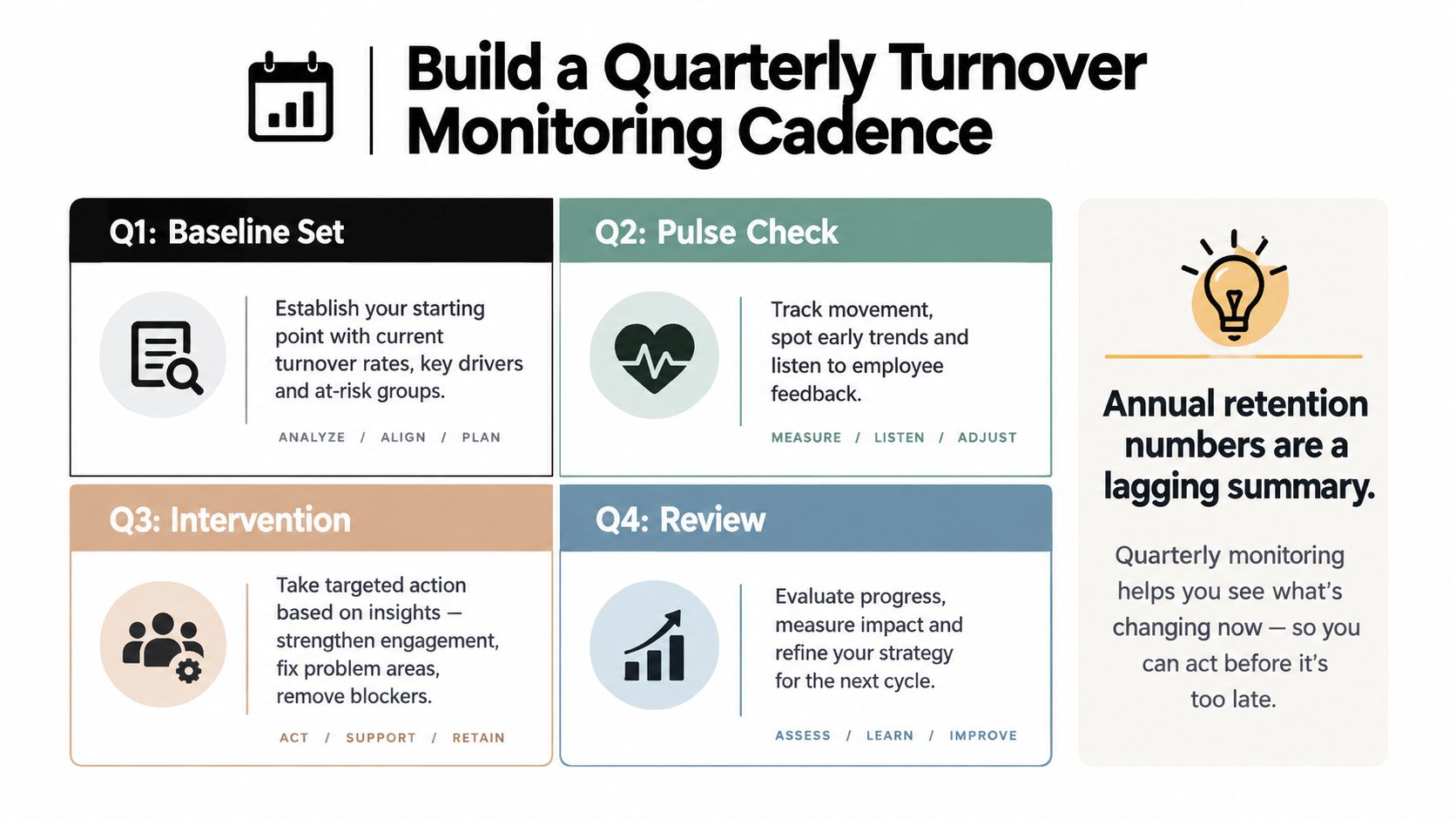
Build a small dashboard that leaders can read in minutes:
Voluntary attrition rate: Segment it by team, manager, role, and tenure band.
30-60-90-day survival: Identify onboarding failures before they become annual turnover.
New-hire pulse score: Track confidence, role clarity, and manager support.
Manager engagement index: Measure whether people experience useful feedback and clear priorities.
Internal mobility rate: See whether employees can find growth without leaving.
Backfill time-to-fill: Connect departures to delivery and recruiting capacity.</li>
Each metric needs an owner, a threshold, and an intervention menu. A manager should know what happens when 90-day survival falls, just as recruiting should know which action follows a stalled backfill.
Run the quarterly review in 45 minutes:
Review the dashboard without debating definitions.
Drill into one negative outlier and one positive outlier.
Identify the root cause, not just the exit reason.
Commit to three experiments for the next quarter.
Assign an owner and a review date to each experiment.</li>
Use hiring-funnel data in the same meeting. Shortlist quality, source-to-hire ratios, and time-to-fill belong beside retention metrics because weak hiring inputs often become future exits. Continuous improvement only works when the people who own recruiting, management, onboarding, and delivery review the same evidence.
Your 30-60-90 Day Turnover Reduction Checklist
Wire up three metrics first: voluntary attrition segmented by tenure band, 90-day new-hire retention, and a stay-interview score that gives each manager a leading read on flight risk. Don't wait for a perfect people-data warehouse. A consistent spreadsheet tied to your HRIS, recruiting system, and manager review can reveal the first high-cost cluster.
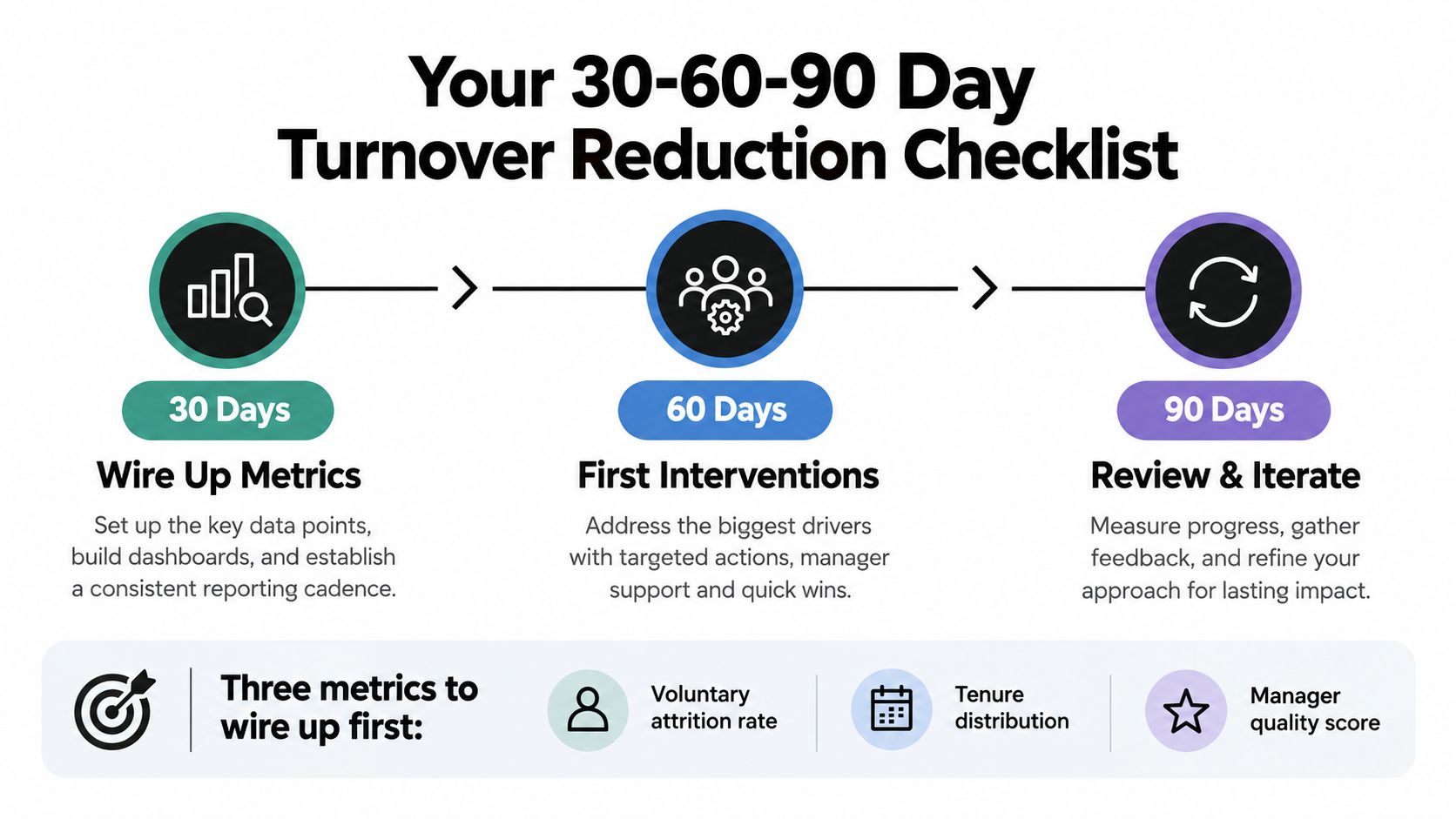
Days 1 to 30 focus on diagnosis
Segment the last 12 months of exits by job family, team, manager, and tenure. Separate voluntary from involuntary departures, identify the one or two clusters causing the most operational damage, and interview current employees in those clusters before selecting a solution.
Audit the hiring funnel at the same time. Compare sources, interview progression, offer acceptance, and early-tenure outcomes. If nearshore hiring is under consideration, pull a current LATAM compensation benchmark and define which roles can operate effectively across the relevant time zones.
Your first-month output should be a short diagnostic:
Highest-cost cluster: Name the role, team, manager, and tenure pattern.
Likely root cause: State the evidence and the uncertainty.
Owner: Assign one executive or functional leader.
Baseline: Record the metric that should change.</li>
Days 31 to 60 focus on the funnel and managers
Rewrite job specifications into scorecards. Add skill-first sourcing, a practical work sample, and a curated shortlist standard. Train managers on onboarding plans, feedback, stay conversations, and escalation when workload or role scope changes.
For distributed teams, the remote hiring guidance can help connect sourcing decisions with communication expectations and team operating norms. Nearshore hiring only improves retention when the company is honest about overlap, ownership, and support.
Days 61 to 90 focus on operating rhythm
Launch the onboarding milestones, day 30 and day 90 pulses, and stay-interview cadence. Schedule the quarterly retention review, publish the dashboard owner list, and define the intervention menu before the first negative outlier appears.
The compounding move is to pick one highest-cost exit cluster, assign a named owner, and tie the result to a number on the next quarterly review. Turnover reduction fails when accountability diffuses across HR, engineering, and recruiting until nobody owns the outcome.
GENTY recruitment helps tech and sales teams build curated LATAM shortlists through skill-first sourcing, structured technical and cultural assessments, RPO, staffing, and salary benchmarking. If your turnover problem starts with bad-fit hiring or slow backfills, visit GENTY recruitment to discuss a more controlled hiring process and a replacement-backed approach to reducing early attrition.