

A structured hiring process for startups is a repeatable sequence of defined steps, including clear role definition, targeted candidate sourcing, objective interviews, and timely offers, that together improve hiring quality and speed. Most early-stage teams treat hiring as an ad hoc exercise, which produces inconsistent results and costly mis-hires. This structured hiring guide for startups addresses that gap directly, covering every stage from writing a role scorecard to closing a remote candidate in under 48 hours. Tools like LinkedIn, behavioral interview scorecards, and skills-based assessments are central to the framework described here.
What are the essential components of a structured hiring framework?
A structured hiring framework is built on five foundational elements. Skip any one of them and the process breaks down at the seams.
Role definition with success metrics. Before you write a job description, define what success looks like at 30, 60, and 90 days. A 30/60/90-day success plan created before interviews is the most effective mis-hire prevention tool available to startups. It forces clarity on what the role actually requires, not what sounds good in a posting.

Competency-based job descriptions. Strip job descriptions down to must-have competencies. Avoid listing 15 requirements when 5 are genuinely non-negotiable. Candidates self-select more accurately, and your screening time drops.
Need help hiring?
See the next step after this guide
If this topic is relevant to your team, these are the most useful pages to check next.
A hiring scorecard. A scorecard with 4–6 competencies rated on a 1–4 or 1–5 scale is the single most effective tool for objective candidate comparison. That scoring range is specific by design. Fewer than four competencies misses critical dimensions; more than six creates noise that obscures real differences between candidates.
Pre-interview screening. A short async video screen or a 20-minute phone call filters out misaligned candidates before you invest interview hours. Tools like Loom or a simple Google Form with role-specific questions work well at this stage.
Timeline discipline. The optimal hiring timeline for startups is 2–4 weeks with 2–3 interview rounds. That benchmark exists because top candidates in competitive markets, especially remote tech talent, rarely wait longer than four weeks before accepting another offer.
Pro Tip: Build your scorecard before you post the job, not after you receive applications. Defining competencies upfront prevents you from unconsciously adjusting criteria to fit a candidate you already like.
Here is a quick reference for the core components and their purpose:
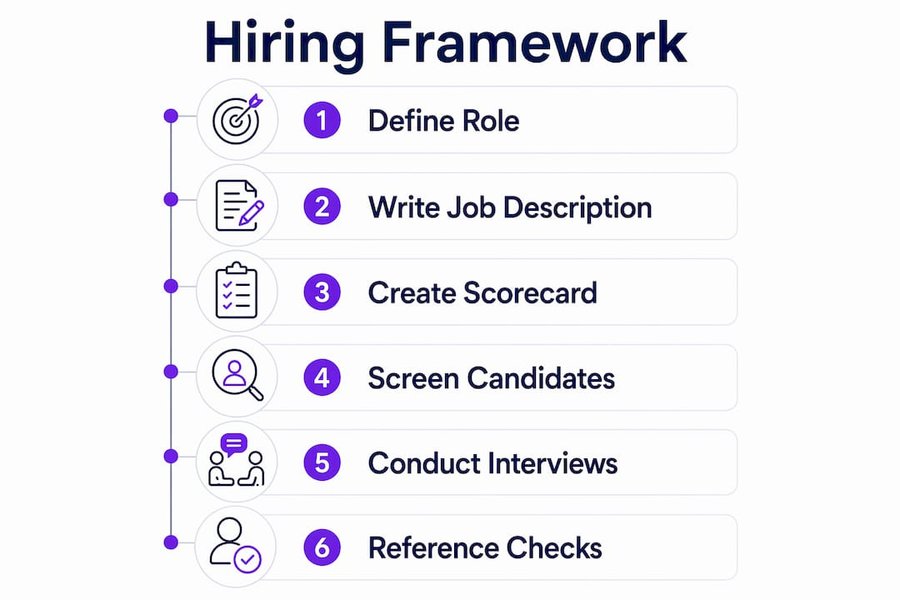
How to source startup candidates effectively for remote roles
Sourcing for remote roles requires a multi-channel approach. Relying on a single job board produces thin pipelines, especially for technical roles in FinTech, AI, and SaaS.
The most effective startup recruitment strategies combine three channels simultaneously:
- LinkedIn direct outreach. Personalized cold messages tied to a specific role problem, not a generic “we’re hiring” note, achieve 15–25% reply rates and account for roughly 30% of hires at small startups. A strong message names the candidate’s specific experience, states the problem the role solves, and keeps the ask to one sentence.
- Employee referral programs. Skills-based hiring and referrals outperform paid job boards per dollar spent for early-stage teams on lean budgets. A $500 referral bonus to your existing team generates better-fit candidates than a $400 monthly job board subscription.
- Niche job boards and communities. For remote tech roles, platforms like We Work Remotely, Remotive, and Wellfound reach candidates who are already oriented toward distributed work. Posting there signals that your company understands remote culture, which itself is a filter.
Compensation and flexibility matter more than most founders expect. Flexible work arrangements and improved compensation are tied at 61% as the most effective recruiting strategies for startups. That means a competitive salary paired with async-friendly hours beats a higher salary with rigid schedules for most remote candidates.
When to bring in a recruiter. Early recruiter involvement cuts startup time-to-hire by about one-third. If you are hiring more than three roles simultaneously or entering a new market like Latin America, engaging a specialist before you need one pays off faster than waiting until pipelines run dry.
Pro Tip: When writing LinkedIn outreach, reference a specific project or skill from the candidate’s profile in the first sentence. Generic messages get ignored. Specific ones get replies.
How to conduct structured interviews and make objective hires
Structured interviews replace gut-feel assessments with evidence-based competency scoring. The difference in outcome quality is significant, and the process is not complicated to implement.
Behavioral and situational questions
Every interview question should map directly to a competency on your scorecard. Behavioral questions follow the STAR format: Situation, Task, Action, Result. Situational questions present a hypothetical scenario relevant to the role. For a senior engineer, a behavioral question might be: “Tell me about a time you had to ship a feature under a tight deadline with incomplete requirements.” That question tests adaptability, communication, and execution simultaneously.
Independent scoring before debrief
Independent interviewer scoring before the group debrief is non-negotiable. When interviewers share opinions before scoring, the most senior voice in the room shapes everyone else’s rating. That is groupthink, and it defeats the purpose of a structured process. Each interviewer submits scores independently, then the team compares and discusses discrepancies.
Reference checks before the offer
Reference checks performed before the verbal offer give you behavioral data from former managers while you can still act on it. Conducting references after the offer is made rarely changes the outcome because commitment is already established. Ask former managers for specific performance examples, not general impressions.
Here is a comparison of unstructured versus structured interview approaches:
The balance for startups is structured enough to reduce bias and speed to decision, yet flexible enough to avoid corporate bureaucracy that slows hiring. Two to three rounds is the right number. Four or more rounds signal process bloat and cost you candidates.
How to manage offers and onboarding to retain remote talent
Closing a candidate is where many startups lose ground they spent weeks gaining. Speed and clarity at the offer stage determine whether your top choice accepts or takes a competing offer.
Follow this sequence to close candidates and set them up for long-term success:
- Make the offer within 48 hours of the final interview. Delays beyond two days signal indecision and give competitors time to move. Have the offer letter templated and ready before the final round begins.
- Include equity and flexible compensation terms. For early-stage startups, equity is a genuine differentiator. Candidates evaluating multiple offers weigh total compensation, not just base salary. Be transparent about vesting schedules and strike prices.
- Communicate the process timeline upfront. Tell candidates at the first touchpoint how many rounds to expect and when they will hear back. Candidates who know what to expect drop off less frequently.
- Build a 30/60/90-day onboarding plan. A structured success plan before the first day sets expectations for both the new hire and the manager. It reduces the ambiguity that causes early attrition in remote roles.
- Schedule manager check-ins at day 15, 30, and 60. Remote employees who receive structured early feedback are significantly more likely to stay past the six-month mark. These check-ins do not need to be formal reviews. A 30-minute conversation focused on blockers and wins is enough.
Pro Tip: Send a welcome package or a personalized Loom video from the hiring manager before the new hire’s first day. For remote hires, that gesture replaces the in-office welcome experience and builds early connection.
For startups hiring across Latin America, salary benchmarking data by country and role is critical to making competitive offers without overpaying. Argentina, Brazil, Mexico, and Colombia each have distinct market rates for engineering and sales roles.
Key takeaways
A structured hiring process for startups requires defined role competencies, multi-channel sourcing, independent interview scoring, and fast offers to consistently attract and retain top remote talent.
What i have learned about structured hiring after years of watching startups get it wrong
The most common mistake I see founders make is treating the scorecard as optional. They run three rounds of interviews, everyone has a strong opinion, and then the team spends 90 minutes in a debrief arguing from memory. Nobody wrote anything down. The hire that results from that process reflects whoever spoke most confidently in the room, not who was actually the best candidate.
The second mistake is waiting too long to involve a recruiter. Founders often believe they can handle the first 10 hires themselves. Sometimes they can. But the cost of a slow or failed hire, which can exceed $15,000 per mis-hire, is almost always higher than the cost of early recruitment support. Engaging recruiters early in the growth cycle is not an admission of weakness. It is a resource allocation decision.
For fully remote hiring, the structured process matters even more. You cannot rely on office energy or casual hallway conversations to assess culture fit. Every data point you collect has to come from the process itself. That means your behavioral questions, your scorecard, and your reference calls carry more weight than they would in an in-person context.
Corporate-style hiring processes create unnecessary bureaucracy that slows startups down without improving outcomes. The goal is not to replicate what a Fortune 500 does. The goal is to make fast, accurate decisions with the information you have. A well-built scorecard and two focused interview rounds will outperform a six-round process every time.
— Eugene
How Gentyrecruitment helps startups hire remote talent faster
Startups that need to move quickly on technical and sales roles do not always have the time to build a full sourcing pipeline from scratch. Gentyrecruitment specializes in connecting US and European tech companies with pre-vetted, English-speaking talent from Latin America, covering Argentina, Brazil, Mexico, Colombia, and more.
The Gentyrecruitment process combines structured assessment, technology-assisted screening, and hands-on recruiting to deliver qualified candidates faster than most internal teams can source them independently. For startups in FinTech, AI, and SaaS, that speed matters. Explore pre-vetted LATAM tech talent or review remote staffing options to find the model that fits your current growth stage. Gentyrecruitment also provides salary benchmarking across Latin America so your offers land competitively from day one.
FAQ
What is a structured hiring process for startups?
A structured hiring process is a repeatable sequence of defined steps, including role scorecards, standardized interview questions, and independent scoring, designed to improve hiring quality and reduce bias. It replaces ad hoc decisions with evidence-based evaluation.
How many interview rounds should a startup use?
The optimal range is 2–3 rounds completed within 2–4 weeks. More rounds increase candidate drop-off without meaningfully improving decision quality.
When should a startup involve a recruiter?
Early recruiter involvement reduces time-to-hire by about one-third. Engage a recruiter when you are hiring more than two or three roles simultaneously or when your internal pipeline is consistently thin.
What is the best way to reduce bias in startup interviews?
Use a competency scorecard with a defined rating scale and require each interviewer to submit scores independently before any group discussion. This prevents dominant voices from skewing the team’s collective judgment.
Should reference checks happen before or after the offer?
Reference checks belong before the verbal offer. Conducting them afterward rarely changes the hiring decision because commitment is already made, which defeats their purpose entirely.