
Sales recruitment is the process of identifying, assessing, and hiring people whose roles generate revenue through customer acquisition, account development, product selling, or commercial relationship management. For a technical leader or HR director at a Series A to C software company, that definition carries immediate operational weight. Your engineering team ships reliably and early customers love the product, yet revenue stalls whenever a new rep misses quota or leaves inside two quarters.
Most commercial hiring mistakes happen because teams borrow their engineering or general corporate hiring playbook and apply it to revenue roles. Understanding what is sales recruitment requires treating hiring as a measurable revenue funnel tied to your exact sales motion, buyer profile, and post-hire ramp metrics rather than a generic search for polished resumes.
What Sales Recruitment Is and How It Differs From General Hiring
Sales recruitment aligns candidate behaviors directly with how your company turns prospects into paying customers, rather than filling a seat against a list of past job titles. Think of a commercial organization as a toolbox: an outbound Sales Development Representative, an enterprise Account Executive, and a Sales Engineer each perform a distinct mechanical task. Handing an enterprise buyer to a rep trained only for transactional calls fails regardless of effort.
The scale and diversity of the field show why generic screening breaks down. According to the U.S. Bureau of Labor Statistics Salesperson Day report, the U.S. workforce included nearly 13.4 million workers in sales and related occupations in May 2024, accounting for roughly 8.7% of total U.S. employment. That umbrella spans 3,800,250 retail salespersons, 1,266,860 wholesale and manufacturing representatives (excluding technical and scientific products), and 1,189,330 service sales representatives outside advertising, insurance, financial services, and travel.
What do you need?
Choose the hiring path that fits
After reading "What Is Sales Recruitment? Roles, Process and Metrics", most teams compare these options before deciding how to hire.
Sales hiring is also a continuous workforce-planning function, not an occasional project. Even though the U.S. Bureau of Labor Statistics Occupational Outlook Handbook for sales occupations projects overall employment in sales roles to decline over the 2025 to 2035 decade, it still projects approximately 1.7 million openings per year on average because of workers permanently leaving these roles through turnover, retirement, or career shifts.
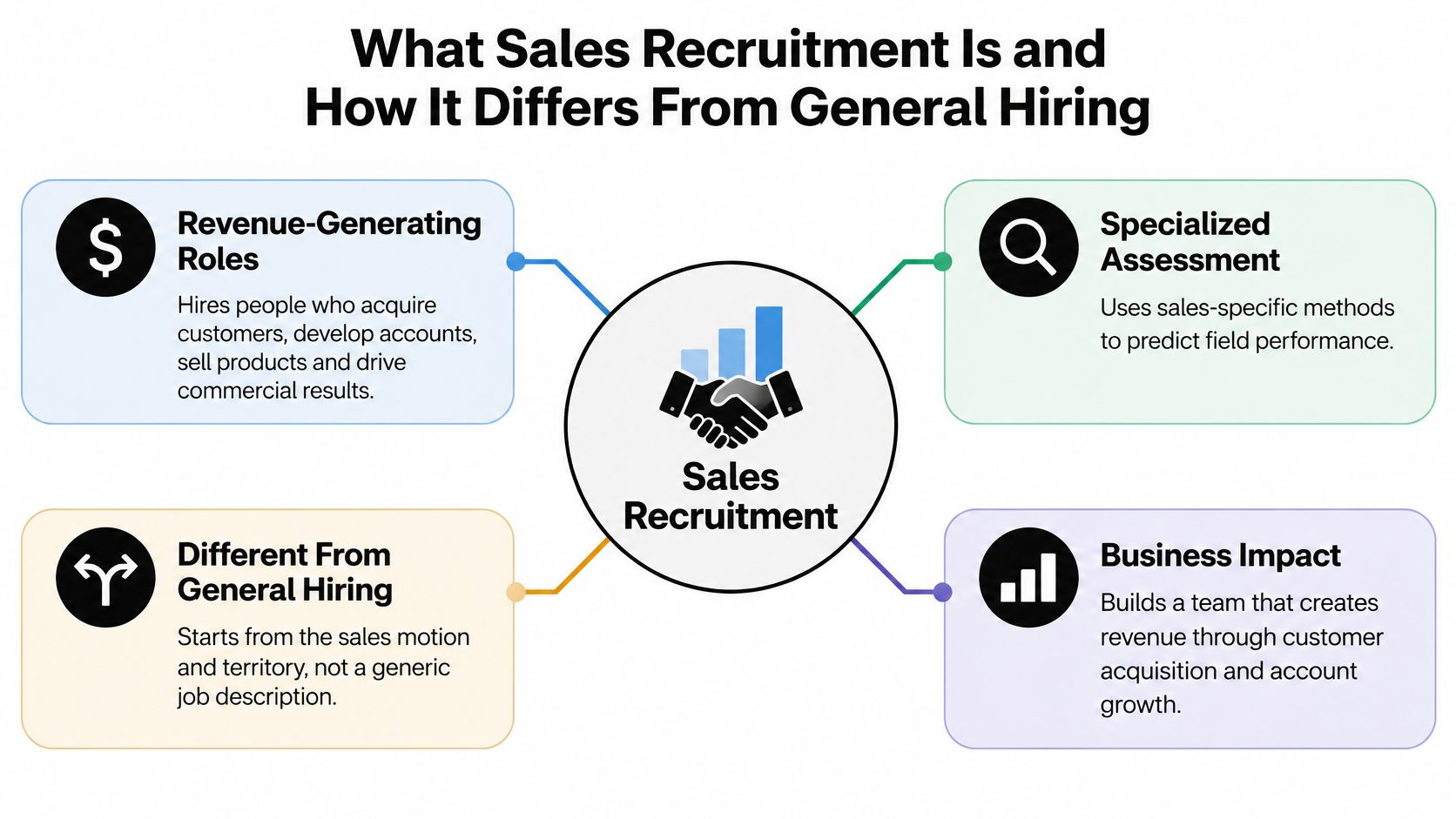
General hiring asks whether a candidate can perform the duties listed on a job description. Sales recruitment asks a sharper question: can this person sell this specific product, to this specific buyer, through this specific motion, in this market? The differences touch every stage from job design to pay structure.
Matching the Candidate to the Sales Motion
Past employer prestige is one of the weakest predictors in commercial hiring. A top performer who crushed inbound, single-call SaaS demos at a recognizable brand often struggles in outbound enterprise sales where deals require six months of multi-stakeholder consensus. Without testing fit for the actual motion, brand-name resumes create expensive misfires.
Say a B2B infrastructure startup is hiring its first enterprise Account Executive. Before reading a single CV, the hiring team should document the buying committee (often a VP of Engineering, a security lead, and procurement), the typical contract cycle, and the level of technical fluency needed to survive an architecture review.
A strong CV only proves a rep succeeded inside someone else's funnel, brand recognition, and inbound lead flow.
Before advancing any candidate past the shortlist stage, apply two practical filters:
Verify motion alignment: Confirm the candidate has operated in a comparable deal complexity, outbound-to-inbound mix, and buyer seniority.
Demand behavioral proof: Look for concrete evidence of discovery, qualification, and closing habits rather than self-reported quota percentages without context.</li>
Key Sales Roles and What Each Hire Must Prove
Hiring a "salesperson" without isolating which revenue bottleneck you need to fix leads to overloaded roles that fail on every front. Most growing tech companies recruit across five core commercial profiles, each owning a distinct handoff in the customer journey.
Mapping Each Role to Your Revenue Funnel
Each role above owns a specific handoff, so an error in one layer immediately starves the next. Sales Development Representatives (SDRs) build top-of-funnel momentum by turning cold accounts or marketing leads into qualified discovery meetings. If you're deciding whether your pipeline needs inbound qualification or outbound territory hunting, reviewing the differences between SDR and BDR roles keeps your job scope sharp before sourcing starts.
Once an opportunity is qualified, mid-market Account Executives carry deals from initial discovery to signed contract using tight forecast discipline. When product integrations or security questionnaires enter the conversation, Sales Engineers step in to prove technical feasibility without drowning non-technical buyers in jargon. At the upper end, enterprise Account Executives run structured account plans and multi-thread across executive sponsors, legal, and IT so a single champion leaving doesn't kill a six-figure deal.
Frontline Sales Managers tie those layers together by inspecting pipeline hygiene, running weekly deal reviews, and coaching underperforming reps before quarters slip away. Competition for proven commercial leaders remains steady: the U.S. Bureau of Labor Statistics profile for sales managers reports roughly 650,100 jobs held in 2025, with about 47,300 openings projected annually on average from 2025 to 2035. Assessing leadership hires requires testing coaching skill, process execution, and how they balance immediate revenue targets with long-term rep development.
Before opening a new requisition, run through this quick diagnostic:
Locate the weakest funnel stage: Check whether you're short on qualified meetings, losing deals during technical evaluation, or stalling at late-stage procurement.
Assign the single owning role: Hire for the bottleneck stage instead of asking one mid-market rep to prospect full time, run deep technical demos, and close enterprise contracts.
Audit the scope definition: Confirm the hiring brief specifies the exact sales motion, average contract value, and buyer persona rather than relying on a generic job title.</li>
Pinpoint the single role currently capping your revenue velocity before you write a job post.
How the Sales Recruitment Process Runs Step by Step
A disciplined hiring workflow treats candidate evaluation with the same rigor engineering applies to release pipelines. Skipping intake alignment or dragging out interview scheduling costs you your strongest sellers while leaving territories uncovered.
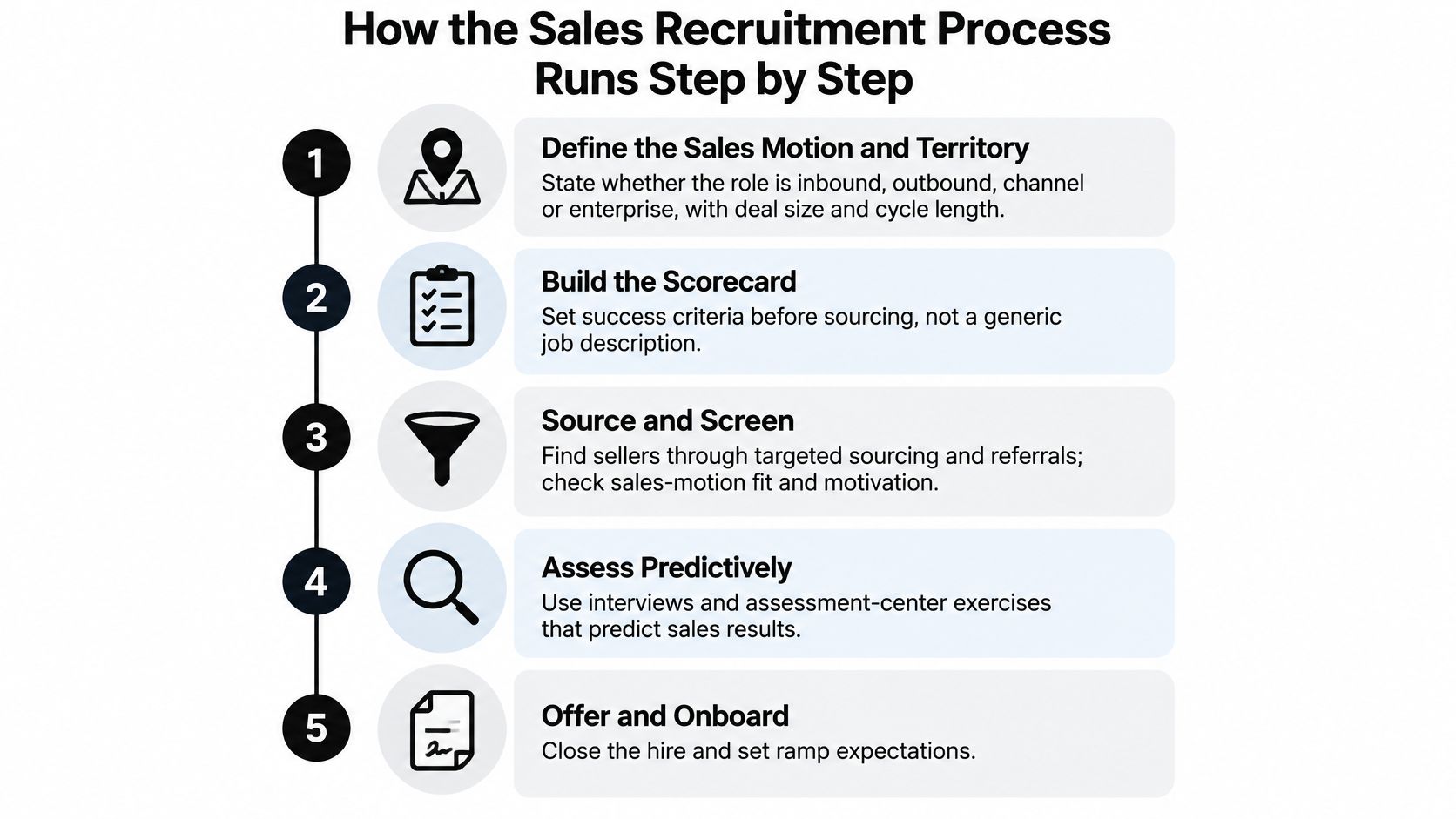
The diagram below outlines the five core stages that anchor an end-to-end commercial search, from territory definition through onboarding.
Eight Stages From Territory Scope to Ramp Plan
Breaking those five phases into eight operational checkpoints prevents hiring managers from improvising midway through a search.
Define the sales motion and territory. Put in writing whether the role is inbound, outbound, channel, or enterprise, along with target deal size and typical cycle length. Copying last year's job description is the fastest way to attract reps built for a different go-to-market model.
Build a scorecard of observable behaviors. Score candidates on discovery quality, qualification judgment, objection handling, forecast discipline, and learning speed rather than years of tenure. According to Meritt's 2026 sales recruitment trends analysis, 73% of talent-acquisition leaders rank critical thinking as their top priority, while AI skills rank fifth, reinforcing why commercial reasoning beats buzzwords on a resume.
Source across multiple channels and log every origin. Combine outbound headhunting, employee referrals, careers pages, and targeted job boards, tagging each applicant's source inside your ATS. If you need a clean workflow blueprint for organizing sourcing, screening, and interview handoffs, the Eztrackr candidate pipeline guide lays out practical stage mechanics you can adapt directly.
Screen for motion fit and language clarity. Run a tight 20-minute structured call verifying past sales motion, baseline motivation, and spoken fluency required for your target buyers. Skipping structured screening fills hiring managers' calendars with charismatic talkers who can't execute your playbook.
Run structured interviews and a realistic work sample. Include a timed discovery-call simulation or cold-outreach teardown graded against your rubric. Watch scheduling speed closely here: Sloane Staffing's 2026 GTM hiring benchmarks report that 42% of candidates withdraw when interview scheduling takes too long, and note an average of 35 days to hire for sales roles compared with 58 days for IT and information-security roles and 53 days for engineering roles.
Score independently before group debriefs. Every interviewer submits written rubric scores before the panel meets. Otherwise, the most senior executive in the room anchors the conversation and overrides genuine red flags spotted during technical or peer rounds.
Benchmark compensation and present the offer transparently. Before issuing the offer, benchmark the base-to-variable split against on-target earnings (OTE) and confirm any guaranteed draw during ramp so candidates see realistic first-year income. Walk through quota math and commission accelerators live instead of hiding behind a headline OTE number.
Onboard against a 30-60-90 day ramp plan. Tie early milestones directly to verifiable behaviors such as completed product certifications, shadowed calls, outbound sequences launched, and first qualified pipeline created. For deeper tactical playbooks on structuring outreach and closing top commercial talent, review our breakdown of how to recruit sales agents.</li>
Protecting Candidate Momentum During Evaluation
Speed and structure work together when you pre-book interview blocks on hiring managers' calendars before sourcing begins. Set a firm ceiling on total interview stages and enforce a 24-hour feedback turnaround after every call so strong sellers don't accept competing offers while your team debates logistics.
For a practical walkthrough of how hiring leaders design structured commercial interviews and evaluate real selling instincts, watch the overview below.
You know your process is working when it passes one simple audit: every stage has a named owner, a fixed deadline, and a recorded numerical score.
Assessing Candidates With Methods That Predict Sales Results
Unstructured "get to know you" chats reward candidates who excel at interviewing rather than candidates who excel at selling. Research backs a much tighter design. A peer-reviewed analysis of salesperson assessment centers cited in the Marketing Management Journal study on structured behavioral interviews found that combining motivation for sales success with social competence predicted field-sales performance one year later with a reported true-score criterion validity of 0.49. The same paper's evaluation of a customized structured-behavioral interview also reported predictive validity for eventual sales success alongside improved salesperson retention.

Translating that evidence into a practical Series A to C interview loop takes three disciplined pieces. Start by defining four to five job-specific competencies tied to your territory and buyer profile. Next, build behaviorally anchored questions that force candidates to recount real past deals, such as walking through a lost late-stage opportunity and explaining what qualification signal they missed.
Finally, give every comparable candidate the exact same work sample, such as a 15-minute discovery role play where the hiring manager plays a skeptical CTO. Give candidates clear pre-call context, watch how they uncover pain instead of pitching features early, and score their follow-up recap email using our framework for communication skills assessment. Have each panelist log scores independently before comparing notes so vocal opinions don't skew the hiring bar.
Balancing AI Tools With Human Judgment
Recruiting software and AI assistants now handle profile discovery, resume parsing, and interview scheduling far faster than manual spreadsheets. Even so, automation compresses administrative time without proving commercial competence. As Optima Europe's analysis of 2026 sales hiring pipeline trends highlights, human evaluators are still essential for judging discovery depth, coachability, ethical judgment, and fit with your actual sales workflow.
Teams hiring in or selling into Europe also need clear AI governance. Whenever automated tools screen or rank sales applicants, document which candidate data was processed, how potential bias is monitored, and how final human decisions are recorded to align with European privacy and regulatory expectations.
Evaluation trap: Never waive your role-play exercise for a candidate coming from a famous tech company. Brand-name sellers are the exact profiles most likely to rely on inbound momentum rather than self-sourced pipeline.
Watch closely for three assessment red flags that signal your selection bar is slipping:
Gut-feel hiring: Advancing a rep because interviewers "clicked" with their energy despite vague answers on deal structure or quota attainment.
Improvised interviews: Letting each panelist ask different questions, making side-by-side comparison across finalists impossible.
Uncalibrated coaching checks: Failing to give feedback mid-role play to see whether the candidate adjusts on a second attempt.</li>
Close the loop after hiring by comparing pre-hire scorecard ratings against actual ramp time, quota attainment, and early attrition once your first cohort completes two quarters. If high-scoring interviewees struggle in discovery, tighten your role-play rubric immediately.
Measuring Speed, Cost and Quality in Sales Hiring
Treating sales hiring as a resume-screening chore hides its true revenue impact. Managing it as a measured funnel lets technical and HR leaders spot bottlenecks before an empty territory costs a full quarter of bookings.
According to JobScore's 2026 recruiting benchmarks, median time-to-hire sits at 16 to 23 days, median time-to-fill runs 44 to 45 days, and the overall offer-acceptance rate reaches 75%. That same dataset places median cost per hire for sales roles at $1,095, noticeably below $2,795 for technology roles and $1,942 for science and engineering roles. Channel performance matters just as much: the benchmark attributes 43% of hires to job boards, 27% to careers sites, 11% to referrals, and 9% to sponsored job advertisements.
Adding Post-Hire Quality Metrics to Your Dashboard
Track time-to-hire and time-to-fill as separate numbers rather than lumping them together. Time-to-hire tells you whether interviewers and scheduling move briskly once an applicant enters the funnel, while time-to-fill captures the full vacancy duration while your territory generates zero pipeline. Defining exact start and stop timestamps using standard time-to-fill metrics keeps finance, sales leadership, and recruiting looking at the same reality.
Similarly, audit your source-of-hire mix against actual post-hire performance, not just applicant volume. A job board generating hundreds of cheap applications looks efficient on cost per hire, yet referrals or outbound sourcing often produce higher quota attainment and lower churn.
Dashboard rule: Fast hiring is a liability if new reps quit in month five. Pair every speed and cost metric with post-hire revenue outcomes.
Before setting aggressive quarterly hiring targets, establish clean internal baselines for three post-hire quality indicators, with written start and end points for each:
Time to first qualified opportunity: Count calendar days from the rep's start date to their first sales-accepted pipeline opportunity.
Quota attainment at six and twelve months: Measure cumulative closed-won revenue against ramped quota targets rather than relying solely on activity metrics.
Early attrition rate: Track the share of sales hires who leave voluntarily or involuntarily within their first twelve months, alongside hiring-manager interview-to-offer ratios.</li>
Set up those three baselines during the coming quarter before committing to headcount expansion targets.
Decide Where Your Next Sales Hire Should Come From
Say your team needs two SDRs next quarter and a sales lead before year end. One sourcing route rarely fits both hires. The right choice depends on your sales motion, your internal capacity and how fast the territory must produce pipeline, so answer four questions before spending a dollar on any search.
Is the sales motion documented in writing? If your buyer profile, quota logic and discovery playbook still live only in the founder's head, write them down before paying a recruiter or posting ads. A recruiter can only match candidates to a motion you can describe.
Can your team run structured assessments internally? Consistent role plays and rubric scoring take dedicated manager hours; under-resourced teams slip back into casual chats that predict nothing.
How quickly must the territory start generating pipeline? Urgent revenue gaps leave little room to build an internal sourcing engine from scratch.
Should this seat be a permanent employee or a flexible contract hire? Decide whether you need long-term account ownership or short-term outbound testing in a new market.</li>
Match your answers to one of four sourcing routes.
Evaluating Nearshore LATAM Talent With Objective Data
For US and European tech companies scaling SDR, sales or customer-facing pods without draining runway, Latin America (LATAM) combines nearshore time zones, strong English proficiency and up to 40% cost savings compared to US or European markets, with talent pools across Argentina, Mexico, Brazil, Chile, Colombia, Peru and Uruguay. Country-level language evidence helps you allocate sourcing effort across the region rather than guessing. As cited in Brain Labs' guide to hiring sales reps across LATAM, the 2025 EF English Proficiency Index covers 123 countries and territories and reports scores of 575 for Argentina (ranked 26th globally in the high-proficiency band), 517 for Chile, 480 for Colombia and 440 for Mexico.
Treat those figures as population-level sourcing hypotheses. An index score says nothing about whether one candidate can run a discovery call with a technical buyer in English, so set the exact fluency bar your buyers require and test every finalist directly: a live discovery call, an objection-handling drill and a written follow-up email scored against your rubric.
The right route also depends on who owns each stage of the hiring funnel. Teams scaling steady headcount internally can sharpen their outbound workflow with structured talent sourcing playbooks. Companies that want an external team to run the entire hiring process end to end can use Recruitment Process Outsourcing (RPO), while teams testing a new territory or adding flexible capacity can weigh staffing and contracting support.
Whatever route you pick for an urgent commercial role, hold the partner to operational accountability in writing. At GENTY recruitment, every client search gets a dedicated recruiter, sales placements carry a three-month replacement guarantee, fixed-fee hiring starts from $2,999 with no upfront payments, and first shortlists for Sales or Marketing Team Leads arrive in 5 to 7 business days, with full-cycle hires typically closing in about two weeks.
Run one low-risk pilot this week: write a single behavioral scorecard for your highest-priority open sales role, then grade your next shortlist against it before scheduling a final-round interview. The route that delivers candidates matched to your motion, buyer and market will prove itself in the funnel numbers that follow: faster ramp, stronger quota attainment, lower early attrition.
GENTY recruitment helps US and European startups and scale-ups build high-performing tech and sales teams across Latin America through skill-first screening, fixed-fee pricing with no upfront payments, and dedicated recruiting support. Whether you need bilingual SDRs, sales reps or a full RPO hiring engine tied to clear funnel metrics, we deliver pre-vetted, culturally screened shortlists built for your exact sales motion. Explore how we can help you staff your next revenue milestone at GENTY recruitment.