
SDRs usually qualify inbound and marketing-generated demand and hand meetings to account executives, BDRs usually prospect outbound into net-new accounts, and the two titles are often used interchangeably. The advice most comparison posts repeat, "read the acronym and hire that person," is the part that gets companies into trouble. A title on a LinkedIn profile doesn't tell you who owns the lead, when the handoff happens, or which number the rep is paid on. If you staff from the label, you'll hire someone who is excellent at the wrong motion.
What SDR and BDR Mean in Practice
Treat SDR vs BDR as a job-design choice, not a vocabulary choice. Typically, the SDR works demand that already exists, and the BDR creates demand in accounts that have never raised a hand. Plenty of companies ignore that pattern and put both motions under whichever acronym they inherited.
The 6sense 2025 BDR benchmark describes BDRs and SDRs as the initial point of contact between providers and potential buyers. The old operating model was high-volume calling and email. The same benchmark describes a shift toward insight-led, technology-supported outreach. Reporting has moved with it. The share of BDRs reporting to Sales rose from 60% in 2022 to 68% in 2023, 76% in 2024, and 80% in 2025, a 20 percentage point climb in four years. That is a revenue seat, not a marketing overflow desk.
Write the seat around four outputs: target-account coverage, qualified conversations, accepted meetings, and pipeline contribution. If those four aren't in the requisition, the title won't save the hire.
Need help hiring?
See the next step after this guide
If this topic is relevant to your team, these are the most useful pages to check next.
Practical rule: If two candidates with opposite titles would both fit the requisition, the requisition is the problem.
SDR vs BDR Side by Side
Lead source is the row that separates the work. Everything else in the table follows from it.
An SDR generally qualifies warm, marketing-generated demand: website inquiries, content downloads, and marketing-qualified leads. A BDR creates pipeline through cold outbound and account research. HubSpot's SDR glossary treats that temperature split as the most consistent operational difference, and it also notes the split isn't universal. Smaller SaaS and mid-market teams often fold both motions into one title.
Say a Series B company posts "SDR" and then expects that person to build outbound lists, write cold sequences, and also clear the demo-request queue by lunch. That seat is a BDR with an inbound chore bolted on. The posting has to name both halves, or the person you hire will be calibrated to only one of them.
Read the reporting-line row as a signal of where the team sits, not as a personality test. The column that matches next quarter's work is the one you hire. If neither column matches, you don't have a title problem. You have an undefined motion.
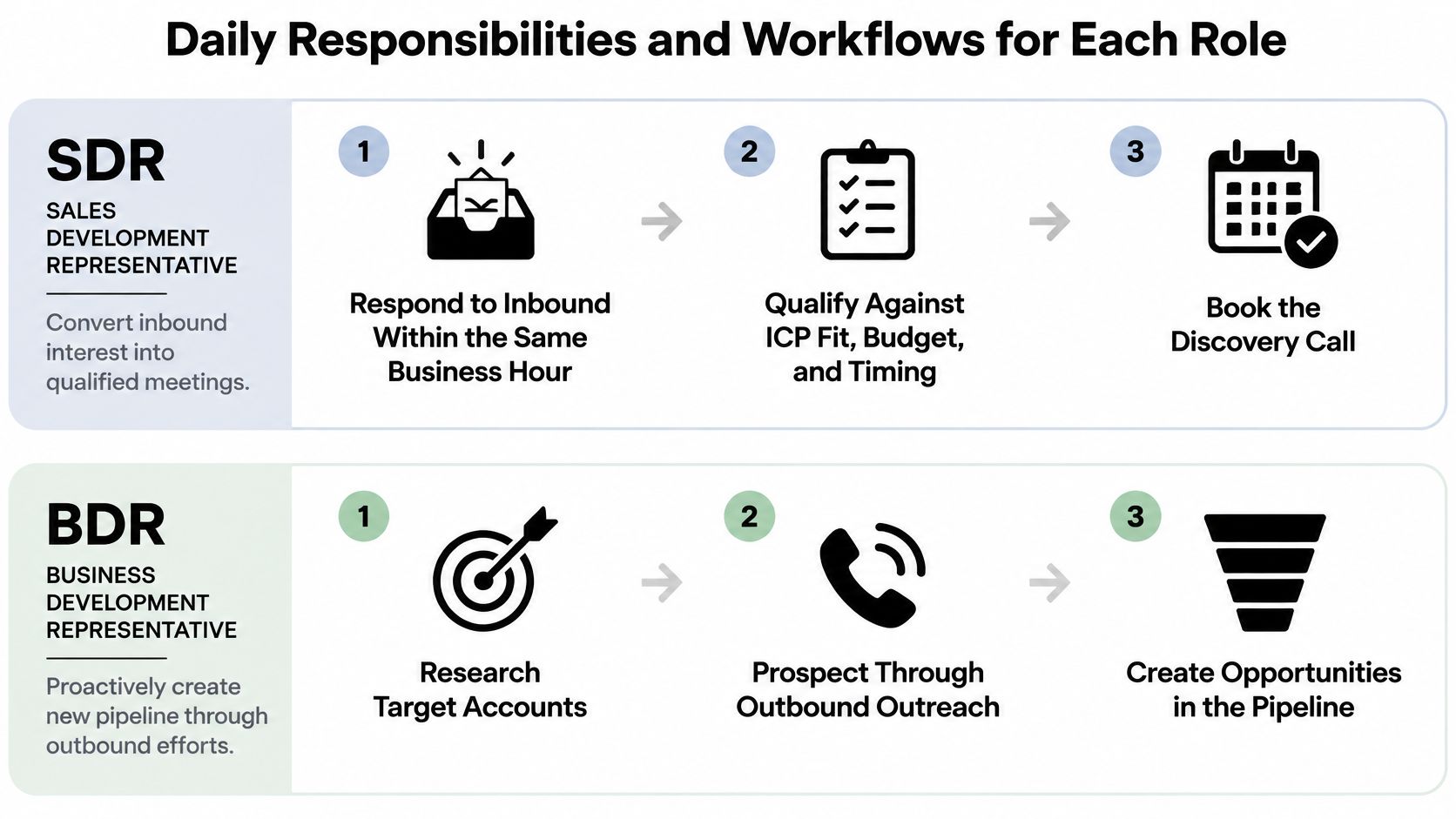
Daily Responsibilities and Workflows for Each Role
Inbound SDR stages
Respond inside the same business hour. A demo request that sits overnight is a colder lead than the form suggested.
Qualify against ICP, budget, and timing. Fit questions come before a calendar link. A booked meeting with a student researcher isn't pipeline.
Book the discovery meeting. Offer two slots that match the account executive's real calendar, not a generic link with no owner.
Log the outcome with a disposition code. "Interested" isn't a code. Use a closed set: qualified, nurture, disqualified, no answer.
Hand off with a written summary. ICP fit, trigger, objection, and the question the AE should open with.</li>
Outbound BDR stages
Build the list from account criteria. Named accounts, employee band, tech stack, and a reason they belong this quarter.
Pick a trigger per account. Funding, a new executive, a job post, or a product change beats a generic "quick question."
Run call, email, and LinkedIn as one sequence. Channel mix is the job. A single channel is a hobby.
Work replies and objections. The second conversation is where most outbound meetings are won or lost.
Book the meeting and open the opportunity. The CRM record exists before the AE sees the invite.
Send territory notes back to marketing. Objections and missing segments are product input, not a private notebook.</li>
The handoff that stops the argument
A meeting counts only after the account executive accepts it. Until that acceptance, the SDR or BDR owns the record, the reminder, and the reschedule. Pay on "meetings I put on a calendar" and you'll fund no-shows. Pay on accepted, held conversations and the two roles stop fighting over credit.
Inbound speed only works if someone is at the desk during the buyer's morning. If your pipeline is US or European inbound, the seat has to cover those hours, whether the person sits in the same city or works a nearshore overlap. Map the steps before you write the ad. A requisition that merges both workflows is two jobs, and candidates will assume they own the half they prefer.
For the outbound half, sequence design and list hygiene matter more than another dialer seat. A current find SDR prospecting tools for 2026 roundup is a useful filter before you standardize the stack. If you'd rather not run that search yourself, our SDR hiring shortlists are pre-vetted and English-capable, so the first interview is a working session rather than a resume screen.
KPIs and Scorecards That Separate the Two Roles
A quota copied from a blended benchmark fires good reps for someone else's list. Set the role by lead source first, then score the handoff you will enforce.
A published sales-development benchmark summarized by Zeliq puts daily multichannel touches at about 80–120, cold-outbound reply rates at 5–10%, meeting-booked rates from positive replies at 50–70%, show rates at 75–85%, and AE acceptance at 60–75%. Monthly meetings land around 8–15 for SDRs and 12–20 for tenured representatives. Treat those ranges as directional and segment them before you compare people. Pipeline dollars move with annual contract value, so a meeting count with no ACV is a vanity number.
What each scorecard actually judges
SDRs are judged on speed and qualified conversion. Time-to-first-touch and lead-to-SQL show whether inbound is caught while the buyer is still in the thread. BDRs are judged on connect rate, positive-reply rate, and new-account penetration. A tidy meeting count inside three logos you already own is not a territory.
Both roles then face the back half of the chain: SQL-to-opportunity, AE acceptance, and pipeline that is still real after the first call. Activity volume is a diagnostic, not the score. Sequencing tools now draft opens and follow-ups, so a high touch count no longer proves the rep can qualify a lead or open a new account.
An SDR clearing US inbound and a rep running Spanish-language outbound into Europe are not on the same scoreboard, even when the title matches.
Cut the benchmark by market, language, territory, list quality, channel mix, ACV, and time-zone coverage before you rank anyone. Nearshore teams selling into the US or Europe skip that cut often. LATAM hours can be right and the list wrong, or the reverse.
I would lock three numbers with the hiring manager on day one, before the first interview:
One leading indicator. Response time for an SDR, or connect rate for a BDR.
One quality gate. AE acceptance, with a written reason code when a meeting is rejected.
One money metric. Accepted pipeline, or opportunities created, tied to your real ACV.</li>
That calibration belongs in the sales recruitment process, not on a slide the rep sees after the offer.
Salary Benchmarks and Compensation Structure
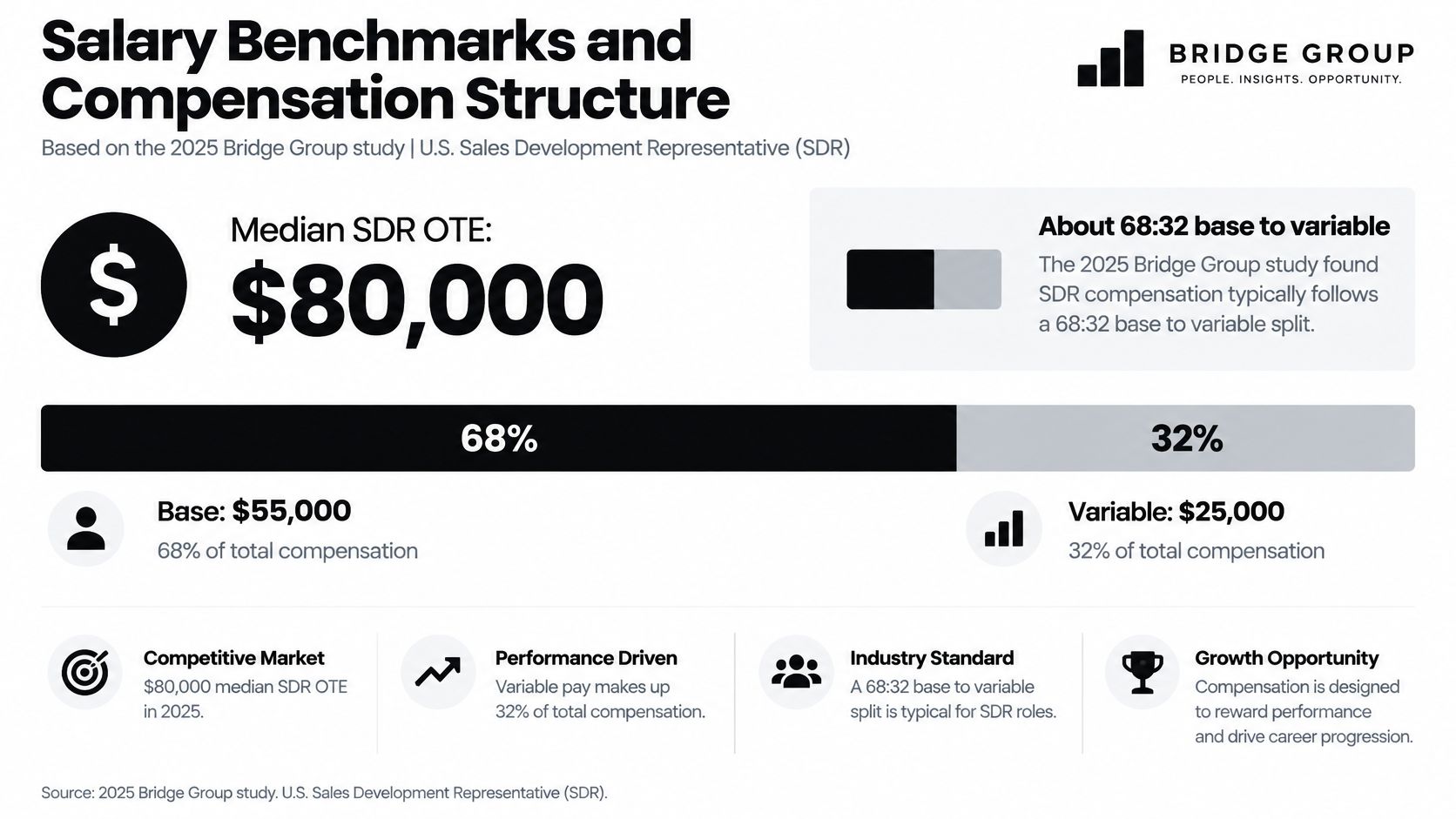
Median US SDR on-target earnings are $80,000. That number prices a blended sales-development seat. It does not tell you what to pay an inbound qualifier versus a rep who has to open new accounts.
The Bridge Group's 2025 Sales Development report, the tenth edition of a study run since 2007, surveyed 351 B2B companies. 78% were based in North America and 83% sold B2B SaaS. Median company revenue was $47 million and median ACV was $50,000. The $80,000 median splits about 68:32, or roughly $55,000 base and $25,000 variable. Average ramp was 3.0 months, down from a 3.8-month peak in 2014. Bridge Group tracks SDR and BDR together, so the median is one pool, not two motions.
Don't paste team-lead pay onto a rep
SDR Team Leads in Latin America earn $2,434–$5,531 per month, against US team-lead base rates of $9,868–$13,351 per month. LATAM SDR Team Leads cost 50–70% less than US team leads. Those bands are for player-coaches, not for a first-year individual contributor. Using them as an SDR offer will either overpay a junior seat or, more often, underpay someone you expect to coach.
Match the percentile band to the seat, the country, and the motion before the requisition goes live. Salary benchmarking for this comparison covers country and role-specific salary data, percentile-based compensation bands, and a custom PDF report. That is the check I'd run before a number hits a job post. Start with the LATAM SDR salary breakdown.
Pay the handoff, and budget for replacement
Use a fixed base plus variable tied to meetings the AE accepts, not dials or emails sent. Raw activity is cheap to fake and expensive to manage. Tools already produce volume, so the pay mix should buy judgment on lead source and a clean handoff, not more touches. An SDR paid on same-queue speed and an outbound BDR paid on new-logo meetings are on different variable plans even when base looks similar.
Ramp of about three months is the short part of the model. In the same Bridge Group study, 58% of companies saw average tenure of 12–23 months. Replacement is a planning cost. Variable should reward pipeline that still exists after the rep's first year, and the hiring plan should assume seats turn over well inside two years.
There isn't a verified BDR on-target figure that stands apart from the SDR number. Run a market-specific check for outbound seats instead of assuming the $80,000 median covers a senior enterprise BDR in London or a first outbound hire in a seed-stage startup.
Sample Job Descriptions for Each Role
Titles aren't standardized, so the posting has to carry the operating model. HubSpot's BDR glossary puts it in hiring terms. SDRs should show rapid qualification, CRM discipline, and high-volume multichannel follow-up. BDRs should show account research, personalization, cold outreach, and territory creation. Both get judged on lead-to-SQL, SQL-to-opportunity, AE acceptance, and pipeline, not on activity alone.
Use the same skeleton for both seats so candidates can see the motion, not the acronym. Lead source, the handoff rule, and the success metric belong in the summary. If those three lines could swap between the two postings, you have not defined the jobs.
Inbound SDR skeleton
Role summary. Qualify inbound and marketing-generated leads against a named ICP and book discovery meetings for AEs inside a defined routing territory. The handoff is a logged disposition plus a note an AE can use the same day.
Must-have. Proven CRM discipline and a record of qualifying a high volume of inbound leads, with disposition codes a manager can audit.
Nice-to-have. Experience with a routing tool such as LeanData or Chili Piper, and comfort editing sequences in Outreach or Salesloft rather than only sending them.
KPIs on the posting. Same-hour response, lead-to-SQL, and AE-accepted meetings. Leave dials off the public scorecard.
Pay, hours, language. State the OTE band, the hours that overlap the inbound queue, and the English level you will test, not the level you hope for.
Process. Screen, live exercise, hiring-manager interview, offer. Don't promise an AE promotion in 12 months unless that path has happened here.
Outbound BDR skeleton
Role summary. Create pipeline in net-new named accounts through research and cold multichannel outreach. No inbound queue unless you want both jobs in one seat.
Must-have. A record of building target-account lists and running cold outreach across phone, email, and LinkedIn.
Nice-to-have. Experience with account triggers in tools such as 6sense, Apollo, or LinkedIn Sales Navigator, and writing that doesn't sound like a template.
KPIs on the posting. Connect rate, positive-reply rate, and opportunities created. Meeting count alone invites padding.
Pay, hours, language. Same structure as the SDR posting, with hours set to the buyer's morning in the territory, not to the office's convenience.
Process. Same stages. Don't use one title for a seat that includes both workflows, and don't dangle a career ladder you can't staff. For a nearshore hire, put the overlap with the client's working day in the posting and test English on a live call, not on a certificate.
If the outbound seat is the one you're opening, write the posting so it separates qualification work from cold territory work before you publish it. A clear business development representative posting names the named-account motion and leaves the inbound queue off the scorecard.
The exercise and the AI line
An SDR candidate qualifies three simulated inbound leads and logs them with the right disposition and a handoff note an AE could use. A BDR candidate writes an account plan and personalized outreach for two named accounts, including the trigger and the first objection.
Add one line to both postings. The candidate must show accepted meetings produced with AI tools, not message volume. The 6sense 2026 BDR report puts BDR attempts per contact at roughly 17 in 2024, about 21 in 2025, and approximately 34 in 2026, with AI dialing and voice agents in the mix, and reports that 99% of BDRs used AI in 2026, up from 62% in 2025. Volume is now the floor. What still separates candidates is which accounts they pick and which replies they refuse to send.
Decide the Role and the Hire

The acronym on the req does not pick the motion. Available 2026 title data, as discussed in PulseRevOps, suggests only about 25% of SaaS companies keep a clean inbound-SDR and outbound-BDR split. Everyone else swaps the labels or keeps whatever the last manager inherited. "Should we hire an SDR or a BDR?" has no answer until lead source, handoff rule, and one success metric are written down. Importing a person because the last company used the same acronym mismatches prospecting complexity, hours, language, and pay. Compare operating models: inbound qualification, outbound prospecting, account-based development, or full-cycle junior selling.
A Series A company selling a mid-priced tool to US SMBs on paid inbound should start with one SDR. A Series C company sitting on several hundred named enterprise accounts and almost no inbound should start with BDRs. Swap those seats and both teams stall, one on speed-to-lead and the other on account coverage.
Lead-source mix comes first. What share of next quarter's pipeline is inbound versus outbound? If you cannot estimate it, you are not ready to hire either seat. A named-account list comes next. A defined list of a few hundred accounts supports a BDR. A vague "mid-market, US and Europe" does not. Then ACV and cycle. A mid-priced SMB tool with a short cycle can live on fast qualification. A long enterprise cycle needs account research more than speed-to-lead. Coverage decides location. If demos arrive across the US or European workday, someone has to sit those hours. That choice sets where the seat lives as much as how many people you add. AE capacity overrides the rest. Extra booked meetings with no AE to take them are wasted salary. I would stop the req on this check more often than the first four suggest.
Hire an SDR when inbound volume is high and speed-to-lead is the bottleneck. Hire a BDR when the account list is real and inbound is thin. Hire both only when the two motions run in parallel with different owners.
This week, write a one-page definition: lead source, account ownership, territory, handoff rule, and one success metric. Agree the three-metric scorecard with the hiring manager. Hire to that page, not to the title. Set the hours the queue or the territory needs. Then check the pay band against ramp and the reality that a large share of these seats turn over inside the first year. Score finalists on accepted meetings they produced with AI, including how they avoided spam and bad CRM notes. A practical guide to AI-powered staffing sales is useful context for that interview design, because the skill you are buying is supervision of assisted prospecting, not another pair of hands on a dialer.
GENTY recruitment delivers pre-vetted, English-capable SDRs as a shortlist and runs the search for a vetted SDR end to end, so your team is not sourcing it. Finish the one-page definition before the first interview and use it as the script with the hiring manager. If that page is unfinished, the interview drifts back to the title, which is how the mismatch starts. The same discipline belongs in a sales and recruitment plan written before any offer goes out. Visit GENTY recruitment to start a search or to benchmark the salary for the role before you post it.