

A new account executive rarely pays back in the first quarter. If you hire before you know what productive looks like at month one, month three, and month six, you'll judge the person against a number nobody agreed to, and you'll repeat the search six months later.
Ramp Scorecard Before You Open a Req
To recruit sales agents well, write a ramp scorecard first and hire against it. Posting a generic closer role and hoping the interview sorts it out is how teams end up judging candidates against a number nobody agreed to. Recent benchmark reporting citing The Bridge Group puts median AE ramp at 6.2 months, with median on-target earnings of $200,000 and median annual quota of $960,000, in the QuotaPath summary of sales compensation benchmarks. That's about two quarters of salary, enablement, and manager time before expected production.
Split the roles before you source
An SDR, an AE, and an account manager prove themselves in different ways. One card per role keeps you from asking an SDR about closed revenue or an account manager about cold prospecting volume.
Read this table as a planning frame, not a pay promise. A 4.8x quota-to-OTE ratio works as a reference point only, since $960,000 divided by $200,000 lands at roughly that figure. Your deal size, sales cycle, inbound volume, and territory quality can make it unrealistic overnight. A rep covering a thin territory will miss a target that a rep with dense inbound hits comfortably, so adjust the ratio before you advertise it.
Need help hiring?
See the next step after this guide
If this topic is relevant to your team, these are the most useful pages to check next.
Name four gates and what you owe
For each role, write four gates in order. First, training complete, meaning product, pricing, and CRM certification. Second, first real pipeline created. Third, first qualified meeting or opportunity that survives manager review. Fourth, full quota capacity, with a date attached.
Next to each gate, write the support the company owes. That means named lead volume or account list, territory rules, CRM and sequencing tool access on day one, and specific weekly coaching hours from a named manager. If a gate slips because you didn't deliver accounts or tooling, that's a management miss, not a hiring miss.
Gate rule: No metric goes on the scorecard unless the company support needed to hit it sits in the next column.
For remote roles covering US customers from Latin America, add two lines that local hiring often skips. Test written English with an actual follow-up email, and test async follow-up across time zones, since deals stall in inboxes more often than on calls. Our competency-based recruitment guide for tech sales maps these competencies into interview criteria.
Three fields must be filled before the req opens. Name the quota period, the lead source, and the ramp owner who reviews gates weekly. A requisition without those names is a wish, not a role.
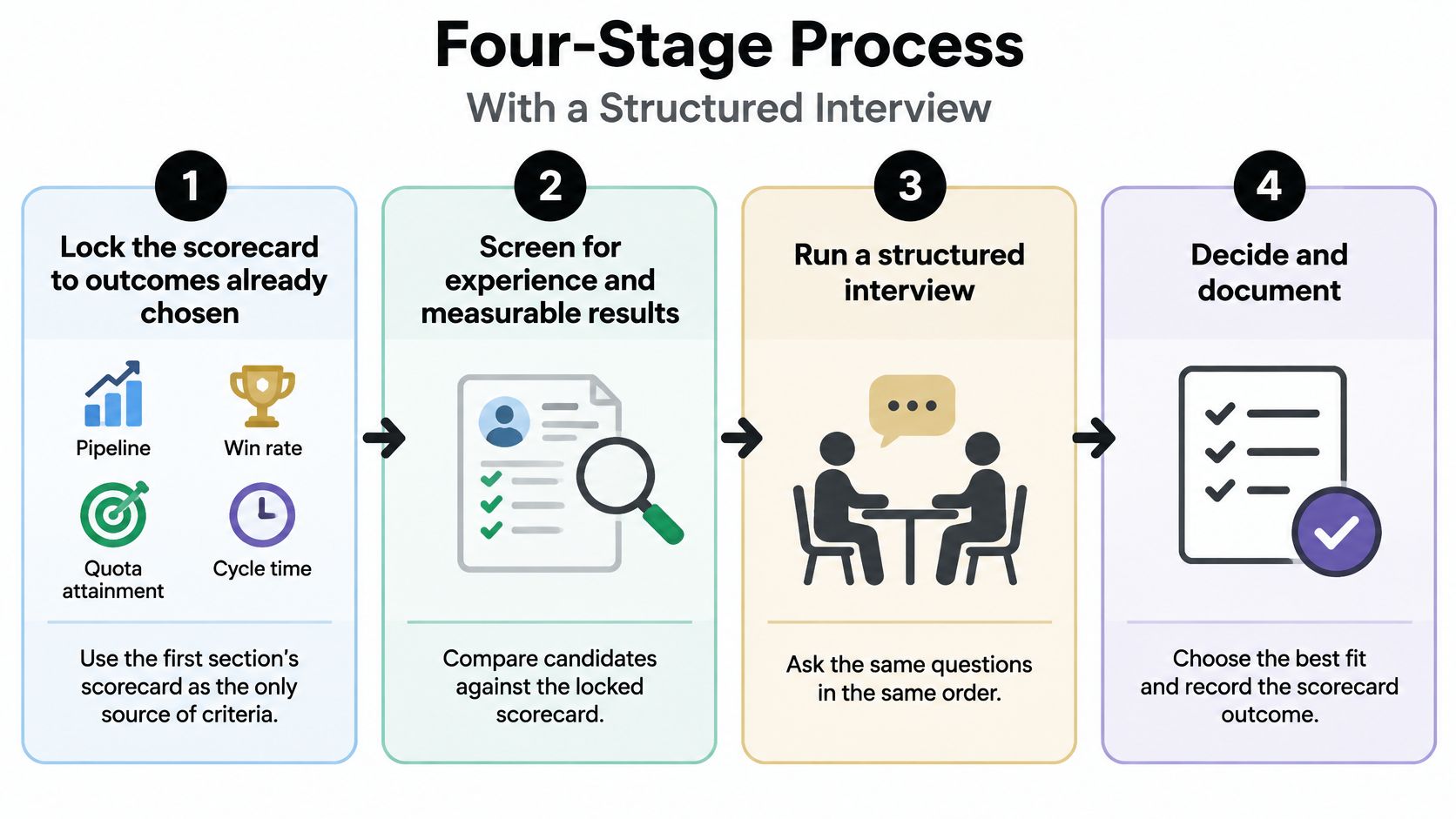
Four-Stage Process With a Structured Interview
Run the search in four stages, with the scorecard as your only source of criteria. The visual below maps the sequence you'll apply to every finalist.
Stage 1 Lock the scorecard
Translate the role into measurable outcomes. Pick the ones your business runs on, such as qualified pipeline, win rate, quota attainment, sales cycle length, and ramp time. Keep SDR, AE, and account manager cards separate, and weight each outcome before you meet anyone.
Say you're hiring an outbound AE. Discovery and qualification might carry the heaviest weight because weak qualification creates late-stage losses months later. For an account manager, commercial judgment and forecast accuracy deserve more weight. Write the weights down so a charismatic candidate can't move the goalposts.
Stage 2 Source against competencies
Screen resumes and profiles against those outcomes, not job-title similarity. Someone titled AE who only worked inbound leads hasn't shown outbound prospecting. Look for deal size, cycle length, tools used, and motion that resembles yours. Channel choices matter less than this filter, and you'll waste less interview time if it holds.
Stage 3 Interview every finalist the same way
Most sales hiring breaks down at this stage. A structured interview asks every candidate the same questions in the same order and scores answers against defined behavioral anchors. A synthesis of 85 years of personnel-selection research found predictive validity of 0.51 for structured interviews, compared with 0.38 for unstructured interviews, in a summary of that personnel-selection research. The gap matters because unstructured chats reward charisma and polish.
A separate line of evidence points the same direction. The meta-analysis of 31 interview studies found an average interview validity coefficient of only .27, with estimated true validity of .38, and interview structure was the only examined characteristic that moderated validity. In plain terms, how you run the interview changes how much you can trust it.
Years of experience and a clean resume don't predict selling. Scored evidence from the same tasks does a better job.
Use the same six prompts for every finalist:
Prospecting story: Walk through one account you opened from cold, with names, touches, and outcome.
Walk-away example: Describe a qualification call where you disqualified the deal and why.
Live objection: Handle a real objection on our product, given on the spot.
Discovery simulation: Run a 15-minute discovery call on a named persona we sell to.
Missed forecast: Explain a deal you forecasted to close that slipped, and what you changed.
Written follow-up: Write the follow-up email from that discovery call within a set time.</li>
Two interviewers score independently before comparing notes. Rate each answer 1 to 5 on discovery questioning, qualification logic, objection handling, commercial judgment, and CRM discipline. Every score needs written evidence, a quote or observed behavior, not an impression. Our list of qualities that make a good salesman can help you write the behavioral anchors behind each score.
Set the pass mark before interviews start. A workable rule is no score below 3 on discovery or qualification, and an average at or above 4 overall. Weight the discovery simulation and written task above the conversation, because they're the closest thing to the actual job.
Stage 4 Validate and track the cohort
Check specific claims with targeted references. Ask the reference about the prospecting story, the missed forecast, and quota context, not general character. Then track every hire at 30, 90, 180, and 365 days against the gates you set. Compare interview scores with real outcomes by role and segment.
Assign one rubric owner before the first interview. That person maintains the questions, trains interviewers, and runs the first 30-day review on a fixed date. Without an owner, structure decays into habit within two hiring rounds.
Sourcing Channels and When Volume Is the Wrong Fix
Start by matching the channel to the role, not by posting everywhere. The table below compares common channels by best use, speed, and the way each one usually fails.
When you're screening by demonstrated skill rather than employer name, HiredBySkill's skills-first sales listings give you a reference point for how skill-led postings read. Pair that with a disciplined internal process for searching candidates against fixed criteria, and the channel matters less than the filter.
Stop when volume is masking role design
More applicants won't fix a job qualified people keep rejecting. A compilation of sales hiring and ramp figures cites employers reporting difficulty finding qualified sales candidates at 74%, annual sales turnover around 34–35%, and SDR turnover around 40%. At those levels, reposting the same ad usually recycles the same problem.
Run a short pre-source test before you spend on reach. Check whether current reps hit quota, whether leads cover the activity targets, and whether territory ownership is clear. If quota is widely missed or activity expectations don't match lead supply, pause sourcing and fix the motion. Hiring into a broken model produces another exit, not coverage.
Pause test: If your current team can't succeed in this territory with this quota, a new hire from a bigger funnel won't either.
Skills-based screening reduces the noise when you do source. In 2024, 51% of private-company executives said their organizations were increasing skills-based hiring to improve competitiveness, according to Deloitte's Private Company Outlook. A scored work sample does this concretely. It also cuts resume bias for remote candidates in Latin America, where a discovery role-play and written task show more than a foreign employer's brand name.
Pick one primary channel and one backup. Count applicants weekly against the scorecard, not in total. If the qualified count stays at zero for two weeks, change the channel or rewrite the role, don't just raise the posting budget.
Pay Rules Onboarding and a Missed Quota
A candidate who signs without seeing the pay mechanics has signed half a contract. Quota works like a second agreement inside the offer letter: if its terms live in someone's head, the rep will discover them the hard way, usually around the first disputed commission check. The checklist below covers the terms to define before that candidate compares you with a competing offer that shows its math.
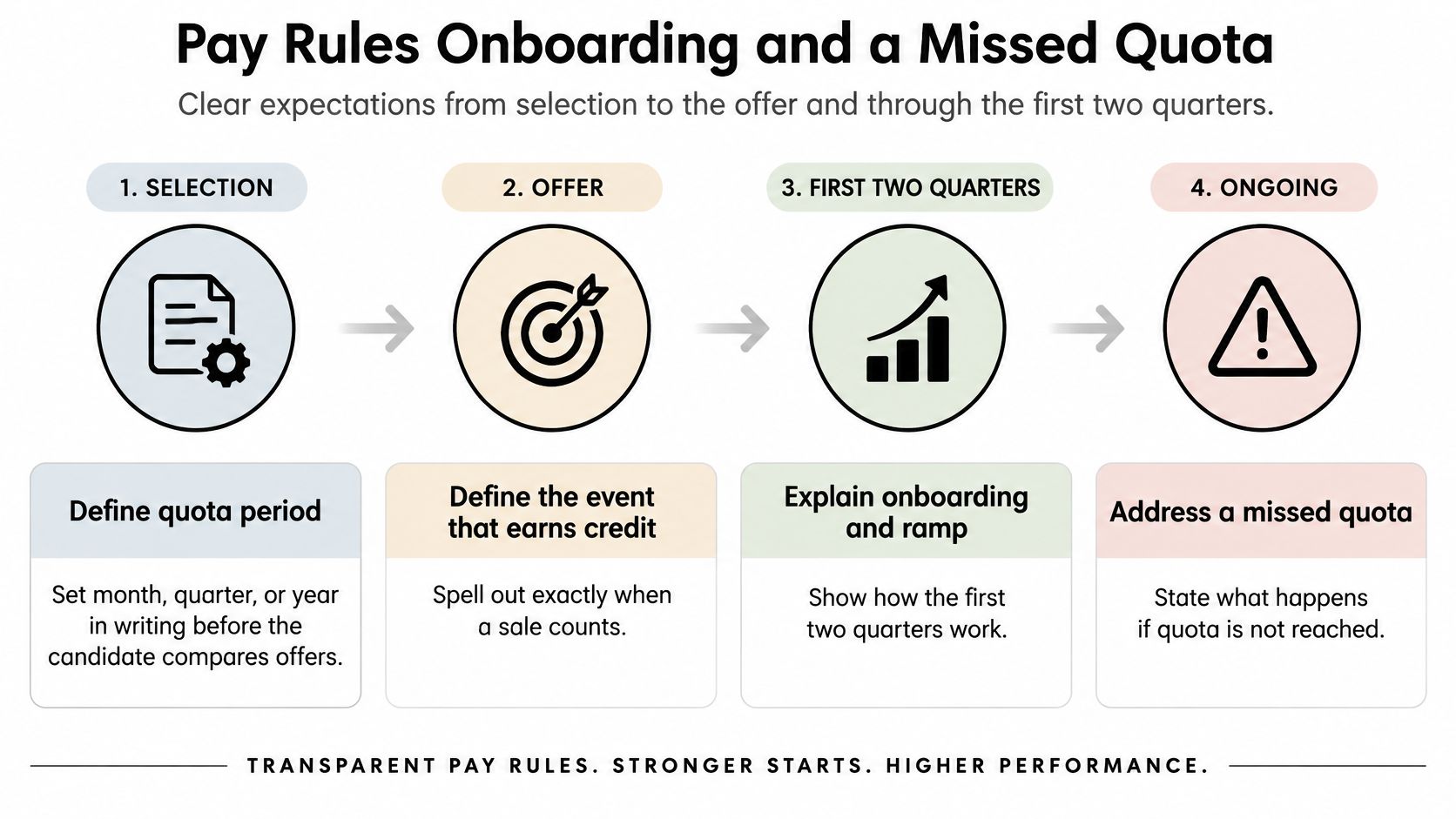
Write the pay mechanics before the offer
Define these items in writing, in plain language:
Quota period: State whether quota runs monthly, quarterly, or annually.
Credit event: Name what earns credit, such as signature, invoice, cash collection, or recognized revenue.
Pay mix: Show the base and variable split, plus commission rates at each attainment level.
Accelerators and thresholds: State whether accelerators start at 100% attainment and whether a threshold below which variable pay is zero applies.
Payment timing: Give the actual pay date rule, not a promise to pay promptly.
Edge cases: Cover cancellations, renewals, multi-year deals, split credit, and deals assigned after someone leaves.</li>
A target salary plus uncapped commission tells a candidate nothing they can price. Uncapped upside against an unattainable quota is worth less than a capped plan against a reachable one, and experienced reps know it. When you model expected earnings, use your own last four quarters of average contract value, conversion rate, and attainment before any external benchmark. Our breakdown of SDR compensation plans in LATAM shows how to structure these mechanics for remote teams.
Onboard to gates, then diagnose a miss
Onboarding follows the ramp scorecard. Schedule product and CRM training week by week, name the coach, set a shadowing target for live calls, and hold back full-quota judgment until the ramp date passes. Judging a rep at full quota in month one is like grading a student on chapters nobody taught. For a general sequence of onboarding stages you can adapt to your sales cycle, see how to improve employee onboarding with Voicedial.
The short video below walks through how pay rules and ramp expectations connect during the first quarters.
Treat a missed quota as a diagnostic, not a verdict on the newest hire. When a large share of sellers across the market miss quota in a given year, a miss at your company often signals calibration trouble: a target set above what the territory, lead flow, or ramp time can support. The pattern of the miss points at the fix.
Track attainment by cohort, segment, territory, tenure, and pipeline source before assigning blame. Then run the retention check that belongs at this stage: market pay, attainable quota, clear territory, a visible promotion path, and a manager who coaches calls weekly. Candidates stay when those five hold up after the offer. When one breaks, the exit you blame on the hire is a design problem the next hire will inherit.
Choose In-House Hiring or a Fixed-Fee Partner
Decide based on whether the documents exist, not on vendor preference. Run the search in-house when one manager owns the scorecard, two interviewers can score independently, and someone is accountable for reviewing the cohort at 30 and 90 days. That's a real system, and it doesn't need outside help for a single well-defined role.
Bring in a partner when that owner doesn't exist, or when you need remote SDR and AE coverage and in-house sourcing keeps returning title matches. For a single sales search, start with our dedicated hiring service. When you need ongoing recruiting capacity across several roles rather than one requisition, look at our RPO model instead. Our explanation of how a fixed-fee recruitment agency works covers the pricing logic before you talk to anyone.
Either way, draft three documents first:
Ramp scorecard: Gates by month, plus the support the company owes at each gate.
Credit and quota rules: The written pay mechanics a candidate can read before signing.
Interview rubric: Questions, work sample, anchors, and pass marks set in advance.</li>
A partner who receives these can source against the actual job. Without them, any partner is inventing your role, and you'll get polished resumes instead of evidence. Our Recruitment plan is fixed-fee hiring for tech, sales, and operations roles across LATAM, starting from $2,999, with no upfront payments on sales recruitment. To start, you book a call with our team or send a message describing your hiring needs, and we respond within 24 hours.
Take the next step only after the three documents exist. Book the partner call with them attached, or schedule your first in-house slate against them this week.
If you're hiring SDRs or AEs against a written ramp plan, we can source and screen candidates against your scorecard, work sample, and pay rules instead of sending resume volume. Tell us the role, the territory, and the ramp gates you're hiring to, and visit GENTY recruitment to start the conversation this week.