
More engineers can slow a startup down. Coordination overhead arrives before capacity does: each new person adds review paths, decision points and a wider shared picture of the system that somebody has to maintain, and per-person output drops before total output climbs.
So the useful question at Series A to C isn't how many engineers you should have. It's which constraint is holding the roadmap back this quarter, and what structure removes it. In practice that means one cross-functional group under the CTO until roughly eight engineers, two or three squads of five to eight after that, managers once direct reports pass eight, and a platform function when infrastructure work starts repeating. The same logic governs how you design a distributed team across time zones, which is where most stage-based guides stop short.
Startup Engineering Team Stages at a Glance
Most startups begin with a single cross-functional group owned by the CTO, split it into two or three squads once it passes about eight engineers, then add managers and a platform function as headcount rises. The table below is the shape I'd plan against.
Read those ranges as planning ranges, not thresholds that trigger a reorg on their own. A company with strong ownership and senior engineers can sit above its row for a year without pain. A company below its row with murky ownership is already late.
Need help hiring?
See the next step after this guide
If this topic is relevant to your team, these are the most useful pages to check next.
Pre-seed, one group owned by the CTO
One to four engineers, founders still writing much of the code, one group, one owner. Nobody is specialized yet, and the CTO reviews the pull requests that carry real risk. The next hire is a senior full-stack engineer who can carry a product area without supervision.
Seed to Series A, two squads and shared platform duties
Eight to 15 engineers split into two squads of five to eight. Platform work is shared until deployment failures or repeated infrastructure chores make it a role. The next hire is usually a DevOps or QA automation engineer, because deploys and regression coverage have become nobody's job.
Series B, product squads plus a platform group
Fifteen to 30 engineers, three or four product squads, and a platform group whose purpose is self-service environments, CI/CD and observability. Managers come in for any squad above eight people.
Series C, domains and a director layer
Thirty to 60 engineers across product domains, with platform, security and data functions and a director managing the managers. The CTO stops reviewing code and starts owning technical direction and org design.
The baseline from real hiring data supports this shape. At the median B2B software startup studied across the US, UK, Canada, Australia, Ireland and New Zealand, the first engineering hire was employee number 2 and the first salesperson arrived at hire number 7; engineering made up 41.1% of hires 1 through 5, falling to 34.0% by hires 16 through 20 as commercial functions scaled (first 20 hires research). Product-building capability gets assembled first, then the go-to-market layer catches up.
Self-check: If your team matches the row for your stage, keep the shape. If your squads are drifting past eight people or routinely waiting on each other, you've outgrown it regardless of headcount.
Why Small Cross-Functional Squads Beat Silos
Picture a kitchen where one station chops, a second cooks and a third plates. Every order waits in line between stations, and a dropped ticket between two of them belongs to nobody. That's a department structure. A squad is the small restaurant crew that takes an order from prep to plate, and the difference shows up in how long a change takes to reach a customer.
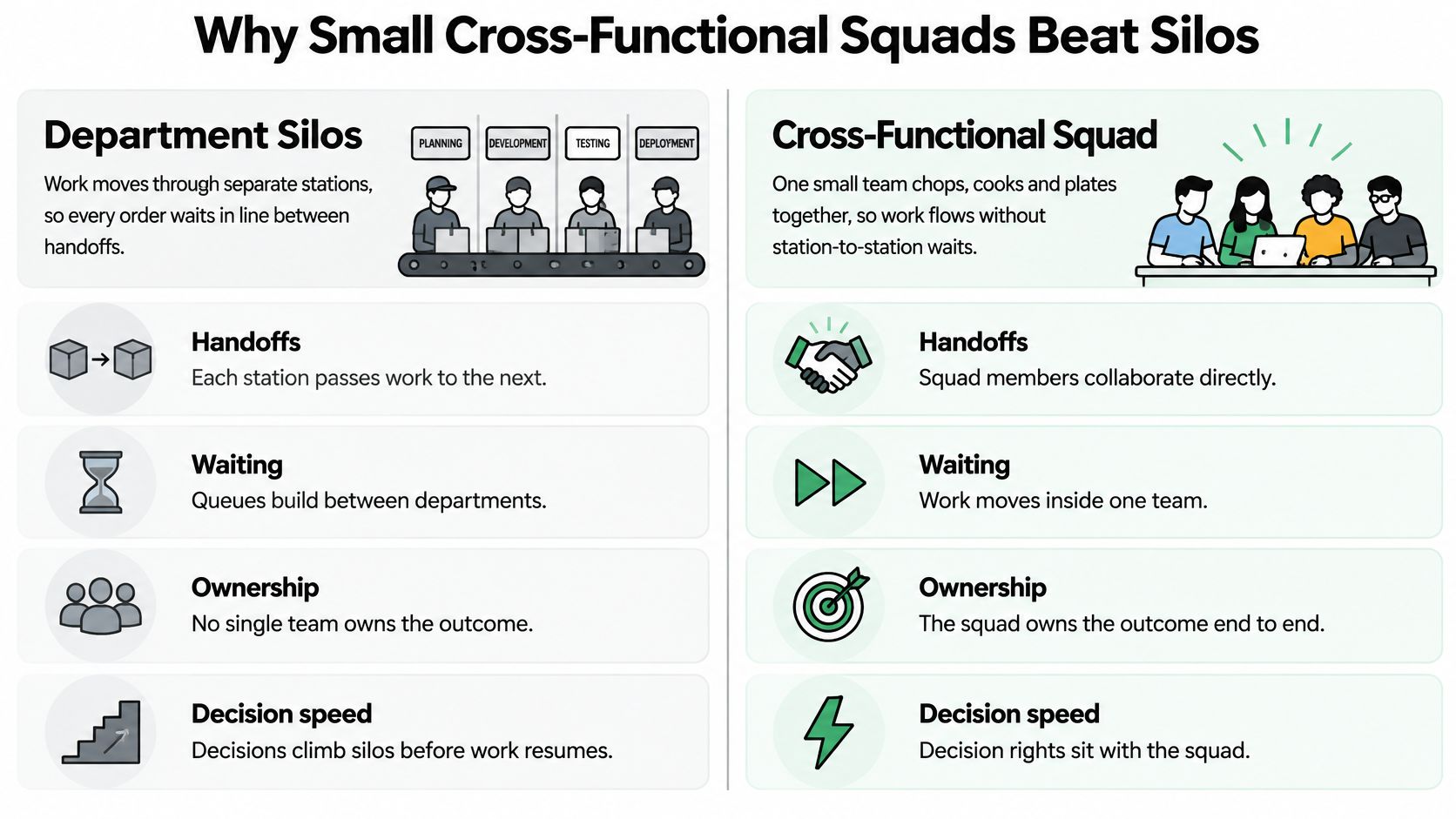
Each handoff adds waiting time, rework and a chance for context to evaporate. The evidence on this is unusually consistent. A 2016 study of 58 open-source projects, more than 580,000 commits and over 30,000 developers found a negative relationship between team size and per-developer contribution, read through the Ringelmann effect as coordination overhead rose (Empirical Software Engineering study). Growing collaboration networks tracked with declining individual productivity.
The 2021 DORA research report found that 62% of respondents worked on teams of 10 or fewer people, including 27% on teams of 2 to 5 and 28% on teams of 6 to 10. Small, product-aligned groups are the norm among high performers, not a compromise you make before you can afford departments.
A squad should own discovery, implementation, testing, deployment and production feedback for one product area. That works because the people closest to the code also feel the consequences of it. The organizing idea is product engineering rather than a ticket queue with a frontend lane and a backend lane.
Practical rule: Add a specialist only when a specific handoff keeps causing delay, and name that handoff in writing before you open the role.
Core Engineering Roles and Reporting Lines
Full-stack or product engineers make up most of the early team and should be able to ship a feature without a relay race. A tech lead appears around four engineers, not because the title is due but because design review and sequencing now consume real hours. An engineering manager carries five to eight engineers and owns hiring, feedback and delivery health, and shouldn't be the strongest coder in the group.
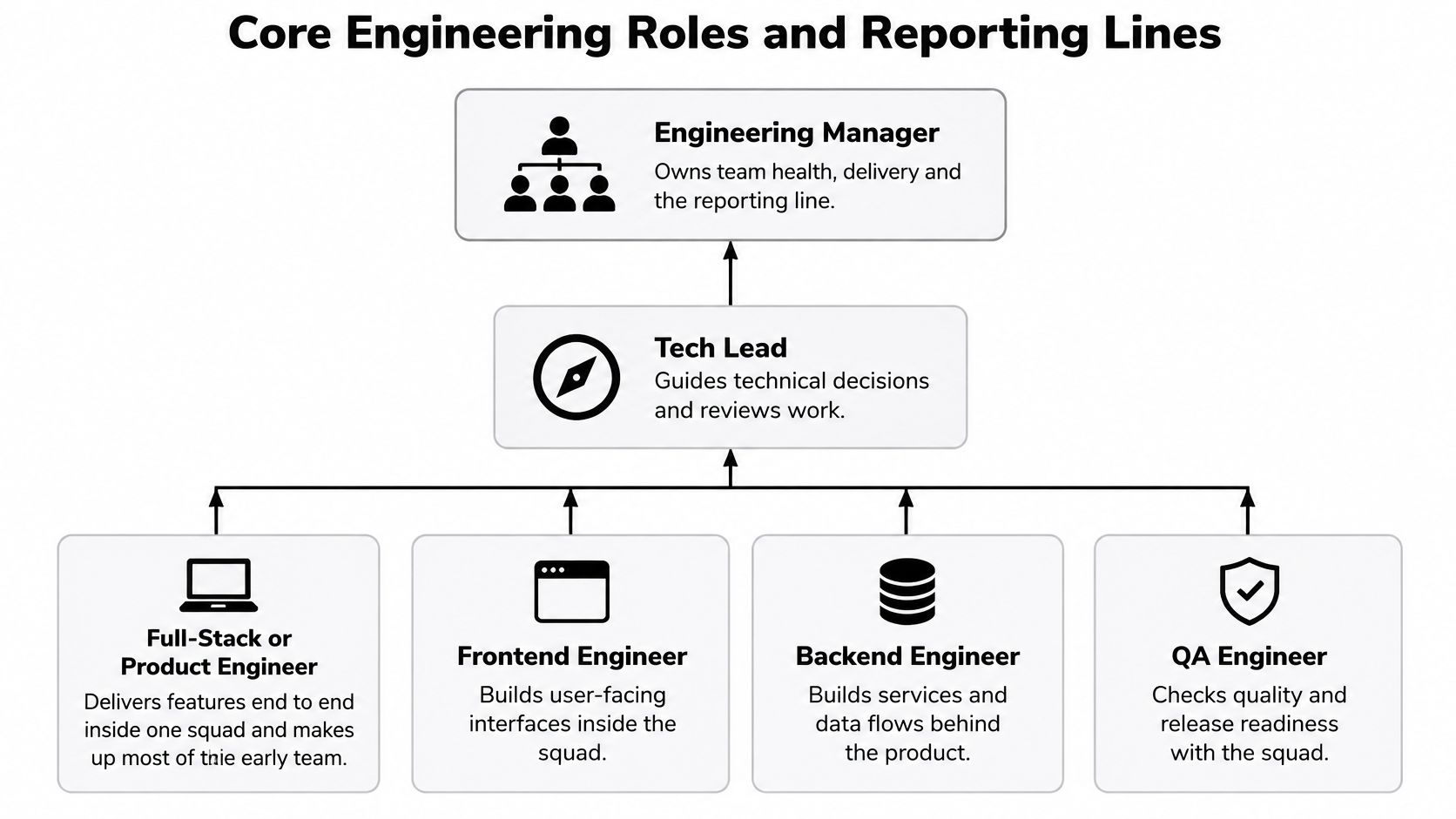
Platform and QA roles are the ones startups create too late and staff too narrowly. A platform engineer builds self-service CI/CD, environments, observability and security guardrails. The moment that function turns into a ticket queue, product teams are slower than they were before it existed. If you're hiring that role, our engineering manager search page shows the seniority level that usually owns this transition.
The reporting rule
Every engineer reports to exactly one lead who sees their work daily. Before the first manager exists, that lead is the CTO, and that's acceptable as long as the CTO is reviewing code and unblocking people rather than sitting in fundraising meetings all week. Never let an engineer report to a product manager and a tech lead at the same time; split accountability produces neither coaching nor delivery.
Where the org chart becomes the architecture
System boundaries tend to mirror communication boundaries, which is the practical lesson of Conway's Law. Split frontend, backend, data and infrastructure into independent groups too early and the architecture will accumulate coordination-heavy interfaces and ownership gaps that outlive the org chart that created them.
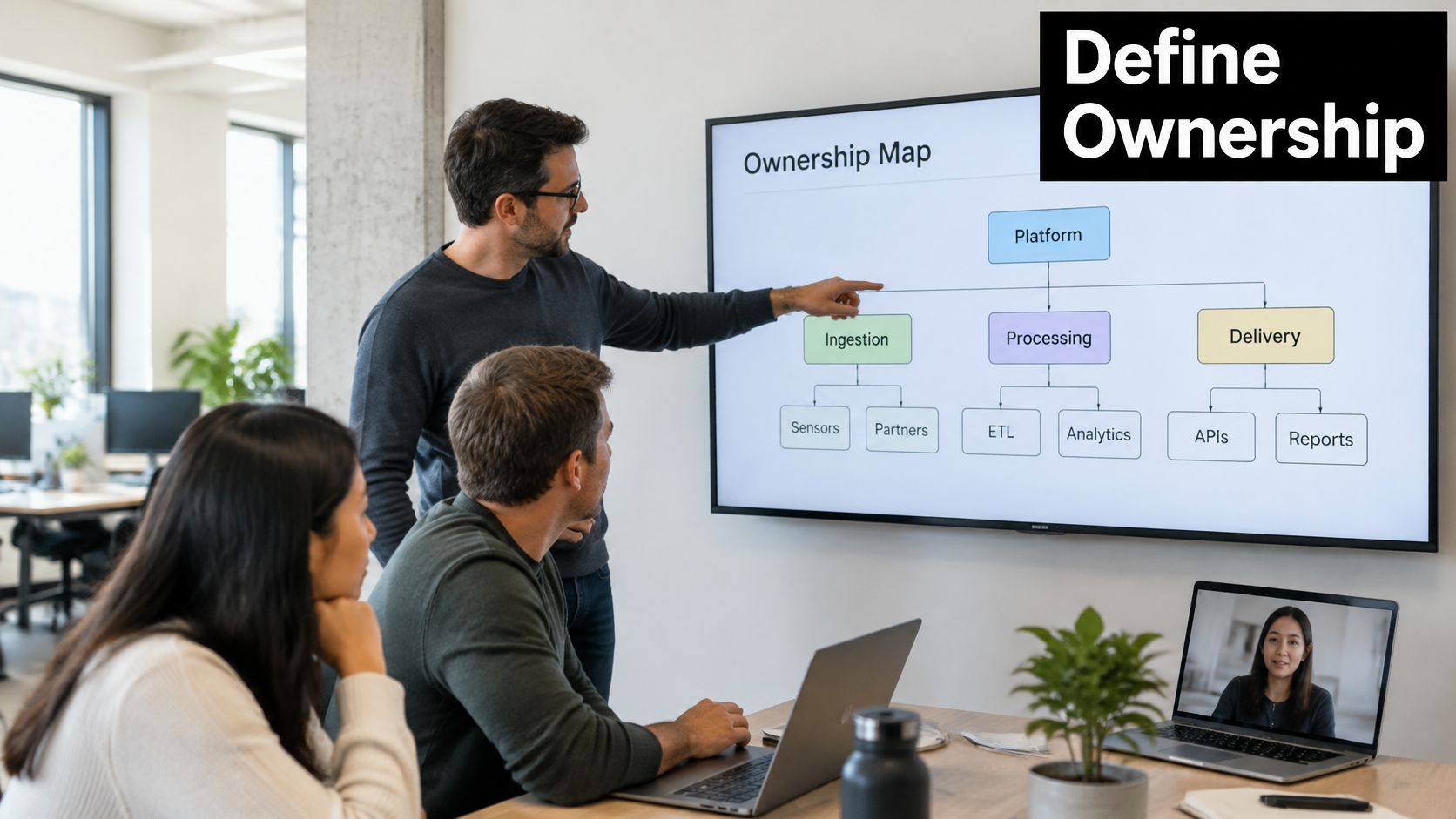
Name one service owner per product area, using the same reporting logic as everything else, and publish the escalation path and the interface contract with it. Take a seven-engineer company with two squads, one tech lead in each, and a CTO running a weekly architecture review. Each squad owns its services in production. The on-call list is one line per service, next to the owner's name, and it changes only when ownership changes.
Growth Triggers and Manager Timing
The instinct when the roadmap slips is to add engineers. It's usually premature. A bigger flat team doesn't move faster; it produces more coordination work per person, and the CTO becomes the routing layer for every decision that crosses a squad boundary.
Split at eight, not at fifteen
One rule covers most of it. A squad splits once it passes eight people. The reference points line up: Harvard's J. Richard Hackman identified four to six members as optimal and recommended staying below ten, Amazon's two-pizza rule maps to roughly five to eight, and the Scrum Guide caps a team at ten or fewer. Gallup guidance puts a strong managerial span at five to seven direct reports, with about eight the common engineering rule of thumb and more than ten a warning that the group needs to split (Mismo's guide to structuring engineering teams).
Wider spans are a live trade-off. Startup managers now supervise roughly 15 engineers on average, up from about 10 in 2019, according to a 2026 analysis of large software teams in the AI age. That flattens the org chart and speeds decisions, and it also hides the work that has no deadline: mentoring, architecture review, incident learning and performance feedback. A manager with 15 reports isn't managing; they're triaging.
Say a CTO holds 11 direct reports. The fix isn't a new layer of three managers. Split into two groups of five or six, promote a senior engineer to tech lead for one group, and keep architecture review across both so the interfaces stay aligned.
Six triggers with a response and a metric
Squads wait on product decisions. Add product-focused engineers or a product manager, and confirm the fix with lead time for changes.
Deployments are risky and rollbacks are frequent. Add platform or QA automation and watch change-failure rate.
Ownership is unclear and work stalls at the seams. Add a tech lead or an engineering manager, judged by lead time and by how many decisions still reach the CTO.
A squad passes eight people. Split it, keeping one bounded mission and decision authority per group.
Support or revenue work outpaces engineering. An analysis of Series A hiring found engineering at 21.5% of hires against 19.8% for sales, a 1.8-point gap inside the study's margin of error (Series A hiring analysis). Product, operations and go-to-market have to scale with engineering, or output piles up at a narrow commercial door.
A funding round, pivot or major tooling change lands. Review the whole structure instead of bolting on a role.</li>
The AI variable
AI tooling may change the ratio between headcount and output. A recent benchmark puts AI-native startups at five to 12 engineers at Series A rather than eight to 15, with 40 to 60 percent higher code output per engineer (a directional claim from the same large software teams analysis, not a productivity law). Validate it against change-failure rate, incident volume and customer outcomes before you reset a hiring plan around it.
Run a quarterly headcount and structure review every quarter and reassess fully after every funding round, product pivot or platform migration. The last question is the one most companies skip. Does the engineer you're about to promote want to manage people, or lead technically? A tech lead track and a management track cost nothing to define and prevent your best architect from becoming a resentful manager.
The trigger is never the headcount number on its own. It's the work that stopped moving.
Structuring Nearshore and LATAM Engineering Teams
Most distributed plans fail on three questions they never wrote down. Which functions need same-hour coverage, covering incident response, planning and architecture review? Does a LATAM engineer report to a US manager or to a regional lead? How does on-call rotate across the overlap window? A team can have exactly the right number of engineers and still stall on all three.
Location is now a design variable rather than an exception. 32.4% of developers work fully remotely and another 50% work hybrid, so more than four in five aren't office-bound at all (2026 software development trends). Structure around capability ownership, not geography: product squads aligned to customer outcomes, a light platform function, explicit overlap windows, written decision records and a named service owner per area.
Overlap is measurable by country, which makes the coverage question answerable with a table instead of a feeling. Brazil, Argentina and Uruguay sit at UTC-3, Chile at UTC-4 in standard time, and Colombia and Peru at UTC-5, which produces roughly six to eight hours of overlap with a 9 a.m. to 5 p.m. US Eastern day when local staff work 9 a.m. to 6 p.m. (LATAM software development statistics). Pacific alignment runs three to five hours, with later local schedules covering West Coast mornings.
Put teams that serve Eastern-time customers or run Eastern-time systems in Colombia and Peru. Use the UTC-3 countries when you want broader Eastern overlap plus coverage extending later into the US afternoon. Country choice also has to account for role scarcity, employment arrangements, local compliance and how many hours a week production incidents need.
That last point decides whether a nearshore team is real or decorative. A group that's excluded from architecture meetings, or can't reach the on-call engineer during the customer's business day, is a subcontractor with a nice title. The comparison between nearshore and onshore hiring models usually comes down to exactly this operational detail rather than to rates.
Distance doesn't force you to duplicate a local team. It does force deliberate interfaces and escalation paths, in writing, before the first person starts.
Pick Your Next Engineering Hire
Three steps settle the next hire. Name the constraint using the triggers above. Match it to a role in the roles table and write down who that person reports to. Then decide where the role sits: a local hire when same-hour collaboration is the whole point, or a nearshore LATAM hire when overlap with Eastern or Pacific hours matters and the role is hard to fill locally.
For engineering searches we run the process end to end through IT recruitment, and for teams that want us to hire, onboard and manage the engineers directly, staffing covers that too. Matching seniority before comparing numbers is what keeps the cost conversation honest, which is the same discipline behind any sane tech talent strategy.
Compare fully loaded cost, not headline salary. One regional comparison puts senior full-stack engineering at about $98,000 all-inclusive in LATAM against $165,000 US base, and mid-level at about $70,000 against $125,000, roughly 41% and 44% lower before US benefits and overhead (LATAM developer cost comparison). Add recruiting fees, employer-of-record costs, equipment, leave, currency exposure and replacement risk before you call it a saving.
Write the org chart this week. One page, one owner per service, reporting lines, on-call rotation and overlap hours, before you post the next job.
GENTY recruitment helps Series A to C teams build remote engineering organizations across Latin America, starting with a free consultation for companies building a remote engineering team and an intake session that covers tech stack, seniority, team structure, culture, working style and timezone requirements. Each role gets a dedicated consultant matched to it, so you get a shortlist built around the constraint you named rather than a pile of resumes. Visit GENTY recruitment to start with the org chart you just wrote.