
A technical interview scorecard is a fixed set of job-related competencies with written behavioral anchors, scored independently by each interviewer before the panel discusses a candidate. A 2022 meta-analytic estimate puts the corrected predictive validity of structured interviews at 0.42, compared with 0.19 for unstructured interviews, but that correlation with later job performance is not a 42% chance that a candidate will succeed, as explained in The Behavioral Scientist's review of structured interviews.
For a CTO or hiring leader, the practical point is simple: a scorecard gives interviewers shared criteria and preserves evidence for the decision. It won't eliminate uncertainty, but it can stop a debrief from turning into a contest of confidence.
Why Technical Interview Scorecards Beat Gut Feel
In an unstructured loop, four interviewers might leave notes like "felt senior" and "good vibes," then enter a debrief with no common standard. The loudest voice can shape the decision, while the team has little evidence to test that person's impression.
Consider a Series B team where two interviewers give the same candidate a 4 and a 1. Neither recorded specific evidence, and nobody can explain the gap. The panel can't tell whether the candidate's performance varied, the interviewers applied different standards, or one score reflected personal preference. A technical interview scorecard makes that disagreement visible before it becomes a hiring decision, because each rater commits to a written judgment against the same anchors.
Planning a hire?
Talk through the best hiring option
This article usually leads to one practical question: should you use it recruitment or staffing? We can help you choose quickly.
Simple next step
Start with it recruitment and we will help you pick the best hiring setup.
It adds three practical controls: comparable scores across interviewers and time zones, written disagreements the panel can examine, and decision rules set before anyone meets the candidate. A structured rating remains a signal with error in it, so a hiring decision should combine interview evidence with a relevant work sample or job-knowledge test rather than rest on one measure.
Two cautions keep the instrument honest. First, a scorecard only earns trust when its scores are later checked against post-hire outcomes; a rubric that never predicts on-the-job performance is documentation, not measurement. Second, standardized coding tasks can reward preparation and access, such as paid practice platforms, coaching and free time, as readily as job ability, so the anchor should describe the reasoning you want to hear rather than the polished solution. The structured hiring guide for startups offers a related framework for making hiring criteria explicit.
Define Competencies From the Role, Not a Generic Engineer Profile
Start with an intake session before scheduling interviews. Gather the tech stack, seniority, team structure, working style, timezone needs, and what success in the first year means. Every search at GENTY recruitment starts with a detailed intake covering the role's tech stack, seniority, team structure, culture, working style, and timezone requirements.
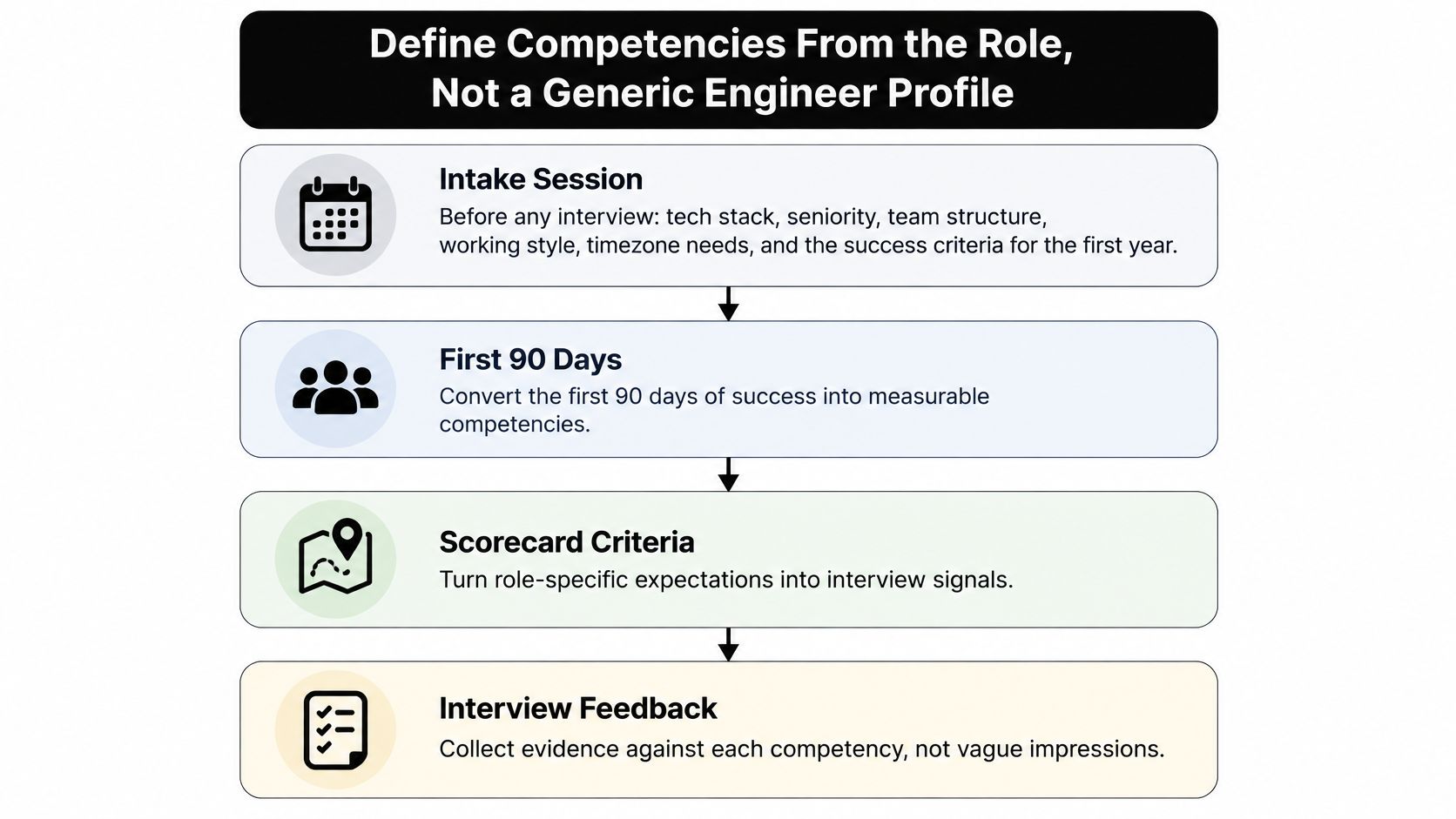
Turn that intake into a concise scorecard with these steps:
Select real work. Pull three to five critical tasks from the job description and the manager's account of what a strong first quarter looks like.
Name the capability. Convert each task into a one-line competency, such as “diagnoses a production incident using logs and metrics.”
Separate requirements from advantages. Mark each competency essential, meaning it must pass, or optional, meaning strength here can offset a weaker optional area.
Keep the list focused. Aim for five or six competencies. Extra rows can dilute attention and make the score harder to interpret.
Define observable behavior. State what the interviewer should be able to hear, see, or inspect. “Strong problem-solver” isn't observable; a clear explanation of a hypothesis and how to test it is.</li>
The role determines the competencies. A senior DevOps scorecard might emphasize incident diagnosis, infrastructure-as-code judgment, security awareness, and operational communication. A frontend scorecard might prioritize browser performance, accessibility, testing, and component design. Generic traits such as “culture fit” don't tell an interviewer what evidence to collect.
The skills-first hiring approach can help teams focus on demonstrated capability rather than resume labels. The U.S. Office of Personnel Management's structured interview guidance supports deriving competencies from job analysis, which is associated with higher validity, rater reliability, and rater agreement than relying on generic traits. It also notes that behavioral-description interviews are useful for complex professional and managerial work.
The must-pass flag prevents a familiar scoring error. If every row is added into one total, broad experience or strong communication can mask a failure on a requirement the person must handle on day one. A candidate who can't diagnose production incidents shouldn't pass a senior DevOps loop because they scored highly on optional strengths.
Build a Weighted Rubric With Behavioral Anchors
Use four levels, but define each level through evidence rather than adjectives. The example below anchors a debugging competency. The decision effect matters as much as the score: it tells the panel what the rating can and cannot support.
Google's published structured-interview framework uses vetted, role-relevant questions, written feedback, standardized rubrics, and interviewer training or calibration. Its anchors distinguish outstanding, solid, borderline, and poor responses. The same principle applies here: interviewers need shared behavioral descriptions, not a shared list of flattering or critical adjectives.
Build the scorecard in this order:
Create one row per competency. Include its definition and the question or exercise that tests it.
Write an anchor for every score. Describe actions, explanations, and trade-offs the candidate demonstrates at each level.
Require evidence before a rating. The interviewer records a quote or specific observation before selecting a score. “Good communicator” isn't evidence; “explained the rollback sequence and confirmed the data risk” is.
Collect scores independently. Each interviewer submits ratings before the debrief, so early opinions don't become the group's default.
Map ratings to recommendations. Use strong hire, hire, no hire, and strong no hire, with written reasons.
Set a must-pass rule. If an essential competency falls below Solid, the candidate can't be hired, regardless of the total score.</li>
Avoid making a single total-score cutoff the decision. Adding scores can disguise a critical gap, while a precise cutoff implies more certainty than interview ratings can provide. For a 60-minute loop, an interviewer might cover three competencies and record evidence within ten minutes after the session. The scorecard should be short enough that this happens consistently.
Clear notes make this practical. Interviewers who want a repeatable way to capture observations can use these note-taking strategies for busy professionals and adapt them to the scorecard's evidence fields.
Sample Scorecards for Backend, Frontend, DevOps and QA Roles
Treat each scorecard as a measurement instrument: the weights below are starting points, not universal formulas. Adjust them to the role's first-year outcomes, and make the must-pass item the failure that would be most expensive to address after hiring. Once the card is live, compare its ratings with what the people you hired deliver, and revise any competency that scores well at interview but poorly on the job.
The point of the work sample is to see job-relevant reasoning, not whether a candidate has memorized a familiar puzzle. A backend pull request can reveal how someone investigates concurrency risks. A flaky-test triage can show whether a QA candidate separates product defects from test instability. Choose a task that fits the role and give candidates a clear scope.
Standardized tasks can still create access problems. Candidates may prepare extensively for LeetCode-style questions, and people with more preparation time and resources can gain an advantage that doesn't reflect their day-to-day engineering ability. An industry survey found technical discussion was used by 75.27%, resume review by 71.61%, live coding by 49.82%, and realistic work samples by 21.06% of respondents, according to the survey published at arXiv. Work samples sit at the bottom of that list even though they come closest to real job conditions.
For each competency, label the evidence observed directly, inferred, or unsupported. If a loop scores debugging but never asks the candidate to debug, the rating isn't evidence. Track completion and pass rates by seniority and geography where lawful, and check whether a coding exercise rewards recall under pressure or the debugging and documentation the job requires. For role-specific prompts that fit the scorecard, use this collection of technical interview questions.
Structured interviews have consistently shown higher validity than unstructured interviews, as reported in the meta-analysis on interview format and structure. Structure helps make candidates comparable, but it doesn't make an artificial exercise representative of the work. Keep the rubric consistent, choose tasks that expose the skills the team needs, and treat every score as a prediction to be checked after the hire rather than a verdict.
Calibrate Panels and Check Scores Predict Hires
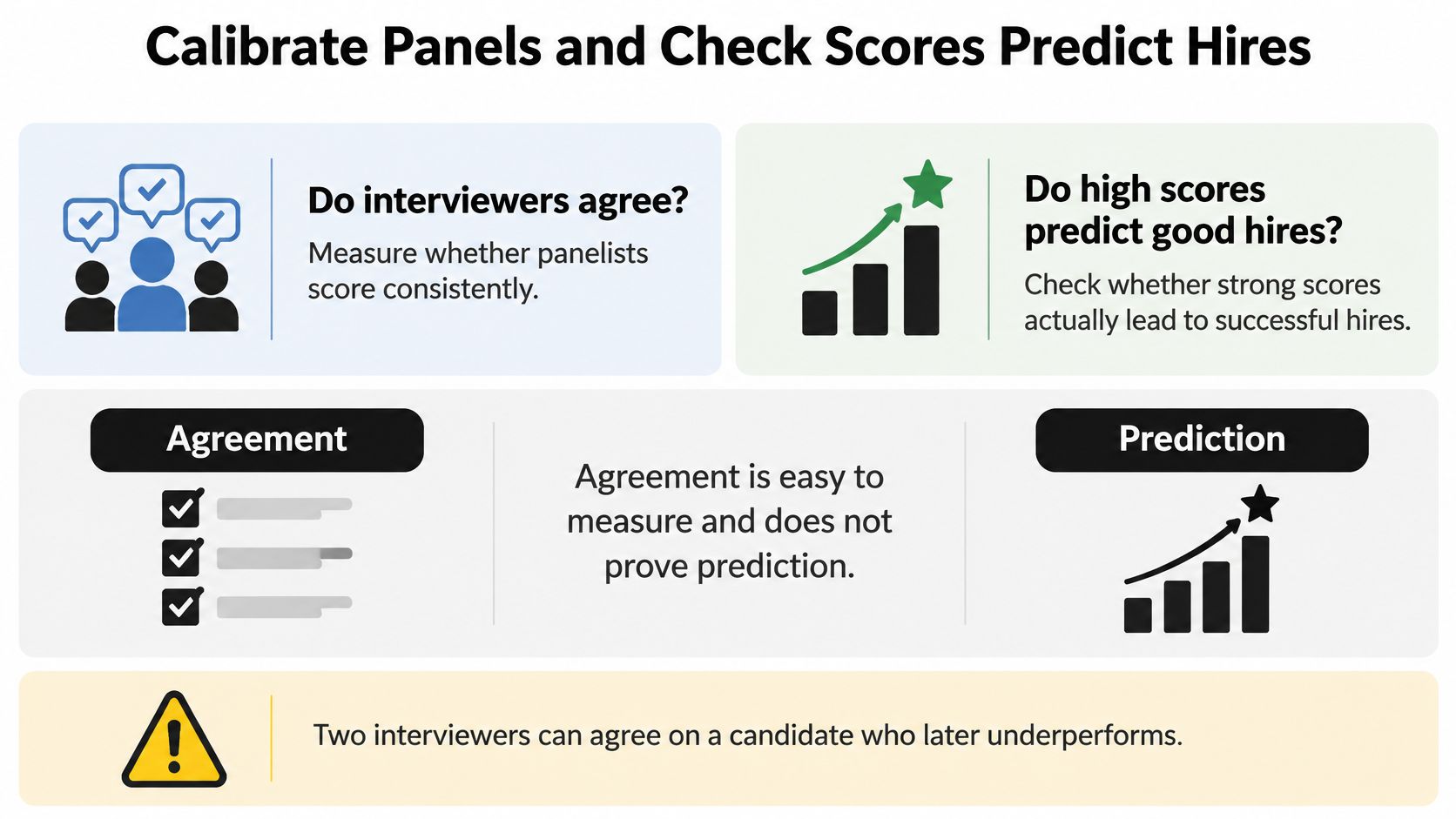
Interviewer agreement and predictive accuracy are different questions. Two interviewers can agree on a candidate who later performs poorly. The scorecard needs both a consistency check and a way to compare its ratings with post-hire outcomes.
A 2025 case study of AI-supported structured interviewing reported improved consistency and reduced subjectivity, but had no direct evidence connecting scorecard results to post-hire performance or retention, as described in the case study on structured interviewing. Standardization alone doesn't prove that a competency predicts success. Track evidence such as onboarding completion, production quality, incident handling, promotion, and retention, while recognizing that each outcome captures a different part of performance.
Calibrate how interviewers apply the anchors
Choose examples. Select three anonymized past answers: one strong, one borderline, and one weak.
Score separately. Each interviewer rates all three against the current rubric without seeing colleagues' ratings.
Investigate large gaps. Discuss any difference greater than one point. Rewrite an anchor when the wording permits reasonable but conflicting interpretations.
Repeat at change points. Calibrate before the first loop for a new role, after every ten hires, and when the stack or hiring manager changes. Treat those as operating rules, not scientifically established thresholds.</li>
Test what the score predicts
At 90 days and six months, compare interview ratings with onboarding completion, production quality, incident handling, promotion, and retention. Keep interviewer agreement separate from those outcome comparisons. A panel can apply its rubric consistently while the rubric measures the wrong thing.
Published guidance doesn't provide definitive thresholds for recalibration frequency, competency weighting, or removing a weak competency. Set a rule locally and document it. For example, decide to reconsider a competency if it fails to separate hires from rejects across twenty candidates, then record the decision and evidence in the scorecard's change log.
Remote and nearshore panels should also keep technical ratings distinct from communication ratings. Language fluency, communication style, time-zone collaboration, or familiarity with local interview conventions can otherwise contaminate the assessment of engineering ability. Teams hiring across locations can use these remote LATAM interview process practices to make the evaluation criteria explicit.
Pilot One Scorecard Before You Scale It
Choose one open role with predictable hiring volume and run the scorecard as a pilot. Don't introduce a new rubric across every engineering team at once; a focused trial makes it easier to identify confusing anchors and exercises that produce little useful evidence.
Build from the intake. Set the competency list, essential requirements, weights, and behavioral anchors around the role's actual work.
Calibrate the panel. Run a 30-minute session in which every interviewer scores three past answers and discusses disagreements.
Collect independent ratings. Require each interviewer to submit scores and evidence before the debrief.
Record funnel decisions. Note whether candidates were hired, rejected, or withdrew, along with the reasons and any missing evidence.
Review after 90 days. Compare the first-interview pass rate with early performance signals, then rewrite or remove competencies that didn't help distinguish candidates.</li>
For remote panels across time zones, score communication separately from technical content. A non-native English speaker's phrasing shouldn't lower a technical rating when the evidence shows sound engineering judgment.
Latin American engineers can be a strong nearshore option for US and European teams that need overlapping working hours. At GENTY recruitment, recruiters check technical depth, English, and availability before an offer is made, and every candidate completes a skills-based technical assessment before any client sees their profile. Teams revising their evaluation toolkit can also consult this guide to technical recruitment assessment tools.
Watch one number during the pilot: the first-interview pass rate before and after the scorecard is introduced. A change doesn't prove the rubric improved hiring quality, but it gives the team a clear starting point for checking whether the new process is changing who advances.
GENTY recruitment supports technical hiring with skills-based assessments and recruiting for nearshore engineering teams. If your scorecard needs a reliable candidate pipeline to test and refine, visit GENTY recruitment to discuss your hiring needs.