
Assessment center recruitment is a structured, multi-exercise evaluation methodology where trained assessors observe candidates performing job-simulated tasks to measure specific competencies. Unlike a single interview, this process uses multiple exercises, multiple assessors, and 6–12 competency dimensions to build a complete behavioral profile of each candidate. 34% of employers now use assessment centers for recruiting managers, professionals, and graduates. For tech and sales HR managers hiring across Argentina, Brazil, Mexico, and Colombia, this methodology delivers the predictive accuracy and bias reduction that high-stakes roles demand.
What is assessment center recruitment and how does the methodology work?
The term “assessment center” describes a standardized methodology, not a physical location. Candidates move through a series of exercises designed to simulate real job demands, while trained assessors record observed behaviors against defined competency criteria.
A valid assessment center includes multiple exercises, multiple trained assessors, and 6–12 competency dimensions evaluated per candidate. Each competency must appear in at least two separate exercises, and each candidate must be observed by at least two assessors. This redundancy is what separates the methodology from a standard panel interview.
Common exercise types include:
- In-basket exercises: Candidates process a realistic backlog of emails, tasks, and decisions under time pressure, revealing prioritization and judgment.
- Role-play simulations: A candidate handles a difficult client call or a sales negotiation with an assessor playing the counterpart.
- Group discussions: Candidates work through a business problem together while assessors observe collaboration, influence, and communication.
- Coding simulations: For tech roles, candidates solve a scoped engineering problem that mirrors actual sprint tasks.
- Presentations: Candidates prepare and deliver a brief on a business case, testing structured thinking and communication clarity.
After all exercises conclude, assessors meet in an integration session, often called a “wash-up,” to reach consensus ratings for each candidate. Skipping this session invalidates the process. It is the mechanism that removes individual rater bias and produces a reliable, defensible hiring decision.
Need help hiring?
See the next step after this guide
If this topic is relevant to your team, these are the most useful pages to check next.
Pro Tip: Design a competency matrix before building any exercises. This matrix maps which exercises evaluate which competencies, preventing gaps where a critical skill like technical problem-solving gets assessed only once.
Virtual formats have become standard for LATAM hiring. Platforms that support live video role-plays, timed digital in-basket tasks, and shared scoring rubrics replicate the in-person experience effectively. LATAM candidates in Argentina, Brazil, Mexico, and Colombia share significant timezone overlap with US EST and PST, making live, synchronous assessment sessions practical without scheduling strain.
How do assessment centers outperform traditional recruitment methods?
Assessment centers carry a predictive validity of 0.65 for job performance. Unstructured interviews score 0.20 on the same scale. That gap translates directly into fewer bad hires and lower replacement costs.
“Assessment centers gather multidimensional behavioral data that interviews cannot capture, providing nuanced insights especially valuable for high-stakes leadership and tech sales roles. The methodology’s strength lies in observing what candidates actually do, not what they say they would do.”
The foundation for this claim goes back to the 1956 AT&T Management Progress Study, which tracked career advancement over 25 years. Researchers found that assessment center ratings predicted managerial success far more accurately than academic credentials or interview performance. That study still shapes how modern assessment centers are designed and validated.
Triangulation drives the reliability advantage. When three separate exercises each produce behavioral evidence for the same competency, and two assessors independently record that evidence, the final rating reflects reality rather than one person’s impression. A single psychometric test cannot replicate this. Psychometric tests are one component of a complete assessment center process, not a substitute for it. Human observation in realistic simulations, combined with psychometric data, produces the highest predictive accuracy.

For tech and sales roles specifically, this matters because performance complexity is high. A software engineer’s ability to collaborate under pressure, or a sales rep’s skill at handling objections, only surfaces in simulated conditions. Resumes and reference checks cannot surface these behaviors reliably.
What are the benefits and challenges of running assessment centers for LATAM hiring?
Assessment centers deliver measurable advantages for US and European companies hiring in LATAM, but they require deliberate planning to execute well.
Key benefits for LATAM tech and sales hiring
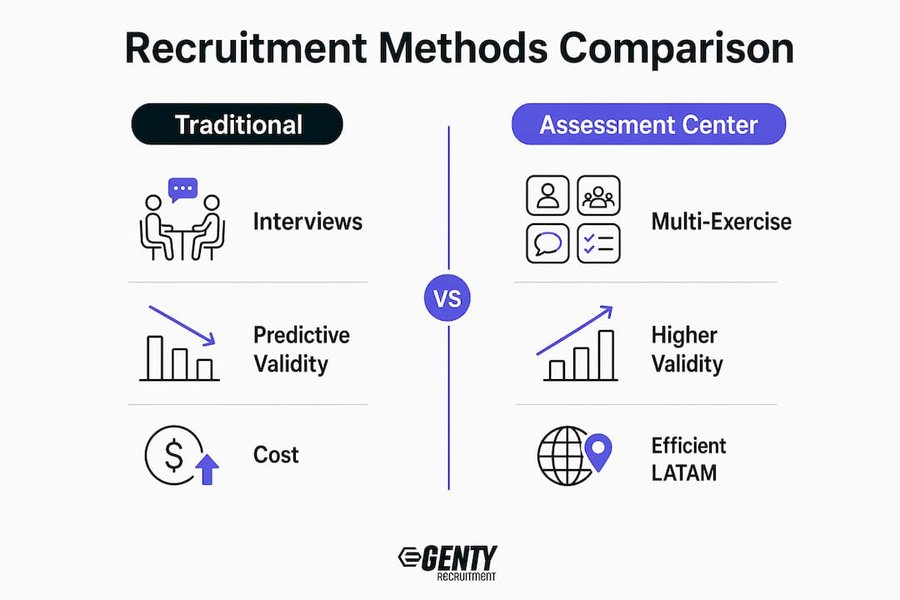
LATAM candidates in Colombia and Mexico align closely with US Central and Eastern time zones. Argentina and Brazil overlap well with EST mornings. This means live assessment sessions, which require real-time interaction between candidates and assessors, run without the scheduling friction that comes with hiring in Asia or Eastern Europe.
Cost is a concrete advantage. Running a full assessment center for a LATAM candidate costs significantly less than the equivalent process for a US-based hire, even before accounting for salary differences. GENTY recruitment clients consistently save up to 40% on total hiring costs compared to US or European equivalents, while maintaining the same evaluation rigor.
Operational challenges to plan for
Assessment centers are resource intensive. Each session requires trained assessors, pre-built exercises, a scoring rubric, and a structured integration session. For a startup running its first engineering hire, that overhead can feel disproportionate.
Recruitment automation tools address this directly. Automated scoring platforms capture assessor ratings in real time, flag scoring inconsistencies, and generate candidate comparison reports. This reduces the administrative burden of the integration session and makes the process feasible for teams without a dedicated assessment specialist.
Pro Tip: For early-stage tech startups, run a condensed half-day assessment center with two exercises and two assessors rather than skipping the process entirely. A shorter, well-designed center still outperforms an unstructured interview panel by a wide margin.
Assessor training is non-negotiable. Assessors must focus strictly on observed behaviors, not inferences or gut reactions. A candidate who seems nervous but solves the problem correctly should score on the solution, not the nerves. Without this discipline, the process loses its objectivity advantage.
How can HR managers implement assessment center recruitment for tech and sales roles?
Effective implementation follows a clear sequence. Skipping steps early creates scoring problems later.
Step-by-step process for tech and sales hiring teams
- Define the competency framework. Identify 6–8 competencies critical to the role. For a sales development rep, these might include objection handling, pipeline prioritization, and communication clarity. For a DevOps engineer, they might include incident response, cross-team communication, and technical documentation.
- Build the competency matrix. Map each competency to at least two exercises. This matrix is your quality control document. If a competency appears in only one exercise, add another or remove it from the framework.
- Design role-specific exercises. Generic exercises produce generic data. A sales role-play should mirror the actual product, buyer persona, and objection types your team faces. A coding simulation should reflect the stack and problem complexity of your sprint backlog.
- Train assessors on behavioral observation. Run a calibration session before the assessment day. Give assessors sample candidate responses and have them score independently, then compare. Disagreements reveal scoring inconsistencies to resolve before the real event.
- Run the integration session. After all exercises, assessors meet to compare ratings, discuss evidence, and reach consensus. This session is mandatory. It is what converts individual observations into a reliable, defensible hiring decision.
- Connect results to onboarding. Assessment center data identifies development gaps as well as strengths. Share competency profiles with hiring managers so onboarding plans address the gaps identified during the process.
For recruitment assessment tools that support scoring, reporting, and integration session facilitation, several platforms now offer purpose-built modules for tech and sales hiring contexts.
The timeline for a well-run assessment center runs 2–4 weeks from design to decision. That includes exercise development, assessor briefing, candidate scheduling, the assessment day itself, and the integration session. For LATAM hiring, virtual delivery compresses logistics without reducing quality.
- Pre-assessment screening (resume review, async video screening): Week 1
- Exercise design and assessor calibration: Week 1–2
- Assessment day (virtual, 4–8 hours): Week 2–3
- Integration session and final decision: Week 3–4
Key Takeaways
Assessment center recruitment outperforms every other selection method for tech and sales roles because it combines behavioral observation, multiple assessors, and consensus scoring into a single, validated process.
Why I think most hiring teams underestimate the integration session
After working with dozens of tech and sales hiring teams across LATAM markets, the single most common mistake I see is treating the integration session as optional. Teams run excellent exercises, train assessors carefully, and then skip the consensus meeting because the hiring manager already has a gut feeling about the finalist. That decision erases most of the methodology’s value.
The integration session is where the process earns its predictive validity. Two assessors who independently scored a candidate’s role-play will almost always disagree on at least one dimension. The discussion that resolves that disagreement is where bias gets identified and corrected. Without it, you have a more expensive version of an interview panel.
The second pattern I see is over-relying on psychometric tests as a proxy for a full assessment center. A personality inventory or cognitive ability test adds useful data, but it cannot observe how a candidate actually behaves under pressure. For a sales hire in Colombia or a DevOps lead in Argentina, the behavioral simulation is the evidence that matters most.
LATAM hiring also rewards speed. The best candidates in Buenos Aires, São Paulo, and Bogotá move through multiple processes simultaneously. A condensed, well-designed two-exercise assessment center completed in a single afternoon beats a drawn-out five-round interview process every time. Rigor and speed are not in conflict. They require planning, not compromise.
— Eugene
How GENTY recruitment supports assessment-driven hiring in LATAM
GENTY recruitment builds pre-vetted shortlists for US and European tech companies hiring across Argentina, Brazil, Mexico, and Colombia. The process integrates competency-based screening before candidates reach your assessment center, so your assessors evaluate a focused group of qualified professionals rather than a broad pool.
For IT recruitment in LATAM, GENTY recruitment delivers curated shortlists within 7 days, with fixed-fee pricing per seniority level and a 3-month replacement guarantee. For sales team hiring, the same skill-first process applies to SDRs, account executives, and sales engineers. Both services are designed to feed directly into your assessment center process, reducing the volume of candidates you evaluate while raising the quality of every hire.
FAQ
What is assessment center recruitment in simple terms?
Assessment center recruitment is a structured hiring method where candidates complete multiple job-simulated exercises, observed by trained assessors, to measure specific competencies. It produces more accurate hiring decisions than interviews alone.
How long does an assessment center typically take?
Assessment centers last from half a day for mid-level roles to one or two full days for leadership positions, depending on the number of exercises and competencies evaluated.
How do assessment centers reduce hiring bias?
The mandatory integration session requires multiple assessors to reach consensus ratings based on observed behaviors, not individual impressions. This consensus process is the primary mechanism for removing individual rater bias.
Are assessment centers effective for remote LATAM hiring?
Yes. Virtual assessment centers work well for LATAM candidates because Argentina, Brazil, Mexico, and Colombia share significant timezone overlap with US Eastern and Pacific zones, enabling live, synchronous exercises without scheduling friction.
Is a psychometric test the same as an assessment center?
No. A psychometric test is one component of an assessment center but does not constitute a complete process on its own. The full methodology requires multiple exercises and assessors combined with a structured integration session.