

Skills-based hiring is the dominant recruitment paradigm in 2026, with 81% of employers now using it, up from 56% in 2022. AI handles 95% of initial candidate screening, cutting time-to-hire by up to 75%. Hybrid work covers 53% of remote-capable workers and reduces quit rates by 33%. These three forces, skills focus, AI efficiency, and hybrid permanence, define the hiring trends in 2026 and demand a fundamentally different approach to talent acquisition. HR leaders who treat these as temporary adjustments will lose ground to those who build them into their core hiring architecture.
What skills and competencies define the 2026 hiring landscape?
The shift from degree requirements to demonstrated skills is the single biggest structural change in recruitment this decade. Skills-based hiring adoption rose from 56% in 2022 to 81% in 2026. That jump reflects a market reality: credentials no longer predict job performance as reliably as verified competencies do.
Human skills now rank alongside technical expertise as non-negotiable hiring criteria. 41% of employers rank communication, collaboration, and teamwork as the most critical skills for effective AI deployment and team success. That figure signals something counterintuitive: the more AI enters the workflow, the more human skills matter for making it work.

The most in-demand profiles in 2026 combine technical depth with business fluency. Hybrid roles requiring coding, AI operationalization, and business acumen are both the hardest to fill and the most sought after. Learning agility now surpasses static training programs as the top hiring criterion, reflecting how fast role requirements shift in AI-driven environments. Employers no longer want candidates who mastered a skill set three years ago. They want candidates who can acquire new ones in three months.
Need help hiring?
See the next step after this guide
If this topic is relevant to your team, these are the most useful pages to check next.
The practical implication for hiring teams is clear. Structured assessments, work samples, and scenario-based interviews outperform resume screening for identifying these competencies. Structured hiring practices used by tech-forward organizations consistently surface stronger candidates than credential-first filters.
- Communication and collaboration: Prioritized by 41% of employers as the top human skill set
- Learning agility: Replaces long-term static training as the primary adaptability signal
- AI operationalization: The ability to work with, direct, and quality-check AI tools in daily workflows
- Business acumen: Required alongside technical depth in hybrid IT and product roles
- Coding and technical fluency: Still foundational but no longer sufficient on its own
Pro Tip: When evaluating soft skills in remote or hybrid interviews, use structured behavioral questions tied to specific scenarios. Ask candidates to describe a time they adapted a process after a tool or system changed. The answer reveals learning agility far better than any credential.
How is AI transforming recruitment and hiring processes in 2026?
AI has moved from a recruitment experiment to the operational backbone of talent acquisition. AI now handles 95% of initial screening, reducing time-to-hire by up to 75% and boosting recruiter productivity by roughly 20% per week. Those numbers translate directly to competitive advantage in tight labor markets where speed determines which company lands the best candidate.
The efficiency gains extend beyond screening. Hiring speed increases 46% when companies use AI-powered assessments. AI-assisted candidate messaging improves the likelihood of a quality hire by 9%. These are not marginal improvements. They compound across every open role in a hiring cycle.
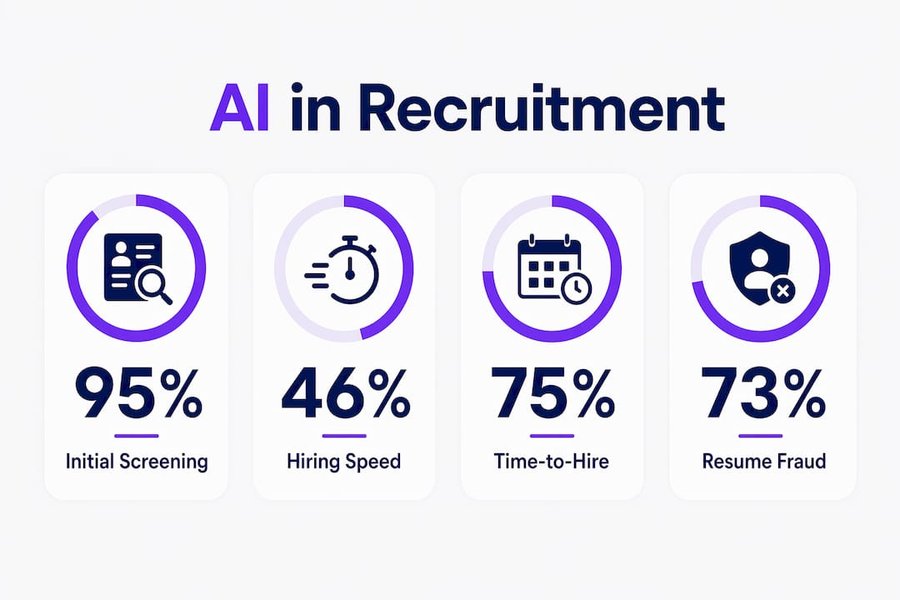
The risk side of AI adoption is equally significant. 73% of companies have encountered AI-generated resumes or assessments, and 49% have extended offers to candidates who misrepresented their skills using AI tools. That is an emergent fraud crisis compelling organizations to invest in AI fraud detection as a standard part of their hiring stack. Ignoring it means roughly one in two offers carries a meaningful misrepresentation risk.
The practical response requires a layered approach:
- Deploy AI for volume screening to reduce time-to-hire and free recruiters for high-judgment tasks
- Use AI-assisted messaging to improve candidate engagement quality at scale
- Implement skills verification tools to cross-check AI-generated application content against live assessments
- Add human review checkpoints at offer stage to catch misrepresentations that passed automated filters
- Invest in fraud detection platforms as a standard line item in your recruitment technology budget
Pro Tip: Never let AI make the final hiring decision. Use it to filter and rank, then apply human judgment at the interview and offer stages. The 49% offer-to-fraud rate drops significantly when a structured human review follows AI screening.
For teams looking to apply these efficiency gains in practice, AI-driven recruitment approaches used by tech startups offer a useful operational model.
What remote and hybrid work trends are shaping talent sourcing in 2026?
Hybrid work is no longer a pandemic accommodation. It is a permanent structural feature of the labor market. 53% of remote-capable U.S. workers are in hybrid arrangements in 2026, and companies that enforce rigid return-to-office mandates face measurable turnover consequences, particularly among female employees.
The data on retention is unambiguous. Hybrid work reduces employee quit rates by 33% compared to fully on-site models. That reduction translates directly into lower replacement costs, faster team productivity, and stronger institutional knowledge retention. The workforce transformation research from HR technology analysts confirms that structured hybrid schedules, not ad hoc flexibility, produce the strongest retention outcomes.
The supply-demand imbalance in remote hiring is striking. Remote job postings represent only 20% of LinkedIn listings but attract 60% of total applications. That gap means remote and hybrid roles generate three times the candidate volume of on-site roles. For employers, it is a sourcing advantage. For candidates, it signals intense competition for a limited supply of flexible positions.
70% of the workforce will work remotely at least five days per month by end of 2026, with remote job postings up 357% since the pandemic baseline. That scale means hybrid and remote sourcing is no longer a niche capability. It is a core recruiting competency.
Pro Tip: Design hybrid policies around role requirements, not executive preferences. Roles requiring deep focus work, like software engineering or data analysis, perform well with two to three remote days per week. Roles requiring frequent collaboration need more structured in-person time. Matching the policy to the role type reduces friction and improves retention.
What compensation and candidate experience strategies attract talent in 2026?
Salary transparency is now the top talent attraction tactic, surpassing workplace flexibility. 75% of business leaders cite compensation as the most critical driver in talent acquisition. That consensus reflects a post-pandemic shift in candidate expectations: workers want to know the number before they invest time in a process.
The strategic implication is direct. Publishing salary ranges in job postings increases qualified application volume and reduces time wasted on candidates whose expectations do not align. It also signals organizational confidence, which itself functions as a quality signal to high-performing candidates who have options.
Career development ranks as the second most effective attraction factor, with 16% of leaders citing it as a top strategy alongside salary transparency and workplace flexibility. Candidates in 2026 evaluate growth trajectory as carefully as they evaluate base compensation. Clear promotion paths, learning budgets, and mentorship structures now appear in competitive job postings as standard content.
Employee referral programs have increased in importance as a sourcing channel, particularly for specialized technical roles where passive candidates dominate the talent pool. Referrals from current employees carry implicit skills validation that cold applications do not.
How can organizations fill the hardest roles and close skills gaps in 2026?
Hybrid IT roles are the hardest positions to fill in 2026. Roles requiring combined skills in coding, AI operationalization, and business acumen remain open for 6–9 months on average. Cybersecurity and machine learning engineering roles follow closely. The common thread is that these roles demand depth in multiple disciplines simultaneously, a profile that the traditional education pipeline does not produce at scale.
Skills gaps now outweigh staffing shortages as the primary hiring obstacle for most organizations. The labor market in 2026 is structurally tight but balanced, with deliberate slow hiring and a quality-over-quantity approach dominant. That means the problem is not finding candidates. It is finding candidates who can actually do the job on day one.
- Cybersecurity engineers: Demand exceeds supply across all experience levels; certifications like CISSP and CEH no longer guarantee readiness
- AI/ML engineers: Require both model-building skills and the ability to explain outputs to non-technical stakeholders
- Data analysts with business fluency: Technical skill is table stakes; the shortage is in analysts who can translate findings into decisions
- Full-stack developers with AI integration experience: Standard full-stack profiles no longer meet product team requirements
- Product managers with technical depth: The gap between PM skills and engineering reality widens as AI complexity increases
Upskilling and reskilling programs address part of the gap, but they require 12–18 months to produce results. For immediate needs, sourcing from talent pools in Latin America, where English-speaking engineers with AI and full-stack skills are available at competitive compensation levels, has become a practical near-term solution for US and European companies. Gentyrecruitment’s IT recruitment in LATAM model addresses exactly this bottleneck, placing pre-vetted candidates in roles that have been open for months.
Key takeaways
The most effective 2026 recruitment strategy combines skills-based evaluation, AI-assisted screening with human oversight, and transparent compensation to attract and retain qualified candidates.
What I’ve learned watching 2026 hiring trends play out in real time
The data on skills-based hiring and AI efficiency is compelling. What the data does not capture is how many organizations are implementing these tools without changing the underlying decision-making process. They add an AI screening layer, then still hire based on pedigree and gut feel. The result is faster screening that produces the same quality outcomes as before.
The organizations getting this right treat AI as a filter for volume and human judgment as the final authority on fit. They also take the fraud risk seriously. A candidate who used AI to generate a polished resume and pass an automated assessment is not necessarily dishonest. But they may be genuinely unqualified for the role. The 49% offer-to-fraud rate is a system design problem, not just a candidate behavior problem.
On hybrid work, the companies I see retaining talent most effectively are not offering unlimited flexibility. They are offering structured flexibility. Two or three defined remote days, clear in-person expectations, and a policy that applies consistently across the team. Inconsistency in hybrid policy is a bigger retention risk than a strict policy applied fairly.
Compensation transparency feels uncomfortable for many leadership teams. The discomfort is worth pushing through. Publishing salary ranges does not eliminate negotiation. It eliminates the candidates who were never going to accept your range anyway, which saves everyone time.
The hands-on recruiting approach that combines structured assessment with direct recruiter involvement consistently outperforms fully automated pipelines for roles requiring hybrid skill sets. That will remain true regardless of how capable AI screening becomes.
— Eugene
How Gentyrecruitment helps you act on 2026 hiring realities
The hardest roles in 2026, hybrid IT, AI engineering, cybersecurity, and data analytics, require a sourcing strategy that goes beyond standard job boards. Gentyrecruitment specializes in placing pre-vetted, English-speaking tech talent from Latin America into US and European teams, typically in a fraction of the time it takes to fill these roles domestically.
Gentyrecruitment’s process combines structured skills assessment, direct recruiter involvement, and salary benchmarking across Argentina, Brazil, Mexico, and Colombia. For companies facing 6–9 month open roles in IT and AI hiring, that combination delivers qualified candidates faster and with lower misrepresentation risk than automated pipelines alone. Gentyrecruitment also covers sales recruitment and AI-focused roles for teams building out commercial and technical functions simultaneously.
FAQ
What is skills-based hiring and why does it matter in 2026?
Skills-based hiring is a recruitment approach that evaluates candidates on demonstrated competencies rather than degrees or job titles. Adoption reached 81% among employers in 2026, up from 56% in 2022, making it the dominant hiring standard across tech and non-tech sectors.
How much does AI actually speed up the hiring process?
AI handles 95% of initial candidate screening and reduces time-to-hire by up to 75%. Recruiters using AI tools also recover roughly 20% of their weekly time for higher-judgment tasks like interviews and offer negotiations.
What are the biggest risks of using AI in recruitment?
AI-generated resume fraud is the primary risk. 73% of companies have encountered AI-fabricated applications, and 49% have extended offers to candidates who misrepresented their skills. Pairing AI screening with live skills assessments and human review at the offer stage reduces this risk significantly.
Why is hybrid work still a major factor in talent attraction?
Hybrid arrangements cover 53% of remote-capable U.S. workers and reduce quit rates by 33% compared to fully on-site models. Remote job postings attract 60% of total applications despite representing only 20% of listings, confirming that hybrid flexibility remains a primary candidate decision factor.
What roles are hardest to fill in 2026?
Hybrid IT roles requiring coding, AI operationalization, and business acumen are the most difficult to fill, remaining open for 6–9 months on average. Cybersecurity engineers and AI/ML engineers follow closely, with demand consistently outpacing the available qualified talent pool.