

The benefits of remote teams are defined by three measurable outcomes: higher individual productivity, lower operating costs, and access to a talent pool that no single city can match. Executives at growing tech companies are no longer debating whether distributed work is viable. The question now is how to structure it so those advantages actually materialize. Research from PLOS ONE, guidance from Asana and Coursera, and analysis from the World Economic Forum all point to the same conclusion: remote teams outperform co-located ones when leadership is deliberate about communication, team composition, and output management.
What are the core benefits of remote teams for executives?
Remote work delivers measurable gains in flexibility and work-life balance, and those gains translate directly into business outcomes. Employees report greater flexibility in how they organize tasks and a healthier separation between work and personal time. That separation reduces burnout, which is one of the primary drivers of voluntary turnover in tech. Lower turnover means lower replacement costs and faster team velocity.
The World Economic Forum frames this shift as a structural change, not a temporary accommodation. Distributed teams offer a competitive advantage when companies focus on output rather than presence. That reframe matters for executives because it changes what you measure. You stop tracking hours in a building and start tracking deliverables, cycle times, and quality scores.

The advantages of remote work also compound over time. Teams that build strong async habits in year one operate with less friction in year two. The initial investment in communication infrastructure pays dividends as the team scales.
Need help hiring?
See the next step after this guide
If this topic is relevant to your team, these are the most useful pages to check next.
How does remote work increase productivity and flexibility for teams?
Productivity in remote settings does not happen automatically. It follows from specific structural decisions that leaders make about scheduling, autonomy, and team design.
The PLOS ONE research on remote work and employee productivity identifies autonomy as a primary driver. When employees control when and how they complete tasks, they align deep work with their peak cognitive hours. That alignment produces better output per hour than a fixed nine-to-five schedule ever could.
Reducing commute time is a direct, underappreciated productivity gain. A team member who previously spent 90 minutes commuting daily recovers more than 30 hours per month. Those hours go back into focused work, recovery, or skill development. All three outcomes benefit the company.
Key productivity mechanisms in remote teams include:
- Flexible scheduling lets engineers tackle complex problems during peak focus windows rather than fixed office hours.
- Reduced commute stress lowers cortisol levels and improves decision quality throughout the workday.
- Asynchronous workflows allow team members across time zones to contribute without waiting for synchronous meetings.
- Documented processes replace hallway conversations with searchable, reusable knowledge that new hires can access immediately.
- Output-based management removes the performance theater of looking busy and replaces it with clear delivery metrics.
Pro Tip: Set a weekly “async-first” rule for any task that does not require a real-time decision. Reserve synchronous meetings for alignment, not information transfer. Teams that apply this rule consistently report fewer meetings and faster delivery cycles.
The remote working benefits described above are not theoretical. They require deliberate design. Leaders who treat remote work as a default office with video calls miss the structural changes that make distributed teams genuinely more productive.
What communication practices optimize remote team performance?
Communication is where most remote teams fail, and the failure is almost always structural rather than personal. Remote collaboration problems do not resolve themselves. Proactive norms and predictable cadence are the only reliable fixes.
Coursera’s 2025 guide to managing remote teams identifies explicit expectation-setting as the single most important leadership behavior. When team members do not know when their questions will be answered, they either wait and stall or interrupt and distract. Neither outcome serves the team.
Asana’s research on remote management adds a second layer: channel clarity. Documenting communication channel purposes reduces cognitive load and what Asana calls “DM sprawl.” When everyone knows that Slack is for quick questions, project management tools are for task updates, and email is for external stakeholders, the team stops wasting mental energy deciding where to post.
A practical communication framework for remote leaders includes:
- Define channel purpose in writing. Post a one-page guide that maps each tool to its intended use case. Review it during onboarding.
- Set response-time expectations by channel. Slack might have a four-hour response window. Email might have 24 hours. Ambiguity kills async momentum.
- Dedicate the last 30 minutes of each workday to clearing messages. This Coursera-recommended practice prevents questions from stalling overnight across time zones.
- Run weekly priority-sharing sessions. Asana recommends that managers share weekly priorities clearly so every team member understands what matters before the week begins.
- Audit meeting frequency quarterly. If a recurring meeting cannot articulate its decision-making purpose, convert it to an async update.
Pro Tip: Build a “communication operating system” document and treat it like a product. Version it, update it when the team grows, and assign an owner. Teams with a documented communication system onboard new hires 40% faster than those relying on tribal knowledge.
Virtual team collaboration works best when the rules are explicit and the tools are consistent. Leaders who invest in this infrastructure early avoid the communication debt that compounds as teams scale.
How does team composition influence remote team success?
Team composition is the most underestimated variable in remote team productivity. Most leaders focus on headcount and skill coverage. The PLOS ONE research from a fully remote company in Japan reveals a more specific lever: the experience level of teammates assigned to each individual.
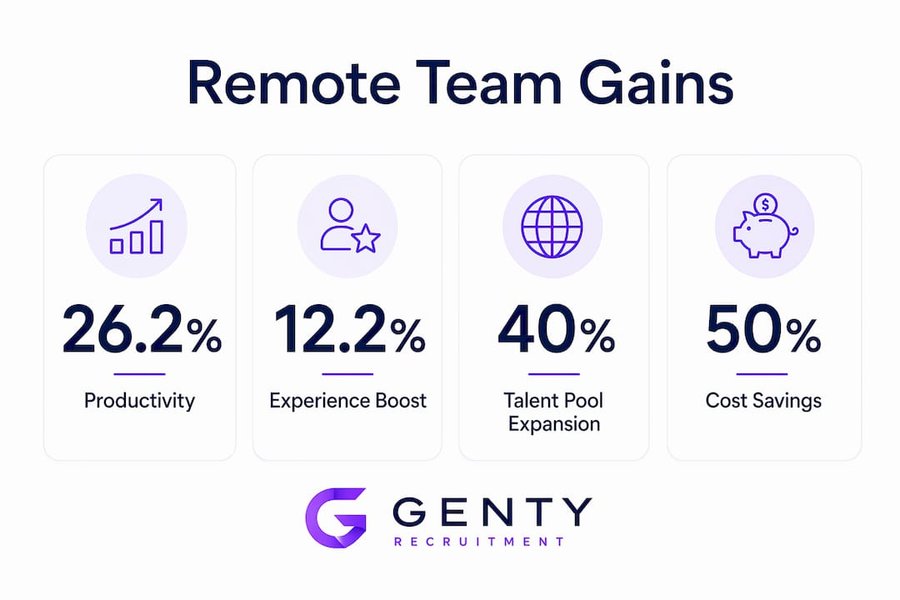
Experienced teammates improved individual productivity by 12.2% in remote settings. For employees with short tenure, that figure reached 26.2%. The mechanism is not more communication. It is structured knowledge transfer from people who have already solved the problems a newer employee is encountering.
The implication for recruiting is direct. When you hire for remote LATAM teams, the experience distribution within each team matters as much as the technical skill level of individual hires. A team of five mid-level engineers will underperform a team of three senior engineers paired with two junior engineers, even if the total skill score looks similar on paper.
Onboarding design follows the same logic. Structured knowledge transfer, documented processes, and deliberate pairing programs are not HR formalities. They are the primary mechanism through which experienced teammates improve remote team productivity at scale.
What cost and talent acquisition advantages do distributed teams offer?
The financial case for distributed teams is straightforward. Remote work reduces costs across office space, furniture, utilities, and physical infrastructure. For a 50-person engineering team, eliminating a dedicated office floor in a major US city represents a significant annual saving that can be redirected into talent, tooling, or product development.
The talent acquisition advantage is more strategically significant than the cost savings. Hiring from a global pool means you are not competing for the same 200 engineers within commuting distance of your headquarters. You are competing for the best candidates across multiple countries, time zones, and labor markets.
Key talent and cost advantages of distributed teams include:
- Wider candidate reach across Latin America, Eastern Europe, and Southeast Asia expands the qualified applicant pool by orders of magnitude.
- Salary arbitrage allows companies to hire senior engineers in markets like Argentina, Brazil, and Colombia at rates below equivalent US or Western European salaries, without sacrificing technical quality.
- Reduced attrition from flexibility benefits lowers the cost of replacement hiring, which typically runs 50–200% of annual salary for technical roles.
- Faster hiring cycles when you are not constrained by local market availability or relocation requirements.
- Access to specialized skills in AI, FinTech, and SaaS that are concentrated in specific global talent hubs rather than distributed evenly across geographies.
Latin America has become a particularly strong source of remote technical talent for US and European companies. The time zone overlap with North American business hours, the growth of English-language technical education, and the depth of engineering talent in cities like Buenos Aires, São Paulo, and Bogotá make the region a practical choice. Gentyrecruitment works specifically in this space, placing pre-vetted engineers and technical professionals from Argentina, Brazil, Mexico, and Colombia into distributed teams at FinTech, AI, and SaaS companies.
Key takeaways
Remote teams deliver their strongest results when leaders manage output, design team composition deliberately, and build explicit communication systems.
Why most executives are still leaving remote team gains on the table
The research is clear. The practices are documented. Yet most distributed teams I observe are still running remote work like a relocated office, with the same meeting cadence, the same presence assumptions, and the same vague performance expectations. The productivity gains never arrive because the structural changes never happen.
The misconception I see most often is that communication volume equals team health. Leaders add more standups, more check-ins, and more Slack channels, and then wonder why output does not improve. The PLOS ONE research is unambiguous: more communication volume does not increase productivity. Experience-based knowledge structures do.
The second misconception is that remote work is a retention perk rather than a design challenge. Flexibility attracts candidates, but it does not retain them if the team is poorly structured. Engineers who join a distributed team and find no onboarding, no communication norms, and no experienced mentors leave within 12 months. The flexibility benefit evaporates.
My honest recommendation for executives: treat your remote team like a product. Design it intentionally. Assign experienced teammates to newer hires. Document your communication system. Measure output weekly. The companies that do this consistently are not just saving on office costs. They are building a talent and execution advantage that co-located competitors cannot easily replicate.
— Eugene
How Gentyrecruitment helps you build high-performing remote teams
Building a distributed team with the right experience distribution and communication-ready candidates requires more than a job posting. Gentyrecruitment specializes in placing pre-vetted technical and non-technical talent from Latin America into US and European companies across FinTech, AI, and SaaS.
Gentyrecruitment’s process combines structured assessment, technical screening, and hands-on recruiting to deliver candidates who are English-speaking, technically qualified, and ready to integrate into global teams. Whether you need IT recruitment in LATAM for engineering roles or remote staffing and EOR services to manage compliance across borders, Gentyrecruitment provides the infrastructure to hire faster and build teams that actually perform. Salary benchmarking and executive search services are also available across the region.
FAQ
What are the main benefits of remote teams for tech companies?
Remote teams reduce operating costs, expand the talent pool beyond local markets, and improve productivity when leaders manage output rather than presence. Research from PLOS ONE and the World Economic Forum confirms these gains are measurable and repeatable with the right structure.
How does team composition affect remote team productivity?
Pairing short-tenure employees with experienced teammates increases individual productivity by up to 26.2%, according to PLOS ONE research from a fully remote company. Experience-based knowledge transfer is more impactful than increasing communication volume.
What communication practices do high-performing remote teams use?
High-performing remote teams document channel purposes, set explicit response-time expectations, and share weekly priorities before the week begins. Asana and Coursera both identify these practices as the foundation of effective virtual team collaboration.
Why do remote teams offer a talent acquisition advantage?
Remote hiring removes geographic constraints, giving companies access to qualified engineers in Latin America, Eastern Europe, and other regions where technical talent is deep and compensation expectations differ from US markets. That reach makes it possible to hire faster and at a wider range of experience levels.
How do you manage remote teams effectively across time zones?
Effective cross-timezone management requires async-first workflows, documented communication norms, and overlap windows for synchronous alignment. Leaders who retain remote LATAM talent long-term combine clear expectations with deliberate recognition and career development practices.