

The case for remote hiring has shifted from pandemic necessity to deliberate competitive strategy. If you’re a hiring manager or founder still treating distributed recruiting as a temporary workaround, you’re missing what the data now confirms: why hire remotely in 2026 is a question with clear, measurable answers rooted in talent access, cost efficiency, and productivity outcomes that in-office-only models simply cannot match. This guide cuts through the noise and gives you the strategic and operational clarity to hire remote talent with confidence.
Key takeaways
Why hire remotely in 2026: the core business case
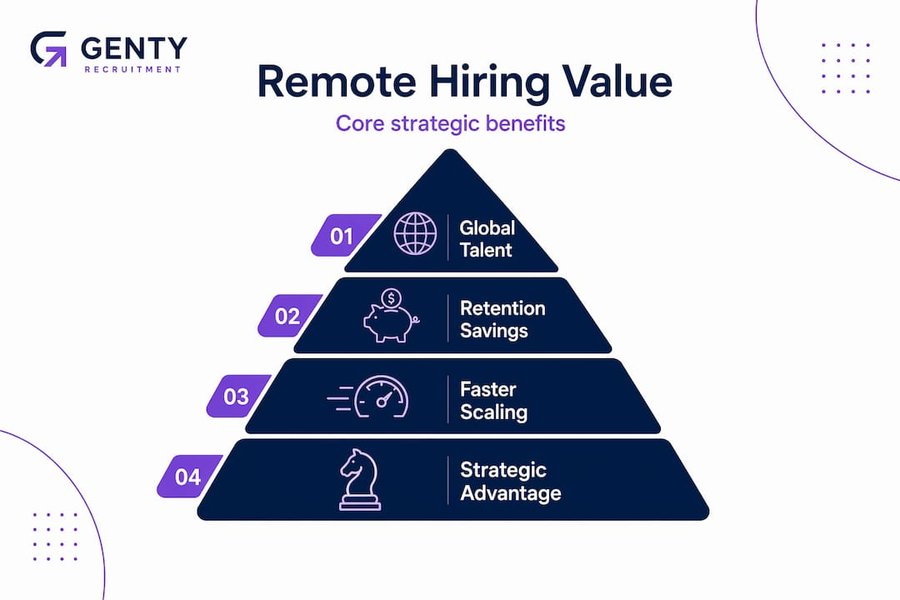
The most commonly cited benefit of remote hiring is access to talent, and the data backs it up. When you remove geography as a filter, you stop competing against every other company in your zip code for the same pool of engineers, product managers, and analysts. You compete globally, and that changes your leverage entirely.
The advantages of hiring remotely extend well beyond just widening the candidate funnel:
- Broader talent pools: Specialized roles in AI, FinTech, and SaaS that are nearly impossible to fill locally become accessible when you hire across regions like Latin America, Eastern Europe, and Southeast Asia.
- Lower cost-per-hire: Async evaluation workflows cut cost-per-hire by 20 to 35%, primarily by eliminating scheduling friction and reducing recruiter hours per candidate.
- Stronger retention: A 2024 randomized controlled trial found that hybrid workers retain at 33% higher rates compared to fully in-office peers, with no measurable productivity penalty.
- Productivity gains from reclaimed time: Remote workers save an average of 72 minutes daily from eliminated commutes, with 40% of that time redirected directly to work activities.
- Reduced operational overhead: Companies with distributed teams spend significantly less on real estate, facilities, and in-office logistics.
The 2026 remote workforce context matters here too. Remote work stabilized at around 27% of paid workdays in the US since 2022, with hybrid schedules of two to three remote days per week now the dominant model. The companies that are winning the talent competition are not debating whether remote works. They are building the infrastructure to do it well.
Before you start hiring
Check location, salary, and hiring fit
If you are moving from research to action, start with the market basics so your hiring plan is clearer.
Pro Tip: When calculating the ROI of remote hiring, include retention savings. Replacing a mid-level engineer typically costs 50 to 100% of their annual salary. A 33% reduction in attrition pays for a significant portion of your remote infrastructure investment.

How remote-first hiring changes your processes
Offering a remote role and running a remote-first hiring process are two different things. Most companies do the former while barely adjusting the latter, and that gap is where hiring quality breaks down.
Here is how to restructure your process for distributed hiring:
<p>Shift from in-person signals to documented outputs. In traditional hiring, interviewers rely heavily on presence, body language, and real-time rapport. Remote hiring requires replacing those signals with structured work samples, written assessments, and async communication exercises that reveal how a candidate actually thinks and operates independently.</p>
<p>Assess async communication explicitly. Ask candidates to complete a short written brief or respond to a detailed scenario via email before any live interview. How they write, how thoroughly they read instructions, and how quickly they respond are all direct signals of remote work readiness.</p>
<p>Distribute decision-making. Documentation-driven workflows reduce bottlenecks by giving team members the context to make decisions without waiting for a manager to be online. This principle starts in hiring: share structured scorecards, clear role definitions, and evaluation rubrics across your hiring panel before interviews begin.</p>
<p>Redesign performance expectations upfront. Candidates should understand how output is measured, how feedback is delivered, and what “good” looks like at 30, 60, and 90 days. Vagueness in expectations is the fastest path to a failed remote placement.</p>
<p>Mitigate proximity bias early. Performance appraisals in remote settings can disadvantage early-career employees who are not visible to senior managers. Build structured check-ins and documented project milestones into your onboarding design from day one, not after problems appear.</p>
Pro Tip: Build a one-page “how we work” document that every candidate receives before the first interview. It signals organizational maturity, sets expectations clearly, and self-selects for candidates who prefer structured, async-friendly environments.
Legal compliance and global payroll infrastructure
This is where most founders and hiring managers underestimate the complexity. Hiring someone in Colombia, Brazil, or Argentina is not the same as adding a remote employee in another US state. Cross-border employment involves local labor laws, mandatory benefits structures, tax obligations, and currency considerations that vary significantly by country.
The growth of compliant global employment platforms tells the story clearly. Remote’s global payroll business grew over 300% year-over-year, supporting 100-plus legal entities across tens of thousands of companies globally. That growth reflects how many companies were hiring internationally without the right infrastructure in place, and then fixing it.
Compliant global employment infrastructure is a strategic decision, not an administrative one. Misclassifying a contractor as an employee, or vice versa, can trigger significant penalties and create legal exposure that far exceeds whatever cost savings you anticipated.
Pro Tip: If you are hiring more than three people in the same country, run a cost analysis comparing EOR fees against the cost of establishing a local entity. The break-even point is lower than most founders expect, often under 10 employees annually.
Challenges and pitfalls to watch for
Remote hiring delivers real advantages, but a clear view of the risks makes you a better operator. Here is what experienced hiring managers consistently flag:
- Early-career employees face steeper challenges. Junior hires in remote settings often lack the informal mentoring, casual knowledge transfer, and visibility that accelerate growth in office environments. Without deliberate structure, they can plateau faster than their in-person peers.
- Weak async culture creates burnout. When companies add remote work without genuinely redesigning communication norms, employees end up always online to compensate. That “always-on” dynamic is a direct driver of attrition, not a productivity feature.
- “Productivity paranoia” distorts management behavior. Managers who cannot see employees working often overcorrect with excessive check-ins, monitoring tools, and status meetings. Measuring output instead of hours consistently produces better results, but it requires a deliberate cultural shift from the top down.
- Work style mismatches cause the most failures. The leading cause of remote hire failures is not a shortage of skilled talent. It is poor fit between how a candidate prefers to work and what an async, distributed environment actually demands.
“The biggest mistake companies make is hiring great talent for a remote role without redesigning the role for remote work. You cannot take an office-native job description and expect a distributed hire to succeed in it.”
The hidden costs of bad remote hiring decisions compound quickly. Beyond replacement costs, failed placements erode team morale, slow project timelines, and introduce knowledge gaps that take quarters to close.
Practical steps for implementing remote hiring in 2026
Getting remote hiring right requires more than job board postings with “remote” checked. Here is a structured approach that addresses both talent quality and operational sustainability:
<p>Screen for async communication skills first. Before evaluating technical ability, assess how candidates write, respond to ambiguity, and handle asynchronous feedback. These skills predict remote performance better than most technical assessments.</p>
<p>Build transparency into every stage. Candidates should know your process timeline, evaluation criteria, and decision timeline before they apply. Transparency at this stage reflects how you operate internally.</p>
<p>Choose your compliance infrastructure before you make offers. Select an EOR platform or establish local entities for your target hiring markets before you extend a single offer letter. Retrofitting compliance after hiring is expensive and legally risky.</p>
<p>Create culture intentionally. Remote culture does not emerge organically the way office culture can. You need documented team rituals, regular video touchpoints, and explicit norms around communication response times and availability expectations.</p>
<p>Build a staffing strategy workflow that includes well-being checkpoints. Schedule quarterly pulse surveys, one-on-one meetings tied to career development, and periodic reviews of workload distribution to catch burnout signals before they become resignation letters.</p>
Pro Tip: Add a 30-day “remote onboarding check-in” to every new hire’s first month. Ask three questions: What is working well? What is unclear? What do you need that you do not have yet? The answers reveal gaps in your remote infrastructure faster than any performance metric.
My perspective on remote hiring in 2026
I’ve watched companies wrestle with the remote hiring question for years, and the pattern I keep seeing is the same. Organizations treat remote as a perk or a policy decision when it is actually an operational design question. The companies that get the most from distributed teams are the ones that built their information flows, decision-making structures, and performance frameworks around remote work from the start, not the ones that bolted it onto an existing in-office model.
The conventional focus on physical presence is genuinely outdated at this point. What I’ve found consistently is that the best remote hires are not just technically strong. They are self-directed, document their thinking clearly, and communicate with specificity in writing. Those traits are measurable in a hiring process if you design the process to reveal them.
What I’ve also learned is that infrastructure investment is not optional. The companies that treat compliance, payroll, and legal setup as afterthoughts spend far more on corrections than they saved by moving fast. Building the right remote hiring foundation upfront is what separates companies that scale reliably from those that keep rebuilding broken teams.
Remote hiring in 2026 rewards those who treat it with the same strategic discipline they apply to product development or go-to-market planning. The opportunity is significant. The execution is what separates results from regret.
— Eugene
How Gentyrecruitment helps you hire remote talent
Gentyrecruitment specializes in connecting US and European tech companies with pre-vetted, English-speaking talent across 14 countries in Latin America, including Argentina, Brazil, Mexico, and Colombia. If you are ready to act on the benefits of remote hiring, Gentyrecruitment’s process combines structured assessment, technology-driven screening, and hands-on recruiting to deliver shortlists in five business days or fewer.
Whether you need IT recruitment in LATAM for engineering and product roles, or you want to hire remote LATAM talent across sales and operations, Gentyrecruitment handles candidate vetting, salary benchmarking, and integration support so your team can move fast without cutting corners on quality. Reach out to Gentyrecruitment today and get your first shortlist within a week.
FAQ
What are the main benefits of remote hiring in 2026?
The primary benefits of remote hiring include access to broader talent pools, lower cost-per-hire through async workflows, improved retention rates, and reduced operational overhead. Research shows hybrid and remote arrangements improve retention by up to 33% with no productivity penalty.
How do you assess candidates for remote work fit?
Screen candidates using written assessments and async communication exercises before live interviews, since work style fit is the leading cause of remote hire failures. Look for self-direction, clear written communication, and comfort with structured, documentation-driven workflows.
What legal infrastructure do you need to hire remotely across borders?
Cross-border hiring requires either an employer-of-record platform or a locally established legal entity, depending on hiring volume. Skipping compliant infrastructure exposes companies to misclassification penalties and significant legal liability.
Does remote work hurt productivity?
No. A 2024 randomized controlled trial found hybrid workers equally productive as in-office peers, and remote workers save an average of 72 minutes daily from eliminated commutes, with 40% of that time redirected to work. Teams measured on output rather than hours logged consistently show the strongest results.
How quickly can you build a remote team in Latin America?
With a structured process and the right recruitment partner, companies can receive pre-vetted shortlists in five business days. Latin America offers strong timezone overlap with the US, English-speaking candidates, and competitive compensation, making it one of the most efficient regions for remote hiring in 2026.