

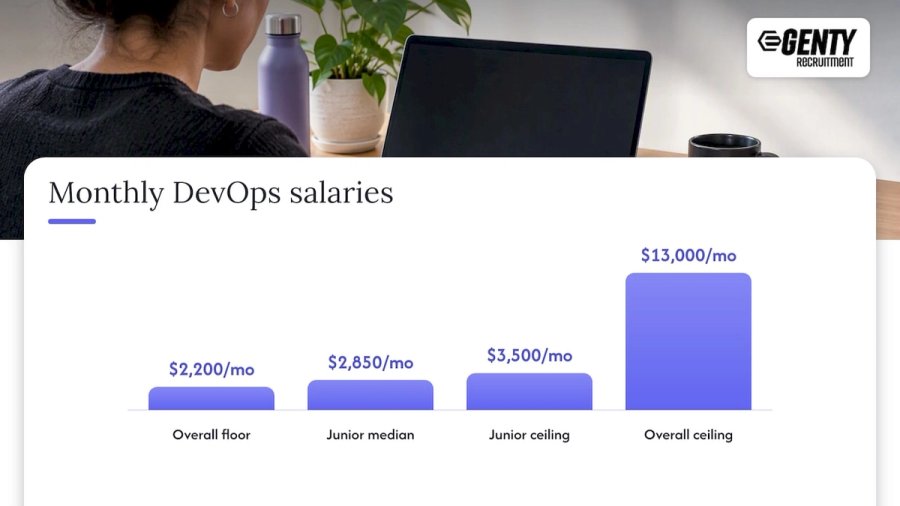
Remote DevOps engineers in Latin America are paid well below US levels but well above local averages. Published ranges run from roughly $2,200 a month for juniors to $13,000 a month at the top of the market, and the figure you should budget depends on seniority, country, English fluency and the employment model you choose. This guide gives you the numbers we can source, shows how to turn them into an offer, and explains where timezone overlap with US Eastern and Pacific teams changes the math.
TL;DR
- One published salary dataset puts DevOps pay in LATAM between $2,200 and $13,000 per month, with juniors at a median of $2,850 per month.
- The US benchmark is far higher: $135,980 median base wage for DevOps engineers in the US (BLS OEWS 2025), before equity and bonuses.
- Market medians are starting points. Pay for the same title varies by country, English level, cloud depth and on-call ownership.
- Total cost to company is not take-home pay. Contractor, EOR and local payroll models carry different overhead, so decide the model before you fix the number.
- Colombia and Mexico align closely with US business hours, and Brazil and Argentina overlap for most of the US workday, which matters for incident response.
What DevOps engineers earn in Latin America
The most useful single reference we found for the region is a salary dataset covering DevOps engineers across LATAM. It reports an overall range of $2,200 to $13,000 USD per month, and a junior band of $2,200 to $3,500 with a median of $2,850. That junior median works out to $34,200 a year.
The spread between the bottom and the top of that range is almost six to one. It is wide because “DevOps engineer” covers very different jobs: someone maintaining a few GitHub Actions pipelines for a monolith, and someone owning multi-region Kubernetes clusters, Terraform modules and a PCI-scoped FinTech platform on call. The title is the same. The scope and the price are not.
Other published aggregates, including job-board averages and employer-side rate cards, show mid-level medians in the $3,900 to $5,500 per month range and senior figures that start near $5,800 and climb from there. Treat those as directional, because methodologies differ: some report advertised salaries, some report what US companies actually pay contractors, and some report local payroll.
Before you start hiring
Check location, salary, and hiring fit
If you are moving from research to action, start with the market basics so your hiring plan is clearer.
How this compares with the US
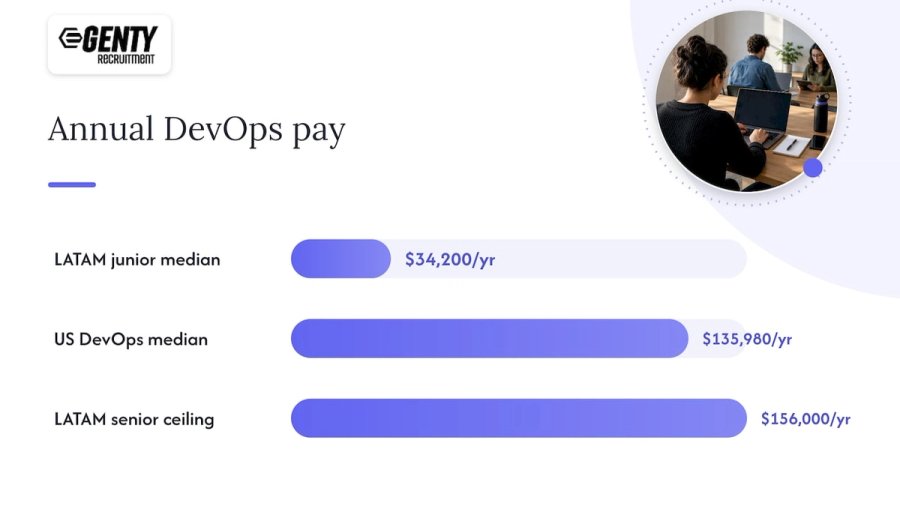
The Bureau of Labor Statistics lists a 2025 median pay of $134,040 per year for software developers, QA analysts and testers. For DevOps engineers specifically, BLS OEWS data puts the median at $135,980, and total compensation at US startups often exceeds that once equity and bonuses are counted.
A worked example makes the gap concrete:
The last row matters. The top of the LATAM range is not cheap: a senior engineer with deep platform experience, strong English and a track record inside US teams can cost as much as a US hire. Savings of up to 40% against US or European hiring, which is what our clients typically target, come from hiring the right level at the right market rate, not from assuming every LATAM salary is a discount.
Salaries by country: where DevOps talent is concentrated
Country choice affects price, talent depth and timezone. Here is how we think about the four markets our clients ask about most, plus Chile.
Brazil
Brazil has the largest tech workforce in the region, which means the deepest pool of Kubernetes, AWS and Terraform specialists, and also the most competition from local banks, marketplaces and multinationals. GSC’s analysis of the Stack Overflow Developer Survey 2025 found median annual compensation of about $30,600 for software developers in Brazil. DevOps and SRE roles typically price above general software development because of the on-call burden and the scarcity of senior infrastructure people. Brazil is also where English proficiency varies most between candidates, so screen for it rather than assuming it.
Mexico
Mexico gives you the strongest overlap with US Central and Mountain time, and a large pool of engineers who already work for US companies. Because so many US startups hire there, remote salaries are more competitive than local averages suggest, and good candidates expect US-dollar offers. Mexico is a strong fit when your incident response needs someone online during your US morning.
Colombia
Colombia sits on the same clock as US Eastern standard time, which makes it the most natural fit for East Coast teams that want a DevOps engineer in the same standups and the same on-call rotation. Contractor rates there are often quoted differently from salaried pay, so see our breakdown of DevOps contractor rates in Colombia before you compare numbers from different sources.
Argentina
Argentina has a deep, highly technical engineering culture and many engineers with years of experience in US-style Agile teams. Pay conversations are shaped by currency volatility, so many candidates prefer to be paid in US dollars. That makes the dollar figure you quote the figure that matters, and it makes accurate benchmarking more important, not less.
Chile
Chile is a smaller market, but it is one of the higher-paying ones in the region and has a mature cloud and FinTech scene. Expect to pay closer to the upper half of the LATAM range for senior platform and security-minded DevOps engineers.
How seniority and skills move the number
The junior median of $2,850 per month is a floor for the region, not an average. Pay climbs with the following factors, roughly in this order of impact:
- Ownership of production. An engineer who carries the pager and has led incident postmortems costs more than one who only builds pipelines.
- Cloud and orchestration depth. AWS, GCP or Azure certifications matter less than hands-on experience with Kubernetes, Terraform and observability stacks at scale.
- English and US-style collaboration. Hiring managers consistently report that salary distributions in LATAM are skewed by English proficiency and experience with US-style Agile. A candidate who can run an incident call in English with your VP of Engineering is worth a real premium.
- Domain regulation. FinTech and Web3 candidates who know compliance, key management and audit trails are scarcer and priced accordingly.
- Platform engineering experience. The 2024 DORA State of DevOps report found that internal developer platforms improve individual productivity by 8% and team performance by 10%, but can initially reduce throughput by 8% and change stability by 14% through added handoffs. Engineers who have built platforms with a user-centric mindset, rather than just installing tools, command a premium for exactly that reason.
If you are defining the role itself, our DevOps engineer hiring playbook covers scope and level, and our DevOps interview questions help you test for production ownership.
Salary, total cost and take-home are three different numbers
Most budgeting errors we see during the offer phase come from mixing these up. Founders often conflate total cost to company with take-home pay, and the employment model changes both.
The staffing option is where fixed monthly pricing helps. Our remote staffing and EOR service starts at $99 per employee per month, so you can see the administrative layer separately from the salary instead of buried in a blended rate.
Timezone overlap: the reason DevOps belongs in LATAM
For DevOps, overlap is an operational requirement. Deploy windows, incident response and CI/CD changes are collaborative, and a six-hour gap turns a ten-minute fix into an overnight wait.
- US Eastern (EST): Colombia is on the same clock, and Brazil and Argentina are one to two hours ahead depending on the season, so the whole US morning is shared.
- US Pacific (PST): Mexico and Colombia give you a full working-day overlap from late morning onward, and Brazil and Argentina still cover the US morning and early afternoon.
- Follow-the-sun coverage: A LATAM engineer can open the day, run the morning deploy and hand off to your US team already briefed.
Compare that with offshore hiring in Asia, where overlap with US Pacific hours can be close to zero. If your team depends on synchronous work, that difference often outweighs any salary savings.
Our perspective: anchor offers to the person, not the median
We place engineers across Argentina, Brazil, Mexico, Colombia and Chile, and the pattern is consistent: market medians tell you what to expect, but they do not tell you what to offer. Two engineers with the same title and the same years of experience can sit 40% apart in expectations, because one has operated production for a US FinTech and the other has not.
Our advice to CTOs and VPs of Engineering is to define the scope first. Decide who owns incidents, who owns cost, and who owns the platform roadmap. Then price that scope against the candidate’s demonstrated ability to work independently inside a US team. Cost-of-living indices are a poor guide here. Candidates compare your offer with what US-based companies pay remote engineers in their own market, not with rent in their city.
We also recommend setting a band before you source, rather than negotiating from the first resume. Fixed-fee recruitment supports this: because our fee depends on seniority level and not on a percentage of salary, we have no incentive to push the offer higher, and you can use the salary conversation to win the candidate you want.
— Eugene
A practical checklist for setting your DevOps offer
Use this before you open the role:
- [ ] Write the scope in one paragraph: infrastructure owned, cloud provider, on-call expectations, compliance requirements.
- [ ] Choose the seniority level and the country or countries you will hire in, based on the overlap you need.
- [ ] Decide the employment model (contractor, EOR or local payroll) and calculate total cost to company, not only salary.
- [ ] Set a salary band in USD from at least two sources and cross-check it against the published $2,200 to $13,000 monthly range.
- [ ] Test English and incident-communication skills in the interview, not only technical depth.
- [ ] Plan for a premium if the role requires FinTech compliance, Web3 key management or platform engineering ownership.
- [ ] Define the review cycle and any dollar-denominated raises, especially in Argentina.
If you want to benchmark a role beyond public ranges, our comparison of salary benchmarking tools explains what each type of source can and cannot tell you. For leadership roles, our engineering manager salary guide for LATAM covers the next step up, and the DevOps salary overview on our site collects the figures in one place.
Hiring a DevOps engineer through GENTY recruitment
GENTY recruitment focuses exclusively on Latin America, with dedicated recruiters per vertical, and delivers curated shortlists of triple-vetted candidates within 7 days. IT recruitment starts at $2,999 per hire as a one-off fixed fee that depends on seniority, with no upfront payments and a 3-month replacement guarantee. If you already know the profile, you can go straight to our page for hiring a DevOps engineer from LATAM. We also place release engineers, and our full list of roles we hire shows the rest.
FAQ
What is a realistic monthly budget for a mid-level remote DevOps engineer in Latin America?
Published data shows the full DevOps range running from $2,200 to $13,000 per month, with the junior median at $2,850. Mid-level offers typically sit well above that junior figure and below the top of the range, and the exact point depends on country, cloud depth and English. Build your band from several sources and the specific scope of your role, then confirm it against the candidates in your shortlist.
Which Latin American country is best for hiring DevOps engineers?
It depends on what you optimize for. Brazil offers the deepest talent pool, Mexico and Colombia offer the best overlap with US time zones, and Argentina offers strong technical depth with experience in US-style teams. Most of our clients choose by timezone first, then by seniority availability.
Is a LATAM DevOps engineer really cheaper than a US one?
At most levels, yes. The US median base for DevOps engineers is $135,980 according to BLS OEWS 2025 data, while the junior LATAM median is $34,200 a year. Senior engineers at the top of the regional range can cost as much as a US hire, so savings come from matching the level to the need. We see clients save up to 40% against US or European hiring.
Do I pay DevOps engineers in LATAM in US dollars?
Most remote offers to senior engineers are quoted in US dollars, especially in Argentina, where currency volatility makes a dollar figure more attractive. Whether you pay as a contractor or through an employer of record changes taxes and benefits, so decide the model before you fix the number.
Sources
- DevOps Engineer salary data for LATAM (Vacantes Digitales)
- DevOps Engineer Salary in USA: BLS OEWS 2025 percentiles (Hyring)
- Software Developers, QA Analysts and Testers, Occupational Outlook Handbook (BLS)
- Software Developer Salary in Brazil: 2026 Employer Guide (GSC)
- Software Developer Salaries in Latin America: 2025 Country Benchmarks (GSC)
- 2024 Accelerate State of DevOps Report (DORA)