

Filling a senior leadership position is nothing like posting a job and waiting for applications. The stakes are high, the process is complex, and a single misstep can cost a company more than the executive’s annual salary. Executive search is a specialized discipline built to navigate exactly that challenge, combining deep market intelligence, structured assessment, and precise stakeholder alignment to secure leaders who can actually deliver results. This article breaks down what executive search really means, how the process works, where it fails, and why it matters especially for tech companies hiring across North America, Europe, and Latin America.
Table of Contents
- What is executive search? Breaking down the essentials
- How the executive search process works, step by step
- Why executive hires fail: common risks and how search mitigates them
- Executive search in the US, Europe, and Latin America: how regional focus changes the game
- Our take: the truths behind successful executive search
- Ready to build your leadership team?
- Frequently asked questions
Key Takeaways
What is executive search? Breaking down the essentials
Executive search, sometimes called headhunting, is a proactive and highly structured recruitment approach designed to identify, assess, and secure senior leaders for organizations. Unlike standard recruiting, which typically involves publishing a vacancy and screening inbound applicants, executive search operates in reverse. The agency actively maps the market, identifies candidates who are often not actively looking, and pursues them on behalf of the client company. This distinction matters enormously because the best executives are rarely browsing job boards.
Companies that use executive search agencies range from early-stage funded startups to multinational technology corporations. Founders who need their first VP of Engineering, CFOs building a finance team for a Series B company, and established SaaS businesses seeking a Chief Product Officer all rely on this method. The roles most commonly filled through executive search include C-suite positions such as CEO, CTO, CFO, and COO, as well as VP-level and Director-level leadership positions that carry significant organizational impact.
The difference between executive search and general recruiting becomes clearer when you look at the two approaches side by side:
Before you start hiring
Check location, salary, and hiring fit
If you are moving from research to action, start with the market basics so your hiring plan is clearer.
For growing tech companies, getting this distinction right is critical. Promoting internally without the right assessment or relying on a LinkedIn post to surface your next CTO is a gamble that executive search for tech leaders helps you avoid. The reality is that executive hires carry high failure risk due to poor fit and flawed process, and the downstream cost of replacing a failed executive placement typically exceeds two to three times the role’s annual compensation.
- Executive search targets passive candidates with no interest in active job hunting
- Roles involve high business complexity and unique skill requirements
- The process includes structured evaluation of leadership style, cultural alignment, and long-term fit
- Agencies bring specialized networks and market intelligence unavailable to internal HR teams
Pro Tip: Treating executive search as simply “fancy recruiting” underestimates the risk. The structured methodology exists specifically to reduce the probability of costly early failure from misalignment between the leader, the role, and the organization.
How the executive search process works, step by step
With a strong understanding of what executive search means, let’s look at how a real search unfolds, from kickoff to signed offer. A well-run search follows a disciplined sequence that cannot be compressed without increasing risk.
The step-by-step executive search process typically looks like this:
- Stakeholder alignment meeting — The search firm and hiring company align on business context, leadership gaps, reporting structure, success metrics, and cultural norms before any sourcing begins.
- Ideal candidate profile development — A detailed profile captures technical requirements, leadership competencies, industry background, communication style, and soft skills that fit the organizational culture.
- Market mapping and sourcing — The search team proactively identifies potential candidates using proprietary databases, professional networks, referrals, and direct outreach to passive targets.
- Initial outreach and screening — Candidates receive confidential outreach. Those who express interest go through a first-round evaluation covering background, motivations, and preliminary fit.
- Deep assessment — Finalists undergo structured behavioral interviews, leadership assessments, and sometimes psychometric evaluations to measure alignment across multiple dimensions.
- Client interviews and calibration — A shortlist of qualified candidates enters formal interviews with the client’s leadership team. The agency facilitates feedback loops and recalibrates if needed.
- Reference checks and verification — Thorough reference checks with past managers, peers, and direct reports validate the candidate’s track record and leadership style.
- Offer negotiation and close — The agency manages offer structuring, compensation benchmarking, and negotiation to ensure acceptance without inflating cost unnecessarily.
- Onboarding integration support — Leading search firms stay engaged through the first 90 days to help the executive integrate, identify early friction points, and support retention.
A standard executive search takes 10 to 14 weeks, and complex or senior roles can extend to four months depending on market conditions, role specificity, and stakeholder availability. Here is how executive search timelines typically compare by role type:
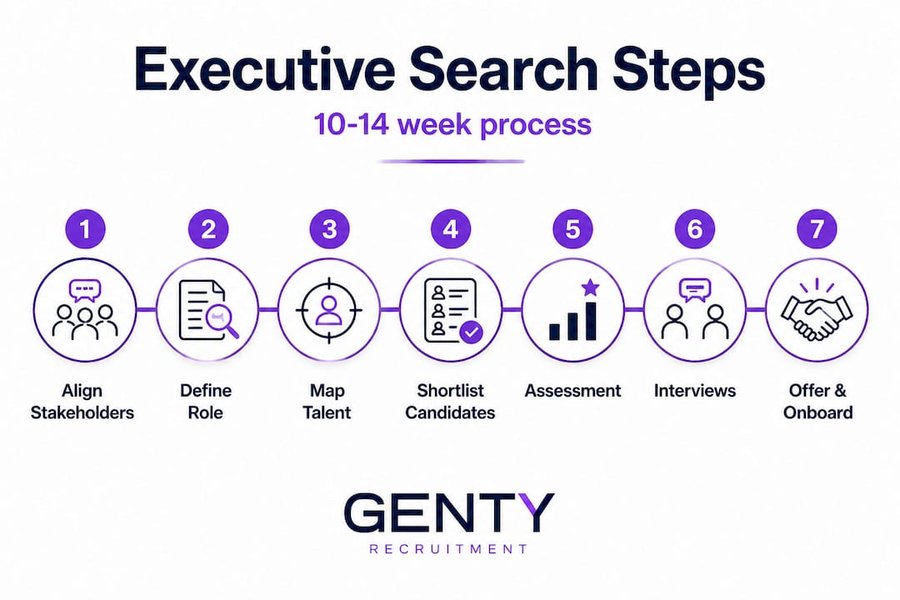
In a Latin American context, timelines can be influenced by local market depth, language requirements, and the added complexity of cross-border onboarding. Searches for English-speaking executives in markets like Argentina, Brazil, and Colombia require additional sourcing depth but are entirely achievable within the standard timeframe when conducted by a firm with regional expertise.
Pro Tip: Rushing through steps three through five to speed up placement is the single most common cause of executive failure within the first year. Each step compounds the previous one, and skipping assessment is functionally the same as hiring blind.
Why executive hires fail: common risks and how search mitigates them
Understanding the process is key, but it is equally important to know why so many executive hires go wrong and what executive search does to prevent expensive mistakes.
Research shows that about half of external executive hires fail within the first 18 months, largely due to process or fit issues rather than technical incompetence. This is a striking statistic that most companies underestimate when they believe they have found the right person after two or three interviews.
“The majority of failed executive placements are not caused by a lack of skills. They are caused by a mismatch between the leader’s operating style and the company’s culture, by unclear success criteria, or by a hiring process that prioritized speed over rigor.”
The most common causes of failed executive placements include:
- Cultural misalignment — The executive’s leadership style conflicts with how the company actually operates, not how it presents itself in interviews.
- Unclear role definition — Vague expectations about authority, budget, team structure, and success metrics create confusion that compounds quickly.
- Stakeholder disagreement — When internal leaders have different visions for the role, even a strong candidate struggles to succeed without unified support.
- Skipped reference checks — References surface patterns that structured interviews rarely do, especially around how a leader manages under pressure.
- Weak onboarding — Executives placed in high-stakes roles without structured integration support often fail to build the necessary internal relationships in time.
The risks of executive hiring are significantly amplified for leadership roles because failure is visible, destabilizing, and expensive. A failed CTO placement can stall a product roadmap for six months. A mishire at the VP of Sales level can miss a revenue quarter and damage team morale across the organization.

Executive search systematically mitigates these risks through each step: stakeholder alignment prevents disagreement before it surfaces, structured assessment catches cultural misalignment early, and extended onboarding support gives the executive the best possible conditions to succeed. The methodology is not bureaucracy for its own sake. Every element exists because skipping it has a measurable cost.
Executive search in the US, Europe, and Latin America: how regional focus changes the game
Since many companies now source leadership talent globally, let’s compare how executive search works across different regions and why those differences matter for tech hiring.
US and European tech companies increasingly look to Latin America not only for engineering and product talent but for experienced leaders who combine technical depth with strong communication skills and international orientation. Countries like Argentina, Brazil, Mexico, and Colombia have produced a generation of senior professionals with strong academic foundations, experience at global companies, and genuine fluency in English and business norms.
Executive search is more intensive due to the stakeholder alignment and deep assessment required, and this intensity increases when crossing regional boundaries. Cultural nuance affects everything from how candidates present themselves to how they negotiate, make decisions, and build team trust. An effective cross-regional search accounts for these factors explicitly rather than assuming the same process applies everywhere.
A practical example: a US-based FinTech company hiring a VP of Product from Argentina needs to assess not only the candidate’s product management credentials but also their comfort with async communication, their experience working across time zones, and their capacity to lead distributed teams. Assessment frameworks designed purely for on-site, US-based hires will miss these dimensions entirely.
Key regional factors to consider when conducting executive search in Latin America:
- Language verification — English fluency at a business communication level must be validated through real interaction, not self-reporting.
- Time zone alignment — Assess whether the candidate’s working patterns fit the client company’s collaboration model.
- Cross-cultural leadership competency — Leadership style, feedback culture, and hierarchy expectations vary significantly across LATAM markets.
- Compensation context — Salary expectations in Buenos Aires, São Paulo, and Bogotá differ substantially and require market-specific benchmarking.
- Integration planning — Remote or hybrid onboarding for LATAM executives needs more intentional structure than co-located placements.
Top executive roles in LATAM are increasingly competitive, especially in FinTech, AI, and SaaS. Companies that apply executive search best practices consistently outperform those that improvise the process, particularly when crossing regional and cultural boundaries.
Our take: the truths behind successful executive search
With the main frameworks and regional insights covered, here is some candid, experience-based perspective that most executive search content leaves out.
The most common failure mode we observe is not a bad candidate. It is a company that started the search before it finished the internal conversation. Stakeholder alignment is listed as step one in every executive search process, but in practice, it is frequently treated as a formality. Founders and leadership teams often believe they agree on what they need until a candidate arrives who exposes the disagreement. At that point, the search restarts, weeks of work are wasted, and the role sits vacant longer than it should.
The second uncomfortable truth is that companies routinely underestimate how much the quality of the onboarding determines whether an executive succeeds. Hiring the right person is necessary but not sufficient. An executive placed into a company without structured 90-day integration support, clear quick wins, and genuine sponsorship from the CEO or board is operating at a significant disadvantage. The in-depth search process does not end at the signed offer.
Finally, there is a persistent overconfidence in technical credentials. A strong technical background is a prerequisite for roles like CTO, but the leaders who actually succeed are the ones who can align cross-functional teams, manage ambiguity, and communicate strategy clearly to non-technical stakeholders. Rigor in cultural and leadership assessment consistently predicts success better than credential screening alone.
Pro Tip: Invest as much organizational attention in designing the executive role and structuring onboarding as you invest in the interview process itself. The search does not end when the offer is signed.
Ready to build your leadership team?
Building a high-performing leadership team in today’s competitive tech landscape requires more than a great job description. It requires a proven process, regional market expertise, and a network of pre-vetted candidates who are ready to operate at a global level.
Genty Recruitment specializes in LATAM executive search solutions for US and European tech companies, with deep coverage across FinTech, AI, and SaaS. Whether you are hiring your first CTO, scaling a product leadership team, or sourcing a VP of Sales who can operate across time zones, our structured search process and regional expertise make the difference. Explore our tech hiring in LATAM resources to understand the full scope of what is possible, and reach out to our team to start the conversation about your next executive hire.
Frequently asked questions
How long does executive search usually take?
Most executive searches take 10 to 14 weeks, though some can extend to around four months depending on role complexity and seniority level.
What are the main reasons executive hires fail?
Common causes include cultural mismatch, misaligned role expectations, and process shortcuts, and over 50% of external hires fail for these reasons within their first 18 months.
How is executive search different from in-house recruiting?
Executive search is a proactive, specialized process that targets passive candidates and uses deeper stakeholder alignment, structured assessment, and market mapping compared to standard internal recruiting.
What roles are typically filled through executive search?
Executive search is used for C-suite positions including CEO, CTO, CFO, and COO, as well as VP-level and Director-level roles that carry high organizational impact and require rare or specialized leadership experience.
Does executive search work for hiring remote or LATAM-based leaders?
Yes. Executive search adapts well to remote and cross-regional hiring when the process includes regional market mapping, cross-cultural assessment, and structured onboarding support tailored to distributed team environments.