
Frontend developers in Mexico earn roughly MXN 180,000 to 260,000 a year at the junior level, climbing to MXN 450,000 to 745,000 for senior engineers, which converts to roughly $9,000 to $37,000 USD depending on seniority and exchange rate. US companies hiring through local payroll or an employer of record can reduce fully loaded costs significantly compared with US-based hires, while gaining near-total overlap with EST and PST working hours.
TL;DR:
Multinational technology and FinTech employers often pay 20% to 40% above local startups, while agencies and smaller firms tend to anchor near band floors.
An employer of record suits hires needed within two to three weeks and covers payroll compliance; contractors have misclassification risks when arrangements resemble full time employment.
Budget 25% to 35% above Mexican base pay for employer contributions, then add statutory bonuses, applicable profit sharing, and any EOR or recruiting fees.
Strong TypeScript, React or Vue library, accessibility, and performance experience justify above midpoint offers; private health coverage and clear remote stipends also matter.
1. Salary bands by seniority: what the data actually shows
Benchmarking frontend pay in Mexico means reconciling three different data sources that rarely agree on methodology, sample size, or whether a figure reflects local payroll or remote-headquartered compensation. We built the table below using a blended approach: national aggregates for median accuracy, city-specific data for Mexico City positioning, and junior-specific sources for entry-level anchoring.
We converted MXN figures to USD using an approximate rate of MXN 20 to $1, rounded for readability. Radviser places junior frontend averages at MXN 240,000, within a reported range of MXN 180,000 to 300,000. WorldSalaries aggregates a national software developer average near MXN 398,300, with a wider spread from roughly MXN 214,000 to 602,700 across levels and employers. PayScale reports a Mexico City average base of MXN 480,000 for front end developers and engineers, though the underlying sample size on that profile is small enough that we treat it as a directional city signal rather than a precise median.
None of these sources publish full 25th and 75th percentile breakdowns for frontend specifically, so the ranges above function as practical floor-to-ceiling bands rather than statistically rigorous percentiles. When a client asks us for percentile-level precision, we build a custom benchmarking report that cross-references multiple postings and payroll data points for the specific stack and seniority they are hiring.
Before you start hiring
Check location, salary, and hiring fit
If you are moving from research to action, start with the market basics so your hiring plan is clearer.
Company type and industry move these bands meaningfully:
- Multinational tech firms and FinTech employers in Mexico often pay 20% to 40% above local-market startups for equivalent frontend roles.
- SaaS and AI-focused companies tend to sit closer to the top of each band because of competition for React and TypeScript talent.
- Local agencies and smaller startups frequently anchor near the bottom of the range, especially outside Mexico City.
- Government-adjacent or legacy enterprise roles tend to pay below market but offer more schedule stability.
2. Remote roles vs local Mexico-based roles: pay differences and contract shapes
A frontend developer hired directly onto a US company’s payroll as a remote worker, or through a staffing arrangement, usually commands a premium over a developer hired locally through a Mexican entity. Remote postings aggregated by job boards sometimes show MXN figures that look dramatically higher than local-market averages, often because US or global employers report pay in MXN after converting a USD-denominated package. We treat those board-level numbers as remote-headquartered benchmarks, not reflections of what a Mexican company would pay for the same role, and we recommend US hiring teams do the same when comparing postings.
The structural differences between hiring models matter as much as the headline number:
- Local payroll (Mexican entity): full statutory compliance, including mandatory profit sharing, severance accrual, and social security contributions, but requires a registered legal entity in Mexico.
- Independent contractor: fastest to set up and lowest administrative overhead, but carries misclassification risk if the relationship resembles full-time employment.
- Employer of record (EOR): handles payroll, tax withholding, and statutory benefits on the US company’s behalf without requiring a local entity, trading a per-employee monthly fee for speed and compliance coverage.
- Direct US payroll (remote hire): simplest from a US accounting standpoint, but Mexican developers hired this way lose access to statutory benefits like aguinaldo (the mandatory year-end bonus) unless the employer voluntarily matches them.
Statutory benefits in Mexico include mandatory vacation premiums, profit sharing, and the aguinaldo bonus, none of which are automatically triggered under a straight contractor or direct-US-payroll arrangement. Voluntary benefits like private health coverage, meal vouchers, and home office stipends are not required but have become close to standard among tech employers competing for frontend talent.
Pro Tip: Use an EOR when you need to hire within two to three weeks and want built-in compliance; use direct local payroll only when you already have (or plan to build) a Mexican entity for a larger, longer-term team.
3. City differences: Mexico City, Guadalajara, and Monterrey
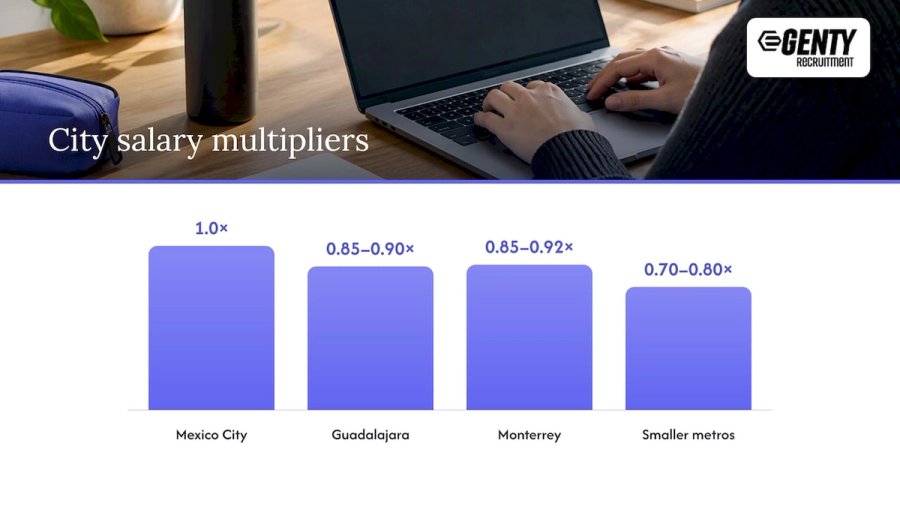
Where a frontend developer is based inside Mexico shifts the offer meaningfully, even though the country operates under a single federal tax and labor framework. Mexico City carries the highest cost of living and the highest frontend salaries, with PayScale’s profile putting average base pay around MXN 480,000, noticeably above the national blended average reported by WorldSalaries.
A simple cost-of-living-adjustment (COLA) multiplier helps US hiring teams avoid overpaying candidates outside the capital:
- Mexico City: use the full benchmarked rate as your baseline (multiplier of 1.0).
- Guadalajara: apply roughly 0.85 to 0.90 against the Mexico City baseline.
- Monterrey: apply roughly 0.85 to 0.92, trending slightly higher than Guadalajara for senior roles given its stronger industrial and FinTech presence.
- Smaller metros and remote regions: apply 0.70 to 0.80, adjusted further for the candidate’s specific cost of living.
As a worked example: say a Mexico City senior frontend offer lands at MXN 600,000 annually. Applying a 0.88 multiplier for a Monterrey-based candidate suggests a locally competitive offer near MXN 528,000, still attractive relative to that city’s market while avoiding to overpay that comes from applying Mexico City numbers everywhere in the country.
4. Employer total-cost comparison: what a Mexico hire really costs
Comparing a Mexico hire to a US hire on base salary alone misses most of the actual cost difference. A fully loaded cost includes base salary, employer-side social security and payroll tax contributions, statutory benefits (profit sharing, aguinaldo, vacation premium), optional health coverage, and any recruiting or EOR fees layered on top.
The U.S. Bureau of Labor Statistics reports median annual wages near $90,930 for web developers and $98,090 for web and digital interface designers as of May 2024. Once US employer taxes, benefits, and overhead are layered on top of that base, a US-based mid-to-senior frontend hire commonly lands well above $110,000 in fully loaded annual cost, while an equivalent Mexico-based hire, even after adding statutory benefits and recruiting fees, tends to land in a meaningfully lower range.
To translate a candidate’s base salary into a realistic fully loaded figure, we walk clients through four steps:
- Start with the candidate’s agreed base salary in MXN or USD.
- Add Mexico’s mandatory employer contributions, which typically run in the range of 25% to 35% on top of base, covering social security, housing fund contributions, and payroll tax.
- Add statutory bonus accrual, primarily the aguinaldo (minimum 15 days’ pay) and profit-sharing obligations where applicable.
- Add any EOR or staffing fee, recruiting fee, or benefits stipend the company has committed to.
The arithmetic behind the oft-cited claim that LATAM hiring saves companies 40% to 60% on a fully loaded basis holds up component by component rather than as a single blunt discount.
5. How to set a competitive offer that wins top talent
Offers that lose candidates in Mexico’s frontend market usually fail on structure, not just on number. Certain stack and skill signals reliably push pay toward the top of a band: strong TypeScript fluency, production experience with React or Vue component libraries, accessibility (WCAG) implementation experience, and demonstrated performance engineering (bundle size optimization, Core Web Vitals work) all justify offers above the midpoint.
Before extending an offer, we recommend hiring teams complete a short internal checklist:
- Confirm whether the hire will run through local payroll, an EOR, or direct contractor status, since this changes both the net number and the paperwork.
- Define the full offer package: base salary, any performance bonus, health stipend, home office or internet allowance, and equipment provisioning.
- Set clear probation terms consistent with Mexican labor norms, typically 30 to 180 days depending on role seniority.
- Confirm tax withholding responsibility (contractor self-withholds; EOR or payroll employer withholds on the employee’s behalf).
- Lock a realistic start date, accounting for the two to four weeks most mid-to-senior candidates need to transition from a current role.
A few package components consistently matter more to Mexican frontend candidates than US teams expect:
- Private health coverage, since public healthcare wait times push many professionals toward supplemental private plans.
- A clearly stated home office or equipment stipend, especially for fully remote roles.
- Transparent bonus structure tied to performance rather than vague “discretionary” language.
- Defined growth path or title progression, which carries more weight in retention conversations than a marginal salary bump.
6. GENTY recruitment’s view from inside the hiring process
Skill-first screening consistently outperforms generic job-board sourcing, both in speed and in offer-acceptance rate, especially when combined with behavioral and cognitive assessments for developer screening. We deliver curated, triple-vetted shortlists within 7 days of kickoff, price every search as a transparent fixed fee rather than a percentage of salary, and back every placement with a 3-month replacement guarantee.
Timelines differ meaningfully by seniority:
- Junior frontend roles typically fill within 2 to 3 weeks from shortlist to signed offer.
- Mid-level roles usually take 3 to 4 weeks given tighter stack-matching requirements.
- Senior and lead frontend hires often run 4 to 6 weeks, driven more by candidate availability than by sourcing difficulty.
Screening for timezone fit and communication quality matters as much as technical screening. We check English proficiency through structured conversation rather than scripted questions, confirm real overlap with US working hours (not just stated availability), and probe for async-communication habits, since remote frontend roles live or die on how well a developer documents decisions and flags blockers before they become delays.
Why Mexico works as a frontend hiring market
Having worked through dozens of frontend searches across Mexico, Argentina, Brazil, and Colombia, the pattern that stands out most is how undervalued timezone overlap is relative to raw cost savings. A Mexico City or Guadalajara-based frontend engineer working CST hours overlaps nearly entirely with US EST and PST business hours, which removes the async-communication tax that erodes productivity with offshore teams in Eastern Europe or Asia. Combined with strong English proficiency across the country’s tech hubs, that overlap is often the difference between a remote hire that feels like a full team member and one that always feels one step removed. Reach out if you want current benchmarking data for your specific stack and seniority level.
— Eugene
Get a curated frontend shortlist from Mexico in days, not months
Running your own search across PayScale listings, job boards, and LinkedIn outreach for a single frontend hire can easily burn three to four weeks before a single qualified candidate reaches your calendar. We shortcut that process with a skill-first search built specifically for US and European tech teams hiring across Latin America.
Our core services for frontend and broader engineering hiring in Mexico include:
- IT Recruitment: a fixed-fee, triple-vetted shortlist delivered within 7 days, priced from $2,999 one-off per hire.
- Salary Benchmarking: a custom report pricing your specific role, stack, and seniority against current Mexico and broader LATAM market data.
- RPO: ongoing recruitment support for teams scaling multiple frontend or engineering hires at once.
- Executive Search: dedicated sourcing for frontend architects and engineering leadership roles.
Every search runs with no upfront payment and a 3-month replacement guarantee if a placement doesn’t work out. Visit GENTY recruitment to start a benchmarking request or kick off a frontend search this week.
FAQ
What is the average salary for a front-end developer in the US?
The U.S. Bureau of Labor Statistics reports a median annual wage of $90,930 for web developers as of May 2024, with web and digital interface designers earning a median of $98,090. These figures reflect base pay before employer-side taxes and benefits are added for a fully loaded cost comparison.
What is the average salary in Mexico, measured in US dollars?
Aggregated national data from WorldSalaries puts the average software developer salary in Mexico near MXN 398,300 annually. Frontend-specific pay sits within a similar band, varying by seniority, city, and employer type.
Will AI replace frontend developers?
Current demand data points the other way: the BLS reports 7% job growth for web developers, faster than the average occupation. AI tools are shifting day-to-day workflows but have not reduced hiring demand for skilled frontend engineers who can own architecture, accessibility, and performance decisions.
Is $80,000 a good salary in the USA for a frontend developer?
A salary below the national median reported by the BLS of $90,930 for web developers can be reasonable for a junior-to-mid-level role depending on the metro area’s cost of living. Candidates in high-cost markets like San Francisco or New York typically expect offers above that median rather than below it.