

For a foreign individual contractor, the correct certificate is almost always Form W-8BEN, and we recommend collecting it before the first payment goes out. Skip that step and the payer risks a default 30% withholding rate on the full payment. The one exception: if the contractor performs the work physically inside the United States, W-8BEN does not apply at all, and Form 8233 or Form W-4 takes its place.
TL;DR:
When documentation is invalid, the payer bears withholding liability and may need to correct tax reporting after payment instead of shifting the exposure to the contractor.
For services performed physically in the United States, use Form 8233 for treaty claims; otherwise, collect the applicable employee withholding form.
Treaty benefits require the contractor’s tax residence, applicable treaty article, and valid foreign tax number; a missing number can invalidate the claim despite treaty eligibility.
Report foreign contractor payments through the foreign payee process, not domestic contractor reporting; foreign payees are not subject to domestic backup withholding rules.
Verify the legal name, residence, tax number, signature, and date; renew by the end of the third succeeding calendar year or within 30 days after a change.
1. Quick collection checklist for hiring foreign individual contractors
Before any payment clears, run every foreign individual contractor through the same gate. Treat the form as a prerequisite for payment approval, not paperwork to chase after the fact.
- Request Form W-8BEN during onboarding, before the first invoice is approved.
- Confirm legal name, country of residence, and date of birth match the contractor’s identification.
- Check for a foreign tax identifying number (FTIN) or a written explanation for why one is unavailable.
- Verify the signature and date are current and match the certification statement.
- File the form with the contractor’s payment record, not in a separate HR folder.
A W-8BEN generally stays valid through the end of the third succeeding calendar year unless the contractor’s circumstances change, so build a renewal reminder into your HR calendar rather than relying on memory.
2. What Form W-8BEN is and who must provide it
Form W-8BEN certifies that the person receiving a payment is a foreign individual, not a U.S. person, and lets that individual claim a reduced withholding rate or an exemption under an income tax treaty. The instructions for Form W-8BEN specify that nonresident alien individuals who are the beneficial owners of U.S.-source income provide this form to establish their status.
What do you need?
Choose the hiring path that fits
After reading "W-8BEN for Contractors: US Firms Face 30% Withholding Risk in LATAM", most teams compare these options before deciding how to hire.
A few points matter for how you handle it operationally:
- The form goes to you, the payer or withholding agent, never to the IRS directly.
- Only individuals use W-8BEN; foreign businesses use a different certificate.
- The form supports a treaty claim only when filled out completely and signed.
If a contractor hands you a blank or partially completed form, you have no valid documentation and the default withholding rate applies until a corrected version arrives.
3. When to use W-8BEN vs other forms (W-8BEN-E, W-8ECI, Form 8233, W-9)
Choosing the wrong form is one of the most common compliance errors we see among companies hiring internationally for the first time. Each form matches a specific payee type and income category, and mixing them up creates withholding exposure.
- W-8BEN: foreign individual, beneficial owner of passive income such as royalties or certain services income, claiming treaty benefits.
- W-8BEN-E: foreign entities, not individuals. If your contractor operates through a foreign corporation rather than as a sole proprietor, this form replaces W-8BEN.
- W-8ECI: income effectively connected with a U.S. trade or business, a different withholding regime entirely.
- Form 8233 or W-4: compensation for personal services performed physically inside the United States. Form 8233 lets a nonresident claim treaty benefits on that compensation; W-4 applies when no treaty claim exists.
- W-9: the payee is a U.S. person. Keep this on file if a contractor’s status changes, for instance after obtaining U.S. residency.
Getting this sorted at the start of the relationship avoids a messy correction cycle with your accounts payable team later.
4. How to collect, validate, and store W-8BEN from contractors
Treat W-8BEN collection as a workflow step, not a one-time email. Here is the sequence we recommend building into your contractor onboarding:
- Request the form as part of onboarding, before the contract is finalized and before any invoice is scheduled.
- Tie the completed form to the payment approval step in your accounts payable system so no payment releases without it.
- Validate the FTIN field (lines 6a and 6b), confirming either a valid number or an acceptable written explanation for its absence.
- Confirm the date of birth field is complete when the account type requires it, and check that the signature and date are current.
- Accept electronic signatures when accompanied by evidence that the signer was authorized to sign and retain that supporting documentation alongside the form.
- Set a renewal reminder tied to the form’s expiration, generally the end of the third succeeding calendar year, and store the form with the contractor’s payment records rather than in a separate archive.
Pro Tip: Build the W-8BEN check into your applicant tracking or payroll system as a required field before the first invoice can be approved, so no one has to chase it manually after the fact.
The instructions for the requester of Forms W-8 lay out the validation rules in detail, including when a form must be treated as invalid, which is the single best reference for your finance team to keep on hand.
5. Withholding and reporting: how W-8BEN affects taxes and Form 1042-S
A valid Form W-8BEN is what allows you to apply a reduced treaty rate or exemption instead of the statutory default. Without it, the instructions for Form 1042-S make clear that a payer who lacks valid documentation may be required to withhold at the statutory rate.
The default withholding rate on many U.S.-source payments to foreign persons is 30% absent a valid treaty claim. That number applies to the gross payment, not net profit, which is why an invalid or missing form can be expensive fast.
A few operational facts worth building into your process:
- The withholding agent, meaning your company, is liable for the correct amount if it pays without proper documentation.
- Payments to foreign persons are reported on Form 1042-S, not Form 1099-NEC, which is the domestic contractor form.
- A missing FTIN can invalidate a treaty claim entirely, pushing the payment back to the 30% default rate even when a treaty exists.
- Backup withholding rules that apply to U.S. persons do not apply here; foreign-payee withholding runs on a separate track.
Getting this distinction right from day one saves your finance team from a painful reconciliation later, especially if you are processing payments to contractors across several countries at once.
6. LATAM hiring: country-specific tips for Argentina, Brazil, Mexico, and Colombia
FTIN availability and processing speed vary meaningfully across Latin America, and that variance affects how fast you can finalize a contractor’s documentation. Build in a buffer rather than assuming instant turnaround.
- Argentina: contractors typically hold a CUIT, which usually functions as the FTIN; confirmation is often quick once the contractor shares the number.
- Brazil: the CPF serves as the equivalent identifier and is widely held, but matching it correctly to treaty paperwork takes a careful review step.
- Mexico: the RFC is standard for anyone invoicing formally, and most established contractors already have one on hand.
- Colombia: the NIT or cédula number applies depending on whether the contractor invoices as an individual or through a registered entity.
The EST and PST overlap with business hours across these four countries means documentation questions get resolved same-day rather than losing a full cycle to time zone lag, which matters when a form needs a quick correction before a payment deadline. For companies hiring at volume, pairing this with a payroll or PEO partner, such as the onboarding frameworks described by Inclusive PEO Brokers, reduces the friction of chasing documentation contractor by contractor. We prepare candidate paperwork ahead of placement so compliance steps do not become a bottleneck once a hire is confirmed.
7. How W-8BEN shapes contractor invoicing and payment timelines
A completed W-8BEN does more than set a withholding rate. It determines how fast a contractor actually gets paid, because most accounts payable systems will not release funds against an invoice tied to an incomplete or expired form.
Set the expectation with contractors upfront: no valid W-8BEN on file means no invoice processed, full stop. We recommend stating this explicitly in the contractor agreement rather than discovering it mid-payment-cycle. A contractor whose form shows a mismatched name or missing FTIN will have that invoice held until the correction comes back, which can add days or weeks depending on how quickly they respond.
Invoicing practices that reduce friction include asking contractors to reference the treaty article they are claiming directly on the invoice when relevant, and keeping invoice amounts consistent with the income category declared on the W-8BEN. A contractor invoicing for personal services performed remotely from Brazil, for example, should not suddenly submit an invoice for work performed on-site in the U.S. without a corresponding change in documentation, since that shifts the applicable form from W-8BEN to Form 8233 or W-4.
Payment timelines also benefit from batching documentation checks ahead of the invoicing cycle rather than during it. If you process payments on a monthly cycle, validate every contractor’s form status in the week before invoices are due, not the day payment is scheduled to go out. That buffer gives both your team and the contractor time to fix anything incomplete without delaying the actual payment.
8. What happens if a W-8BEN is missing or filled out incorrectly
An incomplete or invalid W-8BEN does not stop a payment from happening. It changes who absorbs the cost of getting it wrong. If a company pays a foreign contractor without a valid form, the instructions for the requester of Forms W-8 make clear that the withholding agent is liable for the correct withholding amount, meaning your company, not the contractor, carries that exposure.
Practically, that means a company that processes a payment without proper documentation can be assessed for the difference between what should have been withheld and what actually was, plus the administrative burden of correcting the reporting on Form 1042-S after the fact. That correction cycle is far more time-consuming than validating the form before payment in the first place.
For the contractor, the consequence is simpler but still real: an invalid form typically means a lower net payment, since the payer defaults to the 30% statutory rate rather than a treaty-reduced rate. A contractor who wants the benefit of a lower rate has a direct incentive to get the form right the first time, and explaining this clearly during onboarding tends to speed up compliance rather than create friction.
Neither party benefits from treating this as optional paperwork. Building the validation step into your payment approval workflow, as outlined earlier, is the most reliable way to avoid both outcomes.
9. Digital and electronic submission methods for W-8BEN
Electronic collection of Form W-8BEN is standard practice and generally acceptable, provided your process retains the right supporting evidence. The instructions for the requester of Forms W-8 note that electronic signatures are acceptable when accompanied by evidence establishing the signer’s identity and authority to sign on the account holder’s behalf.
In practice, this means a few things for how you set up collection:
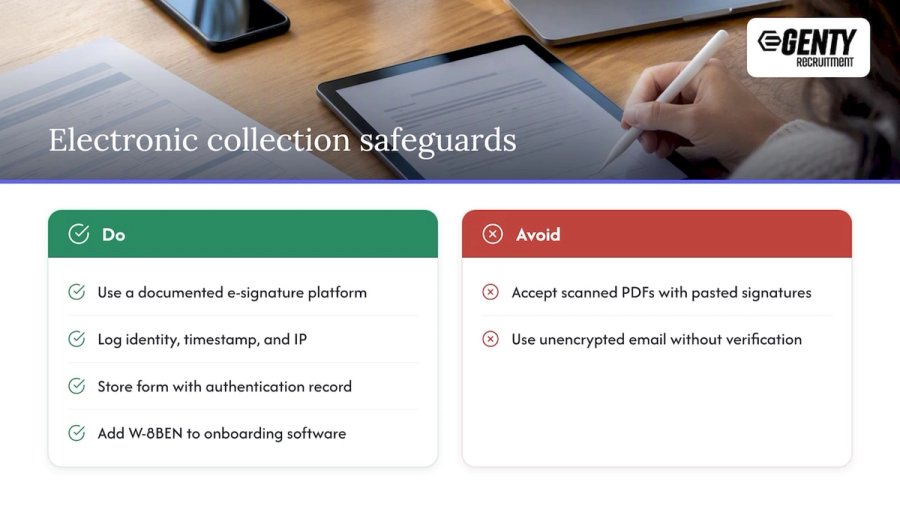
Use a documented e-signature platform rather than a scanned PDF with an image of a signature pasted in. Platforms that log signer identity, timestamp, and IP address give you the audit trail that supports the form’s validity if ever questioned.
Store the completed form alongside the authentication record from the signing platform, not just the final PDF. If a contractor’s status or treaty claim is ever reviewed, having both pieces together saves time.
Build the W-8BEN request into your contractor onboarding software or applicant tracking system so it arrives at the same step every time, rather than as a separate manual email that is easy to lose track of across dozens of hires. For companies hiring at volume across several LATAM countries simultaneously, this consistency matters more than any single tool choice.
Avoid accepting a form via an insecure channel like unencrypted email with no identity verification attached. It is not that the form itself becomes invalid, but you lose the documentation trail that protects you if the IRS ever questions the withholding treatment you applied.
10. Common mistakes contractors make when filling out W-8BEN
Most problems we see with W-8BEN forms are not fraud or evasion. They are simple completion errors that are easy to prevent with a short review step before the form goes into your system.
The most frequent issue is leaving the FTIN field blank with no explanation attached. A missing foreign tax identifying number without a written statement explaining why the contractor does not have one can invalidate a treaty claim, pushing withholding back to the statutory 30% rate.
A second common error is a name mismatch between the form and the contractor’s government identification, often because the form uses a nickname, a maiden name, or an abbreviated version of a legal name. Even small discrepancies can trigger a rejection during review.
Third, contractors sometimes claim a treaty benefit without specifying the correct treaty article, or they list a country of residence that does not match their actual tax residency, especially if they have moved recently. Under the W-8BEN instructions, a change in circumstances that makes any information on the form incorrect requires a new form within 30 days, so a contractor who relocates mid-contract needs to update their paperwork, not wait until renewal.
Finally, an unsigned or undated form is automatically invalid no matter how complete the rest of it is. A short checklist shared with contractors before they submit, covering name match, FTIN or explanation, correct country, and signature, catches nearly all of these before they reach your finance team.
11. Timeline and cost considerations for staying compliant
Collecting a valid W-8BEN rarely takes longer than a few business days when a contractor already holds their country’s tax identifier. The friction shows up when a contractor needs to obtain or locate that number for the first time, or when a form comes back incomplete and needs a second round.
Plan for one to four weeks to confirm an FTIN and finalize treaty paperwork, depending on the contractor’s home country and how familiar they are with the form. A contractor in Mexico with an active RFC on hand can usually return a completed form within days; a contractor who needs to register for a tax identifier for the first time will take longer, and that delay sits outside your control.
The administrative cost of getting this wrong outweighs the cost of doing it right upfront. A rejected or expired form discovered after payment has already gone out means reissuing a corrected 1042-S, recalculating withholding, and potentially absorbing the liability yourself as the withholding agent. Compare that to the cost of a single onboarding step: requesting the form, checking four or five fields, and filing it with the payment record.
For companies hiring one or two contractors a year, this is a manageable manual check. For companies scaling a LATAM team across multiple countries, the administrative load compounds quickly, which is why building the validation step directly into your applicant tracking or payroll system, rather than relying on a spreadsheet, pays off within the first few hiring cycles.
12. How to claim tax treaty benefits for contractors from Latin American countries
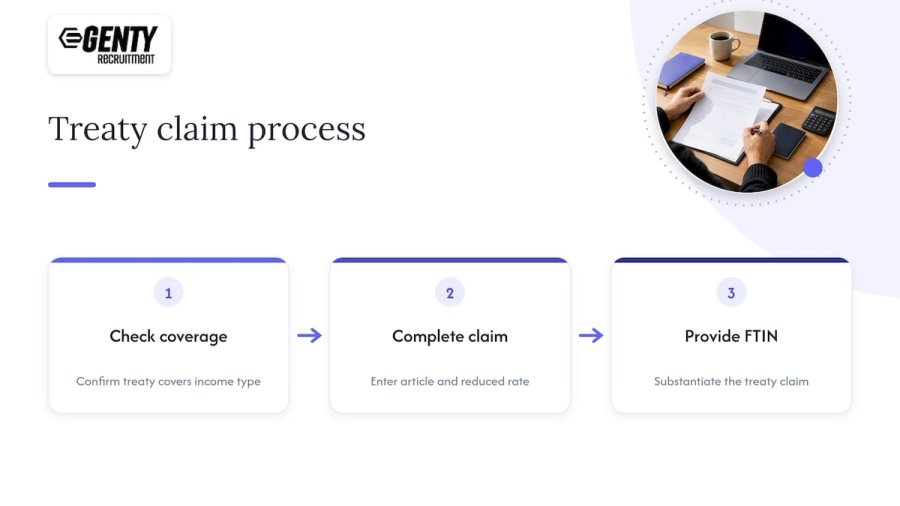
Claiming a treaty-reduced withholding rate on Form W-8BEN requires the contractor to identify their country of residence, cite the specific treaty article that applies to their type of income, and provide a valid FTIN to substantiate the claim.
The process starts with confirming that a tax treaty between the United States and the contractor’s country actually covers the income type in question. Treaty coverage and reduced rates vary by country and by income category, so a contractor’s claim should be checked against the actual treaty text rather than assumed from a general country match.
Once treaty eligibility is confirmed, the contractor completes the treaty claim section of Form W-8BEN with the specific article number and the reduced rate they are claiming, then provides their FTIN. The instructions for the requester of Forms W-8 are explicit that a missing FTIN can undermine a treaty claim even when every other field is correct, since the FTIN is what ties the claim to a verifiable tax identity in the contractor’s home country.
For a payer managing contractors across several Latin American countries at once, standardizing this review step matters more than the treaty details themselves. Set up a short internal reference sheet noting which countries have active treaties with the United States, which income categories those treaties cover, and what identifier format each country uses for its FTIN. That reference turns a case-by-case legal question into a repeatable five-minute check for your finance team, and it is the single highest-leverage document you can build if you expect to keep hiring across the region.
Why most companies get W-8BEN collection backward
Most companies treat W-8BEN as a tax form to collect at the end of the hiring process, right before the first payment goes out. That sequencing is exactly backward, and it is the single biggest reason compliance problems happen.
The form should function as a gate in your hiring workflow, not a step bolted onto accounts payable. A contractor who cannot produce a valid FTIN or who needs 30 days to register for one is not a documentation problem you discover during your first payment run. It is information you want before you finalize the hire, so you can plan the onboarding timeline realistically instead of scrambling when an invoice is already overdue.
The companies that handle this well treat the W-8BEN not as paperwork but as a signal: how quickly and accurately a contractor completes it often reflects how organized they are about their own tax and invoicing obligations generally, which matters for a long-term working relationship far beyond the first payment.
— Eugene
How a specialized LATAM recruitment agency supports compliant LATAM hiring
We connect companies with pre-vetted software engineers, DevOps specialists, data professionals, and sales talent from Argentina, Brazil, Mexico, Colombia, Chile, and beyond, and provide documentation-ready candidate profiles to help compliance workflows start early.
Our fixed-fee recruitment model delivers curated shortlists within 7 days, with no upfront payment and a 3-month replacement guarantee if a placement does not work out.
- We coordinate onboarding timelines to help ensure FTIN and treaty paperwork are addressed early in the hiring process.
- The LATAM talent pool offers timezone alignment with US business hours, facilitating timely resolution of documentation questions.
- We cover specialized placements through our IT recruitment and sales recruitment services, both priced from $2,999 one-off per hire.
Reach out through our contact page to start a shortlist built around your compliance timeline, not just your technical requirements.
This article is general information, not a substitute for advice from a qualified financial advisor. Consult a qualified financial professional about your own circumstances before acting on anything here.
FAQ
What is the purpose of the W-8BEN form?
Form W-8BEN certifies that the person receiving a payment is a foreign individual and lets that person claim a reduced withholding rate or exemption under a tax treaty. The form’s instructions specify it goes to the payer, never directly to the IRS.
What is my US tax identifier number?
A U.S. tax identifier applies to U.S. persons and is not what a foreign contractor provides on Form W-8BEN. Foreign contractors instead supply their own country’s foreign tax identifying number, such as a CUIT in Argentina or an RFC in Mexico, in the FTIN field of the form.
Will I get a W-2 as an independent contractor?
No, independent contractors do not receive a W-2, which is reserved for employees. A foreign independent contractor’s payments are instead reported by the payer on Form 1042-S, while a domestic contractor would typically see a Form 1099-NEC.
How much to withhold for taxes as a contractor?
The default withholding rate on many U.S.-source payments to foreign contractors is 30% of the gross payment unless a valid Form W-8BEN supports a lower treaty rate. The exact reduced rate depends on the specific tax treaty between the United States and the contractor’s country of residence.