

A senior Go developer hired remotely from Latin America by a US company typically costs about $73,000 to $95,000 a year in base salary, according to HireTalent.lat’s Go salary data. The average Go developer salary in the United States is around $140,000, with a typical range of $108,000 to $183,000. That puts the salary saving at roughly a third to a half, with US timezone overlap and strong English included. Below you will find ranges by seniority, how Argentina, Brazil, Mexico, Colombia and Chile differ, and how to build an offer that wins candidates who already hold other US offers.
TL;DR
- Senior remote Go engineers in LATAM’s main hubs (Argentina, Brazil, Chile, Colombia, Mexico) cluster at $73,000 to $95,000 a year when hired by US companies. Mid-level medians sit near $51,000.
- Local-market salary data understates what you will pay. US-remote pay is commonly 2 to 4 times what a local employer pays for the same role.
- LATAM engineers expect about 20% more than they currently earn when they move to US-based roles, so open with a clear, competitive band.
- Colombia and Mexico give the deepest real-time overlap with US Eastern and Central hours. Argentina and Brazil work best with a slightly shifted schedule.
- Hire for distributed systems and cloud experience first, Go years second.
What Go developers earn in Latin America in 2026
Two numbers matter, and mixing them up is the most common budgeting mistake.
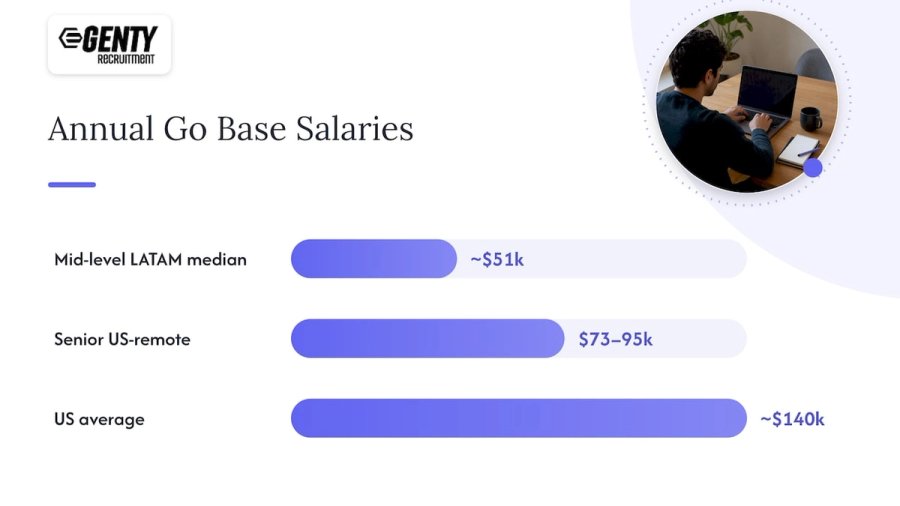
The first is the median for a mid-level Go hire across 19 LATAM countries: about $51,000 a year, within a total range of $13,000 to $106,000, depending on country and experience. The low end reflects junior roles and local employers. The high end reflects senior engineers paid in dollars by foreign companies.
The second is the senior, US-remote band in the high-demand hubs: $73,000 to $95,000. HireTalent’s methodology page states that its ranges reflect what US companies typically pay remote workers in Latin America, not local market rates.
Before you start hiring
Check location, salary, and hiring fit
If you are moving from research to action, start with the market basics so your hiring plan is clearer.
Treat these as base salary benchmarks, not final offers. Employer-of-record fees, equipment, paid time off and any bonus sit on top, and they vary by country and hiring model.
Why salary surveys disagree
Salary aggregators measure different populations. A Glassdoor or TalentUp page reflects employees of local companies paid in local currency. TalentUp, for example, lists a base of roughly 343,400 MXN a year for a Go developer in Mexico, which is a domestic figure. It says little about what a Mexico City engineer earns on a US payroll.
In our experience on searches for US-remote engineers, the best Go talent sits in a different labor market from the local one. A Q4 2025 LATAM compensation survey found engineers’ expected annual salary at $72,000 against current pay of $60,000, a gap that held at 20% for several engineering roles. If you anchor an offer on local data, you will be 30% to 50% under what a strong candidate can already get.
How the five main hubs compare
HireTalent’s Q1 2026 data shows little salary variation between the major hubs once you adjust for English and US timezone alignment. The difference between countries is less about price and more about talent depth, overlap hours and hiring mechanics.
A European buyer’s estimate puts Chile at the top and Peru at the bottom of the mid-level range, with Argentina and Colombia holding the deepest senior Go bench. Treat that as one market view, not a rule.
Argentina
Argentina’s engineers are used to dollar-linked contracts and often hold several remote offers at once. Expect candidates to ask for payment in USD and to compare you against US startups, not Argentine employers. Offers pitched at local-market levels fail technical vetting stage after stage because the strongest people have already moved on.
Brazil
Brazil offers the biggest pool of backend and infrastructure engineers, with many working in large fintechs and payment companies. Go is common in cloud-native stacks there. English proficiency is the variable to test directly, with a live technical conversation rather than a CV line.
Mexico and Colombia
These two are the first choice when a role needs constant real-time collaboration: on-call rotations, pairing, and sprint-day debugging with a US product team. Mexico’s central timezone also lines up well with teams in Chicago, Austin or Denver.
Timezone alignment is part of the price
The savings on LATAM hiring go beyond the salary gap. Teams in Colombia or Mexico avoid the asynchronous delays, off-hour standby and slow sprint-cycle communication that come with Eastern European or Asian engineering teams. A Go developer who is online at 9am Eastern can join standup, review a pull request while the author is still at the keyboard, and respond to a production incident in the same hour.
That matters for the work Go does. The 2025 Go Developer Survey reports that more than a third of respondents build cloud infrastructure tooling, and Go sits underneath Kubernetes and Docker. Those are roles where an incident cannot wait for the next morning.
A practical rule for CTOs:
- Real-time, high-pressure work (on-call, payments, incident response): prioritize Colombia, Mexico or Costa Rica.
- Planned feature work with some async tolerance: Argentina and Brazil work well with an agreed core window, for example 10am to 6pm Eastern.
- West Coast teams: Mexico gives the smallest gap. Plan a shared window of roughly 10am to 2pm Pacific.
What a Go hire costs against the US
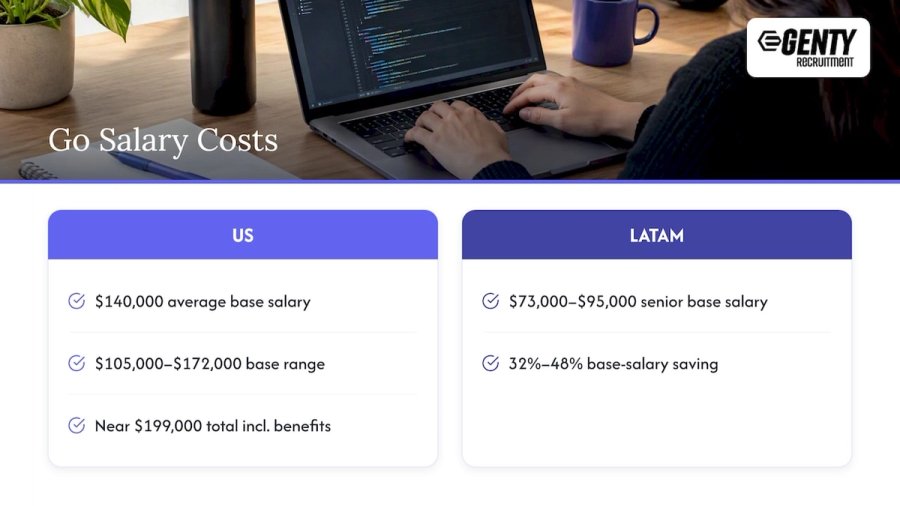
Take a senior hire. At the US average of $140,000 and a LATAM senior band of $73,000 to $95,000, the base salary saving ranges from about 32% to 48%. That is our own arithmetic from the two sources above, and it excludes benefits and employer taxes, which differ by country and by hiring structure.
The gap is wider than the headline suggests on the US side. Ryz Labs cites BLS data putting US Go-comparable base pay at $105,000 to $172,000, with a total cost near $199,000 once benefits are added. Remote engineer data from LeadDev shows salaries in Canada, Latin America and Europe running 28% to 60% lower than the US.
For a broader cost model that includes agency fees, equipment and onboarding, see our guide on how much it costs to hire a developer and our overview of US tech employers hiring in Latin America. If your team also needs infrastructure engineers, our DevOps salary guide for Latin America covers the adjacent band.
Hire for systems experience, not just Go years
Most Go engineers did not start with Go. The 2025 Go Developer Survey shows a professional, experienced community, with 87% of respondents identifying as professional developers. Many arrive from Python, Java or C++.
That changes how you read a CV. A candidate with two years of Go and six years of microservices, Kafka and Kubernetes work often outperforms one with four years of Go in a narrow role. Screen for:
- Concurrency: goroutines, channels, context cancellation, and how the candidate has debugged a leak or a race condition.
- Distributed systems: gRPC, message queues, idempotency, retries, observability.
- Cloud deployment: Kubernetes, Docker, and whichever of AWS, Google Cloud or Azure you run.
- Data layer: PostgreSQL or similar, migrations, query performance.
- Spoken English: a 30-minute architecture discussion, not a grammar test.
Because Go experience is usually a layer on top of deeper engineering, a strong Go hire often needs less hand-holding than a generalist, but costs more per year of narrow experience. Budget accordingly.
Building an offer that wins
Competition for good Go engineers in LATAM comes from US companies, not local ones. A short checklist for your offer:
- [ ] Publish a salary band in the first conversation, in USD.
- [ ] Set the band against the US-remote market, not the local one: assume the candidate can find offers 1.5x to 2x local averages.
- [ ] Budget for the 20% jump candidates typically expect when moving from their current job.
- [ ] Define the overlap window in the job description.
- [ ] Decide the contract model (contractor, employer of record or local entity) before the first interview.
- [ ] Move fast: top candidates rarely stay on the market more than a couple of weeks.
Companies that share compensation clearly at the start tend to close top candidates faster. In our searches, we see transparent structure shorten negotiations and reduce drop-off after final interviews.
Our perspective: pay for output, not for postal codes
We place engineers across Argentina, Brazil, Mexico, Colombia and Chile, and the same pattern repeats. Hiring managers arrive with a salary number from a local aggregator, then discover that the engineers who can run a production Go service are already working for US companies. The right question is not what a Go developer earns in Bogotá or Buenos Aires. It is what a US-standard engineer costs when working your hours.
Our view is that a senior Go hire at $73,000 to $95,000 is a strong value when you count overlap, English and retention. Under-offering saves a few thousand dollars on paper and costs months of searching, failed vetting rounds and turnover. Over-engineering the process is the other trap: a three-stage interview loop will lose a candidate who has two other offers.
We screen on systems experience first, then Go depth, then communication, which is why our shortlists are triple-vetted before you see them. Expect to decide quickly on the best two or three profiles.
— Eugene
Hiring Go developers with GENTY recruitment
If you want a vetted shortlist rather than a job-post lottery, our IT recruitment service starts from $2,999 one-off per hire, with no upfront payments and a 3-month replacement guarantee. Shortlists arrive within 7 days. You can also see how we work on our page for hiring remote software developers in LATAM.
For teams that prefer a monthly model, our remote staffing and EOR service starts from $99 per month per employee. Exact salary expectations for your stack, seniority and country can be built into a benchmarking report with our team.
For process detail, our guides on hiring remote developers from Latin America and the remote hiring playbook for LATAM tech teams walk through contracts, compliance and onboarding.
FAQ
How much does a Golang developer make in Latin America?
For US-remote roles, a mid-level Go developer’s median is about $51,000 a year across LATAM, and senior engineers in Argentina, Brazil, Chile, Colombia and Mexico typically fall between $73,000 and $95,000 (HireTalent.lat). Local employers pay far less, so domestic salary pages will understate what you need to offer.
Is Go in demand?
Yes, particularly for cloud infrastructure and backend work. The 2025 Go Developer Survey found that more than a third of Go developers build cloud infrastructure tooling. In LATAM, fintechs are a major source of senior Go experience, which is why the talent is concentrated in Colombia, Argentina and Brazil.
Which LATAM country is best for hiring a Go developer?
It depends on your overlap needs. Colombia and Mexico give the best real-time alignment with US Eastern and Central teams. Argentina and Brazil have deep senior pools and work well with a shifted but defined core window.
Do LATAM Go developers need to be paid in dollars?
For US-remote roles, most strong candidates expect USD-denominated pay. Local-currency offers pegged to domestic salary data are a common reason offers are declined, since the same engineer can often find US-company roles paying 2 to 4 times the local rate.
Sources
- Go Developer Salary in Latin America (2026), HireTalent.lat
- Salary Guide Methodology, HireTalent.lat
- Golang Developer Salary in 2026: Trends and Insights, Trio
- Results from the 2025 Go Developer Survey, go.dev
- 2025 Tech Salaries and Benefits Trends in Latin America
- Remote Engineer Salary Insights Report, LeadDev
- Golang Developer Salaries in Mexico 2026, TalentUp
- Go Developer Rates and Cost to Hire (2026), Ryz Labs
- Go Developer Salary in Latin America 2026, Globental