

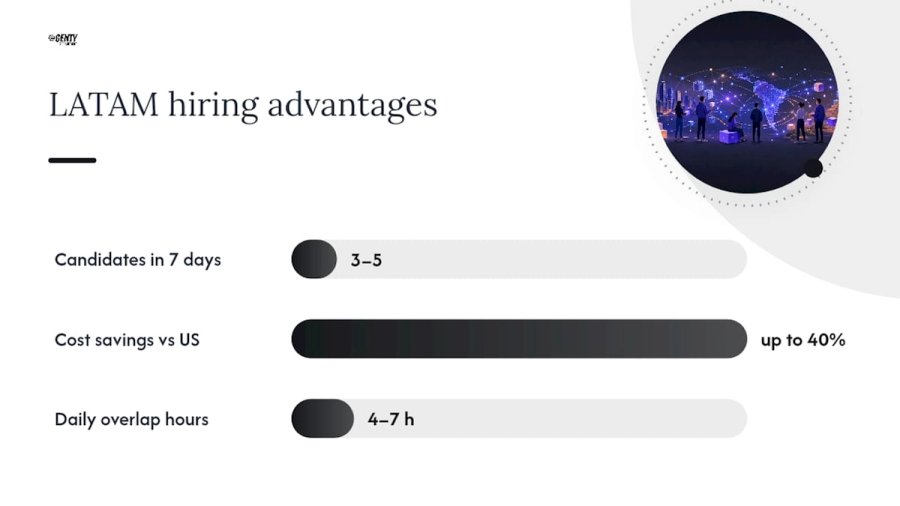
For most hiring managers, the fastest path to a vetted Web3 engineer is a curated LATAM nearshore shortlist combined with a one-week paid test. GENTY recruitment delivers that shortlist in seven days, drawing from Argentina, Brazil, Mexico, and Colombia, where senior engineers with Hardhat and The Graph experience typically cost 40–60% less than equivalent US hires. Your next step: schedule an intake call, define your target chain and required overlap hours, and receive three to five pre-vetted candidates by day seven.
Key Takeaways
Hiring vetted Web3 developers in 2026 is fastest and most cost-effective through a curated LATAM nearshore shortlist combined with a structured paid test that validates production-level skills before any long-term commitment.
Which hiring model should you use for Web3 roles?
The four engagement models each carry a different trade-off between speed, vetting depth, and cost. Choosing the wrong one adds weeks and risk to a Web3 project where a single unaudited contract can cost far more than a delayed hire.
- Specialized recruitment agency (e.g., GENTY recruitment): Best for full-time or long-term contractor hires where audit history, IP clarity, and timezone overlap matter. Shortlists arrive in seven days; candidates are pre-screened for production deployments and security hygiene.
- Curated vetted marketplaces (e.g., Arc): Good for mid-term contractors when you need a match in 24–72 hours and can run your own technical screen. Vetting depth varies; always add a paid test.
- Broad freelance marketplaces (e.g., Upwork): Fastest to post, slowest to vet. Useful for short, well-scoped tasks (a single subgraph mapping, a one-off Solidity review) where you control the spec tightly and accept higher screening effort.
- Direct full-time hire: Highest control and IP clarity, but typically takes 4–10 weeks. Best when you are building a core protocol team and need someone embedded in architecture decisions from day one.
For urgent wallet-flow fixes or a production incident, a curated contractor starts faster. For a protocol lead who will own architecture and coordinate audits, a direct hire or agency placement with audit-history verification is worth the longer timeline.
Need help hiring?
See the next step after this guide
If this topic is relevant to your team, these are the most useful pages to check next.
What technical skills and tools should you require?
A Web3 job spec that lists only “Solidity experience” attracts tutorial writers, not production engineers. Require specific tools and demonstrable outputs across four technical buckets.
Smart contract engineering
Require Solidity for EVM chains; Rust for Solana or Near. Candidates should show verified contract addresses on Etherscan or a comparable explorer, not just GitHub repos. Ask for ABI files and a brief explanation of any audit finding they addressed before deployment.

dApp frontend and wallet integration
Specify ethers.js or web3.js, and ideally wagmi/viem for React-based dApps. A candidate who has only used a tutorial scaffold and never handled a failed transaction in production will surface this gap quickly in a paid test.
Backend indexing and data layer
The Graph subgraphs and GraphQL are the standard for exposing on-chain data to frontends. Mid-level and senior candidates should be able to write a subgraph mapping from scratch and explain how they handle reorgs or schema migrations.

Infrastructure, testing, and RPC management
Hardhat is the dominant Ethereum development environment for compiling, testing, and local mainnet forking. Require Hardhat Network familiarity for candidates who will write or review contract tests. Mocha is the standard test framework in most Hardhat setups; ask for test suites, not just contract files. For RPC providers, require experience with Alchemy or Infura, including failover configuration.
Skill expectations by seniority:
- Junior: Solid TypeScript/JavaScript, basic Solidity, can write simple Hardhat tests with Mocha
- Mid-level: Test-driven contract development, basic subgraph creation, Alchemy/Infura integration
- Senior/Lead: Architecture decisions, gas optimization, audit coordination, formal verification exposure, CI/CD pipelines with static analysis (Slither, MythX)
Pro Tip: Require a public GitHub repo or a verified on-chain deployment in the application itself. Candidates who cannot provide either before the first interview are almost always pre-production only.
How do you vet and interview Web3 candidates effectively?
A repeatable screening workflow matters more in Web3 than in most engineering disciplines because the cost of a bad hire compounds: a poorly written contract that reaches mainnet is expensive to fix and potentially irreversible.
Step-by-step screening process
- Resume and repo screen: Confirm at least one verified on-chain deployment. Check test coverage in public repos. Disqualify anyone whose only evidence is a forked tutorial project.
- Short technical interview (30–45 minutes): Ask the candidate to walk through a contract they deployed. Focus on edge cases, access control decisions, and any audit findings they addressed.
- Paid take-home test (4–12 hours): See the paid-test spec in the next section. Pay a fair rate; serious candidates expect it.
- Code walkthrough with a senior engineer: Have your own senior Web3 engineer (or a trusted contractor) review the take-home output live. Ask the candidate to explain gas optimization choices and test structure.
- Reference and audit-history check: Contact at least one prior employer or client. Ask specifically whether the candidate’s contracts went through a formal audit and what their role was in addressing findings.
Red flags to watch for:
- No public code and no verifiable on-chain deployment
- Cannot explain a past audit finding in plain terms
- Test suite exists but coverage is below 80% on critical paths
- Relies entirely on OpenZeppelin templates without understanding the underlying logic
- Unclear about IP ownership on prior work (especially freelance projects)
Pro Tip: Ask candidates which static analysis tools they run routinely. Engineers who mention Slither or MythX as part of their pre-commit workflow have internalized security hygiene. Those who have never heard of either are a risk on any contract that handles real value.
For a deeper framework on technical and soft-skill vetting, GENTY recruitment’s vetting guide covers assessment design across seniority levels.
What does it cost and how long does it take?
Timelines by model
- Curated agency shortlist: Shortlist in 7 days; first developer onboarded in 1–2 weeks
- Curated marketplace: Matches in 24–72 hours; 1-week trial before commitment
- Direct full-time hire: 4–10 weeks from job post to signed offer
Salary and rate ranges
US-based senior Web3 engineers typically command $130,000–$200,000 per year in total compensation, plus employer overhead (benefits, payroll taxes, equity). LATAM senior engineers from Argentina, Brazil, Mexico, and Colombia typically range from $40,000–$95,000 per year depending on country and seniority level, with no local employer overhead for US companies using a contractor or EOR model.
Freelance hourly rates follow a similar pattern: senior global freelancers commonly charge $80–$200/hr, while senior LATAM freelancers typically run $35–$90/hr for equivalent experience.
Practical timelines for common hires:
- Urgent wallet-fix contractor: start in 24–72 hours via curated marketplace or agency fast-track
- Build-MVP pod (2–3 engineers): 4–8 weeks to assemble via agency
- Protocol lead (full-time, audit-coordination role): 8–12+ weeks for a direct hire with full reference checks
Why timezone overlap reduces cost
LATAM engineers in Argentina, Brazil, Mexico, and Colombia share 4–7 hours of real-time overlap with US EST and PST schedules. For wallet-flow debugging and live transaction tests, that overlap shortens debugging cycles compared with farther offshore time zones, which means fewer calendar days to ship and lower total project cost. Read more on how Web3 teams scale with LATAM engineers for country-specific examples.
What should your job description and interview questions look like?
Senior Web3 engineer: job brief template
Role summary: You will design, write, test, and deploy smart contracts and supporting infrastructure for [protocol/product name]. You will own the full contract lifecycle from spec to post-audit deployment, and collaborate with the frontend team on wallet integration and subgraph queries.
Must-have stack: Solidity (EVM), Hardhat, Mocha/Chai test suites, ethers.js or web3.js, The Graph/subgraphs, GraphQL, Alchemy or Infura (with failover config), Git/CI with static analysis (Slither or equivalent).
Responsibilities:
- Write and maintain auditable Solidity contracts with 90%+ test coverage
- Configure and maintain Hardhat environments including mainnet forking for staging tests
- Build or maintain subgraph mappings and GraphQL schemas for frontend data needs
- Coordinate with external auditors; address findings before mainnet deployment
- Document contract architecture, ABI, and deployment addresses
Success metrics (90-day): At least one contract deployed to testnet with passing CI, subgraph live and queryable, audit-readiness review completed.
Overlap requirement: Minimum 4 hours daily overlap with US EST (9 AM–1 PM ET).
Interview questions by area
Smart contracts:
- Walk me through the most complex access control pattern you have implemented. What edge cases did you consider?
- Describe a gas optimization you made after an initial audit. What was the before/after cost?
Infrastructure and DevOps:
3. How do you configure Hardhat Network to fork mainnet for a staging test? What pitfalls have you hit?
4. Which RPC provider do you use in production, and how do you handle failover?
Frontend wallet flows:
5. Describe a failed transaction scenario you debugged. How did you reproduce it locally?
Indexing and subgraphs:
6. How do you handle a reorg in a subgraph mapping? What does your schema look like for a token transfer event?
Security and audits:
7. What does your pre-audit checklist look like? Which static analysis tools do you run, and when?
Behavioral:
8. Give me an example of a disagreement with a frontend engineer about data shape. How did you resolve it?
Paid-test specification (4–12 hours)
Task: Given a simple ERC-20 contract with a custom transfer fee, the candidate must:
- Write a Hardhat test suite using Mocha that covers the fee calculation, edge cases (zero transfer, max supply), and an access control check
- Deploy to a local Hardhat Network fork of a public testnet
- Write a minimal subgraph mapping that indexes Transfer events and exposes a GraphQL query for total volume by address
- Submit: test output (passing), verified deployment address on testnet, subgraph repo link, and a short written explanation of one security consideration they noticed
Candidate vetting checklist
Use this checklist during screening and interviews. Mark each item as Pass, Fail, or Follow-up needed. Items marked with ★ are deal-breakers.
Scoring guidance: Five or more “Pass” marks with zero deal-breaker failures advances the candidate to the code walkthrough. A single deal-breaker failure ends the process unless the role is explicitly junior and the item is marked negotiable.
For a broader candidate vetting framework covering both technical and soft-skill dimensions, GENTY recruitment’s published guide is a practical companion to this checklist.
How does GENTY recruitment source and vet Web3 hires?
GENTY recruitment runs a structured five-step process designed specifically for technical roles in Web3, FinTech, and SaaS, with all sourcing focused on Latin America.
- Intake call: Define the target chain, required stack, seniority level, overlap hours, and engagement model (contractor vs. full-time).
- Sourcing and pre-screen: GENTY recruitment searches across Argentina, Brazil, Mexico, Colombia, and Chile, filtering for verified deployments, audit history, and English proficiency before any candidate reaches your desk.
- Technical interview: A senior Web3 engineer conducts a structured technical screen covering contract architecture, devtool familiarity, and security hygiene.
- Curated shortlist delivery: You receive three to five pre-vetted candidates within seven days, each with a profile covering production deployments, tool stack, timezone, and English assessment.
- Paid trial and hire: Run a one-week paid spike against the test spec above. If the hire does not work out within three months, GENTY recruitment replaces the candidate at no additional fee.
What the vetting covers:
- Verified on-chain deployments and contract addresses
- Audit history or documented pre-audit hygiene (Slither, MythX)
- Hardhat, The Graph, Alchemy/Infura familiarity confirmed in technical interview
- Timezone overlap with US EST/PST schedules
- English proficiency assessed in both written and spoken formats
GENTY recruitment’s fixed-fee model means you know the cost before you start. No upfront payment, no percentage of salary, and a 3-month replacement guarantee if the hire does not perform. For Web3 roles where a bad hire can delay an audit cycle by months, that guarantee carries real operational value.
Before your intake call, prepare: target chain (Ethereum, Solana, Polygon, etc.), two prioritized use cases (e.g., ERC-20 contract + subgraph indexing), required daily overlap hours, and preferred engagement model. See how Web3 companies scale with LATAM engineers for country-specific context on Argentina, Brazil, Mexico, and Colombia.
Legal and compliance considerations when hiring Web3 developers
IP ownership is the most common legal gap in Web3 hiring, and it surfaces at the worst possible time: during an audit or a token launch. Every contract with a Web3 developer, whether freelance or full-time, should include an explicit IP assignment clause stating that all smart contract code, ABI files, deployment scripts, and subgraph schemas become the company’s property upon payment. Do not rely on implied work-for-hire doctrine for contractors, especially international ones, where local law may not recognize that doctrine at all.
For US companies hiring LATAM contractors, the standard structure is an independent contractor agreement governed by US law (typically Delaware or the company’s state of incorporation), with a choice-of-law clause and a dispute resolution mechanism. If you need the contractor to be classified as an employee for benefits or equity purposes, use an Employer of Record (EOR) service that operates in the contractor’s country. GENTY recruitment’s staffing and EOR model covers this for Argentina, Brazil, Mexico, and Colombia.
Two additional compliance areas matter specifically for Web3 roles. First, if the developer will deploy contracts that interact with financial instruments or tokens, confirm that neither party is subject to OFAC sanctions restrictions, and document that check. Second, for any role involving access to private keys or multisig wallets, include explicit key-management and confidentiality obligations in the contract, along with a clear offboarding procedure that revokes access immediately upon termination. These are not standard clauses in generic freelance agreements; add them explicitly.
This section covers general information, not legal advice. Confirm current rules with a qualified attorney for your specific jurisdiction and contract structure.
What most hiring guides get wrong about Web3 talent
The conventional wisdom says Web3 developers are scarce and expensive, so you should pay a premium and accept long timelines. That framing is partly right and mostly unhelpful.
The real scarcity is not Solidity writers. It is engineers who understand the full production stack: contract security, indexing architecture, RPC failover, and CI hygiene. Tutorial-level Solidity is common. Engineers who have shipped a contract through a formal audit, maintained a subgraph under load, and configured Alchemy failover in a production environment are genuinely rare, and they are concentrated in places most US hiring managers have not looked systematically.
LATAM is one of those places. Argentina and Brazil in particular have deep pools of engineers with strong TypeScript and systems backgrounds who have moved into Web3 over the past three years. The timezone advantage is real and underused: a Buenos Aires or São Paulo engineer working 9 AM–6 PM local time overlaps with US EST from roughly 10 AM–3 PM, which covers the core debugging window for most US-based teams. That overlap is worth more than it looks on paper because live transaction debugging and audit-prep reviews require synchronous communication, not async Slack threads.
The other thing most guides underweight is the paid test. A four-hour paid spike that asks a candidate to write a Hardhat test, deploy to a local fork, and build a minimal subgraph tells you more than three rounds of interviews. It also signals to serious candidates that you run a professional process, which itself filters out the tutorial writers.
Start hiring vetted Web3 developers through GENTY recruitment
GENTY recruitment gives US and European tech companies a faster, lower-cost path to production-ready Web3 engineers from Latin America. The typical engagement runs like this: a 30-minute intake call on day one, a curated shortlist of three to five pre-vetted candidates by day seven, a one-week paid spike to validate wallet flows and contract quality, and a hire or extension with a three-month replacement guarantee built in.
Fixed-fee pricing means no percentage of salary and no upfront payment. Before your intake call, have your target chain, two prioritized use cases, required overlap hours, and preferred seniority level ready.
Start your Web3 shortlist at GENTY recruitment, or review the Web3 recruitment service page to see how the process works for your specific stack and team size.