

For most SMB website projects, the clearest path is a pre-vetted dedicated hire or small agency, not a marketplace freelancer. Marketplace platforms like Upwork and Fiverr work well for discrete, low-risk tasks, but multi-sprint builds and ongoing maintenance demand someone who understands your stack, your users, and your release cadence. Pew Research documents a sustained shift toward remote work in America, which means hiring a LATAM-based developer through a recruitment partner is now a mainstream, operationally proven option, not an experiment.
Two quick alternatives worth knowing: curated agencies or dedicated remote teams for full redesigns and complex builds; freelance marketplaces for one-off tasks like a landing page, a plugin fix, or a logo refresh. Before you contact anyone, define scope first. Decide whether you need a one-time deliverable or ongoing support, because that single decision determines which provider type fits and what contract terms to require.
LATAM developers in Argentina, Brazil, Mexico, and Colombia typically work within US EST/PST overlap windows of several hours, which removes the async bottleneck that makes offshore hiring frustrating. Mid-senior full-stack developers in those markets cost significantly less per year compared to equivalent US-based engineers.
Key Takeaways
Dedicated hires and small agencies outperform open marketplaces for any website project that spans more than one sprint, and LATAM talent from Argentina, Brazil, Mexico, and Colombia delivers the best cost-to-quality ratio for US buyers.
Planning a hire?
Talk through the best hiring option
This article usually leads to one practical question: should you use staffing or country guide? We can help you choose quickly.
Simple next step
Start with staffing and we will help you pick the best hiring setup.
What types of providers can you use to outsource a website?
Website development outsourcing falls into four distinct provider models, each suited to a different project profile.
Freelance marketplaces
Platforms like Upwork, Fiverr, and Freelancer give you fast access to individual contractors at a wide range of price points. Upwork suits mid-complexity tasks where you want hourly billing and a work-diary audit trail. Fiverr is better for fixed-scope deliverables: a homepage design, a logo, a WooCommerce plugin configuration. Freelancer.com runs a competitive-bid model that can surface lower prices but requires more vetting effort on your side. These platforms are open marketplaces, meaning quality varies significantly and you carry most of the screening burden.
Best for: Small, discrete tasks with clear deliverables and low integration risk.
Curated talent platforms
Toptal pre-screens developers through a multi-stage technical and communication assessment, accepting a small fraction of applicants. 99designs applies a similar curation model specifically to design work, with contest and direct-hire options. Robert Half and Instawork operate as staffing intermediaries, with Robert Half focusing on professional and technical roles and Instawork skewing toward operational and light-tech placements. These platforms reduce your vetting overhead but carry higher day rates than open marketplaces.
Best for: Projects where technical quality is non-negotiable and you need a faster shortlist without running your own screening process.
Agencies and managed services
A web agency handles the full project lifecycle: discovery, design, development, QA, and launch. Finsweet’s embedded Webflow team model illustrates how a well-structured agency can operate as a true extension of your in-house team, handing off all project artifacts at launch. Managed services firms go further, taking on hosting, monitoring, and ongoing updates under a retainer. Agencies carry the highest per-hour cost but also the highest accountability for delivery.
Best for: Full redesigns, complex integrations, or situations where you want a single point of accountability.
Dedicated hires via recruitment
A recruitment partner sources, vets, and places a developer who works exclusively on your product, embedded in your team and your tooling. ScienceSoft’s outsourcing guide identifies the dedicated-team model as the structure that most closely mirrors in-house employment while keeping costs below US market rates. GENTY recruitment operates in this space, placing pre-vetted engineers from Argentina, Brazil, Mexico, and Colombia with a 7-day shortlist turnaround and a 3-month replacement guarantee.

Best for: Multi-sprint roadmaps, long-term maintenance, or any project requiring deep product knowledge.
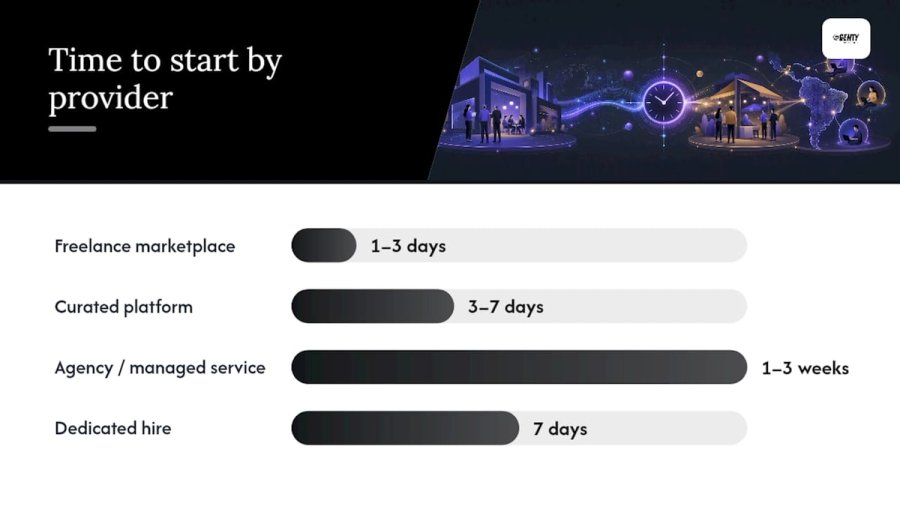
Provider comparison at a glance
Which website tasks should you outsource?
Not every part of your website is equally safe to hand off. The tasks that outsource well share a common trait: they have clear acceptance criteria and limited dependency on proprietary business logic.
Outsource confidently:
- UI/UX design and theme work — visual design, component libraries, Figma-to-code handoff, and WordPress block-theme builds. LATAM frontend engineers are particularly strong here; Argentina and Colombia have produced a dense pool of React and Vue specialists.
- CMS configuration and integrations — WordPress, Webflow, Contentful, and Shopify setups, including third-party API connections. For WordPress projects specifically, block-theme architecture standards are well-documented and give you a concrete technical benchmark to hold vendors against.
- Frontend development — HTML/CSS, JavaScript frameworks, performance optimization, and accessibility remediation.
- DevOps and hosting — CI/CD pipeline setup, AWS/GCP/Azure configuration, containerization, and uptime monitoring. DevOps is a LATAM strength; Brazil and Mexico have strong communities around Kubernetes and Terraform.
- Maintenance and support — bug fixes, dependency updates, security patches, and content updates under a retainer.
- SEO technical work — site speed, structured data, crawl optimization, and Core Web Vitals fixes.
Keep in-house or use embedded hires for:
- Core authentication and authorization logic tied to your product’s user model.
- Payment processing flows that touch PCI-scoped data.
- Any feature that requires real-time access to proprietary business rules or unreleased product strategy.
These aren’t outsourcing-proof tasks, but they require someone deeply embedded in your architecture. A dedicated hire who has worked in your codebase for three months can handle them; a marketplace freelancer on a two-week contract cannot.
Pro Tip: Break your website project into three layers before you scope: presentation layer (design, frontend), integration layer (APIs, CMS, third-party tools), and data/auth layer (user data, payments, access control). Outsource the first two freely; treat the third as a dedicated-hire or in-house responsibility.
How do you choose the right provider for your website project?
The decision comes down to five variables: scope complexity, risk tolerance, required speed, budget ceiling, and whether you need ongoing support after launch. Run through these in order before you shortlist vendors.
Decision checklist for US buyers
- Define scope and deliverables. Write a one-page brief covering pages, features, tech stack, and launch date. Vague briefs produce vague proposals and scope creep.
- Classify your data sensitivity. If your site handles user accounts, payments, or health data, classify those assets before you share access credentials. Institutional guidance like UCSC’s IT resource classification framework provides a reusable model for scoping what can safely be handed to a vendor.
- Decide on provider type. Use the table in the previous section. If you need post-launch support, eliminate pure project-based freelancers immediately.
- Shortlist and screen. For technical and soft-skill vetting, ask candidates to walk through a past project’s architecture decisions, not just show a portfolio. Red flags: no version control history, inability to explain trade-offs, or evasiveness about past client references.
- Check insurance and compliance. US buyers working with external vendors should verify general liability and professional indemnity coverage. UC supplier insurance requirements offer a practical template for the documentation to request.
- Negotiate contract terms. Non-negotiable items: IP assignment (all work product transfers to you at payment), uptime SLA for managed hosting (99.5% minimum), defined response times for critical bugs (under 4 hours), backup frequency and retention, data access revocation procedures, and a handover package at project close.
- Run a paid discovery sprint. Before committing to a full engagement, pay for a 1–2 week scoping sprint. It reveals communication quality, delivery discipline, and technical depth faster than any interview.
Questions to ask every vendor
- Who owns the code and design assets at each milestone?
- How do you handle scope changes mid-project?
- What is your process for security vulnerability disclosure?
- Can you provide two references from projects of similar complexity?
- How do you manage knowledge transfer if a key developer leaves?
Red flags to cut the conversation short: no written contract offered, resistance to milestone-based payments, inability to name the specific engineers who will work on your project, or a portfolio that shows only design mockups with no live URLs.
For WordPress-specific outsourcing, verify that the vendor follows WordPress theme review standards and uses the Theme Check plugin as part of their QA process. These are public, enforceable standards, not optional best practices.
What do outsourced website projects typically cost and how long do they take?
ScienceSoft notes that web development outsourcing costs vary widely depending on scope, from tens of thousands for a standard build to hundreds of thousands for complex applications. The ranges below reflect US-market pricing for the provider types covered in this guide.
Cost and timeline by provider type
LATAM vs. US developer cost comparison
These figures reflect total compensation for remote roles billed in USD. LATAM developers hired through a recruitment partner like GENTY recruitment typically cost significantly less than a comparable US hire when you account for salary, benefits, and employer overhead.
Pricing model trade-offs
Hourly suits exploratory or maintenance work where scope is undefined. It gives you flexibility but makes budget forecasting difficult. Fixed-price works for well-scoped builds with clear acceptance criteria; it transfers delivery risk to the vendor but requires a tight brief upfront. Retainer is the right model for ongoing support, SEO work, or a dedicated hire who splits time across multiple workstreams. Placement fee applies to recruitment: you pay once per hire, then the developer’s salary is a direct employment cost.
US procurement teams should budget 1–2 weeks for contract review and legal sign-off, which affects time-to-start for agency and recruitment engagements. Marketplace platforms can start within days, but that speed comes at the cost of vetting depth.
How do you integrate outsourced developers into your team effectively?
Poor integration, not poor technical skill, is the primary reason outsourced website projects fail. Treating an outsourced developer as a ticket-processing service rather than a team member produces slow cycle times, rework, and knowledge silos. The fix is a structured first week and a repeatable collaboration cadence.
Week-one onboarding checklist
- Day 1: Provision all access: GitHub repo, Jira/Linear project, Slack workspace, staging environment, and any third-party service credentials. Never let a developer spend their first day waiting for logins.
- Day 1–2: Share architecture documentation, README files, and a recorded walkthrough of the codebase. If documentation is sparse, schedule a live walkthrough with your lead engineer.
- Day 2–3: Assign a small, well-defined ticket from the backlog. The goal is a merged PR within the first three days, not a major feature. This validates environment setup and establishes code review norms early.
- Day 3: Run a pair-programming session between the outsourced developer and an internal engineer. This transfers tacit knowledge faster than any document.
- Day 5: Include the new hire in sprint planning and release review. Immediate inclusion in planning signals that their input matters and reduces the “contractor mindset” that creates siloing.
Ongoing collaboration workflow
- Daily standup: 15 minutes, async-first (Slack thread or Loom video) with a live option twice per week. For LATAM hires, schedule the live sessions between 9 AM–12 PM EST to capture the maximum overlap window with Argentina, Brazil, Mexico, and Colombia.
- Ticket triage: Weekly, with the outsourced developer participating in backlog grooming. This prevents the common failure mode where outsourced engineers work from stale or ambiguous tickets.
- Code review: All PRs reviewed within 24 hours. Establish a written code review standard on day one so feedback is consistent and not personality-dependent.
- QA and release: Define who owns QA sign-off before the first sprint. Ambiguity here causes launch delays more reliably than any technical issue.
KPIs to track integration quality
Track PR lead time (time from first commit to merge), cycle time (ticket open to deploy), defect rate (bugs per sprint), and response SLA (time to acknowledge a critical issue). Run a retrospective every two weeks for the first two months, then monthly. These metrics tell you whether integration is working before a missed deadline does.

Pro Tip: For LATAM hires, run an English communication check during onboarding, not just at the interview stage. Assign one async written task (a Slack thread summary or a short technical doc) in the first week. Written English proficiency matters more than spoken fluency for distributed teams, and it surfaces gaps early when they are easy to address.
For practical remote team management techniques that apply directly to outsourced web teams, the cadence recommendations in that guide translate well to LATAM-based dedicated hires. Tips on hiring and managing remote employees from structured onboarding to async communication norms are also worth reviewing before your first LATAM engagement.
When do dedicated hires beat marketplaces for website projects?
The conventional wisdom says marketplaces are fast and agencies are thorough. The more useful distinction is between projects that need continuity and projects that do not.
A marketplace hire on Upwork or Fiverr can deliver a polished landing page in a week. That same hire, asked to maintain a SaaS marketing site through three product launches and a rebrand, will produce inconsistent results. Not because the developer lacks skill, but because the engagement model does not support knowledge accumulation. Every new task starts from a cold context, and the developer has no stake in the long-term quality of the codebase.
A pre-vetted dedicated hire, placed through a recruitment partner and embedded in your sprint cadence from week one, builds product knowledge that compounds. By month three, they are catching edge cases your internal team missed, flagging technical debt before it becomes a launch blocker, and contributing to architecture decisions. That trajectory is not available from a marketplace engagement, regardless of the freelancer’s individual skill level.
The cost comparison reinforces this. A mid-senior LATAM developer placed through GENTY recruitment costs $40,000–$65,000 per year in salary, plus a one-time placement fee. A comparable Toptal engagement at $100–$150 per hour, running 20 hours per week, costs $104,000–$156,000 annually with no knowledge retention when the contract ends.
The scenario where marketplaces win is genuinely narrow: a one-time task with a clear spec, no integration requirement, and no follow-on work. For anything beyond that, the math and the operational reality both favor a dedicated hire.
Pre-vetting advantages are particularly pronounced for website projects because the technical surface area is broad. A developer who can build a React frontend, configure a headless CMS, and set up a CI/CD pipeline is a generalist with depth, and finding that profile on an open marketplace requires significant screening effort on your side.
GENTY recruitment places pre-vetted LATAM developers for your website team
Platforms like Upwork, Toptal, and agencies each have their place, but for US tech companies that need a developer embedded in their product team for more than a sprint or two, GENTY recruitment offers a different route: pre-vetted engineers from Argentina, Brazil, Mexico, and Colombia, delivered as a curated shortlist within 7 days.
GENTY recruitment’s fixed-fee pricing per seniority level means no surprise costs, and the 3-month replacement guarantee removes the risk of a bad fit. For frontend, full-stack, and DevOps roles, LATAM is now the leading region for remote tech hiring among US companies that have made the shift.
To get started with IT recruitment in LATAM, prepare your tech stack, a one-paragraph role description, your target start date, and your budget range. GENTY recruitment’s team will respond with a shortlist and a salary benchmark for your target market within the week.