

Pre-assessed talent is defined as candidates who have completed standardized evaluations of technical skills, personality, and behavioral traits before any human review takes place. This approach, formally known as pre-employment assessment, gives hiring managers objective, validated data before the first interview. The average cost to hire a single employee sits at $4,700, and a bad hire costs approximately 1.5x that employee’s salary. Those numbers make the case for why use pre-assessed talent a financial argument, not just an operational preference. For US and European tech startups hiring remote developers from markets like Argentina, Brazil, and Colombia, pre-assessment removes guesswork from a process where guesswork is expensive.
Why use pre-assessed talent in your hiring process?
Pre-assessed talent gives you a structured signal layer that replaces gut feeling with evidence. Pre-assessment has evolved from a compliance check into a strategic tool that lets teams justify hiring decisions with confidence. Instead of reviewing 80 resumes and scheduling 20 phone screens, you receive candidates who have already demonstrated their capabilities against defined role criteria.
The shift matters most for remote hiring. When you cannot walk the floor or read a room, objective assessment data becomes your primary quality filter. A candidate from Mexico City who has passed a structured coding test, a behavioral interview scored against a competency rubric, and an English proficiency evaluation arrives at your interview with a documented track record. You are not starting from zero.

Skills-first hiring improves role fit, lowers early attrition, and reduces cost-per-hire by focusing on demonstrated capabilities rather than credentials. That is the core value proposition of pre-assessed talent: you hire what a person can do, not what their resume claims they have done.
Need help hiring?
See the next step after this guide
If this topic is relevant to your team, these are the most useful pages to check next.
What types of assessments are used in candidate evaluation?
Pre-employment assessment covers several distinct categories, and each one reveals something different about a candidate’s fit.
- Technical and skills assessments test job-specific competencies directly. For software engineers, this means coding challenges, architecture walkthroughs, or take-home tasks that mirror real work. These tests confirm whether a candidate can actually perform the role, not just describe how they would.
- Personality and behavioral assessments measure work style, communication preferences, and team dynamics. Tools using conversational chat formats, like those developed by Sapia, score responses against competency rubrics without the interviewer present. This removes the halo effect that distorts in-person screening.
- Cognitive ability tests evaluate problem-solving speed, logical reasoning, and learning agility. For roles in FinTech or AI where requirements shift fast, cognitive assessments predict adaptability better than any credential.
- Structured interview scoring uses natural language processing to standardize how responses are evaluated. Structured NLP assessments provide a defensible, standardized way to measure complex competencies and reduce interviewer bias across large candidate pools.
The combined picture from these assessment types goes far beyond what a CV delivers. A resume tells you where someone has been. Assessment data tells you what they are capable of next. For hiring managers evaluating technical and soft skills across remote candidates in multiple countries, that distinction is the difference between a confident hire and a costly mistake.
What are the key benefits of pre-assessed talent for tech startups?
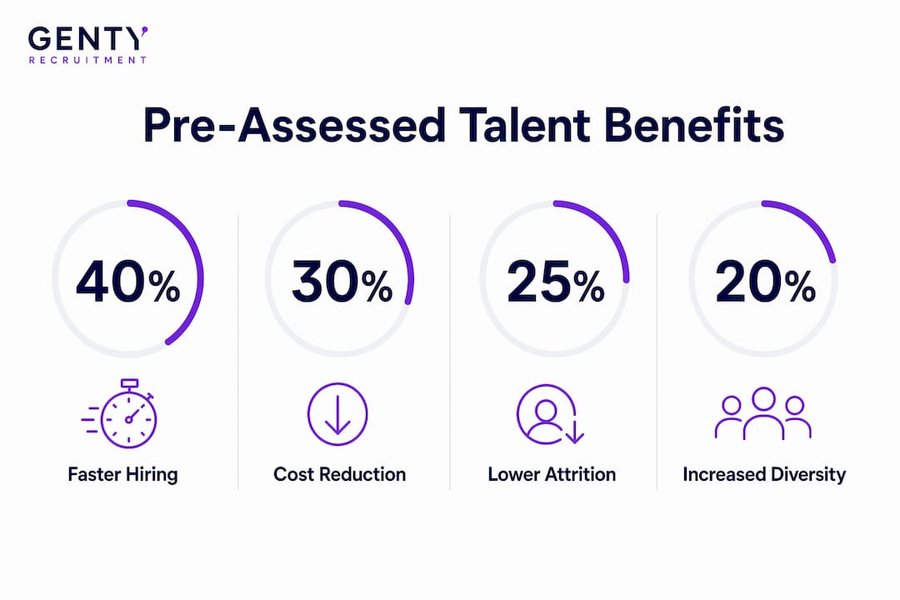
The advantages of using pre-assessed talent compound across cost, speed, quality, and diversity. Each benefit reinforces the others.
Reduced cost and risk of bad hires
A bad hire at the $100,000 salary level costs your company $150,000 when you factor in lost productivity, rehiring, and onboarding. Pre-assessment reduces that risk by filtering candidates against objective criteria before your team invests interview time. Assessment-driven hiring reduces time-to-hire by automating filtering and focusing recruiter effort on high-value engagement. Less time screening means lower cost-per-hire and faster fills.
Stronger cultural and work-style fit
Most hiring failures stem from poor cultural and work-preference fit, not lack of skills. That finding reframes where assessment effort should go. Technical tests confirm competence, but behavioral and personality assessments confirm whether a candidate will thrive in your specific team structure, communication style, and pace of work. For remote teams where onboarding friction is higher, this fit matters from day one.
Fairer, more diverse hiring outcomes
Pre-assessment reduces unconscious bias by standardizing candidate questions and scoring, producing fairer and more diverse hiring outcomes. When every candidate answers the same structured questions and gets scored against the same rubric, your hiring decisions reflect capability rather than familiarity. This is particularly valuable when hiring across Latin America, where top engineers are often overlooked simply because their resume format or educational background looks unfamiliar to US and European reviewers.
Pro Tip: Run a blind scoring pilot on your next 10 candidates. Remove names, universities, and company logos before sharing assessment results with your hiring panel. The difference in how your team evaluates candidates will tell you exactly how much bias your current process carries.
How does pre-assessment change recruiter and hiring manager roles?
Pre-assessment shifts the entire workflow. Recruiters stop functioning as screeners and start functioning as closers.
- Sourcing becomes proactive. The hiring process is shifting from volume-based CV screening to certainty-based evaluation with pre-validated, hire-ready talent pools. Recruiters build assessed candidate pipelines before a role opens, not after.
- Interview time focuses on fit, not verification. When a candidate arrives with a completed technical assessment and a behavioral score, your interview confirms culture and motivation. You stop asking “Can you do this?” and start asking “Do you want to do this here?”
- Hiring decisions become defensible. Structured, evidence-based workflows create a documented record of why each candidate was advanced or declined. This transparency protects against legal challenges and improves internal alignment between recruiters and hiring managers.
- Administrative burden drops. Pre-assessment streamlines recruiter workload by shifting focus from screening many CVs to closing well-assessed candidates. For a startup with a two-person recruiting function, that efficiency gain is the difference between filling a role in three weeks and filling it in eight.
For tech startups hiring remote developers in time zones across Latin America, this workflow shift is especially valuable. Gentyrecruitment applies this model directly, delivering shortlists of pre-vetted candidates who have cleared technical, behavioral, and English proficiency assessments before your team sees a single profile. You can read more about how this approach works in practice in this guide on structured hiring for tech startups.
How to implement pre-assessment without overwhelming candidates or your team
Effective pre-assessment strategy is about precision, not volume. The most common mistake is stacking too many tests and burning out candidates before they reach the interview stage.
- Select 2–3 high-impact signals per role. The most successful assessment strategies focus on 2–3 critical signals per role tailored to common failure modes rather than stacking many tests. For a senior backend engineer, that might mean a coding challenge, a systems design question, and a work-style survey. For a sales engineer, it might mean a communication assessment, a product knowledge test, and a structured behavioral interview.
- Map assessments to failure modes, not wish lists. Ask yourself: “What causes people in this role to fail within the first 90 days?” Build your assessment around those specific risks. Avoid testing attributes that are nice to know but do not predict success or failure in the role.
- Maintain transparency with candidates. Tell candidates upfront what the assessment involves, how long it takes, and how results will be used. Candidates who understand the process complete it at higher rates and arrive at interviews more engaged.
- Integrate with your ATS. Assessment results should flow directly into your applicant tracking system so hiring managers see scores alongside profiles without switching tools. Platforms like Greenhouse, Lever, and Workable all support assessment integrations that keep the process clean.
Pro Tip: Cap your total candidate assessment time at 60–90 minutes across all tests combined. Anything longer signals poor process design and filters out strong candidates who have competing offers.
Companies that implemented AI and structured assessments in hiring outperform those that do not by wide margins in both quality and process efficiency. The competitive advantage is real, but only if the assessment design is disciplined.
How do pre-assessments compare to traditional CV screening?
The limitations of CV-based hiring are well documented. Resumes reward credential accumulation, not demonstrated capability. They perpetuate bias toward candidates from recognized universities and brand-name employers, which systematically excludes top performers from non-traditional backgrounds.
Predictive assessments score structured responses blindly against competency rubrics to remove bias and consistently evaluate candidates’ future potential. That is a fundamentally different standard than reviewing a PDF and making a judgment call. Relying on CV credentials perpetuates bias and misses top performers. Demonstrated capability through real-world task simulations or predictive assessments identifies true talent more effectively than any credential-based review.
For US and European startups hiring remote developers from Latin America, this comparison is particularly stark. A developer in Bogotá or Buenos Aires with a portfolio of shipped products and a strong assessment score is a better hire signal than a resume from a candidate in a familiar city with a familiar school name. Pre-assessment levels that playing field and expands your access to talent that CV screening would filter out.
Key takeaways
Pre-assessed talent reduces hiring risk, accelerates decisions, and produces better long-term fit by replacing resume-based guesswork with objective, structured evaluation data.
What I have learned about pre-assessment after years in tech recruiting
The biggest misconception I see from founders and hiring managers is that pre-assessment is primarily a filtering tool. They treat it as a gate to reduce the number of candidates they have to talk to. That framing misses the real value.
Pre-assessment is a confidence tool. When you sit across from a candidate, whether in person or on a video call, and you already know their technical score, their behavioral profile, and how their work style maps to your team’s communication patterns, the conversation changes completely. You stop auditing and start connecting. That shift produces better hiring decisions and a better candidate experience simultaneously.
The pitfall I see most often is over-assessing. A founder who is anxious about making a bad hire will add test after test until the assessment process becomes a gauntlet. The best candidates, the ones with options, drop out. You end up selecting for persistence under frustration, not for the skills you actually need.
The other thing I would push back on is the assumption that technical skill is the primary hiring risk for remote roles. In my experience, the candidates who fail in remote positions almost always fail on communication, autonomy, and work-style alignment. A developer who writes excellent code but cannot operate independently in an asynchronous environment will cost you more than a slightly less technical candidate who communicates clearly and manages their own workload. Behavioral assessments are not a soft add-on. They are the most predictive signal you have for remote role success.
The future of this practice is moving toward continuous assessment, where talent pools are maintained with regularly updated profiles rather than assessed only at the point of application. That model gives hiring managers access to candidates who are ready to start, not just ready to interview.
— Eugene
How Gentyrecruitment delivers pre-assessed LATAM tech talent
Gentyrecruitment specializes in sourcing and vetting remote tech talent from Latin America for US and European companies, with pre-assessment built into every stage of the process. Candidates are evaluated on technical skills, English proficiency, and behavioral fit before your team reviews a single profile.
Gentyrecruitment delivers shortlists within five business days, drawing from pre-assessed talent pools across Argentina, Brazil, Mexico, Colombia, and nine additional LATAM countries. Every candidate has cleared structured assessments designed around the specific failure modes of their role. If you are ready to hire pre-vetted remote talent without the overhead of building an assessment process from scratch, Gentyrecruitment’s model is built for exactly that. You can also explore the full LATAM talent pool to see what roles and profiles are available today.
FAQ
What is pre-assessed talent?
Pre-assessed talent refers to candidates who have completed standardized skills, behavioral, and cognitive evaluations before any human review. This gives hiring teams objective data to inform decisions before the first interview.
How does pre-assessment reduce hiring costs?
The average cost per hire is $4,700, and a bad hire costs approximately 1.5x the employee’s salary. Pre-assessment filters candidates against objective criteria upfront, reducing the risk of costly mis-hires and lowering overall cost-per-hire.
What assessments matter most for remote tech roles?
For remote tech roles, the highest-value assessments are technical skills tests, behavioral and work-style surveys, and English proficiency evaluations. Cultural and work-preference fit is often a stronger predictor of remote success than technical skill alone.
How many assessments should candidates complete?
The most effective pre-assessment strategies use 2–3 targeted signals per role tied to specific failure modes. Stacking more tests damages candidate experience and filters out strong candidates who have competing offers.
Does pre-assessment reduce bias in hiring?
Pre-assessment reduces unconscious bias by standardizing questions and scoring candidates against the same competency rubrics. Blind scoring removes demographic signals from the evaluation, producing fairer and more diverse hiring outcomes.