
Argentina leads Latin America on the EF English Proficiency Index, scoring in the “High” band, which means hiring managers can expect a stronger average talent pool there. National scores are a useful starting filter, not a hiring decision; every candidate still needs role-specific validation. Below, we break down the regional data, what drives it, and how to turn it into a repeatable screening process.
TL;DR:
EF added speaking and writing to its 2024 report, so rankings before and after that change are not directly comparable.
Use B1 to B2 as a starting point for independent contributors, but target closer to C1 for client calls and stakeholder leadership.
Pair a spontaneous voice assessment with a live role task, then use a paid trial and communication measures before offering the role.
Brazil requires direct checks of bilingual fluency and technical vocabulary, while Mexico offers strong US time zone overlap and calls for business English screening.
EF EPI Scores Across Major LATAM Markets
The EF English Proficiency Index ranks countries using test data from millions of adult test takers worldwide, and as of its 2024/2025 report, it added speaking and writing components alongside the original reading and listening sections. That change matters: a country’s score today reflects productive skills, not just comprehension, so year-over-year comparisons before and after the update are not perfectly apples to apples.
These bands roughly track CEFR equivalents, with “High” clustering near B2 and “Moderate” to “Low” bands spanning B1 and below, though EF’s own scale and the CEFR framework are not identical instruments. Treat the overlap as directional, not a direct conversion, when you brief recruiters on minimum requirements.
Why Proficiency Varies: Education, Access, and Testing Shifts
Country-level scores move for reasons that have little to do with any individual candidate’s ability, and understanding the drivers helps you read the data correctly instead of over-indexing on a single number.
Need help hiring?
See the next step after this guide
If this topic is relevant to your team, these are the most useful pages to check next.
- Chile’s Inglés Abre Puertas program and Costa Rica’s technical-education English mandates have pushed younger cohorts toward stronger baseline skills, according to The Dialogue’s analysis of technical and professional education across the region.
- OECD research finds that broader education enrollment has not fully closed the gap between what graduates learn and what labor markets need, a pattern that shows up in English fluency as much as technical skills.
- Internet access, household income, and urban concentration correlate with proficiency: candidates in major metro areas typically test higher than those in smaller cities, which affects where you source.
- EF’s 2024 addition of speaking and writing tests reshuffled some rankings, so a country’s historical trend line should be read with that methodology shift in mind.
From Country Score to Hiring Decision: Assessment That Actually Works
A national index score tells you about the aggregate pool, not the person sitting across from you in an interview. Pearson’s Global English proficiency report recommends role-relevant, voice-based testing precisely because broad bands miss the job-specific signal that actually predicts performance.
The CEFR descriptors give you a useful starting vocabulary. Independent contributors, like backend engineers who mostly write code and async updates, generally function well at B1 to B2. Client-facing roles, account executives, and engineering leads who run live calls with stakeholders need closer to C1. The framework’s “can-do” statements describe general communication, though, not industry vocabulary, so a candidate rated B2 on a generic test can still stumble on domain terms like “sprint velocity” or “churn rate” until you check for it directly.
A workable screening sequence looks like this:
- Define the specific English tasks the role demands: writing pull request descriptions, running a sales demo, documenting incidents.
- Build a shortlist filtered by baseline proficiency signals from resumes and prior work history.
- Run a short voice-based test focused on spontaneous spoken response, not scripted reading.
- Add a live task: a pair-programming session for engineers, a mock discovery call for sales candidates.
- Confirm fit with a short paid trial or structured onboarding milestone before full commitment.
Pro Tip: For any client-facing role, weight the speaking assessment more heavily than the written one. Accent and comprehension under pressure predict day-to-day friction far better than grammar on a resume.
Country Spotlights: Argentina, Brazil, Mexico, and Colombia
Each major LATAM market has a distinct profile, and your screening emphasis should shift accordingly.
- Argentina: The highest EF EPI score in the region, with especially strong English concentration among Buenos Aires-based talent. A solid fit for senior engineering roles and English-heavy client positions where tone and nuance matter.
- Brazil: One of the largest engineering talent pools in Latin America, but average EF scores trail Argentina’s. Screen specifically for bilingual fluency and technical English vocabulary rather than assuming scale equals language readiness.
- Mexico: Proficiency is mixed across the candidate pool, but volume is high and timezone overlap with US business hours is strong. Focus screening on business English and written technical documentation.
- Colombia: Scores have been improving, and the country’s established BPO and IT outsourcing pipeline means many candidates already have client-facing English experience. A strong balance point for customer support roles and mid-level engineering hires.
A Hiring Checklist Built for LATAM Recruitment
Use this sequence from job brief through probation to keep English assessment consistent across every requisition.
- Write the job brief with explicit English tasks and a minimum CEFR-equivalent target.
- Screen resumes and run voice-based tests before any live interview to filter early.
- Schedule interviews inside the overlap window; most LATAM time zones align closely with US EST and PST hours, which keeps standups and code review cycles on the same working day instead of waiting for a handoff.
- Benchmark compensation: LATAM hiring can save notable cost versus a comparable US-based hire, with clients reporting notable savings compared to US or European hiring for equivalent roles.
- Run a short paid trial with measurable communication KPIs, like response time on async threads or clarity scores on written updates, before converting to a full-time offer.
How English Proficiency Shapes Productivity on Tech and Sales Teams
English fluency is not a soft skill on a distributed team; it is the mechanism through which code reviews, incident response, and sales pipelines actually move and can be supported by specialized technology staffing solutions in multiple US markets. An engineer who writes clear pull request descriptions and asks precise questions in Slack reduces the back-and-forth that slows every sprint. A sales rep who can read tone shifts on a discovery call closes more deals than one who can only follow a script.
Weak written English shows up as longer code review cycles, misread requirements, and documentation that teammates have to rewrite. Weak spoken English shows up more visibly on sales calls, where hesitation or unclear phrasing costs trust in the first ninety seconds. Both problems are fixable with the right screening upfront, which is why role-specific testing, not just a resume claim of “fluent English,” belongs in every requisition for a client-facing or cross-timezone role. Teams that skip this step tend to discover the gap during onboarding, when it is far more expensive to fix.
How LATAM Compares With Other Nearshore English Talent Pools
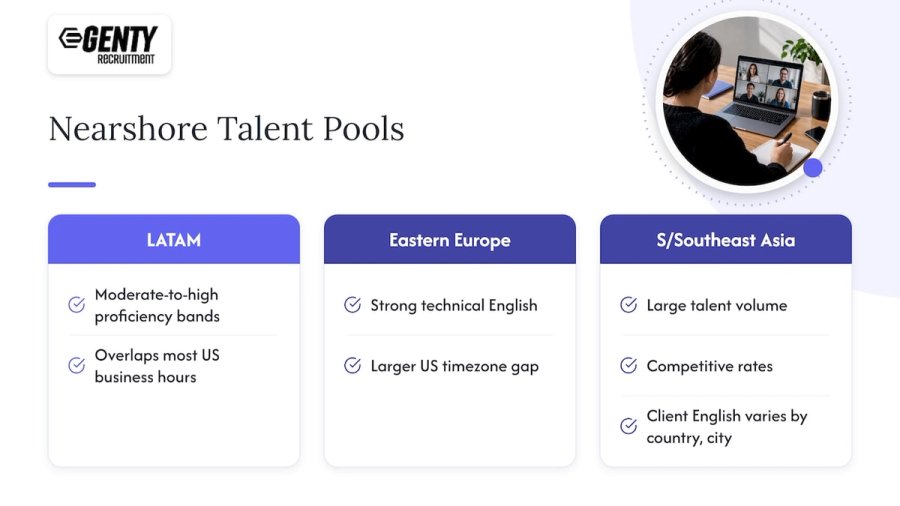
Latin America competes with other nearshore and offshore regions for the same remote tech and sales talent, and English proficiency is one of the clearest differentiators. Eastern European markets often post strong technical English for engineering roles but carry a larger timezone gap from US business hours. South and Southeast Asian outsourcing hubs offer large talent volume and competitive rates, but average spoken English for client-facing work varies widely by country and city.
LATAM’s advantage is the combination: proficiency bands that run from moderate to high depending on the country, paired with time zones that overlap US working hours for most or all of the business day. That overlap means a developer in Mexico City or a sales rep in Bogotá can join a 10 a.m. EST standup without anyone adjusting their schedule, a practical edge that pure proficiency scores do not capture on their own.
Building English Skills Into Your Talent Pipeline After Hire
Hiring for strong English today does not mean the work stops at the offer letter. Teams that invest in ongoing language development alongside technical onboarding see fewer communication breakdowns six months in. Pairing a new hire with an English-fluent mentor for the first few weeks, running structured documentation reviews, and giving feedback specifically on clarity, not just technical accuracy, all compound over time.
Structured English programs tied to professional and technical vocabulary, the kind referenced in The Dialogue’s review of technical education across the region, tend to outperform generic conversation classes because they target the exact terms a role actually uses. A backend engineer benefits more from drilling incident-report phrasing than from general small talk practice. Budgeting a modest stipend for ongoing coaching, especially in the first ninety days, is a cheap way to protect the investment a hiring process already made.
Assessing Cultural Fit Alongside Language Skills
English proficiency measures whether someone can communicate; it does not measure whether they will communicate the way your team expects. Cultural fit covers things like directness in feedback, comfort pushing back in a meeting, and attitudes toward deadlines and async communication norms, all of which vary across LATAM countries and company cultures alike.
The most reliable way to check both at once is a structured interview that mixes a technical or sales task with open-ended discussion questions: ask a candidate to walk through a disagreement they had with a manager, or how they would flag a missed deadline. Listen for clarity and tone, not just correct grammar. A candidate who communicates a problem early, even imperfectly, is often a better long-term fit than one who gives a polished but vague answer.
Common English Challenges Among LATAM Candidates and How to Address Them
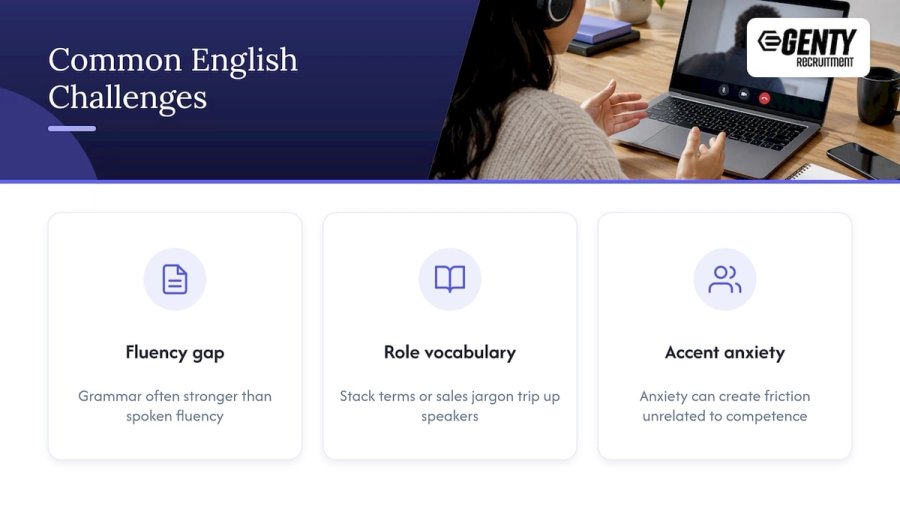
The most frequent gaps show up in specific, predictable places rather than across the board. Written grammar is often stronger than spoken fluency, because most formal English education emphasizes reading and writing over conversation. Technical vocabulary specific to a company’s stack or industry jargon in sales can trip up even strong general speakers. Accent-related comprehension anxiety, on both sides of a call, sometimes creates friction that has nothing to do with actual competence.
Addressing these gaps starts with naming them precisely during screening rather than labeling a candidate broadly as “not fluent enough.” A short glossary of role-specific terms shared before a technical interview, extra time on spoken assessments rather than penalizing hesitation, and feedback that separates language friction from technical competence all reduce false negatives in the hiring funnel.
Where LATAM English Proficiency Is Headed
Several forces point toward continued improvement in LATAM English proficiency over the coming years. National programs like Chile’s Inglés Abre Puertas and expanding technical-education mandates in Costa Rica are shaping younger cohorts entering the workforce now, and OECD analysis suggests the region’s skills gap, while still present, is a visible policy priority rather than a static condition.
For hiring teams, the practical takeaway is to expect the talent pool to keep deepening, especially in countries investing in technical English curricula, while still building role-specific assessment into every requisition rather than assuming national trends apply evenly to every candidate. The gap between population-level averages and individual readiness is unlikely to close on its own, which keeps structured screening relevant no matter which direction the regional average moves.
What Role-Fit Hiring From LATAM Actually Looks Like in Practice
We have placed pre-vetted engineers and sales talent across Argentina, Colombia, Mexico, and Brazil, and the pattern holds everywhere: a strong EF EPI score tells you about the pool, not the person. Skill-first shortlists built around role-specific English tasks, delivered within a week, consistently outperform resume-based filtering alone.
— Eugene
Hiring English-Capable LATAM Talent With GENTY Recruitment
Everything above works best as a repeatable process, and that is exactly what we built. We run specialized IT and sales recruitment across Latin America, with dedicated recruiters per vertical who already screen for role-specific English before a candidate ever reaches your shortlist.
Our fixed-fee model starts from $2,999 per hire for IT recruitment and the same starting rate for sales recruitment, with no upfront payment and a 3-month replacement guarantee if a placement does not work out. Shortlists arrive within 7 days, pre-vetted on the exact communication tasks your role demands. If your hiring need runs ongoing rather than one-off, our staffing option starts from $99 per month per employee. Start with a brief on your recruitment or staffing needs and we will build the shortlist around it.
FAQ
What languages are spoken in Latin America?
Spanish is the dominant language across most of Latin America, while Brazil speaks Portuguese and several countries also have significant indigenous and creole languages spoken alongside the national language. English proficiency varies by country, as reflected in the EF English Proficiency Index rankings covered above.
What do CEFR levels A1 through C2 mean?
The CEFR framework defines six proficiency bands: A1 and A2 cover basic communication, B1 and B2 describe independent use suitable for most workplace tasks, and C1 and C2 represent proficient, near-native command. Each level uses “can-do” descriptors rather than a raw test score, which is why hiring teams should translate the band into specific job tasks.
Are Quebecois people considered Latino?
No, Quebecois people are French-speaking Canadians and are not considered part of the Latino or Latin American demographic, which refers to people with cultural or ancestral ties to Latin America. The distinction matters for recruiters mapping candidate pools, since Quebec sits outside the LATAM markets covered by indices like the EF EPI.
Which Latin American country has the highest literacy rate?
Literacy is a separate metric from English proficiency, and a country’s strong literacy rate does not necessarily predict its EF EPI score or English fluency band.
How much can hiring from LATAM save compared to US-based hires?
Actual savings depend on role seniority and the specific country, so a role-by-role salary benchmark is the most reliable way to confirm the number for your hiring plan.