
The right approach to background checks in Latin America is a centralized policy with country-specific annexes, documented consent, and role-based checks calibrated to what each position actually requires. Compliance rests on three pillars: a lawful basis for processing candidate data, proportionality between the check and the role, and full transparency with the candidate. Before running a single check, inventory the roles you hire for and map each one to the checks and legal rules of the country involved.
TL;DR:
Criminal record checks in Latin America often require multi-jurisdictional pulls, which can extend the screening process beyond usual US benchmarks.
Data privacy laws demand explicit candidate consent and clear data handling policies, especially when dealing with sensitive information like criminal records.
Verifying education requires direct contact with institutions and independent confirmation, as regional diploma mills and falsifications are common.
Using local vendors with direct access to registry systems significantly improves accuracy and reduces delays compared to relying solely on automated database searches.
Pre-vetting candidates through recruitment partners and shortlisting experts helps reduce background check costs and speeds up the hiring process across multiple countries.
What Background Checks Are Available for Hiring in Latin America?
Employment screening in Latin America covers the same broad categories you’d expect in the US or Europe, but the depth and reliability of each check shifts by country. Criminal record checks often require a national police certificate, but access rules vary. Argentina centralizes records nationally, while Brazil requires pulling from both federal and state courts because criminal history is decentralized across jurisdictions.
Identity verification confirms the candidate is who they claim to be, usually against a national ID or passport. Education verification means contacting the issuing university directly, since diploma mills and falsified certificates are a documented problem in the region. Employment verification confirms dates, titles, and sometimes reason for departure, but many LATAM employers only confirm dates by phone or email, which slows the process. Credit checks exist in Brazil and Mexico for finance-facing roles, but they’re rarely permitted for general hires and require explicit justification. Sanctions and watchlist screening applies mainly to regulated industries like FinTech.
For a senior software engineer, a lean package usually covers identity verification, education verification, and employment history. For a finance or FinTech role handling funds or sensitive data, you’d add credit checks (where legally permitted) and sanctions screening.
Planning a hire?
Talk through the best hiring option
This article usually leads to one practical question: should you use staffing or country guide? We can help you choose quickly.
Simple next step
Start with staffing and we will help you pick the best hiring setup.
- Criminal record checks: national certificate in Argentina and Mexico; combined federal/state pulls in Brazil
- Identity verification: government ID cross-checked against biometric or database records
- Education verification: direct contact with the issuing institution, not a self-reported transcript
- Employment verification: confirms dates and titles; reference quality varies by employer size
- Credit checks: limited to finance roles and only where local law permits
- Sanctions and watchlist screening: standard for FinTech, banking-adjacent, and Web3 compliance roles
How Do Data-Privacy Laws Affect Background Screening in Latin America?
Brazil’s Lei Geral de Proteção de Dados (LGPD) classifies criminal history as sensitive personal data, meaning you need a specific, documented legal basis before you touch it, not just a generic hiring justification. Mexico’s Ley Federal de Protección de Datos Personales en Posesión de los Particulares (LFPDPPP) requires a privacy notice (aviso de privacidad) given to the candidate before collection, spelling out exactly what data you’re gathering and why. Argentina’s Law No. 25.326 predates both and set an early regional template for consent and data-subject rights that Colombia and Chile have since echoed with their own habeas data frameworks.
Across all four markets, the compliance logic is consistent: employers must tie every check to a lawful basis, keep the check proportional to the role, and stay transparent with the candidate about what’s being collected. HireRight’s regional benchmarking found that organizations running structured screening programs report measurably higher confidence in hire quality compared to those relying on informal reference calls alone.
Compliance checklist for HR teams:
- Draft one central policy, then attach a short annex per country covering local consent language and record-access rules
- Collect written, dated consent before initiating any check, not after
- Provide a privacy notice that names the data categories collected and the retention period
- Set a retention limit and delete records once the decision is made and any legal holding period expires
- Require vendor contracts to specify where data is stored, how long it’s retained, and how cross-border transfers are secured
- Avoid pulling credit or financial data unless the role and local law both justify it
Cross-border data transfer, common when a US company’s HR system holds candidate files processed by a LATAM vendor, needs contractual safeguards specifying data location, encryption standards, and breach notification timelines. Build these clauses into every vendor agreement before the first check runs, not after an audit flags the gap.
Why Are Background Checks in Latin America Operationally Harder Than in the US?
Decentralized record systems are the core operational headache. Brazil alone has dozens of state court systems that don’t share a unified database, so a “national” criminal check there really means multiple regional pulls. First Advantage’s regional guidance points to this fragmentation, plus inconsistent document formats and language barriers, as the biggest source of delay and error in LATAM screening programs.
Document fraud adds another layer of risk. Brazilian federal police detained a group in 2024 for producing fake diplomas from unaccredited institutions, underscoring why self-reported transcripts aren’t enough. Verifying directly with the registrar’s office, not just checking a diploma number against a database, catches fraud that automated tools miss.
Here’s how to structure the process for reliable results:
- Use local, in-country agents or vendors with direct registry access rather than relying solely on third-party database pulls.
- Require translated documents reviewed by a bilingual verifier, not machine translation alone.
- Flag any diploma or employment record that can’t be independently confirmed with the issuing party, and escalate it rather than accepting it at face value.
- Build in buffer time. Criminal checks that pull from decentralized court systems typically take longer than a single-database US check, often a week or more depending on jurisdiction.
Pro Tip: Run education and employment verification in parallel with criminal checks instead of sequentially. Most delays come from waiting on one slow record type while faster ones sit finished, so parallel processing can cut total turnaround by several days.
How Should You Choose a Background Check Vendor for LATAM Hiring?
Vendor selection comes down to seven axes: country coverage, primary-source access, compliance support, service-level agreements, integration with your applicant tracking system, language capability, and data security. A vendor that only offers database pulls without local registry access will struggle in markets like Brazil, where primary-source verification consistently outperforms automated searches on both accuracy and dispute rates.
Procurement checklist:
- Get written SLAs by country, not a regional average
- Confirm the vendor has local staff or agents, not just a database subscription
- Require sample reports before signing
- Verify dispute-resolution procedures for contested findings
- Confirm data retention and deletion timelines in the contract
A tool like Resyme can help surface qualified matches earlier in the funnel, which reduces the number of candidates who need a full formal screening pass.
The Recruitment Angle Most Compliance Guides Miss
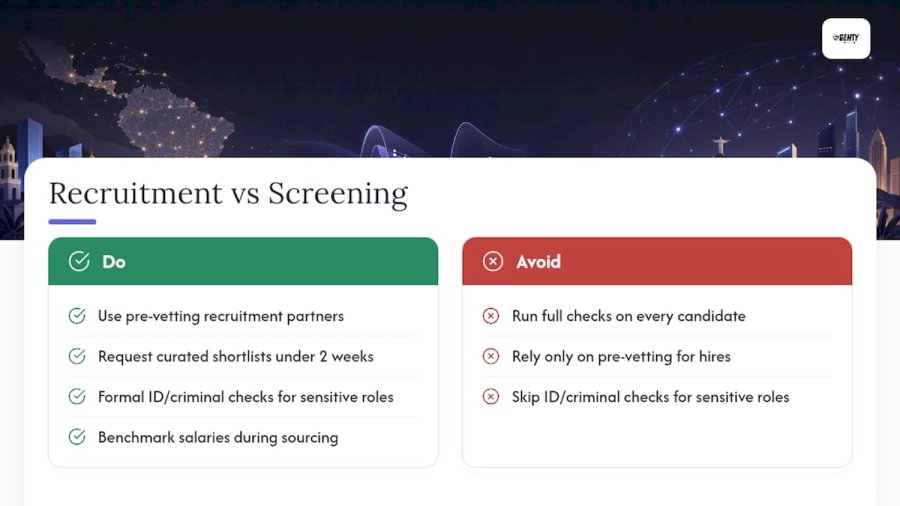
Most background check guidance treats every candidate as a blank slate requiring the full screening battery, but that’s not how efficient hiring actually works. When you source through a recruitment partner that pre-vets technical skills and work history before a candidate reaches your desk, you shrink the pool that needs full formal checks. Curated shortlists, typically delivered in under two weeks, help filter out candidates whose claimed experience doesn’t hold up, cutting wasted verification cycles.
Salary benchmarking matters here too. Pre-vetting doesn’t replace identity and criminal checks. Pair it with formal verification for the roles that touch financial systems or sensitive data.
— Eugene
Skip the Screening Bottleneck With a Pre-Vetted Shortlist
GENTY recruitment is the alternative to building an in-house screening operation from scratch: instead of running full checks against a wide, unfiltered applicant pool, you start with a shortlist of candidates whose technical skills and work history are already vetted, so your background check budget goes toward confirming details rather than sorting through noise.
Fixed-fee pricing means you know the cost per hire before the search starts, with no upfront payment and a three-month replacement guarantee if a placement doesn’t work out. This matters most when you’re scaling engineering or sales teams across Argentina, Brazil, Mexico, and Colombia at the same time, since running parallel formal screening programs in four legal jurisdictions gets expensive fast. If you’re hiring a senior Java Spring engineer or building out a broader tech team from LATAM, reach out to GENTY recruitment and get a shortlist built around the specific compliance and skill requirements your role demands.
Sources
- Building trustworthy background checks in Latin America: data governance and compliance best practices
- Best Practices for Background Screening in Latin America | First Advantage
- Fundamentals and Regulations of Background Checks in Latin America