
Ask these 10 questions on the first call, and you will know within thirty minutes whether a recruitment partner can actually deliver LATAM engineering or sales talent. Run through: named EOR or local entity in the candidate’s country, disclosed shortlist pass rate, written replacement window, CEFR level tested (B2 for internal roles, C1 for client-facing), timezone overlap guaranteed, fee breakdown (salary, statutory taxes, markup), 7-day shortlist benchmark, live client reference offered, IP/data handling process, and post-hire escalation contact. Any recruiter who hedges on three or more of these is selling leads, not vetted candidates.
- Who legally employs the candidate, and under what entity?
- What is your shortlist pass rate for this exact role?
- Is the replacement guarantee in writing, and for how long?
- What CEFR level do you test for, and how?
- How much daily overlap with EST or PST can you guarantee?
- What’s included in your fee: salary, taxes, markup?
- Can I speak to a live client who hired this role in this country?
- Who handles LGPD compliance if the candidate is in Brazil?
Key Takeaways
A LATAM recruitment partner earns trust by answering vendor due-diligence questions with named entities, disclosed numbers, and written terms, not general reassurances.
What Questions Should You Ask HR About LATAM Recruitment?
The questions for HR that matter most fall into six buckets: partner due diligence, candidate vetting, contracting, cost, compliance, and onboarding. Miss any one of them and you inherit risk you did not price in.
Partner due diligence. Ask how many candidates the recruiter screened before presenting the shortlist, and what percentage typically pass the initial filter. A partner that has actually measured its funnel gives you a number, not a shrug. Kore BPO frames this as the single fastest way to separate real staffing partners from lead-gen resellers reselling the same résumé database everyone else uses. Red flag: “We only send you the best,” with no figure attached.
Before you start hiring
Check location, salary, and hiring fit
If you are moving from research to action, start with the market basics so your hiring plan is clearer.
Candidate vetting. For a senior backend engineer, ask whether the assessment includes a live coding round, a system-design conversation, or a paid take-home project, not just a resume review. For a VP of Engineering search, ask how the recruiter validates leadership track record beyond a LinkedIn title. For an SDR or AE hire, ask whether they test cold-call scripts or run a mock discovery call. Hire South recommends combining an automated assessment with a peer interview, since talking about shipping code and actually shipping it are different skills entirely.
Contracting and EOR. Ask directly: “Who is the Employer of Record, and can you name the entity?” A partner that answers “we handle all compliance” without naming the entity is often outsourcing that liability to someone else, or skipping it. This matters more once you’re hiring in Brazil, where labor law penalties for misclassification are steep.
Cost and guarantees. Ask for the fee split: base salary, statutory employer taxes, and provider markup, itemized separately. Talent Scout notes that vendors who won’t itemize this are usually padding the markup into a number they’d rather you not scrutinize. Also ask for the replacement window in writing. GENTY recruitment, for example, backs every fixed-fee placement with a 3-month replacement guarantee.

Compliance and IP. Ask how candidate IP assignment and confidentiality are handled, and whether the answer changes by country. Mexico, Brazil, and Argentina each have distinct employment statutes.
Onboarding and integration. Ask what happens in week one after signing. A mature partner has a documented onboarding plan, not a handoff email.
Pro Tip: Get the pass rate and replacement window written into the service agreement, not just stated on the sales call. Verbal promises evaporate the moment a placement goes sideways.
What Do LATAM Salaries and Total Cost Actually Look Like?
Mid-level backend engineer salaries generally vary by country in Latin America, with Argentina, Brazil, Mexico, and Colombia each offering different salary bands. Senior or lead-level engineers tend to earn more, especially in fintech-specialized roles, with Brazil and Argentina among the higher-paying markets.
Comparing total hiring costs involves considering statutory employer taxes and EOR fees alongside salaries. Direct hire via a local EOR usually includes employer taxes and a monthly service fee added to the salary. Fixed-fee recruitment tends to be a one-time payment, often roughly equivalent to one or two months’ salary, without ongoing charges. This difference can significantly affect overall expenses depending on the size of the team. Colombia and Mexico give you the tightest EST overlap for daily standups; Brazil and Argentina still overlap several working hours with US East Coast teams, just with a later local start.
How Do You Score a Recruiter’s Answers?
Score every answer on three axes: specificity, verifiability, and whether it’s contractable. A number you can write into a contract beats an adjective every time.
Pass criteria: Named EOR or entity. Disclosed pass rate with a real figure. Replacement window stated in days, offered in writing. Willingness to connect you with a live client reference in the same country and role. Documented IP and data-handling process. Live client references matter more than case studies, since polished write-ups can hide operational gaps that a five-minute call exposes.
Fail criteria: Vague compliance language (“we manage all of that”). Refusal to name the EOR. No written replacement terms. No tenure or retention data offered when asked.
Sample high-quality answer to “Who legally employs the candidate in Mexico?”: “We partner with [named EOR entity] as the local employer of record. They handle payroll, statutory benefits, and termination compliance under Mexican federal labor law, and we can share their entity registration on request.” That’s specific, checkable, and puts a name on the liability chain.
Pro Tip: If a recruiter can’t name their EOR partner within one sentence, they likely haven’t formalized the relationship. Ask for it in writing before moving forward.
What Timeline Should You Expect From Shortlist to Hire?
Standard mid-level roles should produce a curated shortlist within 7 days. Senior or specialist roles, especially in fintech, AI, or cloud infrastructure, often take 2 to 6 weeks depending on the market and how narrow the skill requirement is.
- Day 3: Preview shortlist with initial candidate summaries.
- Day 7: First-round interviews scheduled with hiring team.
- Day 14 to 21: Technical assessment, final interviews, offer extended.
- Day 30: Onboarding success check with vendor.
Brazil and Argentina senior fintech searches commonly run longer, and specialized roles may require a paid take-home project to verify real shipping ability. Require a written replacement SLA, a named escalation contact, and reference availability before signing anything.
Why Most Vendor Checklists Miss the Real Risk
The conventional advice on vetting LATAM recruiters obsesses over price comparisons and skips the question that actually predicts a bad hire: can the vendor name a number when asked? Pass rates, tenure data, replacement windows measured in days rather than “a reasonable period.” Vague language is not a communication problem. It’s a signal the vendor hasn’t built the operational infrastructure to back its promises.
CTOs also underrate timezone overlap as a hiring filter, a critical aspect discussed in Effective Communication Strategies for Remote Teams. A brilliant Argentina-based engineer with two hours of daily overlap with your Boston team will slow your sprint cadence regardless of skill level. Colombia and Mexico often deserve more attention than they get for exactly this reason.
Prioritize the written contract terms first: EOR name, replacement window, pass rate. Everything else, including salary negotiation, is easier once those three are locked down.
Why Work With GENTY recruitment for LATAM Hiring
GENTY recruitment cuts the vendor vetting process down to a single conversation: fixed-fee pricing per seniority level, a 7-day curated shortlist, and a 3-month replacement guarantee, so you are not left guessing which of the questions above will get a straight answer.
- Country coverage across Argentina, Brazil, Mexico, Colombia, and Chile, with local employment relationships already established.
- Skill-first vetting that combines technical assessment with English proficiency checks before any candidate reaches your shortlist.
- Transparent fixed fees per seniority level, disclosed upfront, with no hidden markup buried in a bundled rate.
- A 3-month replacement guarantee in writing, not a verbal assurance you have to chase down later.
If you’re hiring backend engineers, DevOps specialists, or a full sales team, start a LATAM hiring conversation and get a shortlist built around the exact criteria covered above, EOR clarity, tested language levels, and timezone overlap included from the first candidate profile.
Frequently Asked Questions
What questions should I ask HR before hiring a LATAM recruitment partner?
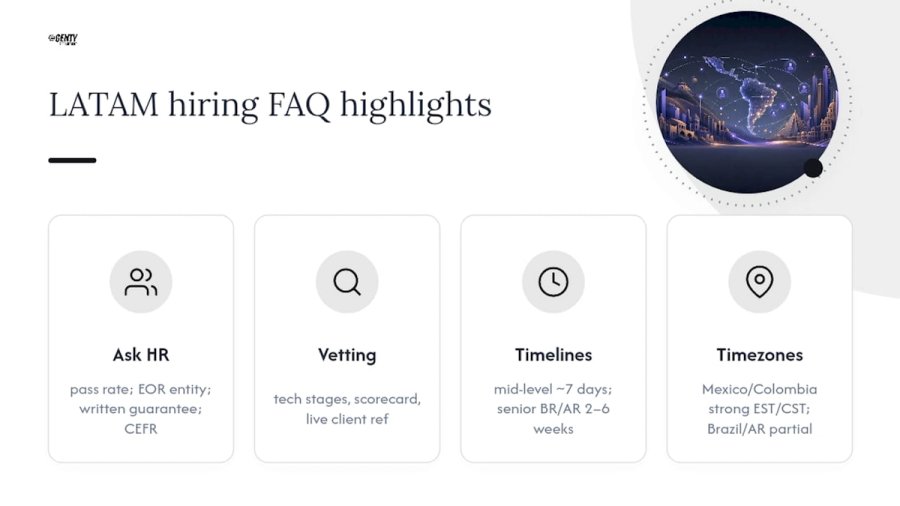
Ask about their disclosed shortlist pass rate, whether they name a specific EOR entity, whether the replacement guarantee is in writing, and how they verify English proficiency using a standard like CEFR B2 or C1.
How do I verify a recruiter’s candidate vetting process?
Ask what technical assessment stages they use beyond a resume review, request a sample scorecard, and ask for a live client reference in the same country and role you’re hiring for.
What’s a reasonable timeline for a LATAM shortlist?
Standard mid-level roles typically get a shortlist within 7 days. Senior fintech or AI specialist roles in Brazil or Argentina can take 2 to 6 weeks.
How much does LATAM hiring cost compared to direct EOR employment?
Which LATAM countries offer the best timezone overlap with US teams?
Mexico and Colombia offer the strongest EST and CST overlap for daily standups. Brazil and Argentina provide partial EST overlap, still workable for most async-friendly teams.
Sources
- How to Choose Latin America Staffing (2026 Guide) | Kore BPO
- Find a LATAM Partner: Vetting Remote Recruitment Agencies | Hire South
- How to Evaluate Nearshore Staffing Companies | Talent Scout