
A bilingual SDR in Latin America typically earns about $1,200 to $3,000 per month in base salary, depending on the country, seniority and English level. That is roughly a third to a half of what a US-based rep costs once variable pay is included. The base figure is only part of the picture, though. Employer contributions, variable pay design and ramp time decide what you actually spend, and they differ sharply between Mexico, Colombia, Argentina, Brazil and Chile.
This guide is written for CTOs, VPs of Sales and founders at US and European tech companies. It gives you country ranges, a cost model you can copy, and a compensation structure that keeps remote SDRs productive.
TL;DR
- Base salaries for mid-level, bilingual LATAM SDRs mostly fall between $1,200 and $3,000 per month, with Chile and Mexico at the upper end and Colombia and Argentina slightly lower.
- Statutory employer costs change the ranking: Chile is light, Brazil is the heaviest, and Mexico, Colombia and Argentina sit in between. Always compare fully loaded cost, never base salary.
- A 60/40 or 70/30 base-to-variable split tied to meetings held or SQLs works better for remote teams than commission on closed revenue.
- Colombia shares US Eastern time for most of the year, Mexico City is one to two hours behind it, and Argentina and Brazil are about two hours ahead of it for much of the year. Every one of them gives a full working-day overlap with US teams, including the Pacific coast for a few hours.
- GENTY recruitment places pre-vetted SDRs and AEs from $2,999 per hire, with a 3-month replacement guarantee.
What a US SDR costs, as the baseline
Before comparing, fix the US benchmark. The Bridge Group’s 2025 SDR research reports a median SDR on-target earnings (OTE) of $80K, and SaaStr’s guidance on first SDR comp plans describes a typical base that makes up 60 to 80% of OTE, with the rest paid as performance bonus. Salary.com puts the median US SDR salary at about $68,204 as of May 2025.
So a US rep lands around $68,000 to $85,000 in cash compensation before payroll taxes, benefits, equipment and office or stipend costs. Fully loaded, many US teams spend well over $90,000 per seat. That is the number to hold against the LATAM figures below.
Planning a hire?
Talk through the best hiring option
This article usually leads to one practical question: should you use country guide or salary guide? We can help you choose quickly.
Simple next step
Start with country guide and we will help you pick the best hiring setup.
SDR salary in Latin America by country
Published 2026 market ranges for monthly base pay of a bilingual SDR in the main hubs cluster as follows. Treat them as ranges for candidates with 1 to 3 years of B2B outbound experience and conversational-to-fluent English. Senior reps who book enterprise meetings in English sit at or above the top of each band.
Three patterns matter when you read the table.
- Entry-level reps cost less, but English is the constraint. An SDR who can run discovery calls in English is the scarce profile, and that is where the upper half of each range starts.
- Capital cities pay more than regional hubs. Mexico City, São Paulo, Buenos Aires, Bogotá and Santiago set the ceiling. Guadalajara, Monterrey, Medellín, Córdoba and Curitiba often come in 10 to 20% lower for similar skills, which is useful if you hire several reps.
- Currency dynamics move the number. Argentina in particular has seen high inflation, so USD-denominated contracts are the norm for remote roles. Agree the currency and a review date in writing.
If you are focused on Mexico, our breakdown of Mexico SDR contractor rates goes deeper on what US teams pay and how contractor engagements are structured.
Why base salary is the wrong number to benchmark
Most hiring managers compare base pay and stop. That is how teams end up surprised by an invoice. The cost of a rep is the salary multiplied by the employer burden of the country, plus the months you pay before the rep produces.
The burden differs a lot by country, and published 2026 payroll guides tend to agree on the broad shape:
- Chile carries the lightest employer load, often in the single digits as a percentage of salary.
- Colombia and Mexico add roughly 35 to 45% once health, pension, housing fund and similar contributions are counted.
- Argentina adds roughly 40 to 50%, including the aguinaldo (a mandatory extra month of pay, paid in two installments).
- Brazil is the heaviest. INSS, FGTS, the 13th-month salary and the vacation bonus can push the total multiplier to 1.65x to 1.80x the base salary for an employee on a formal CLT contract.
These are estimates that vary with contract type, company size and benefits, so ask your provider for a written, country-specific breakdown before signing. One consequence is worth stating plainly: a Brazilian SDR with the same base salary as a Mexican one can cost 20 to 30% more all-in, which is why many US teams hire through a staffing or employer-of-record arrangement instead of building a local entity.
A worked example
Take a mid-level SDR hired at $2,000 per month base in each country, using midpoints of the multipliers above:
Against a fully loaded US SDR above $90,000, even the Brazilian figure is less than half. The saving is real, but it is closer to 55 to 70% than to the headline gap between base salaries. Our own client work points to savings of up to 40% for many roles once recruitment fees, management and tools are included, and SDR seats at the lower end of the table can beat that.
Ramp time and tenure change the math
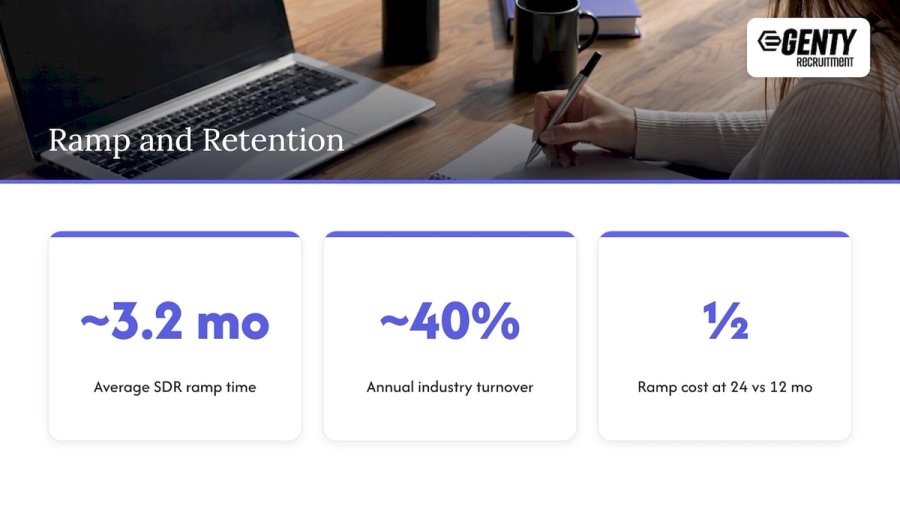
The Bridge Group’s report puts average SDR ramp time at about 3.2 months, a figure also cited in recent SDR cost comparisons. During ramp you pay the full monthly cost for partial output. In a US market where SDR turnover is widely described as high, with SaaStr citing roughly 40% annual turnover across the broader industry, every early exit resets that clock.
This is why retention deserves a line in your budget. A rep who stays 24 months instead of 12 halves your ramp cost per productive month. Pay that sits just above local market, a clear promotion path to AE, and a manager who is reachable in the same working hours do more for tenure than a small salary bump. If you are building the internal process to track pipeline and candidate stages, a look at project management tools for recruitment can help you choose how to organize it.
How to structure SDR pay for a remote LATAM team
Salary is half the question. The other half is variable pay, and it is where early-stage teams most often go wrong.
Pick a split and a metric the rep controls
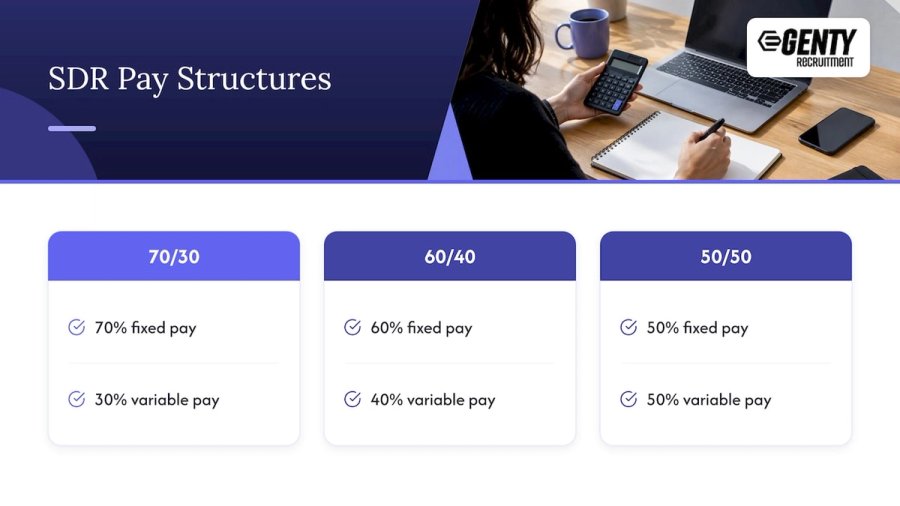
Whistle’s SDR compensation blueprint describes 70/30 as suited to longer sales cycles and 60/40 or 50/50 as the most common balanced structures. For a remote SDR in LATAM, 60/40 or 70/30 is a sensible default. In local terms, the fixed part also has to cover the statutory items (aguinaldo in Mexico and Argentina, the 13th salary in Brazil), so confirm whether the base you quote already includes them.
Tie the variable portion to meetings held or sales-qualified leads. These are inside the rep’s control. Tying bonuses to closed-won revenue, as SaaStr warns, disconnects the rep’s daily effort from the outcome and breeds disengagement. Jason Lemkin’s test in the same piece is practical: the rep should be able to explain the plan in one sentence. Pay monthly, not quarterly, so that a good month is rewarded while it is still fresh.
A sample plan
For a Colombia-based SDR targeting US mid-market accounts:
- Base: $1,900 per month, paid in USD
- Variable: up to $1,000 per month at target, based on held meetings that meet your ICP definition
- Accelerator: a higher rate per meeting above quota
- OTE: about $2,900 per month, or $34,800 per year
- Quota-to-OTE ratio: Whistle recommends 5:1 to 8:1 as a sanity check on how many dollars of pipeline or revenue each OTE dollar should create
That OTE is about 40% of a US rep’s median OTE, with the rep earning meaningfully more than a local sales-support salary, which is exactly what supports retention.
Contractor or employee?
Many US companies engage LATAM SDRs as independent contractors. That lowers burden on paper, but misclassification risk is real, especially in Brazil and Argentina where long-term, full-time, single-client arrangements can be treated as employment. The International Labour Organization’s 2025 labour overview for Latin America and the Caribbean points to informal employment as a persistent structural challenge in the region, and formal, compliant contracts are the way to avoid inheriting it. Ask a local employment lawyer or your staffing provider which model fits each country before you issue an offer.
Timezone alignment is the quiet advantage
SDR work is synchronous. Reps need to call prospects inside the prospect’s business day, join pipeline reviews and get fast coaching from an AE or manager. Offshore teams 10 to 12 hours away struggle with all three.
Latin America removes that friction:
- Colombia runs on the same clock as US Eastern standard time, so an SDR in Bogotá or Medellín covers an East Coast prospect’s whole day.
- Mexico is one to two hours behind New York and one to two hours ahead of Los Angeles, which gives West Coast teams a solid shared window.
- Argentina, Brazil and Chile sit a little ahead of the East Coast for much of the year. Reps start early and finish when the US afternoon is in full swing, with the US morning fully covered.
For a team calling on both coasts, a practical setup is two reps: one in Colombia or Mexico for the Pacific overlap and one in Argentina or Brazil for strong East Coast and European overlap. European companies get a further benefit: Argentina’s afternoon overlaps with the European workday more than any other major hub in the region.
Our perspective on LATAM SDR pay
We place sales teams in Latin America every week, and the same mistakes show up in the first conversation with a new client. They benchmark against the lowest quote they have seen, they price Brazil like Mexico, and they offer a flat salary with no variable element because they assume cheaper talent means lower expectations.
Our view is the opposite. The best SDRs in Bogotá, Mexico City, Buenos Aires or São Paulo already have offers from US-funded companies, and they compare employers on three things: total pay in USD, clarity of the comp plan, and whether the manager works their hours. Pay around the middle to upper part of the local band, publish the variable plan in one page, and your close rate on offers goes up while your replacement rate goes down.
We also push clients to define the SDR scorecard before the search starts. If you cannot say what a qualified meeting is, no recruiter, ours included, can screen for the right rep. That is why our process is skill-first: we test outbound skills and spoken English first, then match to your ICP, and send a curated shortlist within 7 days.
— Eugene
What it costs to hire an SDR through GENTY recruitment
If you want a vetted SDR or AE shortlist rather than posting a job ad and waiting, our sales recruitment service starts from $2,999 one-off per hire. There are no upfront payments, and each placement carries a 3-month replacement guarantee. If you prefer to avoid local entities and payroll altogether, our LATAM staffing and EOR service starts from $99 per month per employee. For a deeper look at designing variable pay, read our guide to LatAm SDR compensation plans, and for the wider process see our tech sales hiring guide.
A checklist before you make the offer
Use this list to turn the numbers above into a decision:
- [ ] Choose the hub by time zone first: Colombia or Mexico for Pacific overlap, Argentina or Brazil for Europe and East Coast.
- [ ] Set the budget as fully loaded cost per month, not base salary.
- [ ] Ask for a written employer-burden breakdown by country, including aguinaldo, the 13th salary, vacation bonus and health contributions.
- [ ] Decide employee, EOR or contractor with local legal advice, country by country.
- [ ] Write the variable plan in one sentence and pay it monthly.
- [ ] Define what counts as a qualified meeting before the first interview.
- [ ] Test spoken English with a live mock cold call, not a CV line.
- [ ] Budget 2 to 3 months of ramp before judging results.
- [ ] Agree USD payment and a salary review date, especially for Argentina.
- [ ] Set up a weekly 1:1 inside the rep’s working hours.
FAQ
How much does an SDR make in Latin America?
A bilingual SDR typically earns about $1,200 to $3,000 per month in base salary, depending on the country. Chile and Mexico sit at the upper end, Colombia and Argentina a little lower. Variable pay often adds 30 to 40% on top at target.
Which LATAM country is cheapest for SDRs?
On a fully loaded basis, Chile and Colombia are usually the most economical, while Brazil is typically the most expensive because of its statutory employer costs. Base salary alone can mislead here, so compare the total monthly cost with the burden included.
Can an SDR make $100K?
In the US, a top-quartile SDR with strong variable pay can approach that level, but the median OTE is closer to $80K according to The Bridge Group. In Latin America, six-figure USD earnings are rare for SDRs and usually only appear after a promotion to AE or team lead.
What is a good SDR pay structure for a remote team?
A 60/40 or 70/30 base-to-variable split with monthly payouts tied to meetings held or sales-qualified leads works well. Keep the plan simple enough to explain in one sentence, and add an accelerator for over-performance.
Sources
- The Bridge Group: SDR Models, Motions & Metrics 2025
- SaaStr: How to build a good basic sales plan for your first SDRs
- Whistle: SDR compensation plans made simple
- Salary.com: Sales Development Representative salary in the United States
- ILO: Labour Overview 2025, Latin America and the Caribbean