

LATAM salary benchmarks give hiring teams a reliable USD-based starting point for competitive offers, typically resulting in cost savings versus comparable US hires while gaining several hours of US EST/PST timezone overlap. That reliability depends on using current, role-matched data. Check the country-role table below, then run the checklist to set your offer.
TL;DR:
Benchmark salary ranges should be set at the 75th percentile for hard-to-fill or urgent roles, especially in Tier 1 countries like Argentina and Brazil.
USD-standardized data prevents distortions from local currency fluctuations, which is critical for accurate budget planning in markets like Argentina.
Salary expectations in LATAM are rising due to increased demand for specialized roles and competition from global companies, especially in Brazil and Argentina.
Currency devaluations, particularly in Argentina, require pay adjustments and regular USD-based review processes to stay competitive.
Including total compensation components such as bonuses, benefits, and equity, along with base salary, improves candidate negotiation success in LATAM markets.
What Does Salary Benchmarking in Latin America Actually Cover?
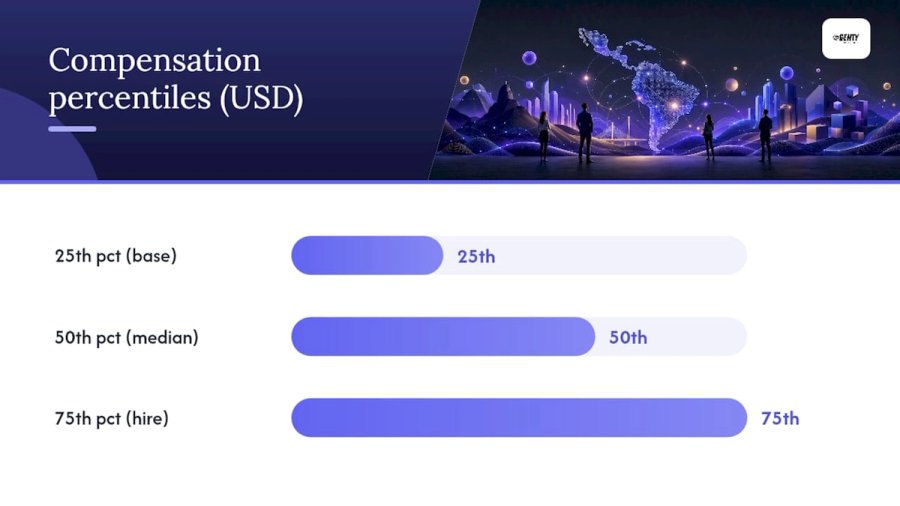
Salary benchmarking in Latin America means comparing what companies pay for a specific role, seniority level, and country against a dataset of real compensation records. Done properly, it produces a few core numbers: the 25th percentile (entry-level or budget-constrained offers), the median or 50th percentile (the market standard), and the 75th percentile (what you pay to win against multiple competing offers). Total compensation adds equity, bonuses, and benefits on top of base salary.
USD-denominated data matters more than most hiring managers realize. Local-currency figures get distorted fast by inflation and exchange-rate swings, especially in Argentina, where the peso has lost significant value against the dollar in recent years. A benchmark quoted in Argentine pesos from even six months ago can mislead you today. GENTY recruitment’s Latin America salary data standardizes everything in USD so budget conversations with finance stay stable regardless of local currency movement.
Good benchmarking data supports several concrete decisions:
Before you start hiring
Check location, salary, and hiring fit
If you are moving from research to action, start with the market basics so your hiring plan is clearer.
- Setting the initial offer level for a specific role and seniority tier
- Building salary bands for internal leveling and future hires
- Getting budget approval from finance or the board with defensible numbers
- Prioritizing which open roles to fill first based on scarcity and cost
Timezone alignment compounds the value of these numbers. A Colombian backend engineer working 9-to-5 local time overlaps almost completely with US Eastern hours, meaning your engineering team gets synchronous standups, pair programming, and code reviews without asking anyone to work nights. That overlap has real financial value, even though it never shows up as a line item in a salary table.
Benchmark Salary Ranges by Role and Country (USD)
The ranges below reflect mid-market USD compensation for full-time hires, drawn from GENTY recruitment’s software developer salary data across Argentina, Brazil, Mexico, and Colombia. Figures represent monthly base salary; annualize by multiplying by twelve for yearly comparisons. Where local currency figures exist in underlying payroll data, they were converted to USD using recent market exchange rates rather than official or blended rates, since that reflects what companies actually pay when settling in dollars.
Brazil and Argentina generally sit at the higher end of these bands for senior talent, particularly in São Paulo and Buenos Aires, where cost of living and local demand from domestic tech companies have pushed rates up. Mexico City and Bogotá tend to land closer to median, offering a strong balance of cost and talent depth.
These ranges are starting points, not fixed prices. Actual offers shift with company size, funding stage, remote-work policy, and how badly you need someone in the next two weeks versus the next two months. A Series A startup competing against a well-funded Series C for the same senior DevOps engineer in Brazil should expect to land near the 75th percentile, not the median.
Two limitations matter here. First, contractor rates and full-time-employee rates diverge by a noticeable margin, because contractors price in their own tax and benefits burden. Mixing the two in a single benchmark understates what a payroll hire actually costs. Second, these figures reflect market conditions as tracked in current datasets; salary inflation in tech has run ahead of general inflation in several LATAM markets, so revisit any benchmark older than several months. For roles with unusual scope, equity-heavy compensation structures, or country-specific legal complexities, validate against local payroll providers or employment counsel before finalizing an offer.
Country Tiers and Seniority Bands: How LATAM Groupings Change Hiring Strategy
Not every LATAM country behaves the same way in a hiring search, and grouping them into tiers helps you set realistic expectations for cost and speed.
Tier 1 covers Argentina, Brazil, and Mexico. These markets have the deepest talent pools, the most mature tech ecosystems, and the fastest time-to-hire for senior roles, but also the highest salary expectations within the region. Argentina in particular produces a disproportionate share of senior backend and DevOps talent relative to its population, partly because of a long-established outsourcing industry serving US clients.
Tier 2 includes Colombia and Chile. Talent supply is strong, particularly in Bogotá and Medellín for software engineering, and salary expectations run notably below Tier 1 for comparable seniority. Time-to-hire runs slightly longer for highly specialized roles like machine learning engineering.
Tier 3 covers smaller markets such as Peru, Ecuador, and parts of Central America. Costs are lower, but candidate pools for senior and lead roles are thinner, so expect longer searches for niche skill sets.
Seniority bands themselves carry predictable percent increases. Moving from junior to mid-level typically adds a substantial increase to base pay. Mid to senior adds another significant raise. Senior to lead or manager can add further increments, often with equity or bonus structures layered on top rather than pure base increases.
A few tactical moves help you win candidates without blowing your budget:
- Expand your offered range toward the 75th percentile when a candidate has competing offers from well-funded companies
- Add a signing bonus instead of raising base pay if you need flexibility for future raises
- Offer clear promotion timelines; LATAM tech candidates increasingly negotiate on career trajectory, not just current pay
- Consider Tier 2 or Tier 3 markets when a role doesn’t require daily synchronous collaboration, since the savings can be significant without a real productivity cost
How to Read and Validate Salary Ranges (Methodology and Pitfalls)
Any salary benchmark is only as good as the data behind it, and hiring managers rarely get to see that data directly. Running a quick validation pass before trusting a number protects you from a bad offer.
- Check the sample size. A range built from a handful of data points swings wildly; ask whether the source tracks dozens or hundreds of records per role and country.
- Check recency. Tech salaries in LATAM have moved fast; a table older than two quarters may already understate current market rates.
- Match the role definition precisely. “Full-stack engineer” means different things at different companies; confirm the benchmark’s role scope matches your actual job description, not just the title.
- Separate contractor rates from payroll/FTE rates. These frequently get blended in public salary aggregators, producing numbers that don’t match what you’ll actually pay through a compliant employment structure.
- Confirm the USD conversion method. A benchmark converted at an official exchange rate can differ meaningfully from one converted at a market rate, particularly in Argentina.
The most common pitfall is treating a single number as gospel rather than a percentile within a range. The second most common: pulling data from a general-purpose salary site that lumps all of Latin America into one figure, ignoring the real gap between, say, a Mexico City senior engineer and a smaller-market equivalent.
Pro Tip: Cross-check any external salary table against at least one recruiter actively placing that exact role in that exact country right now. Published benchmarks lag live market conditions by a quarter or more, and a recruiter closing offers this week has fresher signal than any dataset.
Hiring Insights and Trends for LATAM Tech Talent in 2026
Two structural forces are reshaping LATAM tech hiring right now, and both push salaries upward while keeping GENTY recruitment’s clients ahead of companies still hiring exclusively in the US.
Latin America’s STEM graduate pipeline has grown into a meaningful global contributor, according to Georgetown’s Center for Security and Emerging Technology, which maps global STEM graduate output by country. More graduates should, in theory, ease scarcity. In practice, demand is growing faster than supply for specialized skills.
The World Economic Forum reports a widening digital skills gap across Latin America through 2025 and 2026, with employer demand for tech talent outpacing the region’s skills development.
That gap shows up directly in negotiation behavior. Senior candidates in Brazil and Argentina increasingly field multiple simultaneous offers, often from US, European, and domestic companies competing for the same shortlist. Candidates who once accepted the first reasonable offer now routinely counter, especially on total compensation structure rather than base pay alone.
On the economic side, US inflation trends affect how companies budget for LATAM hires just as much as LATAM-side inflation does, since US hiring budgets get set against domestic cost pressures. When US engineering salaries climb, the relative savings of LATAM hiring becomes even more attractive to finance teams, which increases competition for the same LATAM talent pool.
Practical adjustments worth making now:
- Cut your time-to-decision; strong candidates disappear from the market within one to two weeks in Tier 1 countries
- Present a clear internal career path in the first interview, not after an offer is extended
- Use a modest sign-on bonus rather than inflating base salary when you need to move fast without resetting your entire band structure
Practical Checklist: Setting a Competitive Offer Using LATAM Benchmarks
Turning a benchmark table into an actual offer takes four steps.
- Choose your target percentile. Urgent, hard-to-fill roles justify the 75th percentile. Roles with a deeper candidate pool or more hiring flexibility can start at the median.
- Adjust for seniority and location. Apply the seniority uplift percentages from the tier section above, then adjust further for the specific city; a senior engineer in São Paulo commands more than the same title in a smaller Brazilian market.
- Add a timezone or collaboration premium where synchronous work matters. Roles requiring daily overlap with a US team justify sitting higher in the range, since the candidate pool willing and able to do that shrinks the requirement itself.
- Structure total compensation clearly. A typical competitive package pairs base salary with a health or wellness stipend, a modest annual bonus tied to performance, and equity for senior or leadership roles. Present the full package during the offer conversation, not just base pay, since LATAM candidates increasingly evaluate offers on total value.
GENTY Recruitment’s Salary Data and Services
GENTY recruitment maintains current salary benchmarks for more than 40 roles across 11 Latin American countries, all denominated in USD for direct comparison against US pay scales, available through the Latin America salary dataset. That dataset underpins every range in this article and gets used daily by clients setting real offers, not just researching the market.
Beyond data, GENTY recruitment runs the actual hiring process end to end:
- Fixed-fee recruitment pricing set per seniority level, disclosed upfront with no surprise charges
- Curated, skill-first shortlists delivered within 7 days of kickoff
- A 3-month replacement guarantee if a placed hire doesn’t work out
- No upfront payment required before work begins
Companies wanting a custom benchmarking report scoped to their exact roles and countries, or ready to start a search, can request one directly through GENTY recruitment’s salary benchmarking service.
How Local Labor Laws Shape What a Benchmark Actually Costs
A salary benchmark shows base pay. It rarely shows the full employer cost, and labor law is the reason those two numbers diverge. Brazil’s CLT framework requires a 13th-month salary payment, mandatory vacation bonuses, and specific severance provisions (FGTS contributions) that add meaningfully to total employer cost beyond gross salary. Mexico requires aguinaldo, a mandatory year-end bonus equal to at least 15 days of salary, plus profit-sharing obligations for many employers. Argentina’s labor code includes strong termination protections that make severance costs a real budget line, not a hypothetical.
None of this means LATAM hiring costs more than it looks; the total package usually still lands well below equivalent US costs. This is exactly where structure matters: hiring through an employer of record or a recruitment partner familiar with local compliance keeps these obligations predictable instead of surprising, while a direct entity setup without local legal guidance risks miscalculating true cost or, worse, running afoul of misclassification rules. Any benchmark you use should get paired with a real employer-cost estimate for the specific country before it reaches a budget approval.
Inflation and Economic Factors Behind LATAM Salary Movement
Currency volatility, not just wage growth, drives much of what looks like salary inflation in Latin America. Argentina is the starkest example: peso depreciation has been severe enough that a raise in local currency terms can still represent a pay cut in USD terms if it doesn’t keep pace with exchange-rate movement. Employers who pay in local currency without regular USD-indexed adjustments risk losing talent to companies paying directly in dollars.
Brazil and Mexico have shown more currency stability in recent years, which makes their local-currency benchmarks somewhat more durable, though still worth revisiting quarterly rather than annually. Colombia sits in between, with moderate peso fluctuation that affects real wages less dramatically than Argentina but still enough to matter over a 12-month contract.
The practical response is straightforward: pay in USD wherever contractually possible, particularly for Argentine hires, and build a light quarterly review into your compensation process rather than treating salary as a set-once decision. GENTY recruitment’s guidance on structuring USD-denominated offers covers the practical mechanics of paying this way while staying compliant with local requirements. Companies that skip this step often find their “competitive” offer from six months ago has quietly fallen behind the market, not because the role changed, but because the currency did.
Beyond Base Pay: Bonuses, Equity, and Non-Salary Compensation
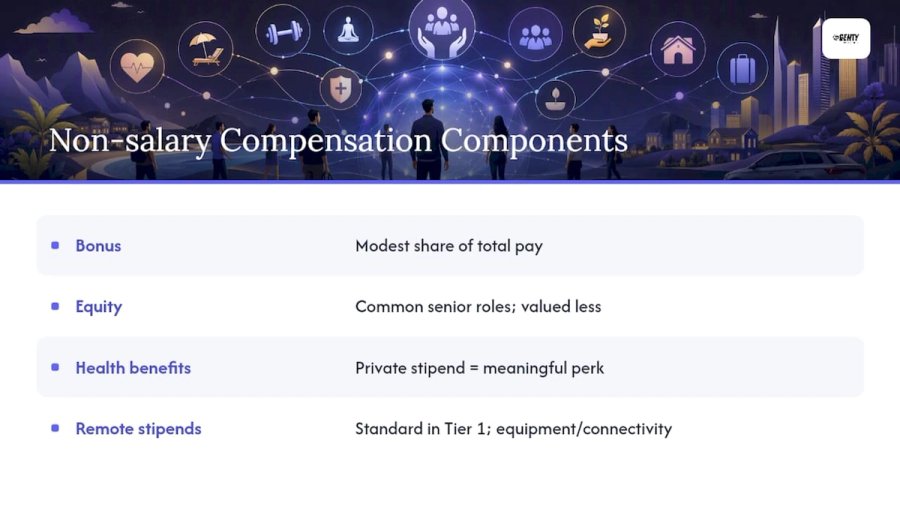
Base salary tells only part of the story in any serious benchmarking exercise. Annual or year-end bonuses, whether the legally mandated aguinaldo in Mexico or a discretionary performance bonus, typically add a modest proportion to total annual compensation depending on the role and country. Equity grants have become more common for senior engineering and product roles at venture-backed companies, though LATAM candidates historically weight equity lower than US candidates do, given less familiarity with vesting structures and exit outcomes; clear, simple explanations of how equity works often matter more than the grant size itself.
Health benefits deserve particular attention because expectations differ sharply from the US market. Roughly two-thirds of Americans carry private health insurance, largely tied to employment, which shapes US candidates’ assumptions about what an employer should provide. Most LATAM countries have public healthcare systems that cover baseline needs, so a private health stipend functions as a genuine perk rather than a baseline expectation, and a comparatively modest monthly stipend can carry outsized weight in a candidate’s decision.
Remote-work stipends for home office equipment, co-working space access, and connectivity have also become standard in competitive offers across Tier 1 countries. None of these show up in a raw base-salary benchmark, but leaving them out of an offer while a competitor includes them is often the deciding factor in a close negotiation.
Industry-Specific Salary Patterns Across Latin America
FinTech and Web3 companies consistently pay above the general tech market rates shown in the earlier table, often by 10-20% for backend and blockchain-specialized engineering roles, reflecting both genuine skill scarcity and the sector’s higher funding levels relative to typical SaaS companies. AI-focused roles, particularly machine learning engineers and data scientists with production ML experience, command similar or larger premiums, and that gap has widened as more global AI companies compete directly for the same small pool of experienced LATAM candidates.
SaaS companies, by contrast, tend to hire closer to the median ranges shown earlier, since the role definitions are more standardized and the candidate pool is deeper. Sales roles show a different pattern entirely: base salary sits lower relative to total compensation, with commission structures making up a larger share of expected earnings, particularly for SDR and account executive roles targeting the US market where quota-based pay is the norm candidates expect.
Traditional enterprise software and legacy industry tech roles generally pay below the FinTech and AI premiums, reflecting both slower funding cycles and less competitive pressure on those specific skill sets. A hiring manager benchmarking a blockchain engineer against a general full-stack median will consistently undershoot the offer needed to close that hire, since the relevant comparison set is a narrower, higher-paid specialist pool, not the broader market.
Tactical Priorities When Hiring LATAM Talent
Speed beats precision in most competitive LATAM searches. A slightly generous offer delivered in week one beats a perfectly calibrated offer delivered in week four, because the best candidates are gone by then. The single most common mistake is anchoring entirely on base salary and ignoring how total compensation framing changes candidate perception, particularly around health benefits and career trajectory.
— Eugene
How GENTY Recruitment Turns Benchmarks Into Hires
GENTY recruitment is the direct alternative to running a LATAM search blind with outdated public salary aggregators. You get USD benchmarks built from live placement data across 40+ roles and 11 countries, plus a recruitment team that turns that data into an actual shortlist instead of leaving you to source candidates yourself.
The fixed-fee structure means you know the total cost before you start, with pricing set per seniority level and no upfront payment required. Curated shortlists arrive within 7 days, built around the exact role definition and country tier that matches your budget and urgency, not a generic template. If a placed hire doesn’t work out, the 3-month replacement guarantee protects the investment. For engineering roles specifically, GENTY recruitment’s IT recruitment service covers everything from backend and DevOps to data science and product roles across Argentina, Brazil, Mexico, and Colombia.
Ready to move from benchmark to hire? Start a search through the IT recruitment page or request a custom benchmarking report scoped to your exact roles and target countries.
Sources
- The global distribution of STEM graduates — which countries lead the way? | CSET (Georgetown)
- The future of jobs in Latin America and the Caribbean — World Economic Forum
- Share of Americans with private health insurance — Statista