
A mid-level software engineer in Mexico earns roughly MXN 55,000 to 75,000 per month, or about USD 3,056 to 4,167 at 2026 exchange rates. Mid-level pay in major tech hubs. City, stack, and employer-cost specifics that change this number are below.
TL;DR:
Location significantly impacts pay, with Mexico City and Monterrey offering 10-25% higher wages than the national median, while Mérida and Tijuana are 5-15% below it.
Specializations in cloud, AI/ML, DevOps, and security command premiums of 20-35%, especially for scarce skills like security certifications and MLOps expertise.
Remote work has increased salary expectations, with top candidates benchmarking against U.S. rates, but even with loaded costs, Mexican salaries remain substantially lower than U.S. salaries across all seniority levels.
Software Engineer Salary Ranges in Mexico by Seniority
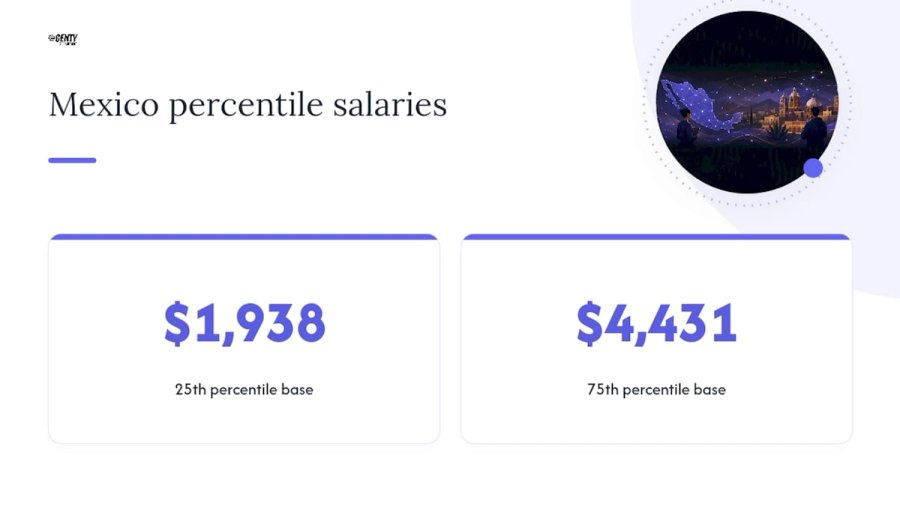
Base pay in Mexico climbs steadily by level, but the spread between the 25th and 75th percentile at every tier is wide enough to trip up hiring managers who anchor to a single number. CodersLink’s 2026 salary report, based on more than 10,000 respondents, puts the median software engineer net pay at about USD 3,046 per month, with the middle 50% falling between USD 1,938 and USD 4,431. That gap reflects company size, city, and specialization more than raw skill.
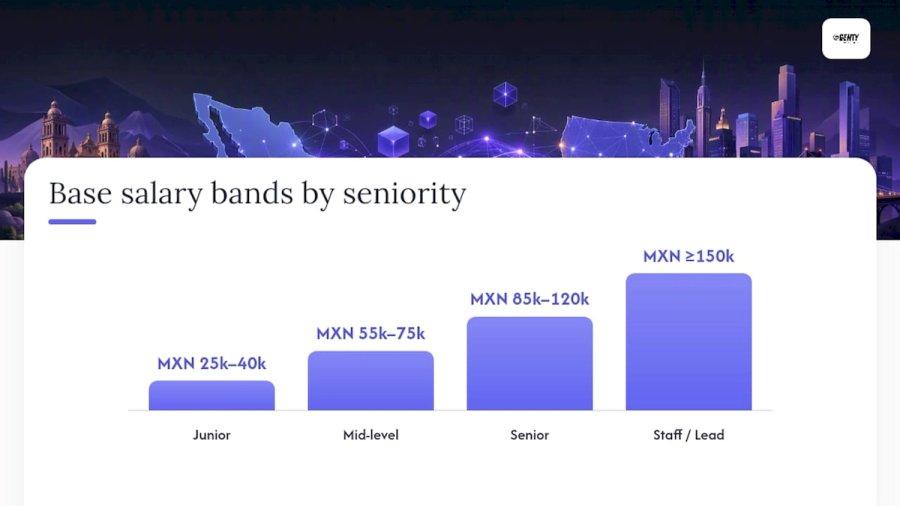
Junior engineers with one to two years of experience typically land between MXN 25,000 and 40,000 monthly. Mid-level engineers, the largest hiring segment for U.S. companies staffing product teams, sit in the MXN 55,000 to 75,000 band. Senior engineers with five-plus years and system-design ownership often clear MXN 85,000 to 120,000. Staff and lead-level roles, especially at multinational subsidiaries, can push past MXN 150,000 in base pay alone.
These figures reflect base gross salary, not total compensation. Levels shows a very different picture once equity and bonuses enter the mix: median total comp near MX$785,682 annually, with a 25th to 75th band from about MX$514,000 to MX$1.14 million, largely driven by multinational tech employers offering stock grants on top of local salary.
Need help hiring?
See the next step after this guide
If this topic is relevant to your team, these are the most useful pages to check next.
Pro Tip: When you see a salary figure quoted without a source, ask whether it’s base pay, take-home net, or total compensation. Confusing the three is the single most common mispricing mistake U.S. hiring managers make when building a Mexico offer.
Regional Pay Differences Across Mexico’s Tech Hubs
Location influences salary levels significantly. Talentosy’s 2026 data cites a national median gross salary in the mid-range of Mexican pesos per month, with notable variation among cities.
- Mexico City and Monterrey run 10% to 25% above the national median, driven by dense concentrations of multinational R&D offices and fintech headquarters.
- Guadalajara, often called Mexico’s Silicon Valley for its hardware and software cluster, tracks close to the national median with a slight premium for senior roles.
- Querétaro pays near or slightly below median but has become a magnet for automotive-software and embedded-systems talent.
- Mérida and Tijuana typically sit 5% to 15% below the national median, making them attractive for cost-conscious teams willing to recruit outside the traditional hubs.
If your target candidates sit in Mexico City or Monterrey, budget the premium upfront rather than discovering it mid-negotiation. A remote-first company with no city preference can often shave real money off payroll simply by sourcing from Querétaro or Mérida instead of the capital.
How Specialization Changes Software Developer Pay in Mexico
Stack and specialty move compensation more than years of experience alone. Cloud, AI/ML, DevOps/SRE, and security specializations carry premiums of roughly 20% to 35% over general full-stack roles at the same seniority level, and that gap has widened as Mexico’s IT services sector has grown.
- Cloud infrastructure (AWS, Azure, GCP certifications) commands the most consistent premium, especially for engineers who’ve managed multi-region deployments.
- AI/ML engineers with production model deployment experience, not just notebook-level research, sit at the top of the premium band.
- DevOps/SRE roles with Kubernetes and CI/CD pipeline ownership price close to senior full-stack rates even at mid-level tenure.
- Security specialists, particularly those with penetration testing or compliance certifications (CISSP, OSCP), are the scarcest and priciest hire in most Mexican tech hubs.
Pro Tip: Pay the premium for genuinely scarce skills like security and MLOps. For trainable skills like a new frontend framework, hire for aptitude and budget a few weeks of ramp time instead of chasing candidates who already know your exact stack.
Total Employer Cost: What a Mexico Hire Really Costs
Gross salary is not your budget number. Mexican labor law requires payroll for Mexico-based employees to run in MXN, and statutory benefits add a meaningful markup on top of base pay.
Plan on an employer-loaded multiplier of roughly 1.25x to 1.30x gross salary as a conservative starting point. That load typically covers:
- IMSS (social security) contributions, covering health, disability, and retirement benefits
- INFONAVIT housing fund contributions, mandatory for all formal employees
- Aguinaldo (Christmas bonus), a legally required 13th-month payment
- Vacation premium and other statutory time-off obligations
A mid-level engineer at MXN 65,000 gross monthly therefore costs closer to MXN 81,250 to 84,500 in fully loaded terms. Compliance options break into three tracks: run payroll through an Employer of Record or PEO (fastest to launch, modest markup on top of statutory costs), open a local entity (more control, higher setup cost and timeline), or partner with a recruiter who structures compliant contracts for you. Most companies hiring fewer than 10 people in Mexico start with an EOR or recruiter partnership rather than incorporating locally.
Mexico vs. U.S. Software Engineer Salaries: The Real Numbers
The savings case holds up even after loading in every statutory cost. BLS occupational data puts U.S. software developer pay well above the Mexico figures across every seniority tier, and the gap widens further once you add U.S. payroll tax, benefits, and 401(k) matching to the American side of the ledger.
- Both Mexico figures already include the 1.25x to 1.30x employer-loaded multiplier, so they represent true landed cost, not just gross salary.
- U.S. figures reflect mid-to-senior software engineer pay in major tech markets like San Francisco or New York, where total employer cost (salary plus benefits and payroll tax) typically runs 25% to 35% above base salary.
- Mexico’s Central and Eastern time zones overlap almost fully with U.S. EST and give partial-day overlap with PST, so daily standups, pair programming, and live incident response work without the 12-hour lag common with offshore teams in Eastern Europe or Asia.
How to Budget and Hire a Software Engineer in Mexico
A repeatable process beats guesswork every time you open a new requisition.
- Define the role and level precisely. “Mid-level backend engineer with Kubernetes experience” prices very differently from “mid-level backend engineer.”
- Set a gross MXN range using current benchmarks. Anchor to the percentile bands above, not a single average number.
- Add the employer load. Multiply your gross range by 1.25x to 1.30x to get your real monthly budget before you post the role.
- Pick a contract model. Decide between EOR/PEO, a local entity, or a recruiting partner who handles compliant contracting before you start interviewing.
- Build in a negotiation cushion. Strong senior candidates in Mexico City or Monterrey routinely field multiple offers; leave 5% to 10% room above your target midpoint.
When you evaluate candidates, ask directly what similar roles at comparable companies have offered them recently. That answer, more than any salary survey, tells you what the market will actually bear this quarter. The most common mispricing mistake isn’t overpaying. It’s anchoring to a national average and then losing a strong candidate in Mexico City to a competitor who did the city-adjusted math first.
Pro Tip: Ask candidates for their last three offers, not just their current salary. Current salary tells you what they accepted before; recent offers tell you what the market is paying them right now.
Where Mexico Software Engineer Salaries Are Headed Through 2031
Mexico’s IT services sector has grown steadily, and Statista’s market outlook points to continued expansion in demand for skilled technical talent through the back half of the decade. That growth trajectory has direct implications for anyone building a five-year hiring plan around Mexico-based engineering teams.
Expect base salaries to keep climbing faster than general inflation, particularly in Mexico City, Monterrey, and Guadalajara, where multinational R&D centers compete directly with U.S. remote employers for the same senior talent pool. Specializations already commanding premiums today, cloud architecture, AI/ML, and security, will likely see those premiums widen rather than shrink, since Mexican universities and bootcamps are still catching up to demand in those specific niches.
The bigger structural shift is total compensation, not base pay. As more multinational employers set up Mexico operations rather than relying purely on remote contracts, equity and bonus components will become standard even for mid-level roles, following the pattern already visible in Levels.fyi’s total-comp data. Companies that compete on base salary alone will find themselves increasingly unable to win senior candidates against employers offering meaningful equity.
For U.S. hiring teams, the practical takeaway is to lock in favorable terms now rather than later. A recruiter or benchmarking partner who tracks these shifts in real time gives you a pricing edge that a static salary guide, updated once a year, simply cannot match.
Remote Work Has Reshaped What Mexico Engineers Expect to Earn
Global remote hiring has pushed Mexican software engineer salaries upward faster than domestic demand alone would explain. When a Mexico City backend engineer can interview with a Bay Area startup paying in USD, that engineer’s local salary expectations shift even if they never take the remote job.
This dynamic explains part of the wide percentile spread CodersLink documented between the 25th percentile (USD 1,938) and 75th percentile (USD 4,431) for the same broad title. Engineers with strong English skills and remote-work experience routinely negotiate toward the top of that band, because they have a credible alternative: a fully remote U.S. or European employer paying USD-denominated rates.
The practical effect for hiring managers is twofold. First, expect candidates in Mexico City, Guadalajara, and Monterrey to benchmark themselves against global remote postings, not just local job boards, so lowball offers anchored to outdated local averages will lose talent fast. Second, remote-first employers based outside Mexico’s traditional hubs, in cities like Mérida or Tijuana, can still access strong talent at a discount, since those markets haven’t been as thoroughly saturated by global remote recruiting yet.
None of this erases the underlying cost advantage. Even engineers pricing themselves against global remote postings still land well below comparable U.S. salaries once you factor in the loaded cost differences covered earlier. It does mean the days of treating Mexico as a flat, low-cost labor pool are over, and pricing has to reflect a genuinely global, competitive market for the same skill set.
Tax Implications on Software Engineer Net Income in Mexico
Gross salary and take-home pay diverge sharply in Mexico, and that gap matters when you’re comparing candidate expectations to your offer. Mexican income tax (ISR) is progressive, and combined with mandatory employee-side IMSS contributions, net income typically runs meaningfully below gross salary, particularly at higher income bands where marginal rates climb.
This is precisely why CodersLink frames its median figure, about USD 3,046 per month, as net pay rather than gross. When you’re comparing salary sources, always confirm whether the number quoted is gross (what appears in the employment contract), net (what lands in the candidate’s bank account), or total compensation (gross plus bonus and equity).
For candidates working through a compliant Mexican payroll structure, whether via a local entity, an Employer of Record, or a recruiting partner who handles contracting, taxes and social contributions are withheld automatically, similar to how a W-2 employee’s taxes work in the United States. Candidates working as independent contractors for foreign companies handle their own tax filings and often factor the administrative burden into their rate expectations. That distinction is worth clarifying early in any negotiation, since a contractor quoting a rate is typically pricing in the fact that they, not an employer, absorb the compliance overhead.
Bonus Structures and Variable Pay for Mexican Software Engineers
Base salary tells only part of the compensation story, especially at multinational employers and well-funded startups. Aguinaldo, the legally mandated Christmas bonus equal to at least 15 days of salary, is universal and non-negotiable, but it’s a statutory floor, not a competitive differentiator.
Beyond that legal minimum, variable compensation varies widely by employer type:
- Performance bonuses tied to individual or team KPIs are common at mid-to-large tech companies, typically ranging from 5% to 15% of annual base salary.
- Annual discretionary bonuses, often paid at fiscal year-end, appear more frequently at multinational subsidiaries than at local startups.
- Equity or stock options are increasingly common at senior and staff levels, particularly at companies with U.S. or global headquarters, and drive much of the spread in Levels.fyi’s total-compensation data.
- Retention bonuses, one-time payments tied to a vesting cliff, show up most often when companies are trying to hold onto scarce specialists like security engineers or ML specialists during a competitive hiring cycle.
For U.S. companies hiring directly, matching local bonus norms, particularly the aguinaldo, isn’t optional. Skipping it or treating it as a discretionary perk is both a compliance risk and a signal to candidates that you don’t understand the local market.
Career Growth: How Fast Software Engineer Pay Rises in Mexico
Salary progression in Mexico follows a fairly predictable arc, though the pace varies by how deliberately an engineer manages their specialization.
The senior-to-staff or lead transition is less linear. It depends heavily on whether an engineer’s employer has a formal staff-engineer track and whether the engineer develops a specialization, cloud architecture, AI/ML, or security, that commands the premiums covered earlier.
Engineers who deliberately build a scarce specialization tend to compress this timeline. Someone who moves from generalist backend work into MLOps or security architecture by their third year in the field often reaches senior-level compensation faster than a peer who stays generalist, simply because specialist demand consistently outpaces the supply of qualified candidates in Guadalajara, Monterrey, and Mexico City alike.
What Hiring Leaders Consistently Get Wrong About Mexico Salaries
The most common mistake in Mexico hiring isn’t underpaying. It’s pricing every candidate against a single national average pulled from a quick Google search, then acting surprised when a strong Mexico City candidate rejects an offer that would have been generous in Mérida.
The data makes clear that seniority, city, and specialization interact, not stack additively. A senior cloud engineer in Monterrey isn’t just “senior pay plus city premium plus specialization premium” added together; the market has already priced that combination as its own tier, and treating it as three separate line items usually undershoots the real number. Conventional salary guides tend to flatten this into a single range per level, which is exactly why so many U.S. companies lose their first-choice candidate on offer number two.
The other overlooked point is timezone value. Companies fixate on the cost savings, and it’s real, but they undersell the operational value of near-real-time collaboration with a Mexico-based team on U.S. EST or PST hours. That’s not a minor perk. It’s the difference between a Slack thread resolved in an hour and a bug fix that waits until tomorrow because your offshore team in another hemisphere is asleep.
If there’s one priority for a hiring leader reading this: build your offer range from city plus specialization data, not a blended national figure, and price the timezone advantage into your decision, not just the salary line.
— Eugene
Hire Faster in Mexico With a Fixed-Fee, No-Guesswork Process
A specialized recruitment agency can take over the benchmarking exercise for you every time you open a Mexico requisition. Instead of triangulating city premiums, specialization markups, and employer-load math from scratch for every role, such an agency may deliver a curated shortlist of pre-vetted candidates within about a week, priced against current market data from day one.
Some agencies offer fixed-fee structures with no upfront payment and no surprise markup once a hire is made, and may include a placement replacement guarantee. They source engineers, DevOps specialists, and data talent across Latin America, pre-screened for English proficiency and technical depth, so clients avoid vetting resumes against a salary guide late at night. These options also support hires that preserve timezone overlap to facilitate daily collaboration.
If you’re ready to turn these benchmarks into an actual hire, start with GENTY recruitment’s IT recruitment services page and request a shortlist for your next open role.
Sources
- Mexico Tech Salaries Report 2026 | 10,246 Salaries Across 36 Roles — CodersLink
- Levels
- Software developers — Occupational Outlook Handbook — BLS