

Nearshore hiring in Latin America is the fastest way for product teams to add senior engineering capacity without sacrificing collaboration speed. hires while keeping same-day overlap across EST and PST. Mexico, Colombia, Argentina, and Brazil each cover different timezone and skill needs. The rest of this guide breaks down the benchmarks, risks, and a step-by-step pilot checklist to prove it out.
TL;DR:
Nearshore hiring in LATAM offers a fully loaded cost of $78 to $90 per hour for senior engineers, about 40% less than U.S. equivalents, enabling significant budget savings.
Timezone overlap with EST and PST improves sprint predictability and reduces management overhead by enabling real-time collaboration and faster code reviews.
Critical legal and retention considerations include choosing the right employment structure, understanding country labor laws, and verifying partner retention rates to avoid hidden costs.
A four to six-week pilot using a defined scope and measurable KPIs can validate whether nearshore engineers improve team output before scaling up hiring efforts.
Partnering with a specialized LATAM recruitment firm accelerates candidate sourcing, ensures quality vetting, and includes a replacement guarantee, reducing hiring risks.
What Is Nearshore Hiring vs. Nearshore Outsourcing and Offshore?
Nearshore hiring means bringing engineers or specialists onto your own team directly, either as employees through a local entity or via an Employer of Record, so they report into your engineering org like any other team member. You control their tools, their sprint cadence, and their code review process. This is different from nearshore outsourcing, where a vendor manages a team on your behalf and delivers a scoped outcome, and you interact with a project lead rather than individual contributors.
Offshore hiring uses the same logic as nearshore, direct hires or vendor-managed teams, but pulls from regions with minimal or no timezone overlap, typically Eastern Europe or South Asia for U.S. companies. The core difference is not skill or cost. It is collaboration friction. An offshore team in a 9 to 12-hour time difference from EST forces async handoffs, delayed code reviews, and standups that happen at 9 p.m. or not at all.
Choosing between these three models comes down to how much control and speed you need against how much operational risk you can absorb. Direct nearshore hiring gives you the most control and the tightest integration with your existing squads, but it means you own onboarding, performance management, and local compliance. Nearshore outsourcing shifts that operational load to a vendor, which speeds up ramp time but adds a management layer between you and the work. Staff augmentation through an agency like GENTY recruitment splits the difference: you get vetted individual hires who report to you directly, while the agency handles sourcing, screening, and legal structuring.
What do you need?
Choose the hiring path that fits
After reading "CTOs: Nearshore Hiring in Latin America, Pilot in 4–6 Weeks & 2026 Pay", most teams compare these options before deciding how to hire.

If your team needs someone embedded in daily standups, making architecture decisions with your leads, and shipping code your team owns long term, direct nearshore hiring or staff augmentation beats outsourcing. If you need a defined feature built with minimal internal oversight, outsourcing to a managed nearshore vendor makes more sense.
What Are the Real Benefits of Nearshore Hiring?
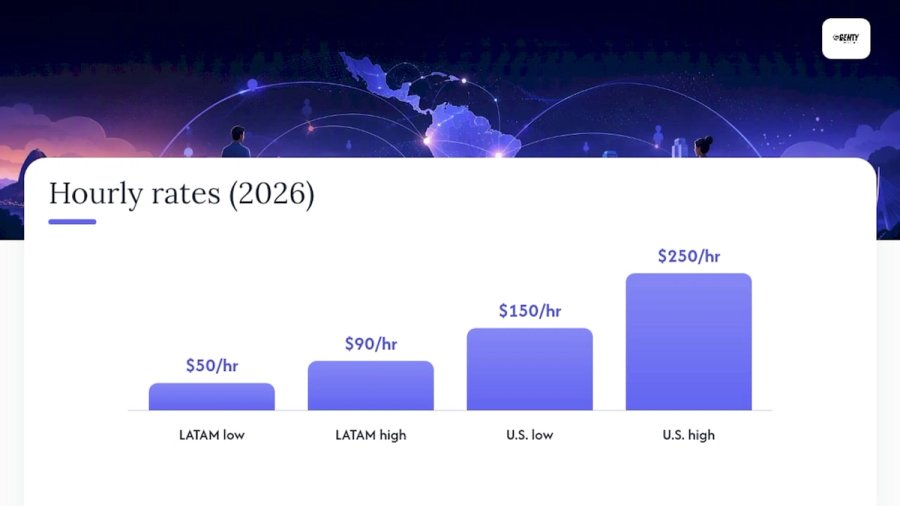
The savings are real, but they are not the whole story. Senior LATAM engineers typically run $50 to $90 per hour in 2026, compared with $150 to $250 per hour for equivalent U.S. engineers, which lines up with annual fully loaded costs of roughly $55,000 to $85,000 for LATAM seniors against $150,000 or more in the U.S. That gap alone justifies a pilot for most engineering budgets.
What actually moves the needle for product velocity is timezone overlap. A developer in Bogotá or Mexico City is online during your morning standup, available for a same-day incident call, and reviewing pull requests while your team sleeps rather than the reverse. That overlap changes sprint predictability in ways a rate card can’t capture. Teams that switch from offshore to LATAM nearshore report improved sprint predictability and lower hidden management overhead, largely because standups, code reviews, and incident response happen in real time instead of queued across a 10-hour gap.
The talent pool has also matured well past generalist web development. LATAM now has meaningful depth in AI/ML engineering, cloud infrastructure, DevOps, and fintech systems, concentrated in tech hubs like Buenos Aires, São Paulo, and Guadalajara. English proficiency in these hubs, particularly in Argentina, is consistently strong in the tech sector, which reduces the miscommunication and rework that erode savings on lower-cost offshore contracts.
Here’s what shows up most often when engineering leaders compare nearshore against other models:
- Cost: roughly 40% lower fully loaded cost than U.S. hires for equivalent seniority.
- Timezone: full or near-full overlap with EST and PST working hours.
- Talent depth: senior specialists in AI/ML, cloud, and fintech engineering across major hubs.
- Communication fit: strong English proficiency and cultural alignment with U.S. business norms.
- Velocity: fewer rework cycles and higher shipped-feature throughput per dollar, according to nearshore-offshore comparisons.
None of this eliminates management work. It shifts your manager’s time from resolving async miscommunication to actual technical leadership, which is a better use of a lead’s day regardless of where the team sits.
How Much Do Nearshore Developers in Latin America Cost in 2026?
Budgeting a nearshore hire means starting with the base rate, then layering on onboarding, tooling, and management overhead. A realistic model multiplies the base rate by 1.3 to 1.5x to get a true fully loaded cost, a buffer that prevents underbudgeting when comparing LATAM against U.S. hiring. Country-level hourly ranges for senior roles cluster tightly, generally in the $50 to $70 per hour band, with specialty roles in AI/ML and DevSecOps commanding a 20 to 40% premium over standard backend or frontend rates.
These ranges hold for general software engineering roles. AI/ML specialists, security engineers, and DevSecOps professionals sit at the upper end of each range or above it, reflecting the same 20 to 40% specialty premium seen across the region. Rates have climbed from 2024 through 2026 in the more competitive hubs; treat these numbers as a floor for 2026 planning, not a ceiling you’ll be quoted forever.
Two costs get missed most often in first-time nearshore budgets. The second is the fully loaded multiplier itself. A $60/hour senior engineer in Colombia is not a $60/hour line item. Once you account for the EOR fee, benefits administration, and management time, plan closer to $78 to $90/hour in true cost. For deeper role-by-role modeling across more than 40 positions, GENTY recruitment’s LATAM salary benchmarking data breaks out these ranges by exact role and seniority tier.
What Challenges and Compliance Risks Come With Hiring in LATAM?
The biggest early decision is how you structure the employment relationship, and it has real cost and legal implications. Direct hiring through a local entity gives you the most control but requires setting up a legal presence in-country, which is slow and expensive for a first hire. An Employer of Record (EOR) lets you hire an employee legally without a local entity, handling payroll, benefits, and tax withholding for a monthly fee per employee. A contractor arrangement is fastest to set up but carries misclassification risk if the person works full-time, exclusively for you, and under your direct supervision, since several LATAM countries treat that pattern as a de facto employment relationship regardless of the contract’s label.
Labor law varies meaningfully by country. Brazil and Argentina both have strong worker protections around severance and termination notice that catch first-time hiring managers off guard, while Mexico’s labor reforms have tightened rules around outsourcing arrangements specifically. None of this is something to guess your way through. Loop in local employment counsel before finalizing a contract structure, especially for your first hire in a new country.
Retention risk deserves as much attention as compliance. Partner attrition is often the single largest hidden cost in nearshore relationships, since a partner or vendor with high turnover forces you to repeat onboarding every few months. Before signing with any staffing partner, ask for actual retention data, not just placement volume.
For regulated industries, security compliance adds another layer:
- Budget an extra 5 to 10% for SOC 2 or equivalent audits during vendor onboarding if you’re in fintech or healthcare.
- Confirm HIPAA or PCI obligations apply to the specific role before assuming a nearshore hire needs that clearance.
- Build audit timelines into your hiring timeline. Security reviews add weeks, not days.
How Do You Run a Nearshore Hiring Pilot?
The lowest-risk way to test nearshore hiring is a parallel pilot: 2 to 3 engineers embedded directly into your existing squads, running alongside your current team rather than replacing it. This structure lets you measure real differences in collaboration and output without betting your roadmap on an untested arrangement. Most teams see observable differences in sprint predictability within one to two sprints, so a four to six week pilot window is usually enough to make a go or no-go call.
Pro Tip: Track cycle time, sprint predictability, and bug escape rate as your pilot KPIs. These three numbers tell you more about fit than any interview ever will, and they let you compare nearshore against your existing offshore or domestic team on equal footing.
Here’s the process, start to finish:
- Pick your engagement model. Direct hire suits long-term roles you want fully embedded; staff augmentation through an agency suits a faster pilot with less legal setup; RPO suits teams scaling multiple hires at once.
- Define pilot scope and success criteria before you interview anyone. Decide what “working” looks like in concrete numbers, not gut feel.
- Vet candidates against a fixed checklist: a coding exercise scoped to your actual stack, an architecture interview with a senior lead, a written or video communication sample, and reference checks that ask specifically about reliability and communication under deadline pressure.
- Confirm the partner’s retention metrics before signing, not after the first engineer churns.
- Onboard against 30/60/90-day milestones. By day 30, expect environment access and first small tickets shipped. By day 60, expect independent ownership of a feature area. By day 90, expect full sprint contribution at the same pace as an equivalent domestic hire.
- Review pilot KPIs at the two-sprint mark and decide whether to scale the engagement, adjust the model, or end it.
Video-based interview workflows can speed up steps 3 and 4 considerably when you’re screening multiple candidates across time zones. Structured video recruitment platforms let you standardize the technical and communication assessment before a single live interview, which cuts real hours out of the vetting process.
Which LATAM Country Fits Your Hiring Needs?
Country choice should follow your timezone need and your stack, not general reputation. Each of the four major LATAM tech hubs has a distinct profile worth matching against your actual team structure.
- Mexico: Best alignment for West and Central U.S. teams, with strong depth in cloud infrastructure and enterprise-grade backend systems. If your engineering leadership sits in Austin, Denver, or the Bay Area, Mexico’s working hours overlap almost completely with yours.
- Colombia: Strong East Coast alignment, with a notably deep fintech and mobile engineering talent pool concentrated in Bogotá and Medellín. A natural fit for teams building payment infrastructure or consumer mobile products on EST.
- Argentina: The deepest senior backend and data engineering talent in the region, paired with the strongest English proficiency in Latin America’s tech sector. Ideal for roles needing senior architecture ownership rather than execution-only work.
- Brazil: The largest talent pool by raw scale, with particular breadth in mobile development and data science. Worth noting for Pacific-based teams: some Brazilian hubs sit closer to a 2 to 3 hour gap from PST, so confirm working-hour overlap before assuming full alignment.
Matching country to need is less about finding “the best” country and more about finding the right fit for your specific gap. A fintech startup on the East Coast building a mobile-first product points toward Colombia. A Series B company in Austin needing senior cloud architects points toward Mexico or Argentina. GENTY recruitment’s breakdown of why Latin America has become a leading region for remote tech hiring covers the maturation trend across all four markets in more depth.
Why Work With a Specialized LATAM Recruitment Partner?
Running the vetting checklist above internally takes real time, time most engineering leaders don’t have alongside their actual job. A specialized recruitment partner can run a skill-first process that delivers a curated shortlist within 7 days, with fixed-fee pricing scaled to seniority level and no upfront payment required. Some placements carry a 3-month replacement guarantee, which removes most of the retention risk that makes first-time nearshore hiring feel uncertain.
Some specialized recruiters place software engineers, DevOps specialists, data professionals, and sales teams across FinTech, AI, SaaS, and Web3 companies, sourcing from Argentina, Brazil, Mexico, and Colombia among other LATAM markets.
Pro Tip: Ask any recruiting partner for their average time-to-shortlist and their replacement guarantee terms in writing before signing. Those two numbers tell you more about how a partner will actually perform than their pitch deck does.
What Are Your Next Steps to Start Nearshore Hiring?
Moving from research to an actual hire works best as a short, decisive sequence rather than an open-ended search. Start by defining the pilot scope in writing: which team the new hire joins, what they’ll own in the first 30 days, and which two or three KPIs will decide whether the pilot succeeds. Skipping this step is the most common reason nearshore pilots stall, because without defined success criteria, a perfectly good hire can look like an ambiguous outcome six weeks in.
Next, pick your engagement model based on how fast you need to move. If you need someone in seat within two to three weeks, staff augmentation through a specialized recruiter beats building an entity or running your own sourcing campaign from scratch. If you’re planning to hire five or more people over the next year, an RPO arrangement usually pays for itself in reduced time-to-fill across multiple roles.
From there, the checklist is straightforward:
- Confirm your budget using fully loaded cost, not base rate alone.
- Choose a target country based on timezone and stack fit, not assumption.
- Set a fixed vetting process before you see a single resume.
- Lock in 30/60/90-day milestones with your hiring manager and the new hire.
- Schedule a KPI review at the two-sprint mark, with a clear go or no-go decision point.
Companies that follow this sequence tend to reach a hiring decision in four to six weeks rather than the two to three months that unstructured searches often take.
An Editorial Take on Nearshore Hiring Trade-Offs
The biggest red flag in vendor evaluation isn’t rate. It’s vague retention numbers. Any partner unwilling to share churn data or specific stack experience is telling you something. Expect the first 90 days to be genuinely productive, not just onboarding theater. If a hire isn’t contributing real code by day 60, the vetting process failed, not the market. The smartest teams don’t replace domestic or offshore staff wholesale. They blend nearshore hires into existing squads deliberately, using the timezone overlap to close gaps async offshore work always leaves open.
— Eugene
Start Your Nearshore Hiring Pilot the Right Way
Working with a direct alternative recruitment provider can save weeks sourcing and screening candidates across multiple countries by providing a curated shortlist in about a week at a fixed fee, with no upfront payment and less uncertainty about candidate qualification.
Our IT recruitment service for LATAM hiring covers software engineers, DevOps, and data specialists across Argentina, Brazil, Mexico, and Colombia, matched to your stack and seniority need within days rather than months. Every placement comes with a 3-month replacement guarantee, so a mismatched hire doesn’t mean starting your search over from scratch. If you’re ready to run a pilot with vetted candidates instead of a cold search, get your shortlist started this week.
Sources
The benchmarks and comparisons in this guide draw from a handful of specific sources worth checking directly if you’re modeling your own budget or building a board presentation around nearshore hiring.
- Nearshore Software Development Cost in 2026 | ParallelStaff
- Nearshore Software Development Rates 2026: By Role, Country, Seniority | HauerPower
Check these against your own budget assumptions before finalizing a hiring plan. Rate ranges shift year over year, and the country that fit your last hire may not fit your next one.