

Software engineers in Argentina earn between $34,000 and $76,000 per year in USD, with a median of $56,000, according to Salary (43 anonymous submissions, last updated June 17, 2026). PayScale puts the average at $51,886 across 23 profiles, while its separate “Software Developer” label averages $60,000, a gap that reflects how much role naming alone can shift benchmark results. In Argentine pesos, Levels total compensation figures in ARS with higher medians concentrated in Buenos Aires, where company HQs and multinational offices cluster.
$34K–$76K USD/year is the 2026 range for Argentina software engineers. The median sits at $56K. Buenos Aires engineers typically land at the upper half of that band; provincial hires often fall in the lower third.
Four variables drive most of the spread: seniority level, city (Buenos Aires vs. the provinces), technical specialization, and whether the engineer is on local payroll or a USD contractor arrangement. Arc and Tecla both publish Argentina-specific remote salary snapshots that corroborate these ranges from the employer side, though their underlying sample sizes vary. Throughout this guide, USD figures reflect market-rate USD or USD-equivalent pay, not ARS converted at the official exchange rate, which would materially understate real compensation.
Key Takeaways
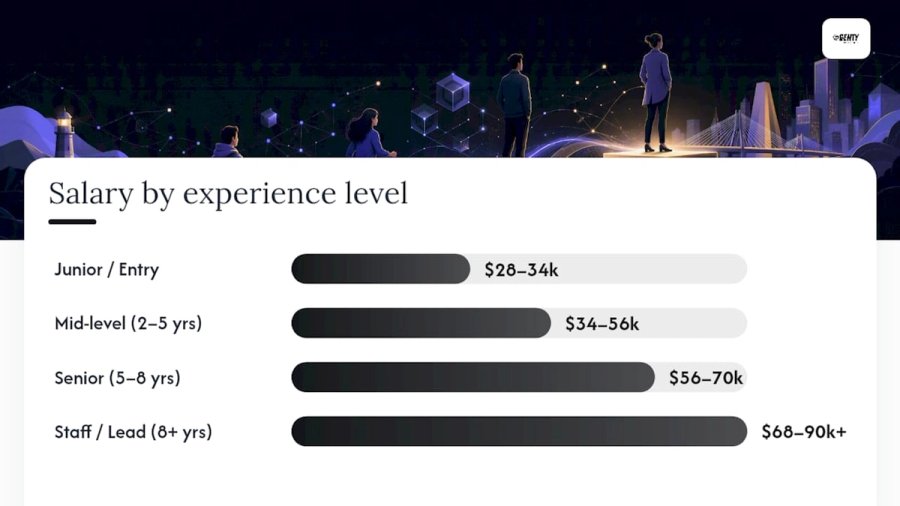
What does software engineer salary in Argentina look like by experience level?
Seniority is the single largest predictor of pay, and the bands are wide enough that a junior and a staff engineer at the same company can sit $40,000+ apart in annual USD compensation.
Entry-level software engineer wages in Argentina are competitive for local living costs, but the real hiring opportunity for US companies sits at the mid-to-senior band, where the USD cost is roughly 40–60% below equivalent US market rates. A senior engineer in Buenos Aires who would cost $130,000–$160,000 all-in at a US company typically commands $55,000–$70,000 as a USD contractor in Argentina.
Planning a hire?
Talk through the best hiring option
This article usually leads to one practical question: should you use it recruitment or country guide? We can help you choose quickly.
Simple next step
Start with it recruitment and we will help you pick the best hiring setup.
Two variance drivers that hiring managers underestimate: English proficiency and remote-work track record. That premium is rational, because onboarding friction drops significantly and the engineer can participate in US sprint ceremonies without a translator or a timezone workaround.
- Specialization premium: ML, cloud infrastructure (AWS/GCP/Azure), and SRE roles push senior pay above the $70K ceiling.
- On-site vs. remote: Engineers on local Argentine payroll typically earn less in USD terms than those on USD contractor agreements with US clients.
- Buenos Aires vs. provinces: Buenos Aires engineers at the senior level often earn 20–30% more than counterparts in Córdoba, Rosario, or Mendoza.
Pro Tip: When structuring offers in an inflationary environment, anchor the base in USD (or a USD-indexed amount) and pay a smaller ARS component for local expenses. This protects the engineer’s purchasing power and reduces the renegotiation cycle that erodes retention.
Which roles and technologies pay the most in Argentina?
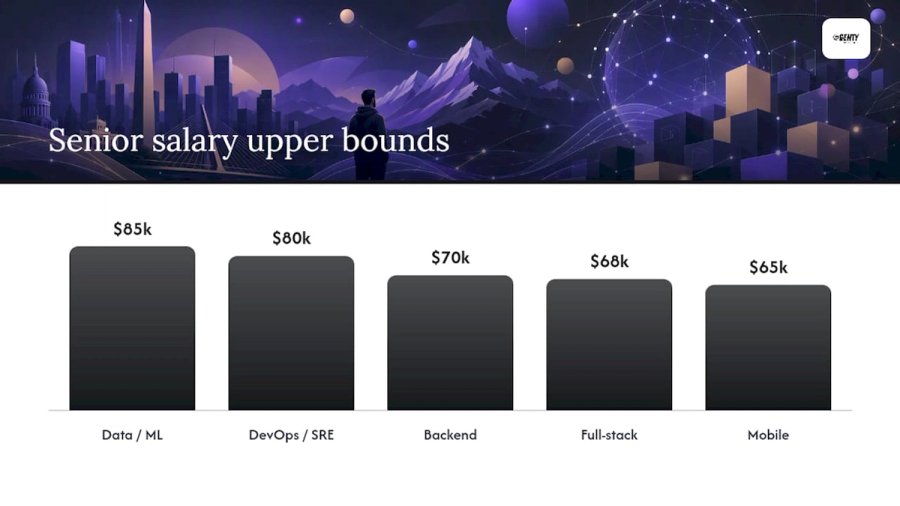
Not all engineering roles sit at the same pay band, even at identical seniority levels. Data science, ML engineering, and cloud infrastructure consistently command premiums above the Argentina baseline, while frontend and QA automation roles tend to sit at or slightly below the median.
- Backend engineers (Node.js, Python, Java, Go): $30,000–$72,000 depending on seniority; the most common hire profile for US SaaS and FinTech companies.
- Frontend engineers (React, Vue, Angular): $25,000–$60,000; slightly below backend at equivalent levels, though React/TypeScript specialists close the gap.
- Full-stack engineers: $28,000–$68,000; popular for early-stage startups that need product velocity over specialization depth.
- Data / ML engineers: $40,000–$85,000; the highest-ceiling category, driven by global demand and a thinner local talent pool.
- DevOps / SRE / Cloud infra: $38,000–$80,000; Kubernetes, Terraform, and multi-cloud experience push pay toward the top of this range.
- Mobile engineers (iOS/Android, React Native, Flutter): $28,000–$65,000; Flutter and React Native specialists are in high demand relative to supply.
For a clearer cross-role view at the mid and senior levels, where most US hiring decisions concentrate:
Argentina’s top IT skills in demand mirror global trends: LLM integration, cloud-native architecture, and real-time data pipelines are the fastest-moving premium categories. If your role brief includes any of these, budget at the upper end of the relevant band and expect a longer sourcing timeline.
How does location affect software developer salary in Buenos Aires vs. other cities?
Buenos Aires is not just the capital; it is where Argentina’s tech ecosystem concentrates. Multinational tech firms, FinTech unicorns, and the largest domestic software houses all maintain HQs or major offices there, which pushes compensation benchmarks above the national average.
Levels.fyi’s Buenos Aires data shows an average total compensation of ARS 58,392,458, with a wider range reflecting the presence of larger company pay bands. Glassdoor’s Buenos Aires aggregates corroborate higher capital-city pay, with candidate-reported figures consistently above the national median.
A few practical points for US hiring teams:
- Engineers hired as USD contractors from anywhere in Argentina often negotiate Buenos Aires-equivalent rates, because their reference point is the global remote market, not local wages.
- Córdoba and Rosario have large engineering university programs (Universidad Nacional de Córdoba, Universidad Nacional de Rosario) that produce strong mid-level talent at slightly lower initial salary expectations.
- Provincial engineers with 3+ years of remote experience for US companies typically close the gap with Buenos Aires peers within one to two years.
The dataset limits here are real: most public salary databases oversample Buenos Aires because that is where the most submissions originate. Treat provincial figures as directional rather than precise.
How does total compensation work, and what does the FX situation mean for your budget?
“Salary” in Argentina covers more than a base figure, and the currency in which it is denominated changes the entire cost equation for a US employer.
Compensation components
- Base salary: The fixed monthly or annual amount, quoted in either ARS or USD depending on the employment model.
- Variable bonus: Common at larger Argentine tech firms, typically 10–20% of annual base, tied to company or individual performance.
- Equity / stock options: More common at US-backed startups than at domestic Argentine companies; engineers with US remote contracts increasingly expect at least a token equity component.
- Benefits in-kind: Health insurance (obra social), meal allowances, and internet stipends are standard on local payroll; USD contractors typically negotiate a higher gross rate to self-fund these.
Employment models
- Local Argentine payroll: The employer (or an Employer of Record) registers the engineer in Argentina, pays ARS salary plus mandatory social contributions (roughly 25–30% employer burden on top of gross salary). Compliance is handled locally.
- USD contractor (1099-style): The engineer invoices as an independent contractor (monotributista or autónomo). The US company pays USD gross; the engineer handles local tax registration. Lower employer burden, faster to start, but less protection for the engineer.
- Employer of Record (EOR): A third-party EOR employs the engineer locally and bills the US company a monthly fee (typically the engineer’s gross plus a service margin). Compliant, fast, and increasingly the preferred model for companies without a local entity.
Currency strategy
Argentina’s inflation and parallel exchange rate dynamics make currency choice a genuine strategic decision, not just an administrative one. Wise’s cost-of-living data estimates single-person monthly expenses (excluding rent) at around $841, which means a $56,000 USD annual salary represents substantial purchasing power locally, even after local taxes.
Three common approaches:
- Full ARS pay: Lowest USD cost on paper, but erodes rapidly with inflation. Engineers will renegotiate frequently or leave.
- Split ARS + USD: A local ARS component covers daily expenses; a USD component (paid via Wise, Deel, or similar) protects purchasing power. Most common for EOR arrangements.
- Full USD contractor pay: Cleanest for the US company; the engineer manages local conversion. Increasingly the norm for senior remote hires.
Pro Tip: Build a 6-month FX review clause into any ARS-denominated offer. Tying annual increases to a USD benchmark (rather than Argentine CPI alone) dramatically reduces the renegotiation cycle and signals long-term commitment to the engineer.
Checklist: Converting a posted ARS figure to effective USD landed cost
- [ ] Identify the exchange rate basis (official, blue/parallel, or MEP rate) the posting uses
- [ ] Add employer social contributions (25–30% on top of gross for local payroll)
- [ ] Add EOR service fee if applicable (typically $300–$600/month per employee)
- [ ] Add benefits in-kind (health, internet, equipment stipend)
- [ ] Divide total ARS annual cost by the parallel/MEP rate for a realistic USD equivalent
- [ ] Cross-check against USD contractor market rate for the same seniority level
How should US companies budget for hiring Argentine engineers?
The BLS median for US software developers provides the baseline for cost-delta calculations. When you factor in US employer payroll taxes, benefits, and recruiting costs, a mid-level US software engineer typically costs $140,000–$180,000 all-in annually. An equivalent Argentine hire on a USD contractor arrangement runs $35,000–$55,000, and a senior hire on an EOR model lands at $65,000–$90,000 all-in, including the EOR margin.
Hiring senior engineers in Argentina typically delivers a 30–40% cost advantage versus equivalent US talent, once employment model costs are included. The actual delta depends on the role, seniority, and whether you use EOR, direct contractor, or local payroll.
Argentina’s timezone alignment is a genuine operational advantage. Buenos Aires runs on UTC-3, which means a 9 AM EST standup is 10 AM in Buenos Aires, and a 2 PM EST design review is 3 PM locally. PST teams get a workable 4–5 hour overlap window in the morning. For remote hiring in Argentina, this overlap is consistently cited as a productivity differentiator versus offshore teams in Eastern Europe or Southeast Asia.
Employment model selection checklist:
- [ ] Speed priority? USD contractor is fastest to start (days, not weeks).
- [ ] Compliance priority? EOR handles local labor law, social contributions, and termination rules.
- [ ] Long-term retention? Local payroll or EOR with full benefits package builds stronger loyalty.
- [ ] Equity grants? Contractor model complicates equity; EOR or local entity is cleaner.
- [ ] Multiple hires? At 5+ engineers, a local entity or dedicated EOR relationship reduces per-head cost.
Budgeting rules of thumb:
- Add 25–30% to gross salary for employer burden on local Argentine payroll.
- Add $300–$600/month per head for EOR service fees.
- Budget $1,000–$2,000 for equipment and onboarding for remote hires.
- Plan for a 6-month FX review cycle on any ARS-denominated component.
Where do these numbers come from, and how reliable are they?
Salary data for Argentina is genuinely fragmented, and understanding the methodology behind each source changes how you use the numbers.
Primary sources used in this article:
- Salary: Self-reported, anonymous submissions. 43 data points as of June 17, 2026. Small sample, but recent and USD-denominated. Use as a directional median.
- PayScale: Self-reported profiles. 23 profiles for “Software Engineer,” $51,886 average. Treat as indicative. The separate “Software Developer” label on PayScale shows $60,000, illustrating how role naming shifts benchmarks by up to 15%.
- Levels: Employer-level and self-reported total compensation in ARS. Stronger for company-level comparisons and Buenos Aires vs. national splits. Dataset updated in 2026.
- Glassdoor: Candidate-reported, city-level aggregates for Buenos Aires. Useful for corroborating capital-city premiums; sample skews toward larger employers.
- Arc: Publishes remote Argentine developer salary snapshots. Referenced as a named SERP source; use for directional remote-market context.
- Tecla: Market-facing Argentina salary data by region and technology. Referenced as a named SERP source; no direct URL available for this article.
Data caveats:
- All sources are self-reported or employer-submitted, not payroll-verified. Actual pay at any specific company may differ.
- USD figures in this article reflect USD-denominated contractor pay or USD-equivalent market rates, not ARS converted at the official exchange rate.
- Buenos Aires is overrepresented in every dataset. Provincial figures are directional.
- Sample sizes across all sources are small by US standards. Use ranges, not point estimates, for budgeting.
- Inflation in Argentina means ARS figures age quickly. Always verify ARS amounts against a current exchange rate before using them in an offer.
How to hire an Argentine software engineer: a 30–60 day checklist
A structured process cuts time-to-hire and reduces the risk of a mis-leveled offer that either loses the candidate or overpays for the role.
- Define the role brief (Days 1–3): Specify stack, seniority level, English requirement, timezone overlap expectation, and employment model (contractor vs. EOR).
- Set the comp band (Days 1–3): Use salary.run, Levels.fyi, and this guide to anchor a USD range by level and role. Build in a 10% negotiation buffer.
- Choose a sourcing channel (Days 3–5): Direct LinkedIn sourcing, a specialized LATAM recruiter, or a platform like Arc. Each has different speed and quality tradeoffs.
- Shortlist review (Days 7–14): Evaluate 4–6 pre-vetted candidates. Prioritize English assessment and async communication samples alongside technical screens.
- Technical interview loop (Days 14–21): Two rounds maximum for most roles. A take-home or live coding screen plus a system design or architecture conversation.
- Offer and negotiation (Days 21–25): Anchor in USD. Specify payment method (Wise, Deel, Payoneer, or EOR payroll). Include FX review clause if any ARS component exists.
- Onboarding (Days 25–60): Ship equipment early (customs delays are real in Argentina). Set up async documentation, a timezone-aware sprint cadence, and a 30-day check-in.
GENTY recruitment’s Argentina hiring process includes pre-vetted shortlists within 7 days, with candidates already screened for English proficiency, technical depth, and remote-work readiness. For senior data and ML roles, the senior data engineer track targets a 5-day shortlist.
Pro Tip: For LATAM remote hires, run a short async communication test before the live interview: send a brief written prompt and evaluate response clarity, structure, and turnaround time. Engineers who perform well asynchronously integrate into distributed US teams significantly faster than those who rely on synchronous communication.
- Confirm English level with a structured conversation, not just a checkbox.
- Set timezone expectations in the offer letter, not during onboarding.
- Assign a US-based buddy for the first 30 days to reduce isolation and accelerate context transfer.
What hiring managers consistently get wrong about Argentina’s talent market
The conventional wisdom treats Argentina purely as a cost play. That framing misses the more durable advantage, and it also leads to hiring mistakes.
Senior Argentine engineers, particularly those with 5+ years of remote experience for US companies, are not primarily motivated by a higher USD number. In practice, the deciding factors are tech stack quality, engineering culture, and growth trajectory. An engineer choosing between two USD offers that are $5,000–$8,000 apart will almost always choose the company with a more interesting technical problem, a stronger engineering team, or a clearer path to staff-level work. Competing purely on base pay at the senior level is an expensive way to win candidates who will leave in 18 months anyway.
The cross-LATAM picture adds useful context here. Argentina consistently produces engineers with stronger English proficiency and more exposure to US product culture than comparable talent pools in Brazil or Colombia, where Portuguese and Spanish respectively create a higher language barrier. Mexico offers better PST timezone alignment, but Argentina’s EST overlap is tighter for East Coast teams. Brazil has the largest raw talent pool in LATAM, but sourcing there requires Portuguese-language pipelines that most US companies do not have. For US teams that want strong English, EST overlap, and a mature remote-work culture, Argentina remains the most direct path.
One more pattern worth flagging: the ARS inflation environment has made Argentine engineers unusually sophisticated about compensation structure. They understand USD indexing, they know the parallel exchange rate, and they will ask about payment method in the first conversation. Hiring managers who treat this as a red flag misread the market. It is a signal of financial literacy, not instability.
GENTY recruitment places pre-vetted Argentine engineers in 7 days
US tech companies hiring in Argentina face a real tradeoff: DIY sourcing takes 5–8 weeks and produces inconsistent candidate quality, while most generalist recruiters lack the LATAM market depth to assess technical fit and English proficiency simultaneously.
GENTY recruitment solves this with a fixed-fee model built specifically for US and European tech companies hiring across Argentina, Brazil, Mexico, and Colombia. Shortlists arrive within 7 days, every candidate is pre-screened for technical depth, English proficiency, and remote-work readiness, and pricing is transparent by seniority level with no upfront payment.
For FinTech, SaaS, and AI teams that need engineers fast, GENTY recruitment’s IT hiring service covers the full process: role brief, sourcing, screening, shortlist, and offer support. A 3-month replacement guarantee is included on every placement. If you want a custom salary benchmark before you open the role, the LATAM salary benchmarking service delivers a role-specific comp report with current market data.
Sources
Primary salary data sources:
- Salary
- Software Engineer Salary in Argentina in 2026 | PayScale
- Levels
- Salary: Software Engineer in Buenos Aires, Argentina 2026
- Software developers and software quality assurance analysts and testers | OOH | BLS
GENTY recruitment resources: