

Tech contractors are short-to-medium-term, skill-focused hires you bring in when you need delivery speed, niche expertise, or flexible capacity without a full-time headcount commitment. For US companies, the practical case gets sharper when you factor in nearshore LATAM talent: vetted engineers from Argentina, Brazil, Mexico, and Colombia typically cost 30–40% less than their US counterparts while working in compatible EST/PST time zones.
The TL;DR hiring signal: hire a contractor when a project has a defined scope, when you need a skill your team doesn’t carry, or when budget certainty matters more than long-term retention.
- IT contractor rates on ZipRecruiter show US IT contractors earning across a wide band depending on seniority and specialization.
- LATAM engineers in Argentina, Brazil, Mexico, and Colombia typically run 30–40% below equivalent US rates, with no meaningful quality drop when properly vetted.
- GENTY recruitment delivers curated shortlists of pre-vetted LATAM contractors within 7 days, at fixed fees per seniority level, with a 3-month replacement guarantee.
What are tech contractors and which contract types do you need?
A tech contractor is a technology professional who works for a defined period under a contract rather than as a permanent employee. US companies engage them through three primary structures, each with distinct tax and payroll implications:
- 1099 independent contractor: The contractor invoices you directly, handles their own taxes, and carries no employee benefits. Fast to set up, but misclassification risk is real if the working relationship resembles employment.
- W-2 via employer-of-record (EOR): A third-party EOR employs the contractor, handles payroll taxes, and provides statutory benefits. You pay the EOR; they pay the worker. This model is standard for IT contractor engagements where you want compliance without building your own payroll infrastructure.
- Corp-to-corp (C2C): The contractor operates through their own LLC or S-Corp and invoices you business-to-business. Common for senior engineers and fractional leaders who prefer the tax structure.
Roles and seniority levels you can source as contractors
The contractor market covers the full engineering stack, from individual contributors to executive-level leadership:
Need help hiring?
See the next step after this guide
If this topic is relevant to your team, these are the most useful pages to check next.
- Junior/mid software engineers (frontend, backend, full-stack): best for defined feature work with clear specs.
- Senior engineers and tech leads: own architecture decisions and can mentor junior team members.
- DevOps and platform engineers: infrastructure, CI/CD, cloud (AWS, GCP, Azure).
- Data engineers and ML engineers: pipelines, modeling, and analytics infrastructure.
- QA engineers: automated and manual testing, release quality.
- Product engineers and technical product managers: bridge between product and engineering.
- Fractional CTOs and interim technical leads: executive-level judgment without a full-time salary.
On that last point: fractional CTOs deliver strategy, architecture decisions, and hands-on delivery at a fraction of a full-time executive’s cost. For early-stage companies, this often produces better outcomes than rushing a full-time CTO hire before the product direction is clear.
How much do tech contractors cost — US rates and LATAM comparisons
US contractor rates vary significantly by seniority, specialization, and engagement model. The table below shows typical hourly ranges for individual contributors and leads, alongside LATAM comparisons for nearshore hires.
LATAM ranges reflect Argentina, Brazil, Mexico, and Colombia. Figures are approximate market midpoints.
Beyond the hourly rate, total cost of hire includes agency or marketplace fees, EOR payroll pass-throughs, and bench risk if a contractor rolls off before project completion. A practical budgeting approach adds overhead and ramp time for new contractors.
Clients hiring vetted LATAM engineers report significant cost savings on total hiring compared to equivalent US or European hires, while maintaining timezone alignment and English proficiency. GENTY recruitment
Pro Tip: When budgeting a contractor engagement, always price in a 10–15% contingency for scope changes. Fixed-scope contracts rarely stay fixed past week three.
Where do you find quality tech contractors for US companies?
Sourcing channels differ sharply in speed, candidate quality, and the effort your team has to invest. The right channel depends on the role’s seniority and how quickly you need someone productive.
Primary sourcing channels:
- Specialist staffing agencies (GENTY recruitment, tech recruiting firms): pre-vetted shortlists, fastest path to senior candidates, fixed fees.
- Curated freelance marketplaces: on-demand access for well-scoped, shorter engagements; quality varies by platform tier.
- General job boards (LinkedIn, Indeed, Dice): broad reach, high volume, significant screening effort required.
- Developer communities (GitHub, Stack Overflow, Discord servers): strong signal for technical depth, but sourcing is manual and slow.
- Employee referrals: highest trust signal, but limited pool for niche skills.
For senior engineers, DevOps leads, or fractional CTOs, a specialist agency consistently outperforms self-sourcing on both speed and candidate quality. General job boards make sense for junior roles with clear specs and enough internal bandwidth to screen volume. IT recruitment trends for 2025–2026 show companies increasingly moving senior searches to specialist agencies to cut time-to-hire.
How do you evaluate and vet tech contractors effectively?
The biggest hiring mistake with contractors is skipping structured evaluation because the engagement feels temporary. A bad contractor hire costs you the same ramp time as a bad full-time hire, with less institutional knowledge to show for it.
The contractor vetting checklist
- Skills test (async): a scoped, time-boxed technical problem relevant to your actual stack. Keep it under 3 hours.
- Code review or portfolio review: ask for a recent sample they can walk you through, not just a GitHub link.
- Live pairing session: 45–60 minutes of collaborative problem-solving. Reveals communication style, how they handle ambiguity, and whether they can explain decisions.
- Architecture conversation (senior roles only): give them a real system design problem from your domain. Listen for trade-off reasoning, not just pattern recitation.
- Reference check: two references minimum, at least one from a direct technical collaborator. Ask specifically about delivery reliability and communication under pressure.
- Behavioral/communication screen: assess async communication quality, response time expectations, and how they handle blockers.
Hard red flags: no references, evasive answers about past deliverables, no code samples for a claimed senior role, or a portfolio that doesn’t match the stated experience level.
Soft red flags: scheduling chaos during the interview process (a preview of working together), vague answers about timezone availability, or reluctance to do a live technical session.

For LATAM contractors specifically, add a language check early in the process. Most senior engineers from Argentina, Colombia, and Mexico have strong professional English, but verify it in a live conversation rather than assuming. Confirm the exact timezone overlap window and whether they can attend your standard standups.
Pro Tip: GENTY recruitment’s candidate vetting approach uses a skill-first framework that separates technical ability from resume presentation — a useful model to adapt for your own screening process.
What are the legal and compliance requirements for hiring contractors in the US?
Getting the classification right before you start is non-negotiable. The IRS applies a behavioral control, financial control, and relationship-type test to determine whether a worker is an employee or an independent contractor. Misclassifying a W-2 employee as a 1099 contractor exposes you to back taxes, penalties, and potential litigation.
Key contract terms to include
- Scope and deliverables: define what “done” looks like, not just the hours.
- IP assignment: all work product created during the engagement must transfer to the company on payment.
- Payment terms: net-15 or net-30, with milestone-based releases for longer engagements.
- Termination clause: specify notice periods (typically 2–4 weeks) and conditions for immediate termination.
- Replacement guarantee window: if using an agency, confirm the replacement period in writing (GENTY recruitment offers 3 months).
- Confidentiality and NDA: standard for any contractor with access to proprietary systems or data.
A practical compliance note: Unlike the UK’s IR35 rules, the US does not apply a single statutory off-payroll working framework. Classification is determined case-by-case using IRS and state-level tests. For LATAM contractors working remotely for a US company, the engagement is typically structured as a foreign independent contractor (1099-NEC for US tax purposes if payments exceed $600) or routed through an EOR in the contractor’s country. Always have a US employment attorney review your contractor agreement before the first engagement.
For C2C arrangements, confirm the contractor’s entity is properly registered and that your contract is with the entity, not the individual. This distinction matters for liability and tax treatment.
Contractors vs. full-time hires: when does each make sense?
Neither model is universally better. The right choice depends on the scope, the skill set, and how long you need the capacity.
Advantages of contractors:
- Speed to hire: contractors can start in days, not months.
- Cost control: no benefits, no equity, no severance obligations.
- Niche skills: access to specialists you couldn’t justify hiring full-time.
- Flexibility: scale up or down without restructuring.
Disadvantages of contractors:
- Limited institutional knowledge: contractors leave, and so does their context.
- Onboarding overhead: every contractor needs ramp time, even senior ones.
- Bench risk: if a project extends, the contractor may have committed elsewhere.
- Cultural continuity: harder to build team cohesion with a rotating contractor base.
When contractors are the right call
- You have a defined project with a clear end date (product launch, migration, audit).
- You need a skill that won’t be needed at full capacity after the project closes.
- You’re pre-Series A and need to preserve equity and headcount budget.
When full-time hiring is the right call
- The role requires deep institutional knowledge that compounds over time (core platform ownership, long-term customer relationships).
- You’re building a team culture and need people invested in the company’s direction.
- The skill is central to your product and will be needed indefinitely.
Nearshore LATAM contractors fit the contractor model particularly well: timezone alignment with EST and PST means they participate in standups and reviews in real time, which eliminates the async lag that makes offshore contractors harder to manage. The cost advantage compounds over a 6–12 month engagement.
What does a typical tech contractor hiring timeline look like?
Speed is the primary reason companies hire contractors over full-time employees. Here’s a realistic timeline broken into phases, with expected days for each.

Onboarding checklist for remote and nearshore contractors
- Grant access to all required systems on day one (GitHub, Jira, Slack, AWS/GCP).
- Schedule a codebase walkthrough with a senior team member in the first 48 hours.
- Define the first two-week deliverable clearly in writing before they start.
- Establish communication norms: async-first or sync-first, response time expectations, and escalation path.
- Confirm timezone overlap windows and recurring meeting schedule.
- Set a 30-day check-in to assess progress against the initial deliverable.
The IT recruiting playbook from GENTY recruitment recommends treating the first two weeks as a structured trial: clear deliverables, daily check-ins, and a defined feedback loop. This approach surfaces fit issues early, before they become expensive.
Why Argentina, Brazil, Mexico, and Colombia are the top LATAM markets for US companies
LATAM has become the default nearshore region for US tech companies for three compounding reasons: timezone compatibility, engineering quality, and cost. The four markets below account for the majority of LATAM contractor placements.
- Argentina: strongest English proficiency in the region, deep talent pool in FinTech and AI, competitive rates relative to quality. Buenos Aires operates on ART (UTC-3), giving 5–6 hours of overlap with EST.
- Brazil: largest talent pool in LATAM, strong in full-stack and data engineering, growing Web3 and SaaS communities. BRT (UTC-3) aligns similarly to Argentina for EST overlap.
- Mexico: closest timezone alignment to US (CST, UTC-6), making it the easiest market for PST-based teams. Strong in mobile, backend, and DevOps.
- Colombia: COT (UTC-5) gives near-perfect EST overlap. Medellín and Bogotá have produced strong engineering communities, particularly in SaaS and cloud infrastructure.
LATAM nearshore hiring offers synchronous collaboration that’s feasible for daily standups, sprint reviews, and architecture sessions, unlike offshore markets in Asia where a 10–12 hour gap makes real-time collaboration impractical.
For payroll, US companies typically use an EOR in the contractor’s country (Deel, Remote, or Papaya Global are common choices) or engage through a staffing agency that handles local compliance. Each LATAM country has distinct labor law requirements; Argentina and Brazil in particular have strong worker protections that affect contract structure.
Salary ranges for LATAM engineers (annual, USD equivalent):
- Junior engineer: $24,000–$40,000
- Mid-level engineer: $40,000–$65,000
- Senior engineer: $65,000–$95,000
- Tech lead / principal: $90,000–$130,000
These figures represent approximate market midpoints across the four countries; Argentina and Brazil tend toward the higher end of each band, Colombia and Mexico toward the middle.
How GENTY recruitment sources and delivers vetted LATAM contractors
GENTY recruitment operates a skill-first vetting process designed specifically for US and European tech companies hiring in LATAM. The process filters on technical ability before cultural and communication fit, which means shortlists contain candidates who can actually do the job, not just candidates who interview well.
What the process covers:
- Technical skills assessment tailored to the role (language, framework, system design).
- Soft skills and communication evaluation, including English proficiency verification.
- Timezone overlap confirmation and availability check.
- Reference validation with past technical collaborators.
What you get:
- A curated shortlist of 3–5 pre-vetted candidates within 7 days of brief submission.
- Fixed-fee pricing per seniority level, with no upfront payment required.
- A 3-month replacement guarantee if the placed contractor doesn’t work out.
- Roles covered: software engineers, DevOps, data engineers, QA, product engineers, and fractional CTOs.
For hiring senior technical leaders from LATAM, GENTY recruitment runs an executive search track that goes deeper on leadership assessment and architecture judgment, not just technical skills. This is the right path when you need a fractional CTO or a principal engineer who will own technical direction, not just execute tickets.
Clients using GENTY recruitment’s process report saving up to 40% on total hiring cost compared to equivalent US hires, with time-to-shortlist consistently under 7 days.
Key Takeaways
Hiring vetted LATAM tech contractors through a specialist agency is the fastest and most cost-effective path for US companies that need senior engineering capacity without a full-time headcount commitment.
The case for LATAM contractors is stronger than most CTOs realize
The conventional wisdom treats nearshore hiring as a cost play. That framing undersells it, and it leads hiring managers to apply the wrong success criteria.
The real advantage of LATAM contractors for US companies isn’t the rate arbitrage, though saving 30–40% on a senior engineer is genuinely significant over a 12-month engagement. The advantage is that you get synchronous collaboration at a lower cost. A senior engineer in Bogotá or Buenos Aires can join your 10 AM EST standup, pair with your team in real time, and push to production before your US-based engineers log off. That’s not an offshore model. That’s a distributed team that happens to cost less.
Where companies go wrong is treating LATAM contractors as interchangeable with offshore contractors in Asia, applying the same async-first, ticket-based management model. That approach wastes the timezone advantage entirely. The teams that get the most from LATAM hires treat them as embedded team members from day one: same standups, same code review process, same escalation path. The only difference is the contract structure and the rate.
The second mistake is skipping structured vetting because the engagement feels temporary. A contractor who joins without a proper technical screen and a clear first-deliverable brief will spend two weeks orienting themselves at your expense. The 3-hour skills test and live pairing session aren’t bureaucracy. They’re the fastest way to confirm you’re not paying a senior rate for mid-level output.
Get a vetted LATAM shortlist in 7 days with GENTY recruitment
US companies that need senior engineering capacity fast have a concrete alternative to months-long full-time searches: GENTY recruitment’s fixed-fee model delivers a curated shortlist of pre-vetted LATAM contractors within 7 days of your brief, with no upfront payment and a 3-month replacement guarantee built in.
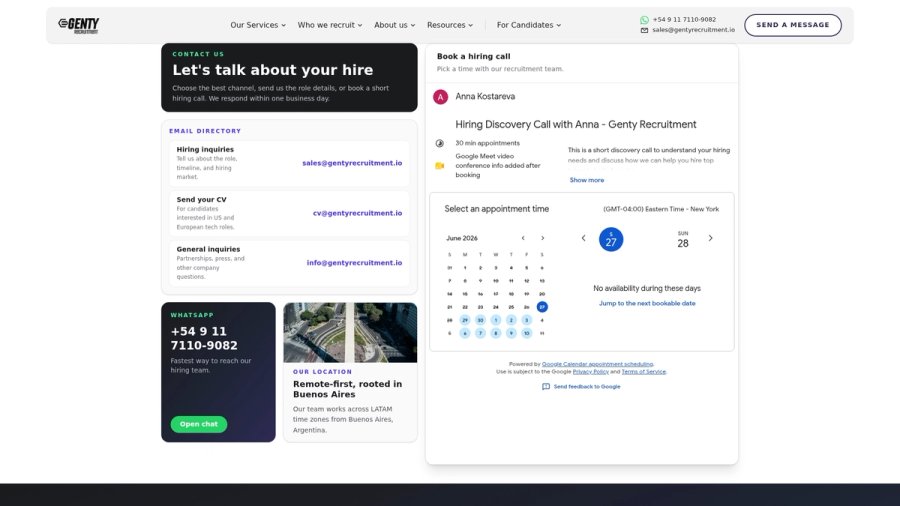
The model is straightforward. You submit a role brief, GENTY recruitment runs its skill-first vetting process across its LATAM network (Argentina, Brazil, Mexico, Colombia, and more), and you receive 3–5 candidates who have already cleared technical, communication, and timezone checks. Fixed fees per seniority level mean no surprise invoices, and the replacement guarantee means you’re not exposed if the first placement doesn’t work out.
For companies hiring across FinTech, AI, SaaS, or Web3, GENTY recruitment covers the full engineering stack: software engineers, DevOps, data specialists, QA, and fractional CTOs. Start your LATAM contractor search today, or browse the remote LATAM talent service to see how the process works before you commit.
This article provides general information about tech contractor hiring practices and is not legal or tax advice. Confirm classification rules and payroll obligations with a qualified US employment attorney before engaging contractors.
Useful sources
- IT Contractor Salary — ZipRecruiter: current US pay-band estimates for IT contractor roles by seniority.
- 10-step guide to becoming an IT contractor — ITContracting.com: practical breakdown of engagement models (1099, W-2, C2C) and tax implications.
- Why Latin America is the #1 region for remote tech hiring — GENTY recruitment: LATAM cost-savings data, timezone alignment, and English proficiency benchmarks.
- Candidate vetting: how to assess technical and soft skills — GENTY recruitment: skill-first vetting framework and scorecard templates for hiring managers.
- IT recruitment trends 2025 — GENTY recruitment: sourcing channel analysis and time-to-hire benchmarks for the current talent market.
- Hiring CTOs and tech leads in LATAM — GENTY recruitment: executive search guidance for senior contractor and fractional CTO placements.