

For US and European tech teams, the fastest path to vetted senior engineers in 2026 is a specialized nearshore staffing partner, not another job board. GENTY recruitment delivers a curated shortlist in 7 days, charges a fixed fee by seniority level with no upfront payment, and backs every placement with a 3-month replacement guarantee. To get your shortlist, book an introductory call or visit the IT recruitment page to see how the process works.
Why nearshore LATAM is the practical choice for US teams in 2026
The core argument is straightforward: Latin America gives US engineering teams synchronous collaboration, strong technical English, and material cost savings that far-offshore models cannot match simultaneously.
Most of LATAM operates between UTC-3 and UTC-6, which means engineers in Argentina, Colombia, Mexico, and Brazil share a full working day with US Eastern and Central teams, and useful morning overlap with US West Coast core hours. That synchronous window matters for sprint ceremonies, code reviews, and incident response in ways that async-only far-offshore arrangements rarely replicate.

On cost, companies hiring nearshore LATAM engineers report significant savings versus US fully loaded costs—with employer-facing data showing 40%–65% savings versus US fully loaded costs depending on the country and level. Payroll-derived data from Howdy indicates the average LATAM developer take-home is roughly $57,000 per year, with country means such as Brazil around $54,000, Mexico and Colombia about $57,000, and Argentina approximately $64,000; senior and staff-level bands reach $90,000–$105,000.
What do you need?
Choose the hiring path that fits
After reading "Remote Tech Hiring Tools 2026: Your LATAM Staffing Playbook", most teams compare these options before deciding how to hire.
Country strengths differ in ways that should drive your sourcing decision:
- Argentina: Strongest for AI/data engineering and English-facing roles; higher average compensation bands reflect the talent quality.
- Brazil: Deep backend and cloud talent pool; mean take-home is competitive; largest developer population in LATAM.
- Mexico: Strong full-stack and DevOps supply at scale; mean take-home is competitive; UTC-6 gives near-perfect EST overlap.
- Colombia: Growing DevOps and cloud-native community; mean take-home is competitive; Bogotá’s UTC-5 aligns well with EST.
Far-offshore (Eastern Europe, South/Southeast Asia) still makes sense for highly specialized niche roles where LATAM supply is thin, or when budget is the only constraint and async workflows are already mature. For most US product teams, those conditions are the exception.
Learn more about LATAM market strengths by country before finalizing your sourcing strategy.
What “remote tech hiring tools” actually means in 2026
In this article, the phrase refers to outsourced recruitment and staffing services for hiring pre-vetted LATAM engineers — not ATS platforms, job boards, or video interview SaaS. The distinction matters because the buying decision is different: you are selecting a partner, not a software subscription.
The main service models you will encounter, and what each one delivers:
- Fixed-fee recruitment: One-time placement fee per hire; partner delivers a vetted shortlist, manages interviews, and hands off the candidate. Best for defined headcount additions.
- Staffing/contracting: Monthly fee per engineer; partner handles payroll, benefits, and compliance. Best for project-based or flexible headcount.
- RPO (Recruitment Process Outsourcing): Partner embeds into your hiring pipeline and manages sourcing, screening, and coordination at volume. Best for teams hiring 5+ roles simultaneously.
- EOR/COR (Employer/Contractor of Record): Partner employs the engineer locally and invoices you monthly. Fastest legal path to a compliant hire with no local entity required.
- Executive search: Retained or contingency search for VP/Director-level technical leaders.
- Salary benchmarking: Standalone report using payroll-derived data to set offer ranges before you open a role.
Interfell’s hiring guide notes that agencies combining vetting, payroll, and replacement reduce hiring risk and free your engineering leads to focus on technical onboarding rather than recruiting logistics.
Pro Tip: Pick staffing/contracting when headcount needs may shift within 6 months; choose fixed-fee recruitment when the role is permanent and well-defined; use RPO only when you are scaling a team by more than 5 engineers in a single quarter.
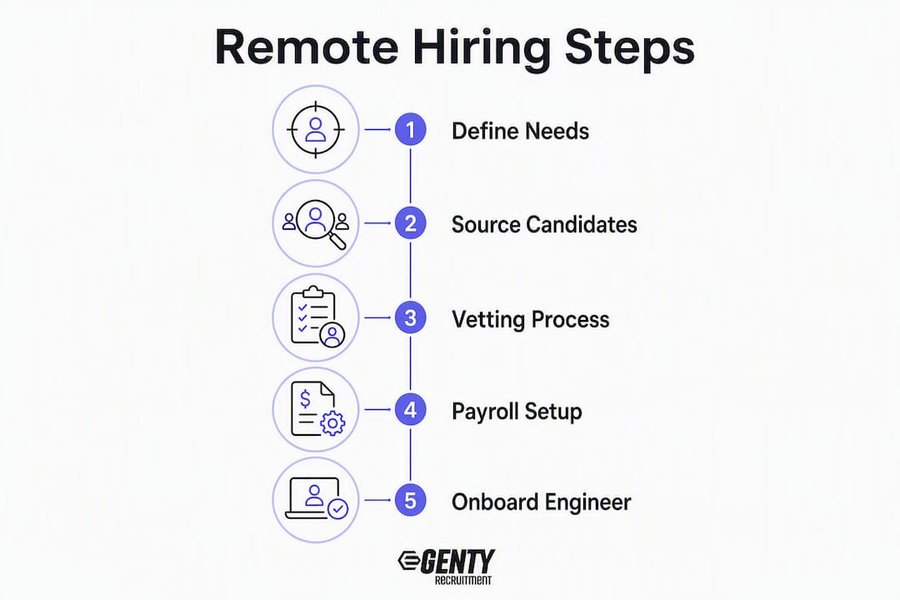
How do you choose the right LATAM recruitment partner?
Prioritize partners who can show you vetting samples, name their payroll/EOR model, and commit to a replacement SLA in writing before you sign anything.
Evaluation checklist
Use this list during your first vendor call:
- [ ] Can they share anonymized shortlist samples from similar roles?
- [ ] Do they run live technical pairing tests or role-specific exercises (not generic trivia)?
- [ ] Is English verified through structured conversation, not self-reported?
- [ ] Do they confirm timezone core-hours commitment in writing?
- [ ] Which payroll/EOR partner do they use, and what does it cover?
- [ ] Are IP assignment and NDA clauses standard in their contracts?
- [ ] Is pricing fixed per seniority level, with no hidden pass-through fees?
Questions to ask and what good answers look like
Red flags to avoid:
- No vetting samples or refusal to describe the technical assessment process
- Opaque pricing with percentage-of-salary fees buried in the contract
- No replacement guarantee, or a guarantee shorter than 90 days
- SLA commitments longer than 10 business days for a first shortlist
- Payroll handled informally without a named EOR/COR partner
Sourcing and vetting best practices from GENTY recruitment’s hiring guide cover additional screening criteria for specific roles.
What does hiring a LATAM engineer actually cost in 2026?
Payroll-derived figures are more reliable for budgeting than posted local job ranges, which consistently understate what US companies pay for cross-border remote talent. Budget to the international rate.
The average LATAM developer take-home is about $57,000 annually based on employer-facing payroll data, with national averages around $54,000 for Brazil, near $57,000 for Mexico and Colombia, and approximately $64,000 for Argentina. Senior engineers and staff reach take-home totals of $90,000–$105,000 depending on experience and role. Country-specific savings typically range from 40%–65% below the fully loaded US cost for comparable roles, which includes benefits, payroll taxes, and equity.
For roles requiring client-facing English or late-day US support, budget a premium on top of base LATAM bands to secure engineers with proven communication skills and timezone commitment.
Sample employer cost calculation: A senior Colombian engineer with senior-level take-home, placed through an EOR partner charging an employer fee, will generally cost about $57,000–$105,000 in annual take-home depending on level, plus a typical provider fee. This remains significantly less than US fully loaded equivalents, and the EOR handles local taxes, statutory benefits, and termination compliance.
Some bundled providers report that the majority of the invoice goes to compensation and benefits with a smaller portion covering the provider fee. Ask any partner to show you the fee breakdown explicitly before signing.
What does the hiring timeline look like from brief to first sprint?
A well-run LATAM staffing engagement moves faster than most CTOs expect. The typical sequence:
- Day 1–2: Submit a complete role brief (stack, seniority, timezone requirements, team context).
- Day 5–7: Receive a curated shortlist of 3–5 pre-vetted candidates.
- Day 8–14: Run technical interviews and a live pairing session in your stack.
- Day 15–18: Extend offer; partner manages acceptance and contract execution.
- Day 19–35: Notice period or start-date coordination; EOR/payroll onboarding completed.
- Day 36–42: Engineer joins first sprint.
Onboarding checklist for week one
- [ ] Repo and CI/CD access (Engineering Manager owns this by Day 1)
- [ ] Credentials and environment setup (DevOps lead, Day 1)
- [ ] Slack/communication channels added and introductions made (EM, Day 1)
- [ ] Timezone core hours confirmed in writing (EM + new hire, Day 1)
- [ ] Pairing sessions scheduled with a senior team member (EM, Days 1–5)
- [ ] 30-day performance metrics defined (EM + new hire, Day 2)
- [ ] First sprint ticket assigned at appropriate complexity (EM, Day 3)
Measuring early fit is straightforward: define 30-day output expectations in the brief, review them at the two-week mark, and flag any gaps to your staffing partner immediately. If the hire is not meeting expectations within the replacement window, a reputable partner activates the replacement process at no additional cost.
What are your legal and payroll options when hiring in LATAM?
EOR and COR models are the lowest-friction path for most US teams. Direct hire requires a local legal entity in each country, which adds months of setup and ongoing HR overhead that most growth-stage companies cannot justify for one or two engineers.
Model comparison:
- EOR (Employer of Record): Partner employs the engineer locally; you pay a monthly invoice. Covers local payroll taxes, statutory benefits (vacation, severance, health), and termination compliance. Fastest to engage, typically 1–2 weeks.
- COR (Contractor of Record): Similar to EOR but structured as a contractor relationship. Lower statutory benefit obligations in some countries; faster to terminate. Best for project-based or trial engagements.
- Direct hire (local entity): You employ the engineer directly through your own registered entity. Full control, lowest ongoing cost per head, but requires local legal setup and HR capacity.
Compliance checklist — confirm these with any partner before signing:
- [ ] Employment contract governed by local labor law (not just US law)
- [ ] Payroll cadence matches local statutory requirements
- [ ] Statutory benefits included (vacation, severance, health contributions)
- [ ] IP assignment clause in the employment or services agreement
- [ ] Local termination rules documented and understood
- [ ] NDA executed under applicable jurisdiction
Pro Tip: Consult legal counsel before making executive hires, granting equity to LATAM employees, or structuring arrangements with cross-jurisdictional tax exposure. EOR/COR covers standard employment compliance; it does not replace legal advice for complex structures.
This section is general operational guidance, not legal or tax advice. Confirm current rules with a qualified employment attorney or your EOR partner before hiring.
From brief to hire: a sample GENTY recruitment engagement
A US-based FinTech startup needed a senior backend engineer in Colombia with strong AWS and Python experience to join a two-person platform team. The brief reached GENTY recruitment on a Monday morning.
By Friday of the same week, the hiring manager had a shortlist of four pre-vetted candidates, each with verified English proficiency and confirmed EST overlap availability. Two candidates completed a live pairing session in the client’s stack the following Tuesday. An offer went out Wednesday. The engineer started 22 days after the initial brief.
Key metrics from that engagement:
- Time to shortlist: About one week
- Time to start: A few weeks from brief
- Replacement guarantee: Three months, in writing
- Sprint contribution: First production PR merged in second week
The role required client-facing English and late-afternoon EST availability, so GENTY recruitment applied a targeted search within Colombia’s Bogotá and Medellín engineering communities, where UTC-5 alignment and bilingual technical talent intersect. The engineer remained with the team beyond the replacement window, and the client subsequently opened two additional roles through the same process.
Key Takeaways
Nearshore LATAM staffing through a specialized partner is the fastest, most cost-effective way for US tech teams to add vetted senior engineers who work US hours in 2026.
What most CTOs get wrong about LATAM hiring
The most common mistake is treating LATAM nearshore hiring as a cost play and optimizing only on price. That framing leads to shortcuts: skipping live technical validation, accepting vague replacement terms, or choosing a partner based on the lowest fee rather than the quality of their vetting process.
The engineers who deliver real sprint velocity are not the cheapest candidates on a shortlist. They are the ones whose technical ownership, communication habits, and timezone discipline have been verified before the first interview. A partner who can show you a pairing-test framework, name their EOR provider, and put a 90-day replacement guarantee in writing is worth more than one who quotes 10% less and delivers a resume pile.
The significant savings versus US fully loaded costs are real and well-documented. But those savings only materialize when the hire sticks, contributes quickly, and does not require a replacement cycle that costs you two months of engineering manager time. The vetting process is where that outcome is determined, not the salary negotiation.
GENTY recruitment gets your next LATAM engineer on the shortlist in 7 days
US and European tech teams that need a vetted senior engineer working US hours, without a 3-month recruiting cycle, have a direct path through GENTY recruitment. The model is fixed-fee by seniority level, with no upfront payment and a 3-month replacement guarantee built into every engagement. GENTY recruitment covers software engineers, DevOps, data specialists, and sales roles across Argentina, Brazil, Mexico, Colombia, and Chile, with English verification and timezone commitment confirmed before any candidate reaches your shortlist.
Visit the IT recruitment page to see role-specific pricing and start a brief, or contact the team directly to request a custom salary benchmark for your target role and country. If you are evaluating staffing and EOR options alongside fixed-fee recruitment, the remote staffing and EOR page covers the full model comparison.
Useful sources for deeper benchmarking
The research behind this article draws on employer-facing payroll data and agency hiring guides. For your own due diligence:
- Howdy 2026 LATAM Developer Salary Report: Payroll-derived salary bands by country and seniority; the most reliable source for budgeting cross-border hires.
- Teclatam Compensation Data: Country-level compensation benchmarks; useful for validating offer ranges against market data.
- Interfell US Companies Hiring Guide: Practical guide covering service models, vetting practices, and compliance considerations for US companies.
- David Gomez 2026 Nearshore Playbook: Covers timezone overlap, technical validation methods, and cost-savings benchmarks for nearshore hiring.
- myGWork Diversity Hiring Tools Comparison 2026: Useful reference for hiring managers evaluating inclusive sourcing practices alongside LATAM recruitment criteria.