
The fastest, lowest-risk route to senior UX designers in Latin America are a fixed-fee vetted shortlist rather than open-market job posting. GENTY recruitment delivers pre-screened LATAM candidates within about a week, backed by a 3-month replacement guarantee. The rationale is straightforward: product-savvy designers, EST/PST-aligned schedules, and salaries far below US equivalents. Contact GENTY recruitment to request a shortlist and start interviews this week.
TL;DR:
Fixed-fee vetted shortlist services deliver LATAM UX designers within about a week, with a three-month replacement guarantee and no upfront payment.
LATAM designers often work in time zones overlapping with US teams, fluent in key tools like Figma, Miro, and Maze, and possess strong research and cross-functional skills.
Salary ranges across LATAM are below US equivalents, allowing companies to hire more senior talent for similar budgets while reducing compliance and hiring risks through EOR or contractor models.
Sourcing channels include remote job boards and marketplaces, but vetted staffing partners like GENTY ensure thorough screening of process, problem framing, and impact, reducing hiring mistakes.
Effective onboarding focuses on clear expectations, early metric tracking, and structured communication habits, ensuring high retention and successful remote team integration.
Why Hire UX Designers in Latin America Right Now?
Product teams that delay LATAM hiring are usually stuck defending headcount to finance, not sourcing candidates. The business case rests on four pillars.
Time zone overlap is the first. Designers in Argentina, Brazil, and Colombia work inside the same business hours as New York and Chicago, and Mexico aligns almost exactly with Pacific time. That means design reviews happen live instead of over 12 hour async delays, and a Friday afternoon blocker gets resolved before the weekend instead of Monday.
Cost is the second pillar, and it changes who you can hire, not just what you spend. A budget that covers one mid-level US designer often covers a senior LATAM designer plus a research contractor.
Before you start hiring
Check location, salary, and hiring fit
If you are moving from research to action, start with the market basics so your hiring plan is clearer.
The region’s design maturity closes the gap further. LATAM candidates typically arrive fluent in Figma, Miro, and Maze, already comfortable inside design systems used at fintech and SaaS companies.
- Full design-system fluency across Figma component libraries
- Async collaboration habits built for distributed teams
- Research-to-delivery ownership, not just visual execution
Statistic callout: Senior LATAM UX roles often carry salary ranges well below equivalent US positions, freeing budget to hire more senior talent for the same spend.
Where Do UX Design Talent Hubs Cluster in LATAM?
Not every country produces the same kind of designer, and matching the market to the role matters more than most hiring managers assume.
Argentina has the deepest bench of senior product researchers and strategists, largely a byproduct of a mature local tech scene serving fintech and SaaS clients across the Americas. Brazil produces designers comfortable working adjacent to engineering, useful when your product has complex data visualization or technical constraints. Mexico’s proximity to Pacific time makes it the default choice when your product team runs West Coast hours, and its talent pool skews toward eCommerce and consumer apps. Colombia has grown fastest in mid-level to senior generalist design, often at lower rates than Argentina or Brazil for comparable experience.
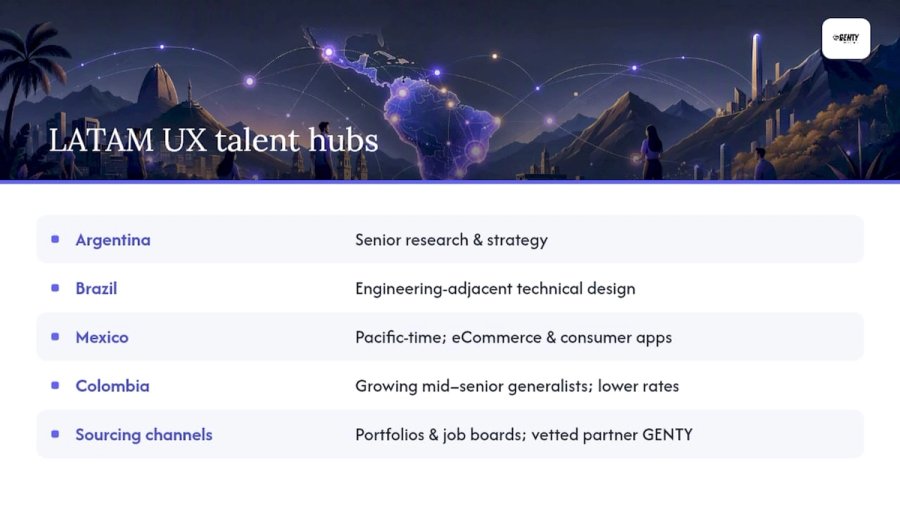
Sourcing channels matter as much as geography. Remote design job boards show consistent listing volume across all four countries, and marketplaces like Remote Rocketship confirm ongoing demand. Portfolio platforms like Dribbble and Behance surface individual talent, but vetted staffing partners like GENTY recruitment remove the screening burden entirely.
What Skills and Tools Should You Screen For?
Visual polish is the easiest thing to fake and the least reliable predictor of on-the-job performance. Screen instead for research depth, information architecture, interaction design judgment, accessibility awareness, and the ability to work cross-functionally with engineering and product.
Tool fluency should be a baseline check, not the interview centerpiece:
- Figma for interface design and component libraries
- Miro for workshops, journey mapping, and stakeholder alignment
- Maze or a comparable platform for usability testing and validation
- A prototyping tool suited to the product’s complexity (Figma prototyping, Principle, or ProtoPie)
Portfolios should show process, not just outcomes. Look for problem framing sections, research artifacts, and quantified impact. Senior LATAM designers frequently document measurable outcomes like conversion lift or adoption gains tied directly to design decisions, which is the clearest signal that a candidate ships results rather than just interfaces.
The biggest red flag is a portfolio built entirely of polished comps with no problem statement, no research, and no metrics. That pattern usually means the candidate executed someone else’s brief rather than owned the outcome.
Pro Tip: Ask every candidate to walk you through one project where the design changed direction mid-stream. How they explain the pivot reveals more about their UX ownership than any polished case study.
How Do You Evaluate Candidates From Screen to Offer?
A repeatable evaluation workflow beats gut-feel interviewing, especially when you are assessing candidates across four different countries and cultural contexts.
Portfolio scorecard — score each candidate 1 to 5 on five axes:
- Research depth (methods used, sample sizes, synthesis quality)
- Problem framing (did they define the right problem before solving it)
- UX flow quality (information architecture and interaction logic)
- Prototyping fidelity (appropriate to the product stage)
- Documented impact (metrics tied to design decisions)
Phone screen questions should focus on process: “Walk me through a time research changed your design direction” and “How do you handle disagreement with an engineering lead over feasibility.” A take-home task works best scoped to 4 to 8 hours: give a real (anonymized) product problem, ask for a flow plus a short rationale document, and evaluate on problem framing and tradeoff reasoning, not visual finish.
Final interviews should center on outcomes and collaboration: “Tell me about a metric you moved” and “Describe how you have handed off designs to a distributed engineering team.”
What Do Hiring Models and Salaries Actually Look Like?
Three hiring models cover almost every LATAM UX hire, and each carries a different risk and speed profile.
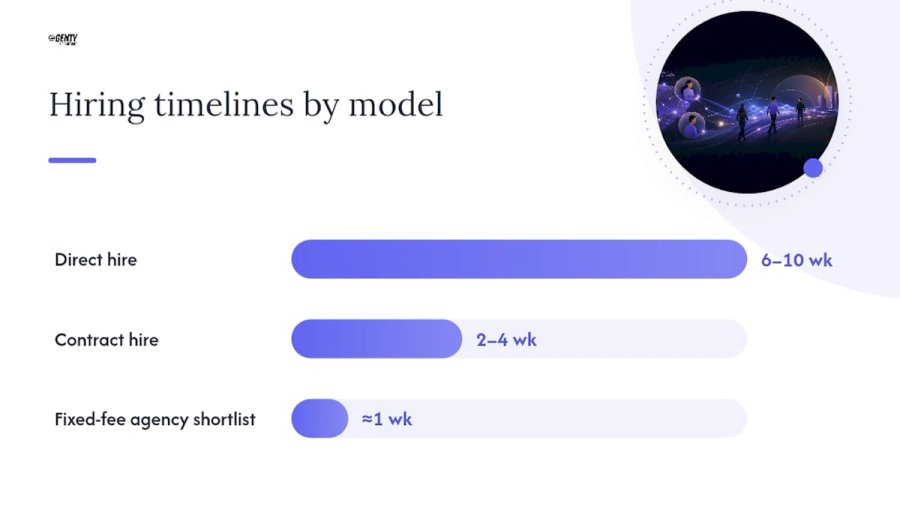
Direct hire gives you the most control but the slowest timeline, often 6 to 10 weeks once you account for sourcing, interviewing, and negotiation. Contract hiring moves faster, typically 2 to 4 weeks, but shifts compliance and payroll complexity onto you unless you use an employer-of-record. RPO (recruitment process outsourcing) fits companies with ongoing hiring volume rather than a single seat to fill, trading a monthly service fee for continuous pipeline coverage.
Statistic callout: Fixed-fee recruitment models commonly deliver vetted LATAM shortlists within a single week, compared to 6 to 10 weeks for a from-scratch direct-hire search.
Salary bands vary by seniority and country, but junior LATAM UX designers commonly land in a range of annual salaries below typical US equivalents, with mid-level and senior designers earning progressively higher, still often below US market rates, all reported in USD. That is frequently well below the total cost of an equivalent US hire once benefits and payroll taxes are included.
Common bottlenecks include candidate counteroffers at the client’s current employer, payroll setup delays for contract hires without an employer-of-record, and mismatched expectations around English proficiency. Fixed-fee pricing with a replacement guarantee absorbs most of that risk. If the hire doesn’t work out inside the guarantee window, you get a new candidate without paying twice.
How Do You Onboard a Remote LATAM UX Designer?
The first 90 days determine whether a good hire becomes a great one or a quiet flight risk.
30 days: set explicit expectations on deliverables, introduce the designer to product and engineering counterparts, and pair them on one small, well-scoped project to build early trust.
60 days: run their first solo design review with stakeholders, and start tracking whether their research and rationale hold up under cross-functional scrutiny.
90 days: evaluate a shipped feature they owned end-to-end, including the metrics tied to it, and formalize retention signals like engagement in team rituals and proactive communication.
- Fix a daily overlap window (even 2 hours) for live design reviews
- Standardize async handoffs through shared Figma libraries and Miro boards
- Track early retention signals: meeting participation, proactive updates, question quality
Pro Tip: Do not wait until day 90 to ask for a metric. Ask for one by day 45, even a small one. Designers who can’t yet point to an early signal often struggle with outcome ownership later.
What Legal and Compliance Steps Apply to LATAM UX Hires?
Hiring across borders introduces compliance questions that a standard US employment contract does not answer. Independent contractor agreements work for many LATAM UX hires, but misclassification risk is real if the designer works exclusively for you, follows your schedule, and uses your tools the way an employee would.
An employer-of-record (EOR) structure solves this for companies that want a formal employment relationship without registering a legal entity in Argentina, Brazil, Mexico, or Colombia. The EOR becomes the legal employer of record locally, handling payroll, statutory benefits, and termination procedures under that country’s labor code, while the designer works exclusively on your product.
Labor laws differ meaningfully by country. Brazil’s CLT framework mandates specific severance and benefit structures that catch unprepared US employers off guard. Argentina has strong worker protections around termination notice periods. Mexico and Colombia each carry their own statutory bonus and vacation requirements. None of this is optional paperwork. Getting it wrong creates real financial and legal exposure, not just an administrative headache.
Work permits are rarely the blocker people expect. Most LATAM UX designers work remotely as contractors or through an EOR, so the reader’s company does not need to sponsor a US work visa unless the role requires physical relocation. The more common oversight is IP assignment: confirm the contract explicitly assigns design work product to your company, since some countries’ default legal frameworks do not assume that transfer automatically.
How Do Cultural and Work-Style Differences Affect Management?
LATAM design culture tends to value relationship-building before task execution, which can read as slower ramp-up to US managers used to transactional first meetings. That perception is usually wrong. Designers who invest in understanding team dynamics early tend to produce better cross-functional work later, because they have built the trust needed to push back on flawed requirements.
Communication style differs too. Direct, blunt feedback common in US product teams can land harder than intended with some LATAM colleagues, particularly early in a working relationship. The fix is not to soften standards, but to pair direct feedback with context: explain the “why” behind a critique, not just the “what.”
Hierarchy expectations vary by country and company culture within LATAM itself, so avoid assuming uniformity across the region. Argentine and Brazilian tech culture, shaped by mature local startup ecosystems, often mirrors flat, feedback-forward US norms. Some Mexican and Colombian corporate environments retain more formal hierarchy, which can affect how comfortable a new hire is challenging a senior stakeholder in week one.
The practical fix is explicit permission-granting: tell new LATAM designers directly that you want pushback on flawed briefs, rather than assuming they’ll volunteer it. The distinction between UI execution and true UX ownership often surfaces exactly here, in whether a designer feels empowered to question the problem, not just solve the one handed to them.
What Are the Biggest Risks in Remote LATAM Hiring?
The most common failure mode is not a bad hire. It is a mismatched hire, someone with strong UI execution skills placed into a role that needs UX ownership and research judgment. Screening for process depth during interviews, not just visual portfolio quality, is the single best mitigation.
Retention risk is second. Counteroffers from a designer’s current employer can derail an otherwise strong hire late in the process. Moving fast on decisions, and being transparent about compensation early, reduces the window competitors have to intervene.
Communication drift is third. Without a fixed overlap window and clear async documentation habits, distributed design work quietly degrades into confusion over who owns which decision. Fixing this early, in the first 30 days of onboarding, prevents most of the friction that surfaces later.
Compliance risk rounds out the list. Misclassifying a full-time contractor, skipping IP assignment language, or ignoring a country’s statutory termination requirements creates exposure that outlasts any individual hire. Partnering with a recruiter who handles vetting, contracts, and replacement risk removes most of this burden from an internal hiring manager who is not a LATAM employment law specialist.
How Does GENTY recruitment Source and Vet UX Talent in LATAM?
GENTY recruitment runs a skill-first process built specifically for US and European tech companies hiring in Argentina, Brazil, Mexico, and Colombia. Clients receive a curated shortlist within 7 days, priced through transparent fixed fees by seniority level, with no upfront payment and a 3-month replacement guarantee if a hire doesn’t work out.
Choose GENTY recruitment over a direct-hire search when speed and risk mitigation matter more than owning every step of sourcing yourself. The process runs in three stages: a scoping call to define the role and seniority, a shortlist of pre-vetted candidates within a week, and support through interviews to final placement. Every candidate is screened for portfolio process depth, tool fluency, and cross-functional communication before a client ever sees the profile.
— Eugene
Ready to Build Your LATAM UX Design Team?
GENTY recruitment is the direct alternative to running a UX search yourself or gambling on an unvetted freelance marketplace. Instead of weeks screening portfolios and negotiating rates one candidate at a time, you get a fixed-fee shortlist of pre-vetted designers from Argentina, Brazil, Mexico, and Colombia within 7 days, with no upfront payment and a 3-month replacement guarantee if the fit isn’t right.
That structure matters most for teams that don’t have a dedicated LATAM recruiter on staff and can’t afford a bad hire eating a full quarter of product roadmap. GENTY recruitment’s IT recruitment service covers UX designers alongside engineering and data roles, so companies scaling a full product team can staff multiple functions through one process instead of juggling separate vendors. For teams specifically hiring UX talent, the dedicated UX designer hiring page breaks down role-specific screening criteria and typical placement timelines.
If your hiring need runs beyond a single seat, the RPO service builds continuous pipeline coverage instead of one-off searches. Request a shortlist today and have qualified LATAM UX candidates in front of your team within a week.