
Junior LATAM SDRs typically earn between about $1,300 and $1,700 per month, mid-level reps earn between about $1,700 and $2,600 monthly, and senior SDRs command monthly pay in the several-thousands dollar range. Those figures reflect all-in cost, not just base pay. Against a comparable U.S. SDR at $60,000 to $75,000 base plus payroll tax and benefits, LATAM hiring cuts total cost by a substantial margin, according to GENTY recruitment’s 2026 salary dataset.
TL;DR:
LATAM SDR salaries range from $1,300 to $4,600 per month all-in, with mid-level roles typically earning $1,700 to $2,600 monthly.
Hiring costs in LATAM are significantly lower than the U.S., with total first-year expenses for a mid-level SDR around $24,000 to $35,000.
Currency stability and timezone overlap are critical factors, making USD contracts and markets like Mexico, Brazil, and Colombia preferable.
Statutory contributions, payroll fees, recruiting costs, and setup expenses are key components that influence the true hiring cost, often overlooked.
The ideal pay plan for LATAM SDRs includes a larger base (60-80%) and a realistic ramp period exceeding 24 months, with early coaching in U.S. hours boosting tenure.
LATAM SDR Salaries at a Glance: Annual and Monthly USD
Budgeting for a LATAM sales development hire starts with knowing whether a quoted number is base salary or the fully loaded cost. Most credible benchmarks now report all-in figures, meaning the number already includes statutory contributions, benefits, and management overhead the employer of record charges. That distinction matters because two sources quoting “$1,800/month” for the same seniority tier can mean very different things if one is base-only.
The ranges below are all-in, pulled from Howdy’s 2026 LATAM SDR benchmark data and cross-checked against GENTY recruitment’s internal dataset covering 40+ roles across 11 LATAM countries.
A separate data pull from a LinkedIn compensation summary puts the LATAM SDR “sweet spot” at $2,500 to $3,100 monthly, a band that sits inside the mid-to-senior range above and correlates with average tenure exceeding 24 months in that sample. Data current as of 2026.
What do you need?
Choose the hiring path that fits
After reading "LATAM SDR Salaries for US Managers: Budget $24,000–$35,000 Year One", most teams compare these options before deciding how to hire.
How Do SDR Salaries Compare Across Argentina, Brazil, Mexico, and Colombia?
Country choice moves the number more than most hiring managers expect, and currency stability matters almost as much as the raw figure. A junior SDR in Buenos Aires and a junior SDR in Mexico City can carry near-identical monthly pay quoted in USD, yet the local-currency experience for each employee looks nothing alike once inflation enters the picture.
- Argentina: Junior SDRs run $1,300–$1,600/month; mid-level $1,700–$2,400/month; senior $3,000–$4,200/month. Argentina has deep sales talent supply and strong English proficiency in Buenos Aires and Córdoba, but peso inflation makes USD-denominated contracts close to mandatory, not optional. Paying in local currency without indexing invites turnover within two quarters.
- Brazil: Junior $1,400–$1,800/month; mid $1,900–$2,700/month; senior $3,400–$4,600/month. Brazil’s SDR market is the most competitive in the region for SaaS and FinTech roles, driven by a large domestic tech sector that bids up local demand. Retention tends to be strong when compensation stays USD-pegged.
- Mexico: Junior $1,300–$1,700/month; mid $1,800–$2,600/month; senior $3,200–$4,400/month. Mexico offers the tightest timezone alignment with U.S. Central and Mountain hours, which shows up in faster response times on inbound leads. Peso volatility is milder than Argentina’s, but USD contracts still reduce budget surprises.
- Colombia: Junior $1,200–$1,600/month; mid $1,700–$2,400/month; senior $3,000–$4,100/month. Colombia has emerged as a lower-cost alternative with growing supply out of Bogotá and Medellín, and reports some of the best retention signals in the region for entry-to-mid tiers.
Quoting every offer in USD rather than local currency removes the guesswork of tracking peso or real depreciation month over month, and it’s now standard practice among agencies serving U.S. companies. Brazil and Mexico show the tightest talent supply at the senior tier right now, while Colombia offers the most room to negotiate on junior and mid-level hires.
What Makes Up the All-In Cost of Hiring a LATAM SDR?
The gap comes from four recurring cost categories that a rushed budget conversation tends to skip.
- Statutory contributions and benefits. Every LATAM country mandates employer contributions to social security, severance funds, or health coverage, and these vary by country rather than following one flat rate.
- Employer of record (EOR) or payroll fees. Using an EOR to hire without a local entity typically adds a percentage on top of base salary and benefits to cover compliance and payroll processing. Treat any quoted EOR fee percentage as illustrative until the provider puts it in writing.
- Recruiting or placement fees. Some vendors charge a percentage of first-year salary; others use fixed-fee pricing per seniority level, which is easier to budget against because it doesn’t fluctuate with the offer you make. GENTY recruitment’s SDR hiring service uses fixed fees starting at $2,900 specifically to remove that variability.
- Tooling and setup. Laptop stipends, CRM seats, dialer licenses, and home-office allowances add a modest recurring cost that’s easy to forget until the first invoice arrives.
Pro Tip: Ask any EOR or payroll provider for a line-item breakdown before signing, not a bundled “all-in rate.” A vendor that can’t itemize statutory contributions separately from their own margin usually can’t tell you when local labor law changes affect your cost.
Before signing with any EOR or staffing partner, request: the exact statutory contribution rate by country, whether health benefits are mandatory or optional, the fee structure (flat vs. percentage), and a written policy on severance obligations if the role doesn’t work out.
Building a Competitive Pay Plan: Base, OTE, and Ramp Commissions
The base-to-on-target-earnings split for LATAM SDRs runs differently than it does for the U.S. because the absolute dollar gap between base and commission carries more weight psychologically at lower total compensation.
- Junior SDRs: 75-80% base, 20-25% variable. A large commission swing on a $17,000 salary feels destabilizing rather than motivating.
- Mid-level SDRs: 65-70% base, 30-35% variable. This is where most LATAM SDR pay plans should land once quota attainment history exists.
- Senior SDRs: 60% base, 40% variable, since experienced reps can absorb more commission risk and often expect it as a sign the role has real upside.
The most common mistake is setting full quota from day one, which manufactures an early failure the rep didn’t cause. A close second: paying commission only on closed-won revenue for an SDR role, when the job is booking qualified meetings, not closing deals. Commission structures should track the metric the SDR actually controls, whether that’s meetings held or opportunities created.
How Long Does It Take a LATAM SDR to Ramp, and What’s Normal Tenure?
Average tenure for LATAM SDRs in the reported “sweet spot” pay band ($2,500 to $3,100 monthly) exceeds 24 months, well above typical SDR tenure benchmarks in most U.S. sales orgs, where 12 to 18 months is common before promotion or attrition.
Three factors consistently extend tenure: clear promotion paths into account executive or team lead roles, compensation that sits inside or above the market band for the country, and early pairing with a U.S.-based AE for live call shadowing. Because most LATAM markets overlap substantially with U.S. Eastern and Central business hours, new SDRs can shadow live calls and get same-day coaching instead of waiting on asynchronous feedback, which shortens ramp meaningfully compared to hiring across a 10 to 12 hour time difference.
LATAM vs. U.S. SDR: A Side-by-Side Budget Example
Numbers convince budget committees faster than narrative arguments, so here’s a worked comparison for a mid-level SDR hire, built on the ranges established earlier and standard U.S. payroll burden assumptions (employer payroll tax, benefits, and typical U.S. recruiting fees).
Assumptions: the LATAM figure uses a fixed-fee recruiting model rather than percentage-based agency pricing; U.S. figures assume a mid-size company without in-house recruiting capacity; tooling costs are comparable across both hires and don’t meaningfully affect the gap. The savings show up almost entirely in base compensation and recruiting structure, not in some hidden discount on quality. Adjust the U.S. side downward if your company recruits SDRs internally without agency fees, and the LATAM side upward slightly if you’re hiring senior talent in Brazil’s more competitive market.
What GENTY recruitment’s Salary Data Reveals About Hiring LATAM SDRs
GENTY recruitment built its salary benchmarks from a dataset spanning 40+ roles and 11 LATAM countries, and the practical use of that data isn’t just publishing ranges. It’s setting realistic offer bands before a shortlist ever goes out, so hiring managers stop losing candidates to counteroffers they didn’t see coming.
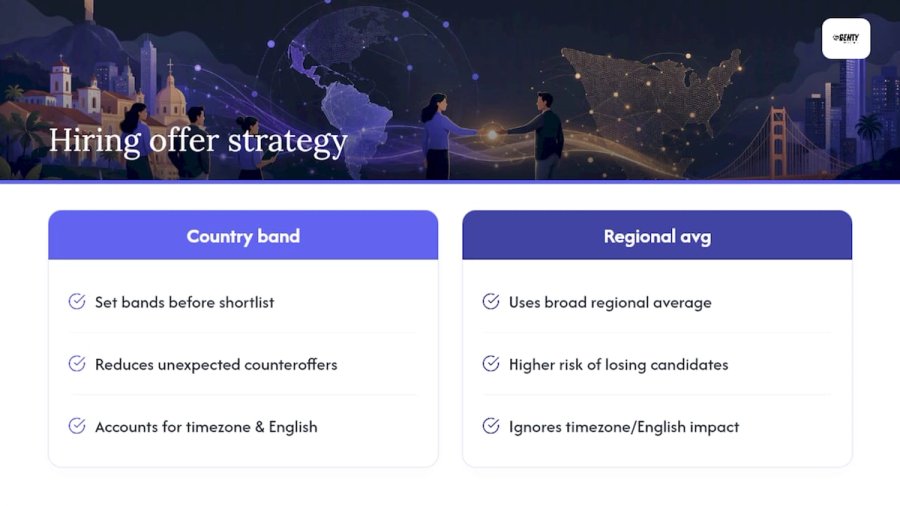
Timezone overlap and English proficiency do more work in candidate fit than most job descriptions acknowledge. A candidate in Mexico City who can shadow a 9am Eastern call and communicate fluently with a U.S. sales floor ramps faster than an equally talented rep working eight time zones away with translation friction. Prioritizing countries with strong English training pipelines and real-time overlap can shave several weeks off ramp time compared to markets with weaker English penetration.
Two takeaways for hiring managers: pay inside the country-specific band, not the regional average, and treat timezone overlap as a productivity variable, not a nice-to-have.
— Eugene
Hire LATAM SDRs Without the Guesswork on Cost or Timeline
GENTY recruitment turns these benchmarks into hires, not just spreadsheets. The service delivers curated candidate shortlists within 5 days, prices every seniority level with a fixed fee instead of a percentage of salary, and backs every placement with a 3-month replacement guarantee if the fit isn’t right.
Internal hiring makes sense when you already have a have a LATAM-based recruiter and legal entity in place. It stops making sense once you’re spending weeks sourcing candidates across three countries, negotiating with local payroll providers, or trying to figure out why a Brazilian offer keeps falling through on comp expectations. That’s the gap GENTY recruitment closes.
For sales teams specifically, the SDR hiring service starts at $2,900 per placement, with broader benchmarks available through the sales and marketing salary dataset for teams building out full pods. Companies hiring into regulated industries can also check FinTech-specific recruitment for candidates already fluent in compliance-heavy sales motions. Start with a contact request and get a shortlist moving this week instead of next quarter.