

Yes, you can hire production-grade Web3 talent in Latin America, and the two advantages that matter most are timezone overlap with US business hours and meaningful cost savings versus American salaries. Start by building a skill-first sourcing funnel across Argentina, Brazil, Mexico, and Colombia, or brief a specialist recruiter like GENTY recruitment to compress the process into a shorter timeframe.
TL;DR:
Latin American Web3 talent benefits from extensive hands-on experience through real projects like DeFi and digital currency pilots, ensuring practical skills.
Sourcing is most effective through global platforms and community channels, with technical verification like live contract deployment overshadowing resume claims.
Salary ranges are generally below US levels, with Argentina posting $70,000 to $100,000 for senior roles, and Brazil around $98,000 to $105,000, depending on employment type.
Proper legal and compliance structures, such as Employer of Record arrangements, are essential to mitigate risks associated with local labor laws and crypto compensation gray zones.
Speed in screening and decision-making is critical, as top candidates often receive multiple offers within days, making a skill-first, verified approach more successful than prolonged traditional processes.
Why Latin America Is a Strong Source of Web3 Talent
Latin America built its Web3 talent pool the hard way: through actual usage. Argentina’s inflation crises pushed everyday people into stablecoins years before most US developers had touched a wallet, and that lived experience with crypto rails shows up in engineering resumes. Brazil and Mexico have both run central bank digital currency pilots and payment integrations that gave local engineers hands on exposure to compliance and banking rails most US-based candidates only read about.
Job boards confirm the depth of this market. SailOnchain listed 82 open Web3 positions across Latin America in a single month, spanning exchanges, protocols, and early-stage startups. That volume signals a market with active hiring, not a talent desert.
- Argentina and Brazil host live DeFi and payments projects, giving engineers production experience
- Time zones from UTC-3 to UTC-6 overlap heavily with US Eastern and Central business hours
- Mexico and Colombia are producing growing pools of security and infrastructure specialists
- Remote-friendly postings across multiple boards confirm employers already hire LATAM-based teams
Where to Find Web3 Candidates Across LATAM
Sourcing Web3 talent in Latin America means combining global aggregators with local signals that most recruiters skip. GitHub commit history and verified contract deployments on Etherscan or Polygonscan tell you more about a candidate’s real skill than any resume line.
Before you start hiring
Check location, salary, and hiring fit
If you are moving from research to action, start with the market basics so your hiring plan is clearer.
- Search global aggregators with location filters. Web3 show real salary bands by city, useful for benchmarking before you post. CryptocurrencyJobs also tags remote-from-LATAM roles across engineering, product, and operations.
- Scout GitHub and deployed contracts. Look for public repos tied to a real project, then check whether the contract address the candidate lists is actually live on-chain.
- Tap community channels. Discord servers for specific protocols, Telegram groups tied to local blockchain meetups, and bootcamps like ETH Kipu in Argentina all surface active contributors before they hit job boards.
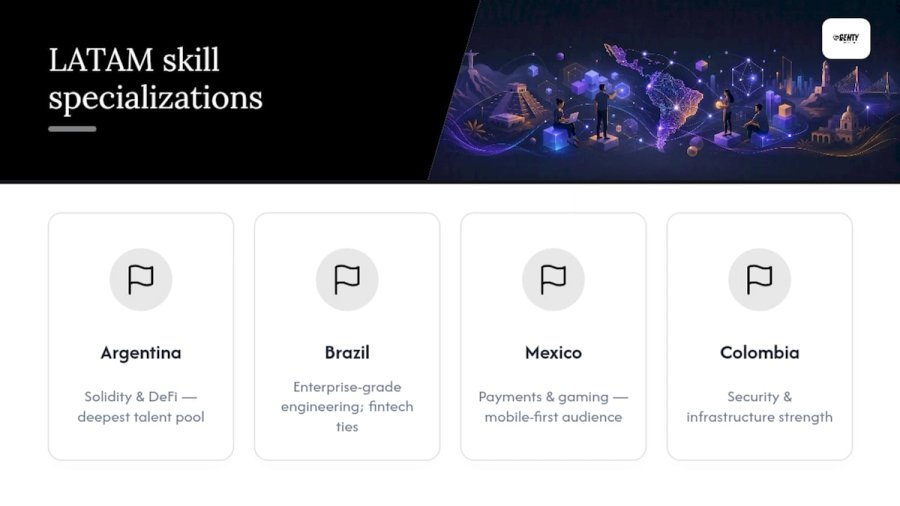
- Match country to specialty. Argentina skews toward Solidity and DeFi protocol work, Brazil toward enterprise-scale engineering teams, Mexico toward payments and gaming integrations, and Colombia toward security and infrastructure roles.
Web3 Skills, Roles, and Tech Stack to Assess
Job titles in Web3 hiring blur together fast, so define the role by stack before you post it. A smart contract engineer, a protocol backend engineer, and a full-stack Web3 developer need overlapping but distinct skill sets, and testing the wrong one wastes weeks.
- Smart contract engineers need fluency in Solidity, testing frameworks like Hardhat, Foundry, or Truffle, and comfort reading gas cost reports
- Protocol and backend engineers often work in Rust, especially for Solana-based projects, alongside standard backend languages
- Security and audit specialists should be able to walk through a real vulnerability class, not just recite OWASP-style checklists
- Full-stack Web3 developers need both a working knowledge of Ethereum or Polygon tooling and standard frontend frameworks
Portfolio signals worth checking include live contract addresses on a block explorer, published audit reports, and any writeup that shows gas optimization work with before-and-after numbers.
Pro Tip: Ask candidates to walk you through one specific exploit or bug they caught before deployment. Anyone can describe a smart contract in theory. Only someone who has shipped one can describe the moment they almost broke it.
Web3 Salary Ranges: Latin America vs. the United States
Budgeting a Web3 hire starts with knowing what the market actually pays, not what a generic salary calculator estimates. Listings on web3.career show a Forward Deployed Engineer role in Buenos Aires posted between $70,000 and $100,000, while a Senior Backend Engineer role in Brazil landed between $98,000 and $105,000. Both sit well below comparable US postings for the same seniority level.
Pay varies by country and by employment model. Contractor arrangements in Argentina often run lower than full-time offers in Brazil, where labor costs and local demand have climbed faster. Reserve premium packages, relocation stipends, or equity grants for senior protocol engineers and security leads, since that tier faces the most competition regionally. Compare your own targets against a detailed software developer salary benchmark for Latin America before finalizing a range.
How to Vet Web3 Candidates Before You Interview
Résumés lie more easily in Web3 than in almost any other engineering discipline, because “worked on a DeFi protocol” can mean anything from writing the core contract to fixing a typo in the documentation. Verification has to happen before the interview, not during it.
- Confirm the candidate can point to a deployed, verified contract on Etherscan or Polygonscan tied to their name or wallet
- Assign a 24 to 48 hour take-home task that requires measurable unit tests and a written gas-cost discussion
- Ask the candidate to describe a specific vulnerability they caught or fixed, not a general security philosophy
- Run a reference check focused on how the candidate handled a production incident, not just team fit
Skip the generic behavioral questions built for SaaS hiring. Ask instead how a candidate would explain a smart contract upgrade path to a non-technical founder, since decentralized products require translating complexity constantly.
Onboarding, Payroll, and Compliance for LATAM Web3 Hires
Employment structure determines how much friction you hit after the offer is signed. Full-time hires, independent contractors, staff augmentation, and Employer of Record (EOR) arrangements each carry different compliance obligations across Argentina, Brazil, Mexico, and Colombia.
- EORs handle local payroll, tax withholding, and labor law compliance without requiring you to open a legal entity
- CryptoJobsList notes that EORs are a standard operational solution for cross-border Web3 employment, precisely because misclassifying a contractor as an employee creates real legal exposure
- Payment can run in local currency or USD, and some Web3 companies pay part of compensation in stablecoins, which candidates should agree to explicitly before the offer stage
- Build a first-week onboarding checklist that confirms working hours overlap, tooling access, and a named point of contact in the candidate’s own timezone
Pro Tip: Never let a contractor agreement substitute for proper local compliance just because the candidate is remote. A misclassified worker in Brazil or Colombia can trigger back-pay and penalty claims that cost far more than the EOR fee would have.
A 30-Day Plan for Hiring Web3 Talent in LATAM
Most hiring delays come from vague role definitions, not a shortage of candidates. A tight 30-day plan keeps momentum from job posting to signed offer.
- Week 1: Define the role precisely by tech stack and seniority, write a skill-first job description, and open your first sourcing channels.
- Week 2: Build a shortlist from job boards, GitHub activity, and community referrals, aiming for 8 to 12 qualified candidates.
- Week 3: Run technical assessments, including a take-home task and a live vulnerability walkthrough, then interview your top 4 to 6 candidates.
- Week 4: Extend an offer, set up EOR or payroll compliance, and complete onboarding with a timezone-aligned first week.
Teams that skip straight to interviews without a defined skill matrix routinely lose three to four weeks re-scoping the role mid-process. The plan above front-loads that decision instead.
Legal Frameworks and Labor Laws for Web3 Roles by Country
Labor law in Latin America was not written with Web3 in mind, and that gap creates real risk for hiring managers who assume a contractor agreement covers everything. Argentina’s labor code presumes an employment relationship once a contractor works exclusively for one company on a fixed schedule, regardless of what the contract calls the arrangement. Misclassify that relationship and you face back-pay, severance, and social security claims.
Brazil applies some of the strictest worker protections in the region under its Consolidação das Leis do Trabalho. Even remote contractors can be reclassified as employees if a labor court finds subordination, meaning fixed hours, exclusive availability, and direct supervision. Companies hiring Brazilian Web3 engineers without a local entity or EOR routinely underestimate this exposure.
Mexico’s 2021 outsourcing reform restricted subcontracting arrangements significantly, pushing most compliant hiring toward direct employment or properly structured EOR relationships. Colombia sits somewhere in between, with labor authorities focused on whether the working relationship shows genuine independence or disguised employment.
None of these frameworks address crypto compensation directly, so paying part of a salary in stablecoins or tokens sits in a legal gray zone in every country listed here. Treat that as a negotiation detail requiring local legal counsel, not a standard payroll line item. The safest path in every one of these markets is a properly structured EOR or local entity, not a contractor agreement stretched to cover what is functionally full-time employment.
Demand Trends for Web3 Talent Across LATAM Markets
Demand for Web3 talent in Latin America has shifted from speculative hiring toward production-grade engineering roles. Job aggregators now show consistent listings for backend engineers, protocol specialists, and security auditors rather than the marketing and community roles that dominated earlier hiring cycles. CryptocurrencyJobs’ LATAM listings span operations, compliance, and product roles alongside engineering, a signal that companies are staffing full teams regionally rather than hiring one remote developer to supplement a US team.
Argentina remains the region’s deepest pool for Solidity and DeFi-specific talent, driven partly by the country’s high personal exposure to crypto as an inflation hedge. Brazil’s market has scaled toward enterprise-grade engineering, reflecting the country’s larger domestic tech sector and growing fintech integration with blockchain rails. Mexico has carved out a niche in payments and gaming applications, tied to remittance flows and a large mobile-first gaming audience. Colombia has built strength in security and infrastructure roles, an area many companies underweight until an incident forces the issue.
Competition for senior talent has intensified as more US and European companies discover the region simultaneously. Active hiring volumes on aggregators like SailOnchain mean the best security auditors and protocol engineers often field multiple offers within days of going active on the market. Speed of process, not just salary, increasingly decides who wins a senior candidate. Companies still running a six-week interview loop lose top candidates to competitors who can close in two.
Non-technical Web3 roles are also growing faster than most hiring plans account for, including compliance specialists who understand both crypto regulation and traditional financial law, and product managers who can translate decentralized protocol mechanics for non-technical stakeholders.
Common Pitfalls When Hiring Web3 Talent in LATAM
Most failed Web3 hires in Latin America trace back to one of a handful of repeatable mistakes, not bad luck. Recognizing them before you start sourcing saves weeks.
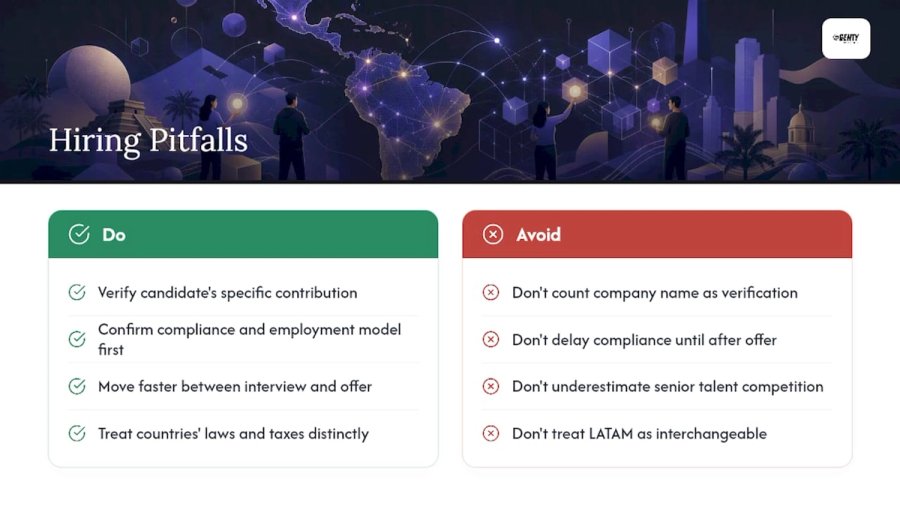
Treating “worked in crypto” as a skill verification. A candidate can genuinely have worked at a crypto company without ever writing production Solidity code. Verify the specific contribution, not the company name on the resume.
Skipping the compliance step until after the offer. Companies routinely extend an offer, then scramble to figure out payroll and legal structure in Brazil or Argentina afterward. That order should reverse. Confirm your employment model and compliance path before you make an offer, not after.
Underestimating competition for senior talent. Because demand signals show intense hiring volume across the region, a slow interview process loses strong candidates to companies that move faster. A two week gap between first interview and offer is often enough to lose a top security auditor.
Assuming remote means interchangeable. Argentina, Brazil, Mexico, and Colombia have distinct labor laws, tax structures, and even distinct technical specialties. Treating the whole region as one undifferentiated pool leads to mismatched role expectations and compliance mistakes.
Ignoring cultural communication style. LATAM engineering teams often favor direct, relationship-based communication over the terse async-only style common in some US engineering cultures. Managers who skip regular video check-ins in favor of pure Slack threads sometimes misread engagement levels entirely.
Overlooking currency and payment friction. Paying in local currency without adjusting for inflation, particularly in Argentina, can erode real compensation value within months even when the nominal salary stays fixed.
Retention and Career Growth for Web3 Talent in LATAM
Hiring is only half the equation. Retaining strong Web3 engineers in Latin America requires understanding what actually drives them to stay, and it is rarely just salary. Career growth paths matter enormously in a field where the technology itself changes every 12 to 18 months.
Give engineers visible paths toward protocol-level ownership rather than keeping them permanently on implementation tasks. A smart contract engineer who spends two years only writing tests for someone else’s architecture will eventually leave for a role that lets them design systems. Structured mentorship from senior protocol architects, even informal ones, measurably improves retention because Web3 skills are still scarce enough that engineers value learning opportunities as much as compensation.
Compensation reviews need to happen more frequently than the standard annual cycle in traditional tech hiring. Web3 salary benchmarks shift quickly as demand fluctuates with market cycles, and an engineer who discovers they are 20% underpaid relative to current market rates will start interviewing elsewhere within weeks.
Equity and token-based incentives, when structured clearly and compliantly, tend to matter more in Web3 than in traditional SaaS hiring, since many candidates entered the space specifically because they believe in the upside of decentralized systems. Vague or poorly communicated equity terms create more attrition risk than an average salary alone.
Finally, invest in language and cultural fluency in both directions. Teams that pair LATAM engineers with US counterparts for pairing sessions, not just standups, build stronger long-term working relationships than teams that treat remote hires as execution-only resources.
What Most Hiring Guides Get Wrong About This Market
Most advice on hiring Web3 talent in Latin America treats the region as a single cost-arbitrage play: cheaper engineers, same output. That framing misses what actually makes LATAM valuable for Web3 specifically. Regional crypto adoption, not just lower salaries, produced engineers who understand production constraints, regulatory friction, and real user behavior around volatile currencies in ways many US-trained developers simply have not encountered firsthand.
The bigger blind spot is speed. Companies spend weeks perfecting a job description while the strongest candidates in Buenos Aires or São Paulo field three competing offers. GENTY recruitment’s own placements show that a skill-first process, built around verified technical proof rather than resume keywords, consistently outperforms generic hiring funnels precisely because it removes the weeks of back-and-forth that let good candidates disappear.
There is also a persistent myth that remote-first hiring eliminates the need for local expertise. It does not. Labor law differences between Argentina and Brazil alone are significant enough that a compliance mistake in one country can cost far more than any salary savings achieved by skipping proper structuring. Companies that treat GENTY recruitment or a similar specialist as the fast path for senior or time-sensitive Web3 roles, while handling straightforward junior hires internally, tend to get the best of both speed and cost control.
— Eugene
Hire Vetted Web3 Talent in Latin America With GENTY recruitment
GENTY recruitment gives hiring managers a faster route to production-ready Web3 talent than building a sourcing funnel from scratch. Instead of spending weeks screening resumes and verifying contract deployments yourself, GENTY recruitment delivers a curated shortlist of pre-vetted candidates within 7 days, backed by a fixed-fee pricing model per seniority level and a 3-month replacement guarantee if a placement does not work out.
This fits companies hiring smart contract engineers, protocol specialists, or security auditors on tight timelines, where losing two weeks to a slow interview process often means losing the candidate entirely. GENTY recruitment’s Web3 recruitment service covers Argentina, Brazil, Mexico, and Colombia, with candidates already screened for technical depth and English proficiency.
If your team needs a senior Web3 hire this quarter, not next, start by reviewing GENTY recruitment’s IT recruitment services and request a shortlist built around your specific role requirements.
Sources
- Crypto Jobs in Latin America - 82+ Web3 Positions (2026) | SailOnchain
- Web3
- Web3 & Crypto Jobs in Latin America - $100k-$200k/year | CryptoJobsList
- Cryptocurrency Jobs in Latin America