

Latin America is one of the strongest places to hire Web3 engineers, protocol developers and crypto-native sales talent, because the region’s engineers build on real, high-volume crypto usage and work in US-compatible hours. Argentina, Brazil, Mexico and Colombia each offer a different mix of skills and cost. The hiring teams that succeed match the role to the country, vet for on-chain work instead of résumés, and set up compensation and contracts before the first interview. GENTY recruitment places pre-vetted LATAM talent for Web3 companies on a fixed fee, so you can compare that route with an in-house search from the first step.
This guide is for CTOs, VPs of Engineering and founders at US and European teams. It covers where the talent is, what each market tends to pay, how timezone overlap works, how to vet Web3 candidates, and how to structure the hire.
TL;DR
- Latin America is a top region for crypto usage, and Argentina, Mexico and Colombia sit in the region’s top five by transaction volume, so the talent builds for live users, not only testnets.
- Argentina and Brazil are the deepest pools for senior smart contract, backend and protocol engineers. Mexico and Colombia are strong for full-stack, product and growth roles.
- Most hubs run between UTC-6 and UTC-3, which means a full or near-full workday overlap with US Eastern and a solid half-day or more with Pacific.
- Vet on shipped code, contract audits and security reasoning. Decide pay structure (USD, stablecoin, token) and the legal employment model before you open the role.
- GENTY recruitment delivers curated shortlists within 7 days, from $2,999 per hire, with no upfront payment and a 3-month replacement guarantee.
Why Latin America produces Web3 talent
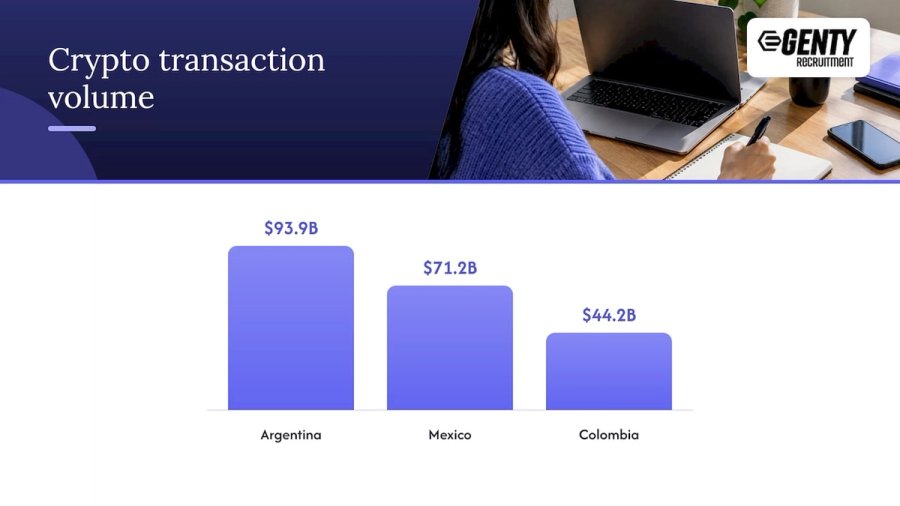
Web3 skills grow where crypto is used daily. Chainalysis’s 2025 regional analysis ranks Argentina second in Latin America with $93.9 billion in transaction volume, followed by Mexico at $71.2 billion and Colombia at $44.2 billion, and it reports that officials put stablecoins at over 90% of Brazilian crypto flows. Engineers in these countries work on payments, remittances, on-ramps and stablecoin settlement because their local economies need them, not because a hype cycle told them to.
That usage has produced a local ecosystem of exchanges and wallets, including Mercado Bitcoin in Brazil, Ripio and SatoshiTango in Argentina, Bitso in Mexico and Wenia in Colombia, all named in the same Chainalysis analysis. These companies are training grounds. A backend engineer who has worked on fiat on-ramps, KYC flows and transaction reporting understands the unglamorous infrastructure that most Web3 products depend on.
Need help hiring?
See the next step after this guide
If this topic is relevant to your team, these are the most useful pages to check next.
Regulation is part of the story too. Chainalysis notes that Brazil has put meaningful crypto rules in place, including its 2022/2023 Virtual Assets Law, which set KYC and transaction reporting requirements and made the central bank the AML authority. Engineers who have shipped under that regime bring compliance awareness that is valuable for any team selling to US or European institutions.
Country by country: where each market is strongest
Treating “LATAM” as one talent pool leads to mismatched hires. The four markets below are the ones we see Web3 teams ask about most, and each fits particular roles.
Argentina
Argentina is the first stop for senior Solidity, Rust and protocol engineers. Years of currency instability pushed a generation of developers toward crypto and DeFi, and many have worked for international teams for years. Buenos Aires and Córdoba are the main hubs. English levels among senior engineers are generally strong, and the country sits at UTC-3, so Eastern-time teams get a full overlapping workday.
Brazil
Brazil has the largest engineering population in the region and a mature fintech and exchange sector. It is the best market for backend, infrastructure, security and DevOps engineers with payments or exchange experience. Brazil’s labor rules are the most formal in the region, so employment structure matters (see the section on contracts below). Candidates are in UTC-3 for most major cities, and many work comfortably with Eastern-time schedules.
Mexico
Mexico has the closest timezone match to US Central and a growing Web3 community in Mexico City and Guadalajara. It is strong for full-stack engineers, front-end developers working with wallets and dApps, product managers, community leads and sales development reps targeting US and Latin American customers. Bitso’s presence has created a pool of experienced crypto product and operations talent.
Colombia
Colombia, with Medellín and Bogotá as the main hubs, matches US Eastern time without daylight-saving shifts for part of the year, which keeps standups simple. It is a strong market for mid-level engineers, QA, data specialists and growth marketers, and a good place to build a second or third hire alongside a senior lead in Argentina or Brazil.
Timezone alignment: the practical advantage
Most major LATAM hiring hubs fall between UTC-6 and UTC-3, which overlaps with US Eastern, Central, Mountain and Pacific business hours. For a Web3 team this matters more than it does for a typical SaaS team, because incidents do not wait. A contract exploit, a failed deployment or an oracle problem needs a live conversation between the engineer and your security lead, not a handoff that lands eight hours later.
A workable overlap policy for a US team:
- Eastern-based team: require a four to six hour shared window, for example 9:00 a.m. to 3:00 p.m. ET, with Argentina, Brazil and Colombia hires.
- Pacific-based team: set a core window from 10:00 a.m. to 2:00 p.m. PT. Mexico hires have the easiest day here, and Argentina and Brazil hires can start early and finish in the afternoon.
- On-call: share rotation across two countries so nobody covers nights alone.
- European teams: Argentina and Brazil give a morning overlap with Western Europe, and the afternoon is covered by your US colleagues.
Put the overlap window in the offer letter. It prevents the drift where a remote hire gradually works their own hours.
What Web3 talent costs in Latin America
Budget from what the market actually posts, not from a generic salary calculator. Listings on web3.career have shown senior roles in Buenos Aires in the range of $70,000 to $100,000 a year and a senior backend role in Brazil at roughly $98,000 to $105,000. Those are posted listings, and your own offer should be benchmarked against several current ones for the specific role.
Three factors move the number:
- Seniority and specialization. Smart contract security, ZK and protocol engineering command a premium over general full-stack work.
- Employment model. Contractor arrangements often cost less than full-time employment in Brazil, where labor costs and local demand have climbed faster.
- Currency and token compensation. Candidates frequently ask for USD or stablecoin pay. Token grants and equity belong to senior hires, not to every role.
The fee for finding the person is separate from salary. With GENTY recruitment, recruitment starts at $2,999 one-off per hire, priced by seniority level, with no upfront payment. If you prefer GENTY recruitment to handle the monthly staffing side for contracted team members, staffing starts at $99 per month per employee. Compared with US or European hiring, clients save up to 40%, which is where the real budget impact sits: a senior protocol engineer at the top of the LATAM range still costs well below a comparable US hire.
A worked example
Say you need a three-person team: one senior Solidity engineer, one backend engineer and one SDR. You could place the senior in Argentina, the backend engineer in Brazil and the SDR in Mexico. Your recruitment fees are three fixed per-hire fees, known before you start. Your salary spend is benchmarked per country. Your timezone plan is Eastern overlap for the first two and Central overlap for the SDR. The number you finalize depends on seniority and on how you structure each contract, which is why you should lock the structure before you extend offers.
How to vet Web3 candidates
A résumé that lists Solidity, Ethereum and DeFi tells you very little. Web3 hiring has a high ratio of enthusiastic beginners to production engineers, so vetting has to test shipped work. Use this checklist.
- [ ] Shipped code on a live network. Ask for deployed contract addresses or merged pull requests to a public protocol, and have the candidate explain design decisions.
- [ ] Security reasoning. Give a short contract with a reentrancy or access control flaw and ask them to find it and propose a fix.
- [ ] Audit exposure. Have they worked through an external audit, handled findings, or written tests with Foundry or Hardhat?
- [ ] Infrastructure depth. For backend and DevOps roles, ask about node operation, RPC reliability, key management and indexing.
- [ ] Compliance awareness. For roles touching fiat, check familiarity with KYC, AML and transaction reporting.
- [ ] English and communication. Run a live technical conversation in English, not a written screen only.
- [ ] Overlap commitment. Confirm the candidate can hold your core hours in their timezone.
For sales roles in Web3, the checklist changes. Look for SDRs and AEs who have sold to developers, exchanges or fintech buyers, can explain a technical product without hiding behind jargon, and have a record against quota. Ask for numbers: meetings booked, pipeline created, deals closed.
Contracts, payments and compliance
The hire is only as clean as the structure behind it. Three decisions belong at the start.
Employment model. Options include direct contractors, an Employer of Record arrangement, or a local entity. Contractor models are quick but need care in countries with stricter labor classification rules, Brazil above all. For any model, have your employment counsel confirm classification in the candidate’s country before you sign.
Pay currency. Decide whether you pay in USD, a stablecoin or local currency, and document the conversion rule. Paying part of compensation in tokens adds tax and securities questions, so take advice from a tax professional in both your country and the hire’s country before you promise token grants.
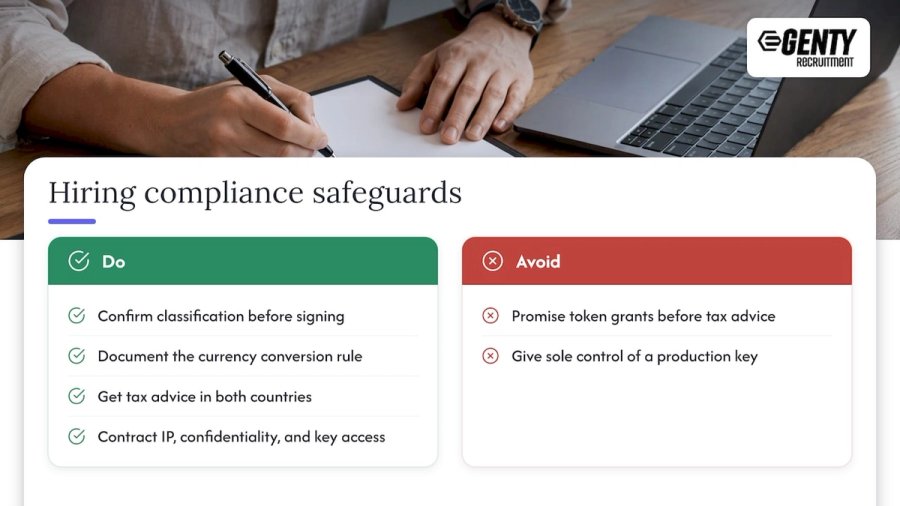
IP and key access. Put IP assignment, confidentiality and a clear access policy for deployer keys and multisig signers into the contract. Never give a new hire sole control of a production key.
How to hire: a step-by-step process
- Define the role in outcomes. “Ship the staking contract v2 and complete the audit remediation in two quarters” attracts better candidates than a list of technologies.
- Pick the country for the role. Use the table above: Argentina or Brazil for senior protocol and backend, Mexico for front end and sales, Colombia for mid-level depth.
- Set the budget with local benchmarks. Compare several current listings for the same seniority and country. GENTY recruitment also offers salary benchmarking for roles in the region.
- Source actively. The strongest Web3 engineers rarely respond to job ads. They sit in protocol communities, GitHub, hackathon results and DAO contributor lists. Our crypto recruitment page covers how we approach that search.
- Vet on shipped work. Use the checklist above and keep the technical screen to under two hours so strong candidates stay in your process.
- Close fast. Senior Web3 engineers often hold several offers. A decision within a few days of the final interview matters more than a small salary difference.
- Onboard with overlap. Give the hire a named buddy in your timezone and a first merged pull request within two weeks.
A broader walk-through of remote hiring in the region is in our guide on how to hire remote talent from Latin America, and for engineering roles specifically, how to hire remote developers covers the developer side in detail.
Beyond engineers: the other Web3 roles
A Web3 company needs more than Solidity developers. Latin America also supplies:
- DevOps and infrastructure engineers for node operations, CI/CD and cloud security. See our IT recruitment service.
- Data specialists for on-chain analytics and risk modeling.
- SDRs and account executives for selling to exchanges, wallets and fintech teams. See sales recruitment.
- Product, community and operations leads who understand local crypto users.
- Executives, through executive search, for heads of engineering or regional GMs.
If your product sits at the intersection of Web3 and AI or SaaS, the same sourcing logic applies, and we run dedicated tracks for AI and SaaS hiring.
How GENTY recruitment fits a Web3 hire
GENTY recruitment is a specialist IT and sales recruitment agency focused exclusively on Latin America, with dedicated recruiters per vertical, including FinTech, AI, SaaS and Web3. Candidates go through a triple-vetted, skill-first process, and you receive a curated shortlist within 7 days. Pricing is a fixed fee per seniority level starting at $2,999 per hire, with no upfront payments, and each placement carries a 3-month replacement guarantee.
If you already know the role, the fastest next step is to share the job brief on the GENTY recruitment site. For software engineers specifically, our LATAM developer hiring page shows how the five-day shortlist works.
For larger programs, RPO (recruitment process outsourcing) lets us run a multi-role hiring plan end to end, and staffing from $99 per month per employee covers ongoing team members in the region.
Our perspective
Most Web3 hiring mistakes we would expect a team to make come from treating Latin America as one market and recruiting from job boards. The strongest protocol engineers are not applying to anything. They are shipping, auditing and contributing, and they respond to a recruiter who understands what they build.
That is why we focus on one region and organize recruiters by vertical. A recruiter who works only on FinTech and Web3 knows the difference between a Solidity developer and someone who has run an exchange backend, and can tell you which one your roadmap needs. Our skill-first process is designed to test shipped work before a candidate reaches your inbox.
We price per hire at a fixed fee, with no upfront payment, because a founder should know the cost of a hire before a search starts. The 3-month replacement guarantee is there because we stand behind the shortlist. Pair that with Eastern and Pacific timezone overlap and savings of up to 40% against US or European hiring, and a LATAM Web3 team becomes a practical way to extend your runway while you keep engineering quality high.
Eugene
FAQ
Which Latin American country is best for hiring Web3 developers?
Argentina and Brazil are the deepest markets for senior Solidity, protocol and backend engineers. Mexico suits full-stack, front-end and sales roles, and Colombia is strong for mid-level engineers and data roles. Most teams place their first senior hire in Argentina or Brazil and add Mexico or Colombia as the team grows.
Do Latin American Web3 developers work US hours?
Most hubs sit between UTC-6 and UTC-3, so they overlap heavily with US Eastern and Central business hours and partially with Pacific. Write the required overlap window into the offer, for example 9:00 a.m. to 3:00 p.m. ET, so expectations are clear from day one.
How much does it cost to hire Web3 talent in Latin America?
Posted listings on web3.career have shown senior roles in Buenos Aires from $70,000 to $100,000 and a senior Brazil backend role around $98,000 to $105,000. Your cost depends on seniority, specialization and employment model. GENTY recruitment’s recruitment fee starts at $2,999 per hire, with no upfront payment.
Can I pay Latin American Web3 hires in crypto?
Many candidates ask for USD or stablecoin payment, and some expect token grants at senior levels. Decide the structure with your tax and employment advisers in both countries before you make offers, because token compensation raises tax and securities questions that differ by jurisdiction.
How fast can I get a shortlist?
GENTY recruitment delivers curated shortlists within 7 days. Each candidate has passed a skill-first vetting process, and each placement comes with a 3-month replacement guarantee.
Sources
- Chainalysis: Latin America Emerges as a Crypto Powerhouse
- LATAM time zones and US time zone alignment