

Hiring a senior engineer in Latin America typically costs 35% to 50% less over the first year than hiring the same profile in the US, once you add the recruiter fee, the monthly payroll or staffing cost, and the legal burden of the country where the person lives. The exact number depends on three decisions: the country, the hiring model (contractor, employer of record, or your own local entity), and who finds the candidate. This guide walks through each cost line, shows a worked year-one model, and flags the places where budgets usually leak.
TL;DR
- Budget four layers: recruiter fee, base salary, statutory employer costs, and tooling or management overhead.
- At GENTY recruitment, recruitment starts at $2,999 one-off per hire and staffing starts at $99 per month per employee, with no upfront payment.
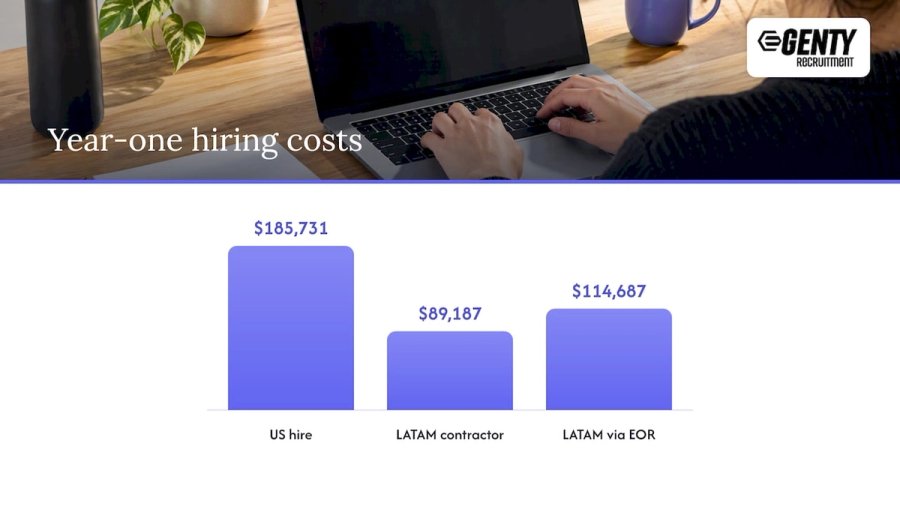
- In the worked example below, a senior hire in LATAM comes to roughly $89,000 to $115,000 in year one, against about $186,000 for a comparable US hire.
- Employer burden differs by country, so Brazil, Mexico, Colombia and Argentina each need their own line in the model.
- Timezone overlap with US Eastern and Pacific time removes a cost that offshore models carry: delayed handoffs and after-hours meetings.
The four cost layers of a LATAM hire
Most cost comparisons stop at salary. A budget your CFO can trust has four layers, and each behaves differently.
- Acquisition cost. What you pay to find and vet the person: an agency fee, an internal recruiter’s time, job board spend, or technical interview hours from your own engineers.
- Compensation. Base salary or contractor rate, paid in USD or local currency.
- Employer burden. Social security, severance funds, mandatory bonuses, paid leave and benefits, which depend on the country and on how the person is engaged.
- Operating overhead. Payroll or EOR fees, equipment, software seats, and the management time needed to onboard someone in a new market.
The sections below price each layer in turn.
Layer 1: what recruiting costs
There are three common ways to source LATAM talent, and they price very differently.
What do you need?
Choose the hiring path that fits
After reading "Cost to Hire in LATAM: Full Breakdown for US Teams (2026)", most teams compare these options before deciding how to hire.
At GENTY recruitment, the model is the third one. IT recruitment and sales recruitment both start at $2,999 one-off per hire, priced by seniority level, with no upfront payment and a 3-month replacement guarantee. Curated shortlists arrive within 7 days. For a founder planning a team of five engineers, a fixed fee turns the acquisition line into a number you can put in the plan on day one, rather than a percentage that moves with each offer.
If you want to see how sourcing cost fits into the broader picture of engineering hiring, our guide on how much it costs to hire a developer covers the same layers outside LATAM.
Layer 2: salary ranges by role and country
Latin American pay is set by local markets, and the four largest tech hubs behave differently for US employers.
- Brazil has the deepest engineering pool, with strong Java, .NET, mobile and fintech talent concentrated in São Paulo. Pay for senior engineers is competitive with other LATAM hubs, and the working language for most senior candidates is solid business English.
- Mexico is the closest match for US Central and Pacific teams, and it has a large base of backend, QA and full-stack engineers. Demand from nearshore firms and US companies keeps senior pay rising.
- Argentina is known for strong engineering education and high English proficiency. Many developers prefer USD-denominated contracts because of local currency volatility, which affects how you structure the offer.
- Colombia has grown quickly in Bogotá and Medellín, with a good supply of mid-level engineers and data specialists and a business culture used to working with US companies.
For budgeting, a practical rule from placements across these markets is that senior engineers cost a fraction of the US equivalent, while the gap narrows for rare specialties such as machine learning, Golang at scale, or senior DevOps with Kubernetes and multi-cloud experience. Specialty pay is where the savings shrink, so price those roles separately. We publish role-level ranges in our own salary guides: DevOps salaries in Latin America and Golang developer salary in LATAM give figures by seniority and country, and our hiring costs overview for US tech employers puts them next to US benchmarks.
Salary data differs by source, because published surveys mix contractor rates, employee pay and agency billing rates. Before you anchor on any number, check whether it is a gross salary, an hourly rate that includes an intermediary’s margin, or a total cost. If you need a number tied to your exact stack and level, a custom salary benchmarking report is the cleaner route than averaging blog posts.
Layer 3: the employer burden nobody puts on the first slide
This layer explains most budget surprises. It depends on how you engage the person.
Contractor model
The person invoices you, handles their own taxes and benefits, and you pay the agreed rate. It is the cheapest on paper and the fastest to start. The risk is classification. The IRS states that a worker under the payer’s control can count as a common-law employee for US employment tax purposes regardless of where they live, and misclassification can create significant tax and penalty exposure. If the person works fixed hours, uses your tools and takes direction from your managers, talk to your tax adviser before choosing this model, and ask a local labor lawyer about the country’s own rules for disguised employment, which are enforced actively in Brazil and Argentina.
Employer of record
An employer of record (EOR) employs the person locally on your behalf, runs payroll, and handles contributions and benefits. You pay salary plus statutory costs plus a monthly fee. Our remote staffing and EOR service starts at $99 per employee per month, which is the platform fee only. Statutory costs are separate and depend on the country.
Your own local entity
This makes sense once you have a sizeable team in one country. It adds accounting, legal and registration costs, so most US companies with fewer than 10 to 15 people in a country do not start here.
What the statutory burden looks like
The World Bank notes that nonwage labor costs, such as social protection contributions, vary substantially across Latin American countries because national legislation differs. In practice, each country adds its own items to the base salary:
- Brazil: employer social security contributions, the FGTS severance fund deposit, the mandatory 13th salary and a vacation bonus.
- Mexico: IMSS social security, housing fund contributions, a mandatory year-end bonus (aguinaldo) and a vacation premium.
- Colombia: social security and pension contributions, severance funds, and service bonuses (prima de servicios).
- Argentina: social security contributions, a mandatory half-year bonus (aguinaldo) and strict severance rules.
A safe planning assumption for a formal employment arrangement is to add a meaningful percentage to gross salary for these items, and to ask your EOR or local payroll provider for the exact figure by country before you sign an offer. In the worked example below we use 30% as an illustrative load, not a quote for any specific country.
Layer 4: overhead you still pay
Remote does not mean free. Plan for these:
- Equipment and software: a laptop shipped to the person, plus your regular seats for code hosting, chat, CI and security tooling.
- Currency and payment fees: USD payments to local accounts carry transfer costs, and some candidates in Argentina ask for stablecoin or USD-account payment options.
- Management time: the first 60 days need clear onboarding, and a manager’s time has a real cost.
- Benefits parity: in competitive markets, health insurance and a learning budget help you keep people. Local candidates compare your offer with the multinationals in their city.
Worked example: year-one cost of a senior backend engineer
The table below is a model with stated assumptions, not a price quote. Replace the inputs with your own.
Assumptions: the LATAM hire earns $85,000 gross per year. The US hire earns $130,000 gross. For the US side, we use the proportion of benefits in US employer costs: the Bureau of Labor Statistics reports that private-industry compensation averaged $46.89 per hour worked in June 2026, including $14.07 in benefits, so benefits add about 43% on top of wages. This is an all-industry average, and tech employers often pay more. For the LATAM side we use the fee and staffing prices published by GENTY recruitment and an illustrative 30% employer load for the EOR scenario.
Three things stand out. First, the recruiter fee and platform fee together are about 4% of the LATAM contractor total, so the fee is not what decides the budget. The hiring model and the salary band decide it. Second, the gap between contractor and EOR is the cost of compliance, and it buys you protection from misclassification risk. Third, the US column leaves out any US agency fee, relocation or higher-cost office space, so the real gap is often wider.
These figures are consistent with the savings of up to 40% against US or European hiring that we see for employment-based setups, and the contractor column shows why headline claims of 50% or more circulate online: they usually compare a contractor rate with a fully loaded US employee.
How to estimate your own number
Use this checklist before approving a LATAM headcount.
- [ ] Define the role, seniority and stack, then fix a salary band from a benchmark tied to that stack.
- [ ] Choose the country by skill density and by timezone: Mexico and Colombia sit close to US Central and Eastern time, Brazil and Argentina give a solid overlap with the East Coast.
- [ ] Choose the model: contractor, EOR or local entity, with legal sign-off for any contractor who works under your direction.
- [ ] Ask for the statutory burden in writing for the specific country and salary.
- [ ] Add the acquisition fee, the monthly platform or EOR fee, equipment and software seats.
- [ ] Add a replacement buffer. A 3-month guarantee covers the search, but your own onboarding time is still lost if a hire leaves.
- [ ] Decide the payment currency and who carries the exchange-rate risk.
- [ ] Compare the total with your US figure on the same basis, loaded cost against loaded cost.
Why timezone alignment belongs in the cost model
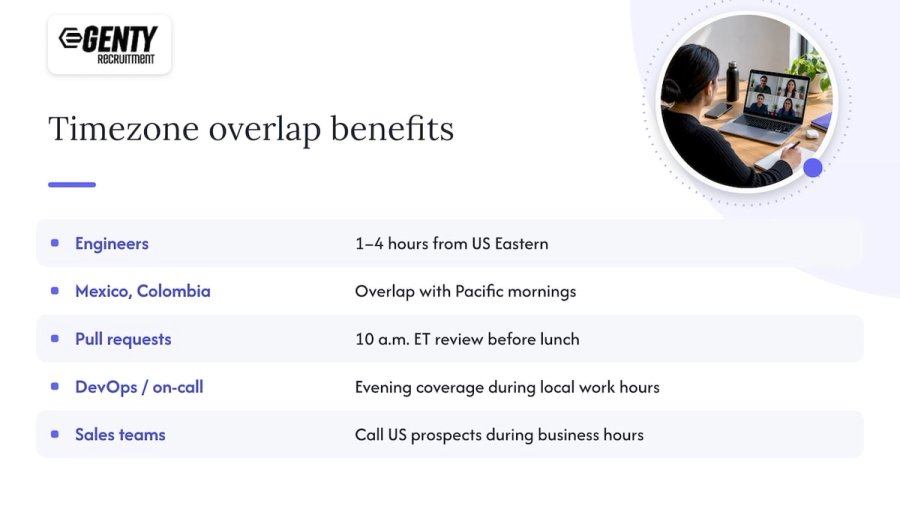
A cost comparison that ignores working hours understates what you pay with offshore alternatives. Engineers in Brazil, Argentina, Colombia and Mexico work within one to four hours of US Eastern time, and Mexico and Colombia also overlap well with Pacific mornings. That means standups, code reviews and incident response happen in real time. A pull request opened at 10 a.m. Eastern can be reviewed before lunch, rather than the next day. For DevOps and on-call rotations, a LATAM teammate covers evening hours at normal local working times. For sales teams, SDRs and account executives in the region can call US prospects during US business hours without night shifts. Those hours are the reason many companies accept a smaller percentage saving than they would get offshore.
For a deeper look at the process side, see our guides to hiring remote developers from Latin America and hiring remote talent.
Where the budget goes wrong
- Treating the contractor rate as the total cost. If the person works like an employee, the true cost includes compliance, either now or after an audit.
- Comparing a billing rate with a salary. An hourly rate from a vendor includes margin. A salary does not. Put both on a loaded annual basis.
- Ignoring seniority mix. Senior hires save the most in absolute dollars, but mid-level hires often deliver the best value per dollar in Colombia and Mexico.
- Skipping the replacement plan. A guarantee of 3 months limits the downside of a bad hire, and it should be in the contract, not in a sales deck.
- Underestimating the speed premium. An open senior role costs your team every week it stays open. A shortlist in 7 days shortens that period.
Our perspective: price the hire, not the headline
We work only in Latin America, with dedicated recruiters for each vertical, and the pattern repeats across fintech, SaaS, AI and Web3 clients: companies that decide on percentage savings alone are disappointed, and companies that decide on total cost and team fit are not. A 50% saving on a mismatched hire is a loss. A 38% saving on an engineer who ships in the first month and stays for three years is a strong result.
That is why we structure our work around a skill-first process. Each candidate is vetted three times, on technical skill, on communication in English, and on fit with the team and timezone, before you see a shortlist. The fixed fee is the second half of the argument. When the fee does not change with the candidate’s salary, our incentive is the best match, not the most expensive one. For leaders new to the region, the first hire is the expensive lesson, so we suggest starting with one or two roles in the country with the strongest talent density for your stack, and expanding once your payroll and management routines work.
— Eugene
How GENTY recruitment prices the work
If you already know the role, the cost is simple to scope. Recruitment starts from $2,999 one-off per hire, with no upfront payment and a 3-month replacement guarantee. Staffing and EOR-style employment start from $99 per month per employee. For larger programs, recruitment process outsourcing and executive search in LATAM are scoped to the project, and we do not publish a price for them. To see which fee applies to your role, start with IT recruitment, or talk to us through the GENTY recruitment home page.
FAQ
How much do recruiters charge to hire in Latin America?
Fees come in two forms: a percentage of first-year salary, or a fixed fee per hire. At GENTY recruitment, recruitment starts from $2,999 per hire, set by seniority, with no upfront payment. A fixed fee makes budgeting easier because it does not rise with the salary.
Is hiring in LATAM really cheaper than hiring in the US?
Yes, in most cases, but the size of the saving depends on the model. In the worked example above, an EOR-based employee comes to about 38% less in year one than a comparable US hire, and a contractor comes to about 52% less. Rare specialties such as machine learning narrow the gap.
What extra costs come on top of a LATAM salary?
Expect statutory employer contributions, mandatory bonuses, paid leave, any EOR or payroll fee, equipment and software seats. These differ by country, as the World Bank notes for nonwage labor costs across the region. Ask for a written breakdown for the specific country before making an offer.
Can I hire a LATAM developer as a contractor to save money?
You can, but classification matters. If the person works under your control, US tax rules can treat them as an employee, and local labor law may do the same. Have your tax adviser and a local labor lawyer review the arrangement before you start.
Sources
- IRS Publication 15 (2025)
- U.S. Bureau of Labor Statistics, Employer Costs for Employee Compensation
- World Bank, (In)Formalizing Jobs in Latin America and the Caribbean