

Contingent hiring is defined as the practice of recruiting non-permanent workers, including freelancers, independent contractors, and temporary staff, to meet specific business needs without the obligations of full-time employment. The industry term for this practice is contingent workforce management, and it sits at the center of how fast-moving tech companies scale their teams. Contingent workers do not receive traditional benefits such as health insurance, paid time off, or retirement contributions, which directly reduces fixed labor costs. For hiring managers at SaaS, FinTech, and AI companies, this model offers a way to add specialized engineering or DevOps talent quickly, without committing to a permanent headcount.
What is contingent hiring and why does it matter for tech companies?
Contingent hiring is a pay-for-performance recruitment model where agencies source, screen, and submit candidates, and clients pay only upon a successful placement. That structure removes upfront financial risk and makes the model attractive for companies that need to move fast. A startup building out its backend team in Q2 does not want to wait four months for a retained search to close. Contingent hiring solves that problem directly.
The model covers a wide range of worker types. Freelancers work independently on defined deliverables. Independent contractors operate under project or time-bound agreements. Temporary staff fill gaps during product launches, hiring freezes, or peak engineering cycles. Each category carries different legal and tax implications, so HR teams need to classify workers correctly from day one.

Tech companies benefit most from contingent hiring when the role is mid-level, high-volume, or time-sensitive. Retained search fees run 30–35% of total compensation and involve exclusive recruiter focus, which makes sense for C-suite or highly specialized roles. Contingent hiring trades that depth of assessment for speed and volume, which is exactly what a scaling engineering team usually needs.
What do you need?
Choose the hiring path that fits
After reading "What Is Contingent Hiring? A Tech HR Guide for 2026", most teams compare these options before deciding how to hire.
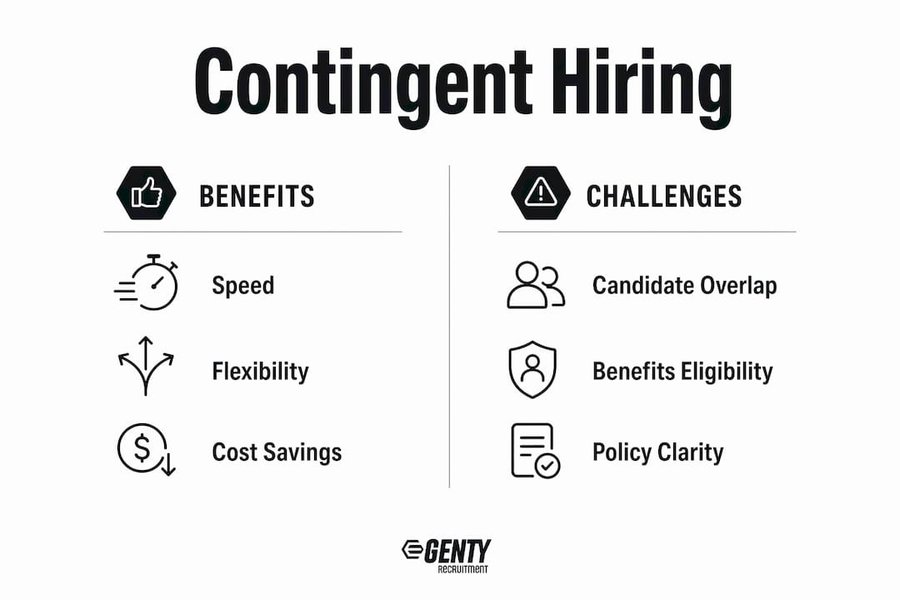
What are the benefits and challenges of contingent hiring in tech companies?
Key benefits for tech hiring managers
The advantages of contingent hiring are concrete and measurable for tech organizations.
- Cost reduction: Companies avoid paying salaries, benefits, and payroll taxes for roles that do not require permanent headcount. This is especially significant for project-based engineering work.
- Speed to hire: Contingency recruiting averages 36 days for placement, which is faster than most internal hiring cycles for specialized tech roles.
- Access to specialized skills: Contingent hiring lets you bring in a Solidity developer for a Web3 project or a data pipeline engineer for a six-month migration without restructuring your permanent team.
- Workforce flexibility: You can scale up during a product sprint and scale back after launch without the legal and financial complexity of layoffs.
- LATAM cost advantages: Hiring contingent engineers from Argentina, Brazil, Mexico, or Colombia delivers significant salary savings compared to US benchmarks, with timezone alignment to US EST and PST that keeps collaboration tight.
Common challenges to manage
Contingent hiring carries real risks that HR teams must address upfront. The most common is candidate overlap, where multiple agencies submit the same candidate, creating fee disputes and wasted time. Clear contracts that define candidate ownership before any submissions begin are the only reliable fix.
Lack of benefits eligibility also creates complications. Contingent workers in Colombia or Mexico may have different local labor law protections than those in Argentina or Brazil, so legal review of each country’s regulations is non-negotiable. Finally, contingent workers may feel less invested in company culture, which affects retention on longer engagements.
Pro Tip: Establish a written candidate ownership policy before engaging multiple agencies. Specify that the first agency to submit a candidate’s resume in writing holds the fee claim. This one rule prevents the majority of disputes.
How does contingent hiring work step-by-step for tech companies?
The contingent hiring process follows a clear sequence. Understanding each stage helps hiring managers set realistic timelines and avoid the bottlenecks that slow most placements down.
- Define the role and requirements. Write a specific job description that includes tech stack, seniority level, engagement type (contract, freelance, or temp), and expected duration. Vague briefs produce misaligned candidates.
- Engage a recruitment agency or platform. Share the brief with one or more contingent recruitment agencies. GENTY recruitment, for example, begins sourcing within 24 hours of receiving a brief and delivers a curated shortlist within 7 days.
- Sourcing and screening. The agency sources candidates from its network, screens for technical and soft skills, and submits a shortlist. This is where agency quality separates itself: pre-vetted shortlists save hiring managers hours of resume review.
- Provide feedback within 48 hours. This is the highest-impact step most clients underestimate. Recruiters prioritize clients who respond quickly, and fast feedback lets the agency recalibrate its search before wasting days on the wrong profile.
- Conduct interviews and select a candidate. Run technical assessments and culture interviews. For LATAM candidates, schedule interviews during overlapping hours, typically 9:00 AM to 2:00 PM EST, which covers most of Argentina, Brazil, Mexico, and Colombia.
- Extend an offer. Once the client accepts a candidate, the offer triggers the agency’s placement fee. No placement, no fee. This is the core mechanic of contingent hiring.
- Onboard and integrate. Work with your legal and HR teams to set up the correct contractor agreements, payment terms, and access provisioning. For LATAM hires, confirm local compliance requirements in the worker’s country.
Pro Tip: Treat your contingent recruiter as a partner, not a vendor. Share honest feedback on every submission, even rejections. Agencies that understand your actual hiring bar place better candidates faster. Silence is the single biggest cause of slow placements.
For a deeper look at how to structure this process at scale, the recruiting process outsourcing guide from GENTY recruitment covers the full decision framework.
What is a contingent workforce and how does it differ from temporary and permanent staff?
The contingent workforce definition covers all workers engaged outside of permanent employment. Contingent workforce members operate under limited-term agreements, typically earning hourly or project-based pay with no employee benefits. That distinguishes them sharply from permanent employees, who receive salaries, benefits, and job security.
Temporary staffing is a subset of contingent work. A temp is usually placed through a staffing agency and works on-site or remotely for a defined period, often to cover a leave of absence or a seasonal demand spike. A contractor, by contrast, typically operates with more autonomy, uses their own tools, and may work for multiple clients simultaneously. Freelancers sit in a similar category but usually engage on a deliverable basis rather than an hourly one.
The table below shows the key distinctions that matter most for workforce planning and budgeting.
GENTY recruitment deploys contingent workers across all four LATAM markets, Argentina, Brazil, Mexico, and Colombia, matching the right engagement type to each client’s legal and operational context. Understanding which category a worker falls into directly affects tax withholding, benefits liability, and termination rights in each country.
How to build tech teams in Latin America through contingent hiring
LATAM is one of the strongest talent pools for contingent tech hiring in 2026. The region produces a large volume of software engineers, DevOps specialists, data engineers, and sales professionals who are actively available for contract and freelance engagements.
- Salary competitiveness: Hiring a mid-level software engineer in Argentina or Colombia costs significantly less than the equivalent US-based hire, with GENTY recruitment clients saving up to 40% compared to US or European benchmarks.
- Timezone alignment: Engineers in Argentina (UTC-3), Brazil (UTC-3), Mexico (UTC-6), and Colombia (UTC-5) overlap with US EST and PST business hours. A team in Buenos Aires and a team in New York share a full morning of working hours, which removes the async communication lag that makes offshore hiring frustrating.
- English proficiency: Senior tech professionals across LATAM, particularly in Argentina and Colombia, consistently demonstrate strong English communication skills, which reduces onboarding friction for US-based teams.
- Cultural compatibility: LATAM engineers working with US tech companies are familiar with Agile, Scrum, and sprint-based delivery models. The working culture aligns well with US startup and scale-up environments.
- Talent depth in key verticals: FinTech, AI, SaaS, and Web3 talent is concentrated in Buenos Aires, São Paulo, Mexico City, and Bogotá. GENTY recruitment’s network covers all four cities with pre-vetted candidates ready for contingent engagements.
For hiring managers who want to vet candidates before committing, the candidate vetting framework from GENTY recruitment outlines how to assess both technical and soft skills for remote LATAM engineers. Pairing that with a clear contingent hiring process gives you a repeatable system for building teams fast.
Understanding job search dynamics in 2026 from the candidate’s perspective also helps hiring managers write briefs that attract the right contingent talent, particularly in competitive markets like Buenos Aires and São Paulo.
Key Takeaways
Contingent hiring delivers the fastest, lowest-risk path to specialized tech talent when paired with rapid feedback, clear ownership contracts, and a LATAM-focused sourcing strategy.
Why most tech teams underuse contingent hiring until it’s too late
The hiring managers I see get the most from contingent models are the ones who treat it as a permanent part of their workforce strategy, not a break-glass option. Most teams reach for contingent hiring only when a permanent search has already stalled for two months. By then, the product timeline has slipped and the team is burned out covering the gap.
The smarter approach is to maintain an active relationship with a contingent recruiter before you need one. That means sharing your tech stack, your team culture, and your typical hiring bar in advance. When a need opens, the agency already knows who to call. GENTY recruitment’s 7-day shortlist model works precisely because clients who brief us thoroughly get faster, better-matched candidates than those who send a generic job description at the last minute.
The other mistake I see repeatedly is running contingent and retained searches simultaneously for the same role without telling either agency. That creates candidate overlap, fee disputes, and a recruiter who stops prioritizing your role because they sense the confusion. Pick the right model for the role, commit to it, and communicate clearly. Contingent hiring is ideal for rapidly scaling tech teams that need volume and speed. Retained search earns its premium for roles where a wrong hire costs more than the fee difference.
LATAM has changed my view on what contingent hiring can deliver. The talent in Argentina and Colombia in particular is genuinely strong, not a compromise. The timezone overlap with US EST makes daily standups and sprint reviews work without scheduling gymnastics. If you have not run a contingent search in LATAM yet, the first placement usually converts skeptics.
— Eugene
GENTY recruitment’s contingent hiring services for tech teams
Tech companies that need pre-vetted LATAM talent fast do not have to build the sourcing infrastructure from scratch.
GENTY recruitment specializes in IT recruitment across Latin America, placing software engineers, DevOps specialists, data professionals, and sales teams for FinTech, AI, SaaS, and Web3 companies. The process delivers a curated shortlist within 7 days, with fixed-fee pricing per seniority level, no upfront payments, and a 3-month replacement guarantee. Clients save up to 40% compared to US-based hiring while gaining engineers who work in overlapping US business hours. For teams ready to move, the IT staffing agency guide covers how to structure your first contingent engagement with GENTY recruitment from brief to placement.
FAQ
What is contingent hiring in simple terms?
Contingent hiring is the process of recruiting freelancers, contractors, or temporary workers for defined periods without offering permanent employment or benefits. Companies pay only when a placement is made, which removes upfront financial risk.
How long does a contingent hiring placement take?
Contingent recruiting averages 36 days for placement. That timeline shortens significantly when hiring managers provide feedback on candidate submissions within 48 hours, which lets recruiters recalibrate quickly.
What is the difference between contingent and temporary staffing?
Temporary staffing is a subset of the broader contingent workforce. Temps are typically placed through agencies for short, fixed periods, while contractors and freelancers operate with more autonomy and may work across multiple clients simultaneously.
Is contingent hiring right for executive or highly specialized roles?
Contingent hiring works best for mid-level and high-volume tech roles. For executive or deeply specialized positions, retained search, which costs 30–35% of compensation and provides exclusive recruiter focus, delivers a more thorough assessment process.
How does LATAM contingent hiring compare to US hiring costs?
LATAM contingent hires from Argentina, Brazil, Mexico, and Colombia cost significantly less than equivalent US-based hires. GENTY recruitment clients save up to 40% while gaining engineers who overlap with US EST and PST business hours.