

A structured, outcome-driven tech hiring process is the single most reliable way to reduce time-to-fill, improve candidate quality, and build engineering teams that scale. The industry term for this end-to-end approach is full-cycle recruiting, and it covers every stage from role definition through onboarding. The average time-to-fill a technical role in the U.S. is 44 days, with screening and interviewing each consuming roughly 8 to 9 days. For startups competing against well-funded companies for the same remote talent pool, every day of delay is a candidate lost. This guide walks you through each stage of the step by step tech hiring process, with specific tools, decision frameworks, and timing benchmarks drawn from 2026 market data.
How to define tech roles by outcomes, not task lists
The most common reason a hiring process fails before it starts is a poorly written job description. Most job descriptions list technologies and responsibilities. The best ones define what success looks like at 30, 60, and 90 days on the job.
Instead of writing “manage backend infrastructure,” write “reduce API response time by 20% within 90 days and own the migration from monolith to microservices by month six.” This shift does two things: it filters out candidates who cannot think in deliverables, and it gives your interview panel a concrete benchmark to evaluate against. Collaborating with a senior engineer or technical advisor to define these outcomes is worth the extra hour, because vague role definitions produce vague candidate pools.
Degree requirements deserve scrutiny. Removing a four-year computer science requirement from a mid-level backend role can expand your qualified applicant pool by 30 to 40 percent, particularly when hiring across Latin America, where strong engineers often hold technical certifications or bootcamp credentials alongside real-world experience.
Before you start hiring
Check location, salary, and hiring fit
If you are moving from research to action, start with the market basics so your hiring plan is clearer.
- Write 90-day and 6-month outcome statements for every role
- List only the skills that are genuinely required on day one, not aspirational ones
- Specify remote work hours, time zone overlap expectations, and communication tools (Slack, Notion, Jira)
- Remove degree requirements unless the role legally or technically demands them
Pro Tip: Include a salary range in the job description. Postings with transparent compensation receive significantly more qualified applicants and reduce time wasted in late-stage negotiations.
What sourcing channels actually work for remote tech hiring
Sourcing remote tech talent requires running multiple channels simultaneously, not sequentially. Waiting for inbound applications on LinkedIn or Indeed before activating referrals and outbound outreach adds two to three weeks to your pipeline before a single qualified candidate is screened.
The most productive sourcing mix for remote tech roles combines job boards (LinkedIn, Wellfound, We Work Remotely), employee referrals, and proactive outreach to passive candidates. Passive candidates, those not actively job searching, often represent the highest-quality segment of the market. Engaging them requires personalized outreach, not copy-paste messages. Resources on passive IT talent engagement show that relationship-building over weeks, not days, converts this segment reliably.
AI tools have changed the speed equation for sourcing. 44% of HR teams now use AI for resume screening, and 66% use AI for writing job descriptions as of 2025. These numbers reflect a structural shift: teams that still review every resume manually are operating at a structural disadvantage. Tools like Greenhouse, Lever, and HireVue offer AI-assisted screening that flags candidates matching your defined criteria before a human reviewer touches the pile.
Sourcing channel comparison
Once candidates enter your pipeline, rolling review and rejection within 24 to 48 hours prevents losing top talent and keeps hiring velocity high. The biggest killer of pipeline health is the silent rejection, where candidates hear nothing for a week and accept another offer. Set a rule: every applicant receives a status update within two business days of submission.
Pro Tip: Activate at least three sourcing channels on day one of a new search. Waiting to see how one channel performs before opening another adds weeks to your timeline with no quality benefit.
How to design structured technical and behavioral interviews
The tech interview process steps that produce the most reliable hiring decisions combine asynchronous technical assessments with live structured interviews. Running both in sequence, rather than relying on one or the other, gives you signal on both technical competency and communication quality.

Async technical screening shortens time-to-hire from an average of 45 days to approximately 28 days. The mechanism is simple: candidates complete a timed coding or system design challenge on their own schedule, and your senior engineers review submissions asynchronously rather than sitting in a live session. Platforms like HackerRank, Codility, and CoderPad support this format well.
For the practical assessment itself, use real problems. Real, anonymized code snippets from your own codebase increase candidate engagement and test practical judgment rather than abstract puzzle-solving. A candidate who can read your actual architecture and identify an optimization is demonstrably more prepared than one who solved a generic binary tree problem.
The live interview sequence for a mid-to-senior tech role should follow this order:
- Communication screen (30 minutes, recruiter): Confirm English proficiency, availability, compensation alignment, and motivation
- Async technical assessment (60 to 90 minutes, self-paced): Coding challenge or system design brief relevant to the role
- Technical review interview (60 minutes, senior engineer): Walk through the async submission, probe reasoning, and explore system design depth
- Behavioral interview (45 minutes, hiring manager): Use the STAR method to assess collaboration, conflict resolution, and ownership
- Culture fit conversation (30 minutes, team lead or peer): Assess communication style, async work habits, and team dynamics
Structured interviews with rubrics improve fairness and comparability, reducing reliance on subjective impressions. Build a scorecard with five to seven criteria rated on a 1 to 4 scale, and require every interviewer to submit scores before the debrief call. This prevents the loudest voice in the room from anchoring the group’s assessment.
Pro Tip: For non-technical founders, delegate all technical scoring to a trusted senior engineer or external technical advisor. Your role is to evaluate leadership potential, communication, and cultural alignment, not to assess code quality.
For remote tech hiring strategies that cover both active and passive candidate conversion, the interview design must also account for candidate experience. Scheduling all interview stages within a five to seven day window signals organizational competence and respects the candidate’s time.
How to make fast, confident hiring decisions and extend offers
Speed at the offer stage is not just a courtesy. Fast hiring processes of 21 days or less signal operational excellence and significantly improve candidate conversion compared to processes that exceed 60 days. Top candidates in the remote tech market typically hold two to three competing offers simultaneously.
Set a hard internal deadline: all hiring decisions must be made within 5 business days of the final interview. This requires pre-work. Draft the offer letter template before the final interview round, with only the candidate-specific fields left blank. Have compensation ranges pre-approved by leadership so the recruiter or hiring manager can extend an offer without a three-day internal approval chain.
Run reference checks and background verification in parallel with the final interview stage, not after. Most reference checks take 24 to 48 hours when initiated promptly. Waiting until after the decision adds unnecessary days to your timeline.
- Pre-draft offer letters before the final interview
- Set a 5-business-day decision deadline from final interview to offer
- Run reference checks in parallel with final interviews
- Communicate the decision timeline to candidates explicitly after the final round
“We aim to have a decision to you within three business days of your final interview.” Saying this out loud to a candidate reduces drop-off, keeps them engaged, and sets a professional tone that differentiates you from slower-moving competitors.
Pro Tip: If a candidate is strong but not your first choice, keep them warm with a brief update rather than silence. Offer acceptance rates drop sharply when candidates feel ignored during the decision window.
Why onboarding is part of the hiring process, not separate from it
Onboarding is the final stage of the hiring cycle, and treating it as an afterthought directly increases early attrition. Nearly 1 in 5 new hires leave within the first 45 days when onboarding is unstructured. For a startup that spent six weeks and significant budget to hire a senior engineer, that outcome is expensive.
Pre-boarding activities should begin the moment the offer is signed. Send IT credentials, access to documentation, and a first-week schedule before the start date. Assign a technical buddy from the existing team to handle day-one questions. Schedule a 30-day checkpoint between the recruiter, the hiring manager, and the new hire to surface friction early.
- Send equipment, access credentials, and first-week agenda before day one
- Assign a peer buddy for the first two weeks
- Schedule 30-day and 60-day check-ins with both the manager and the recruiter
- Share team norms, communication expectations, and sprint cadence in writing
Pro Tip: The recruiter who closed the hire should stay involved through the 30-day mark. A brief check-in call from the recruiter at day 15 catches integration issues before they become resignation decisions.
Structured onboarding also accelerates time-to-productivity. A new engineer with clear documentation, a working dev environment, and a defined first sprint can contribute meaningfully within two weeks rather than six.
Key takeaways
A repeatable tech hiring process requires outcome-based role definitions, parallel sourcing channels, structured assessments, and fast offer decisions to consistently attract and retain top remote talent.
What I’ve learned from watching startups hire the same role twice
The most expensive hiring mistake I see consistently is not a bad hire. It is a slow process that loses a good candidate and forces the company to restart a six-week search. Founders often treat hiring as something that happens when a role opens, rather than a system they design and refine continuously.
The best hiring teams I have observed treat the process exactly as they treat their product: hypothesis, test, measure, and iterate. They track time-to-fill, offer acceptance rate, and 90-day retention by role type. When a metric degrades, they diagnose the stage, not the candidate pool.
The other pattern worth naming is the overreliance on gut feel in final decisions. Structured interviews with calibrated scorecards exist precisely because human intuition is inconsistent under time pressure. A founder who “just knows” a candidate is right, without a rubric to back that instinct, is making a bet rather than a decision. That bet fails at a higher rate than the data suggests it should.
AI tools belong in your process, but they do not replace judgment. Using AI for screening efficiency gains frees your team to spend more time on the conversations that actually predict performance. The 84% of talent acquisition leaders planning to use AI agents in 2026 are not replacing recruiters. They are giving recruiters more time to do the work that machines cannot: build rapport, read context, and close candidates who have options.
Design your process before you open the next role. Write it down. Assign owners to each stage. Set time limits. Then measure it.
— Eugene
How Gentyrecruitment accelerates your remote tech hiring
Gentyrecruitment applies this exact framework to help US and European tech companies hire pre-vetted engineers from Argentina, Brazil, Mexico, Colombia, and across Latin America. The team combines AI-powered sourcing, structured technical vetting, and hands-on recruiting to deliver qualified, English-speaking candidates faster than a typical internal search. For FinTech, AI, and SaaS companies that need to move quickly without sacrificing quality, Gentyrecruitment’s IT recruitment in LATAM service is built to compress your hiring timeline while maintaining rigorous candidate standards. If you are building a remote engineering team and want candidates who are ready to integrate from day one, Gentyrecruitment is worth a conversation.
FAQ
What are the main steps in a tech hiring process?
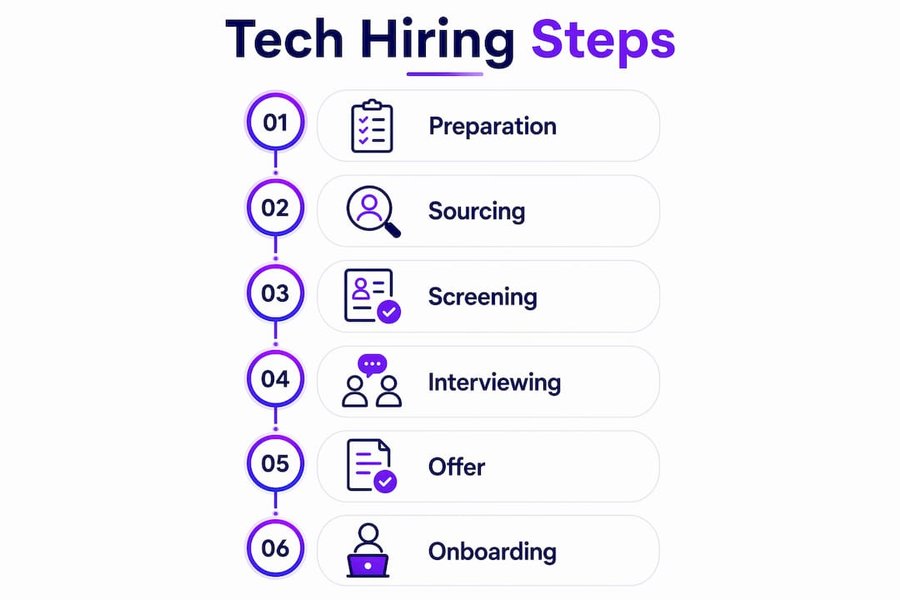
The six core stages are preparation, sourcing, screening, selecting, offer extension, and onboarding. Some organizations add workforce planning at the start and performance tracking at the end.
How long should a tech hiring process take?
The U.S. average is 44 days, but processes completed in 21 days or fewer produce significantly higher offer acceptance rates. Async technical screening alone can reduce time-to-hire to approximately 28 days.
What questions should you ask tech candidates in interviews?
Effective questions for tech candidates combine technical depth with behavioral context. Ask candidates to walk through a system they designed, explain a technical decision they would reverse, and describe how they handled a production incident under pressure.
How do you assess technical skills without a technical co-founder?
Non-technical founders should delegate all technical scoring to a trusted senior engineer or external technical advisor, focusing their own evaluation on communication, ownership, and cultural alignment. Platforms like HackerRank and Codility provide objective scoring without requiring the founder to interpret code.
Why do strong candidates drop out before the offer stage?
Candidates drop out primarily due to slow decisions and poor communication. Setting a 5-business-day decision deadline and communicating the timeline explicitly after the final interview are the two highest-impact changes a startup can make to improve offer conversion.