
Job matching is the practice of aligning a candidate’s skills, experience, and motivations with the specific requirements of a role. Done well, it produces hires who perform faster, stay longer, and fit the team from day one. Done poorly, it generates expensive turnover and months of lost productivity.
The formal definition, drawn from the NHS Job Evaluation Scheme, describes job matching as “an analytical way of evaluating as many jobs as possible to nationally evaluated profiles in the most efficient and consistent manner possible.” That framing matters because it frames matching not as intuition but as a structured, repeatable process. For US and European tech companies hiring in Latin America, that structure is what separates a reliable pipeline from a coin flip.
What is job matching, and why does it go beyond the resume?
At its core, job matching compares what a role demands against what a candidate actually offers. The inputs on the job side include required technical skills, seniority level, compensation band, timezone requirements, and team culture. On the candidate side, they include verified skills, past experience, certifications, salary expectations, and motivational drivers.

Traditional matching relied on keyword scanning: a recruiter searched for “Python” or “Salesforce” and filtered from there. That approach misses candidates who have the capability but describe it differently, and it surfaces candidates who list the keyword but lack real depth. Advanced job matching platforms now use AI and big data to create bi-directional best-fit matches using skills, competencies, and motivations rather than simple keyword matching.
What do you need?
Choose the hiring path that fits
After reading "Job Matching Explained: Process, Tools, and LATAM Hiring", most teams compare these options before deciding how to hire.
For LATAM hiring specifically, the matching criteria expand. A senior backend engineer in Buenos Aires may carry equivalent technical depth to a US-based counterpart at a significantly lower cost, but the match evaluation must also confirm English proficiency, EST or PST timezone overlap, and familiarity with the client’s tech stack. Those are not soft preferences. They are hard matching criteria that determine whether the placement works.
Key elements every job matching process should evaluate:
- Technical skills: Verified through assessments, not self-reported
- Experience depth: Years and context, not just job titles
- Motivational fit: What drives the candidate, and whether the role delivers it
- Compensation alignment: Salary expectations versus the role’s band
- Timezone compatibility: Critical for LATAM remote roles targeting US teams
- Language proficiency: Especially English for cross-border placements
- Cultural and team fit: Communication style, autonomy preference, collaboration norms
How motivation shapes the quality of every match
Skills get a candidate through the door. Motivation determines whether they stay and perform. A software engineer who is technically qualified but fundamentally uninterested in the domain will disengage within months, regardless of how well the resume matched the job description.
Effective job matching processes incorporate motivational assessment alongside skills evaluation. This means asking candidates what kind of problems they want to solve, what work environments they thrive in, and what career trajectory they are pursuing. For LATAM tech talent, common motivational drivers include access to international projects, exposure to US product teams, competitive compensation in USD, and the ability to work remotely without sacrificing career growth.
The benefits of incorporating motivation into matching flow in both directions:
- For employers: Lower early attrition, faster ramp-up, and higher engagement scores
- For candidates: Roles that align with their actual goals, not just their credentials
- For the hiring process: Fewer second-round replacements and reduced time-to-productivity
GENTY recruitment’s skill-first process explicitly evaluates motivational fit during candidate screening. A pre-vetted shortlist delivered within 7 days reflects not just technical alignment but also a candidate’s genuine interest in the client’s product, team structure, and growth stage.
How job matching actively supports diversity hiring
Credential-based hiring systematically excludes qualified candidates who took non-traditional paths. A developer in Medellín, Colombia who is self-taught and has shipped production code for three years will often be filtered out by systems that require a four-year computer science degree. Skills-based matching removes that barrier.
Job matching improves diversity by focusing on skills and competencies, enabling hiring managers to expand candidate pools beyond traditional credential barriers. For US tech companies, this means accessing talent in Brazil, Mexico, Argentina, and Colombia that would never appear in a standard US-centric job board search.
Practical ways to use job matching for more diverse hiring:
- Replace degree requirements with skill assessments as the primary filter
- Use competency frameworks that map to actual job tasks, not proxies like university prestige
- Apply standardized scoring rubrics so every candidate is evaluated on the same criteria
- Expand geographic sourcing to LATAM markets where strong technical talent is underrepresented in global pipelines
- Audit match scores periodically to identify whether any criteria inadvertently screen out qualified candidates from specific regions or backgrounds
GENTY recruitment applies this approach directly. By sourcing across Argentina, Brazil, Mexico, and Colombia and evaluating candidates against role-specific technical benchmarks, the process surfaces talent that credential-first pipelines miss entirely.
Job shadowing as a practical matching and assessment technique
Job shadowing gives a candidate direct exposure to the actual work environment before a formal offer is made. Rather than relying solely on interview performance, the candidate observes or participates in real tasks, team interactions, and daily workflows. Job shadowing provides practical, real-world insights into candidate fit and enhances decision-making in recruitment beyond static job descriptions or resumes.

For remote LATAM hiring, job shadowing takes a different form. A structured trial sprint, a paid technical task completed alongside the existing team, or a two-week contract-to-hire arrangement serves the same purpose: it tests real-world fit before a long-term commitment. This approach is especially effective for assessing timezone communication patterns, async work habits, and how a candidate handles feedback from a distributed team.
Checklist for implementing job shadowing or trial assessments in LATAM remote hiring:
- [ ] Define a specific, scoped task that mirrors actual day-to-day work
- [ ] Confirm timezone overlap for synchronous check-ins (EST/PST alignment is a baseline requirement)
- [ ] Assign a dedicated point of contact on the client team
- [ ] Establish clear evaluation criteria before the trial begins
- [ ] Compensate the candidate fairly for their time
- [ ] Collect structured feedback from all team members who interacted with the candidate
- [ ] Compare trial performance against the original job matching criteria
Constraints to keep in mind: trial periods should not substitute for a fair hiring process, and evaluation criteria must be documented in advance to avoid post-hoc rationalization. Consistency across candidates is what makes the assessment defensible.
Practical next steps for executing effective job matching
A job matching process without structure produces inconsistent results. The following workflow applies whether you are hiring a senior DevOps engineer in São Paulo or a sales development representative in Mexico City.
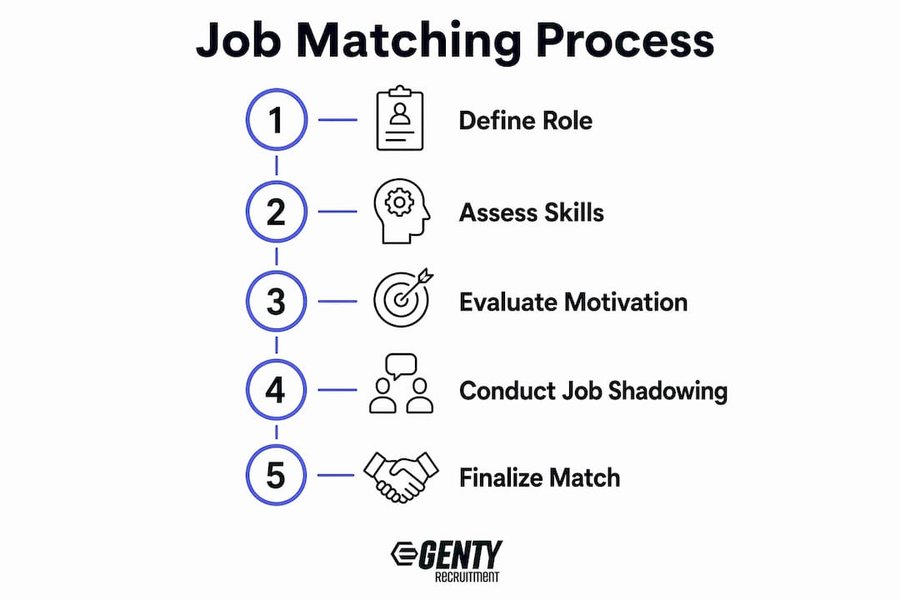
Step-by-step job matching workflow:
- Conduct a job analysis. Document the role’s required skills, responsibilities, seniority level, compensation band, and success metrics before sourcing begins.
- Build a candidate profile. Define the ideal candidate’s technical skills, experience range, motivational drivers, and non-negotiables like timezone and language proficiency.
- Source and screen candidates. Use skills-based assessments and structured interviews to evaluate candidates against the profile, not against each other.
- Score and rank matches. Apply a consistent scoring rubric that weights each criterion according to its importance for the specific role.
- Conduct a trial or job shadowing assessment. Validate real-world fit before extending a formal offer.
- Document outcomes. Record match scores, evaluation notes, and final decisions to build a feedback loop for future hiring cycles.
- Measure post-hire performance. Track 30, 60, and 90-day performance against the original matching criteria to refine future evaluations.
Pro Tip: Before finalizing any job matching criteria, run them past a small panel of current team members who hold similar roles. They will surface requirements the job description missed and flag criteria that do not actually predict success.
For LATAM hiring, salary benchmarking is a non-negotiable step in the job analysis phase. Senior full-stack engineers in Argentina generally earn less than their US counterparts. That gap is real, and it only holds if the matching process confirms genuine skill equivalence, not just a lower price point.
Operational considerations that often get skipped:
- Involve both technical leads and HR in defining match criteria
- Document bias mitigation steps, particularly for cross-border evaluations
- Use the NHS Job Evaluation framework’s factor-by-factor comparison approach as a model for structured consistency, even outside institutional settings
- Integrate recruitment assessment tools into the pipeline to automate early-stage screening
Job design, skills assessment, and training in the matching process
Job matching does not happen in a vacuum. The quality of the match depends directly on how well the role itself has been designed. A vague job description with unclear success criteria produces vague matches. A role with defined skill requirements, a clear career path, and a transparent compensation structure attracts candidates who know exactly what they are signing up for.
Skills assessment methods range from formal technical tests (coding challenges, system design interviews, take-home projects) to informal evaluations (portfolio reviews, reference checks, trial tasks). The most effective processes use both. Formal assessments establish a baseline; informal methods reveal how a candidate thinks, communicates, and handles ambiguity.
For LATAM tech roles, compensation structure and career path clarity carry extra weight. Engineers in Brazil and Colombia are increasingly selective about remote opportunities, and they evaluate roles based on growth trajectory, not just current salary. A role that offers a clear path from mid-level to senior, with defined milestones and a compensation band that reflects that progression, will consistently outperform a higher-paying role with no visible ceiling.
Key elements of job design that directly affect matching quality:
- Role clarity: Specific deliverables and success metrics, not generic responsibilities
- Skill taxonomy: A defined list of required versus preferred skills, mapped to actual tasks
- Compensation transparency: Published or clearly communicated salary bands by seniority
- Career path visibility: Defined progression criteria that candidates can evaluate before accepting
- Training investment: Identified gaps the employer will close through onboarding or development programs
GENTY recruitment integrates skills assessment into the sourcing process itself. Every candidate in a shortlist has been evaluated against the client’s specific technical requirements, not a generic seniority label.
How AI and reinforcement learning are changing job matching
The shift from keyword matching to AI-powered semantic matching is the most consequential change in recruitment technology in the past decade. Where keyword systems match the word “React” to a job posting that lists “React,” semantic models understand that a candidate with deep experience in Vue.js and Angular likely has the transferable skills to work in a React codebase. That distinction alone expands the qualified candidate pool substantially.
Advanced job matching systems use a two-stage architecture: a fast semantic embedding model handles large-scale candidate filtering, and a detailed reasoning model then scores candidates against specific criteria like skills, location, and salary. The first stage processes thousands of profiles in seconds; the second stage applies the nuanced judgment that previously required a human recruiter. Platforms like Indeed process over 4 billion unique data points annually from job seekers sharing skills, certifications, and preferences to refine their matching recommendations.
Reinforcement learning from human feedback (RLHF) takes this further. When a recruiter rejects a candidate, the system does not just log the rejection. It learns the specific reasons, whether the candidate lacked a particular skill, was outside the salary range, or did not meet the timezone requirement, and adjusts future recommendations accordingly. The result is a matching pipeline that gets more accurate with every hiring cycle.
Pro Tip: When evaluating AI job matching platforms, ask vendors to show you how the system explains its match scores. A platform that can articulate why a candidate ranked highly, citing specific skill alignments and criteria weights, is far more trustworthy than one that produces a score with no reasoning.
One critical caveat for LATAM hiring: most AI matching models are trained primarily on US and European labor market data. AI models trained on US/European data may carry biases that undervalue LATAM candidates, making custom data weights that prioritize local benchmarks and English proficiency essential for accurate regional matching. A platform that cannot be recalibrated for LATAM market norms will systematically underrank qualified candidates from Argentina, Brazil, Mexico, and Colombia.
Best practices for adopting AI job matching systems:
- Require explainability: the system should justify every match score with specific criteria
- Test for regional bias before deploying at scale in LATAM markets
- Use AI talent sourcing workflows designed specifically for Latin American candidate pools
- Combine AI filtering with human review for final shortlists
- Feed recruiter feedback systematically into the model to activate RLHF improvements
- Audit match outcomes quarterly to confirm the system is not drifting toward credential proxies
Challenges and limitations of job matching processes
Job matching is not a solved problem, and treating it as one produces bad hires. The most common failure mode is over-reliance on a single signal. A candidate who scores perfectly on a technical assessment but has never worked in a distributed team will struggle in a remote-first environment. A candidate who interviews brilliantly but whose salary expectations are 30% above the role’s band will either decline the offer or leave within a year.
Bias is a persistent structural challenge. Even skills-based matching systems can encode bias if the skills taxonomy was built by a homogeneous team or if the training data reflects historical hiring patterns that excluded certain groups. The NHS Job Evaluation Scheme addresses this directly by requiring that matching panels include both management and staff representatives who have been trained in bias avoidance. That principle applies equally to corporate hiring processes.
Data quality is another limiting factor. Job matching is only as accurate as the information fed into it. Candidates who underreport skills, employers who write vague job descriptions, and platforms that rely on unverified self-assessments all degrade match quality. The response rate on large job boards is low, and employers frequently report receiving high volumes of low-quality applicants through standard online searches, precisely because those platforms do not enforce data quality standards.
For LATAM hiring, additional challenges include inconsistent credential verification across countries, variable English proficiency levels within the same seniority tier, and the difficulty of assessing soft skills remotely. These are solvable problems, but they require deliberate process design rather than off-the-shelf solutions.
Real-world applications of job matching across industries
Job matching is not confined to tech hiring. Its principles apply wherever role requirements and candidate qualifications need to be systematically compared.
Technology and software development: This is where AI-driven matching has advanced fastest. Companies hiring software engineers, DevOps specialists, and data scientists use skills-based platforms to filter candidates by specific languages, frameworks, and system design experience. GENTY recruitment applies this model to LATAM tech hiring, delivering pre-vetted shortlists of engineers from Argentina, Brazil, Mexico, and Colombia within 7 days.
Healthcare: The NHS Job Evaluation Scheme is one of the most formalized job matching systems in the world. It uses a panel-based process to compare roles against nationally standardized profiles, ensuring consistent grading and salary band placement across thousands of positions. The factor-by-factor comparison methodology it uses is a model for any organization that needs matching to be auditable and fair.
Financial services and FinTech: Compliance requirements make precise role-to-candidate matching critical. A FinTech company hiring a compliance analyst needs to match not just on general finance experience but on specific regulatory frameworks, jurisdictions, and software tools. Vague matching produces costly compliance gaps.
Sales and go-to-market roles: Matching for sales positions requires evaluating motivational fit as heavily as skills. A technically qualified account executive who is not motivated by commission structures or competitive environments will underperform regardless of their resume. GENTY recruitment’s sales recruitment practice applies the same skill-first methodology to SDR and account executive placements across LATAM.
Public employment services: Governments in Singapore, France, Belgium, and Canada have deployed machine learning-based job matching platforms within their public employment services to connect job seekers with opportunities more accurately than traditional job boards allow.
How strong job matching drives retention and satisfaction
The connection between accurate job matching and employee retention is direct. When a candidate’s skills, motivations, and expectations align with what the role actually delivers, the conditions for long-term engagement are in place from day one. When they do not, attrition follows, typically within the first 6–12 months.
Poor matches are expensive. Replacing a mid-level software engineer costs, by most industry estimates, a significant multiple of their annual salary when you account for recruiting fees, onboarding time, and lost productivity. For US companies hiring in LATAM, where clients save up to 40% compared to US hiring costs, a bad match erodes that cost advantage quickly.
Satisfaction also depends on whether the role delivers what the matching process promised. If a candidate was told the role offered significant autonomy and it turns out to be heavily managed, the mismatch in expectations produces disengagement even when the technical fit was accurate. This is why motivational alignment, discussed earlier, is not a soft add-on. It is a retention mechanism.
Recruitment automation that incorporates post-hire feedback loops closes this gap systematically. When post-hire performance data feeds back into the matching model, the criteria that predicted success get reinforced and the criteria that did not get deprioritized. Over time, the process gets measurably better at identifying candidates who will stay and perform.
GENTY recruitment’s IT recruitment service applies a skill-first matching process to LATAM tech hiring, delivering pre-vetted shortlists within 7 days, with fixed-fee pricing, no upfront payments, and a 3-month replacement guarantee. For US and European tech companies building engineering or sales teams in Argentina, Brazil, Mexico, or Colombia, that combination of speed, accuracy, and cost efficiency is what effective job matching looks like in practice.
Key Takeaways
Effective job matching combines skills verification, motivational alignment, and structured evaluation criteria to produce hires who perform faster and stay longer.