

Sifting through hundreds of low-fit resumes while a critical engineering role sits vacant is one of the most draining experiences in modern tech recruiting. Traditional sourcing processes are slow, inconsistent, and rarely optimized for the specific challenge of finding English-speaking, technically qualified candidates across Latin America. AI sourcing tools promise speed and precision, but without a structured workflow, many teams end up with a fragmented process that produces mixed results at best. This guide walks you through exactly how to build, run, and optimize an AI-driven sourcing workflow tailored for pre-vetted LATAM tech talent, so you spend less time searching and more time hiring.
Table of Contents
- What you need for an effective AI talent sourcing workflow
- Step-by-step: Setting up your AI sourcing pipeline
- Troubleshooting and optimizing your AI workflow
- How to measure ROI and success metrics
- Why most AI talent sourcing workflows fail—and how to avoid the trap
- Ready to accelerate your LATAM tech hiring?
- Frequently asked questions
Key Takeaways
What you need for an effective AI talent sourcing workflow
Once you recognize the inefficiencies in traditional processes, it’s time to gather the right tools and components for a successful AI workflow. Before writing a single job description into an AI tool, you need to audit your existing stack and close the gaps that will otherwise bottleneck every step downstream.
The foundation rests on three interconnected layers. First, you need a modern applicant tracking system (ATS) that accepts structured candidate data via API, not just CSV uploads. Systems like Greenhouse, Lever, or Ashby handle this well. Second, you need a data enrichment layer, which pulls verified contact information, GitHub activity, LinkedIn profiles, and skills signals into a unified candidate record. Third, you need workflow automation at the outreach stage, whether that is Zapier, Make, or a native automation layer inside your sourcing tool.
Beyond the basic stack, AI in tech hiring has shown that the biggest differentiator between high-performing and low-performing sourcing programs is integration depth. Teams that connect their AI tool directly to their ATS, assessment platform, and outreach system see dramatically better funnel visibility than those using siloed point solutions.
Planning a hire?
Talk through the best hiring option
This article usually leads to one practical question: should you use rpo or staffing? We can help you choose quickly.
For LATAM hiring specifically, you also need to integrate an assessment platform capable of evaluating English proficiency, technical skills, and communication quality before a candidate ever reaches your recruiter’s inbox. This is what separates a pre-vetted pipeline from a raw sourcing list. When you apply strong LATAM sourcing strategies from the start, shortlist quality improves significantly at every downstream stage.
One often-overlooked requirement is a baseline benchmarking standard. AI sourcing tool benchmarks are measured quantitatively as Elo ratings, which compare candidate relevance judgments produced by the AI tool against those made by expert human recruiters. Knowing your tool’s Elo rating relative to a baseline like LinkedIn Recruiter gives you an objective, numeric signal for whether your tool is actually surfacing better candidates or just surfacing more of them.
Key components to have in place:
- ATS with API-level integration capability
- AI sourcing or matching platform with LATAM candidate coverage
- Data enrichment tool for verified contact and skills data
- Technical and language assessment platform
- Outreach automation with response-rate tracking
- Funnel analytics dashboard connecting all stages
Pro Tip: Don’t just evaluate your AI tool on match quality alone. Map every stage from search to offer and confirm that data flows automatically between each system. Gaps in data handoffs create manual work that erodes every efficiency gain your AI tool produces.
Building a scalable hiring pipeline from day one means designing your integrations before you launch your first search, not retrofitting them after your first hire.
Step-by-step: Setting up your AI sourcing pipeline
With your toolkit assembled, you can now build your workflow. Let’s break down each actionable step so your team moves from job brief to qualified shortlist with minimal friction.
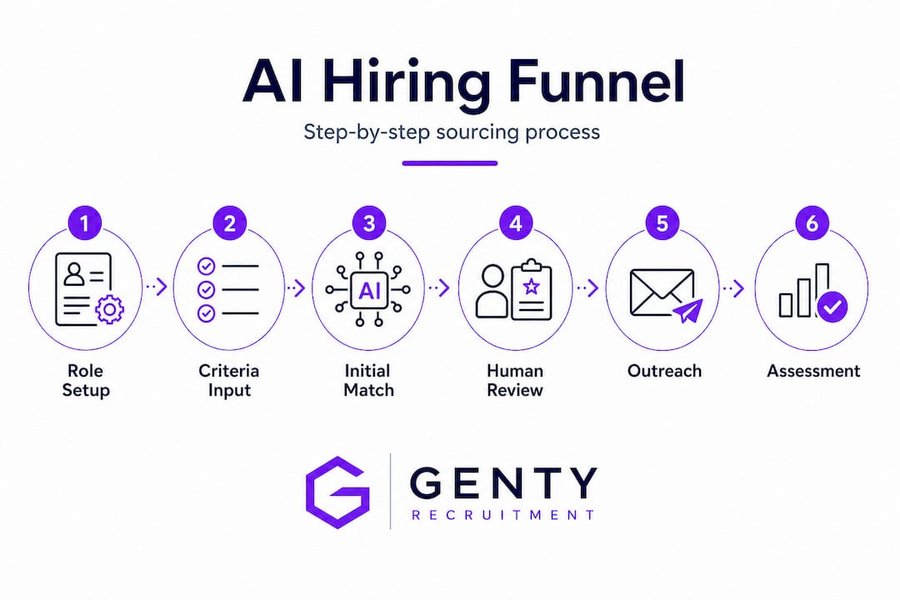
1. Define role requirements with structured precision. Write your role criteria in structured fields, not just a narrative job description. Specify required technologies, years of experience ranges, English proficiency level, time zone overlap requirements, and any industry-specific context. The more structured your input, the more accurate your AI matches will be.

2. Input criteria into your AI sourcing tool. Use Boolean logic and semantic search features together. A good AI sourcing platform combines keyword matching with skills inference, so a candidate who lists “AWS Lambda” also surfaces for “serverless architecture” queries. Validate that your tool covers Argentina, Brazil, Mexico, Colombia, and other target LATAM markets before running your first search.
3. Run the initial match and generate a candidate pool. Most AI tools return between 50 and 200 candidates per search. Your goal here is not to manually review all of them. Instead, apply your pre-vetting filters, such as assessment scores, English proficiency ratings, and verified skills signals, to reduce the pool to a structured shortlist of 10 to 15 candidates.
4. Apply human review at the shortlist stage. A recruiter with LATAM market knowledge reviews the shortlist for cultural fit signals, career trajectory, and any red flags not captured by structured data. This human-in-the-loop checkpoint is non-negotiable. AI sourcing evidence consistently shows that fully automated shortlists without human validation produce lower acceptance rates and slower time-to-offer.
5. Engage candidates through automated but personalized outreach. Use your outreach automation tool to send personalized messages that reference specific skills or projects from each candidate’s profile. Track open rates, response rates, and reply sentiment. A response rate below 25% usually signals that your outreach copy, timing, or candidate fit needs adjustment.
6. Advance qualified responders into your ATS and assessment flow. Candidates who respond positively move immediately into your structured assessment pipeline. Automating this handoff between outreach tool and ATS eliminates manual data entry and keeps your automation in recruitment working as a connected system rather than a series of disconnected steps.
According to a real-world sourcing evaluation, a workflow must be treated as an end-to-end funnel with measurable metrics, not just a search or matching step. Teams that instrument every stage report significantly better ROI than those who only optimize the search layer. Similarly, expert-rated relevance using Elo ratings versus baselines like LinkedIn Recruiter represent the gold standard for evaluating whether your sourcing tool is actually performing.
Explore available AI sourcing platforms to compare feature sets before committing to a long-term stack.
Workflow comparison: Manual vs. AI-augmented vs. full AI sourcing
Pro Tip: Track response rate and time-to-slate as your two leading indicators for workflow health. If either number degrades week over week, you have a signal to investigate before the problem compounds across your entire funnel.
Troubleshooting and optimizing your AI workflow
Even with the best setup, issues will crop up. Here is how to spot and fix the most common problems before they stall your hiring.
Integration failures are the most disruptive issue teams face. When your AI sourcing tool does not hand off candidate data cleanly to your ATS, recruiters resort to manual entry. This creates data inconsistencies and slows every subsequent stage. Run a full integration test with five dummy candidates before going live, and set up automated alerts for any failed data transfers.
Low-quality matches usually trace back to poorly structured input criteria or a sourcing tool with limited LATAM coverage. If your AI tool was trained primarily on US or European candidate data, it will underperform on LATAM profiles. Validate regional coverage during your tool evaluation phase, and use Elo rating benchmarks to compare performance across candidate pools by geography.
Low response rates often indicate a mismatch between the candidates being sourced and the role being offered, or poorly written outreach messages that feel generic. Segment your outreach by seniority level and technology stack, and A/B test subject lines and message length to find what works for your specific target candidates.
“If you only optimize the search or matching step, but not the candidate engagement or integration, AI ROI plummets.” This insight from a six-month production evaluation captures exactly why so many AI sourcing programs underdeliver.
Relying on AI without human review is the most dangerous failure mode. When AI tools surface candidates who pass structured filters but lack genuine fit, and no human validates the shortlist, offers go out to candidates who decline or disengage early. The cost of a mis-hire at the senior engineer level frequently exceeds $50,000 when you factor in lost productivity and rehiring time.
Diagnostic checklist for a struggling AI workflow:
- Are all system integrations transferring data without errors?
- Is your ATS receiving complete, structured candidate records?
- Is your response rate above 25% for initial outreach?
- Are shortlisted candidates advancing to interview at a rate above 50%?
- Is a human recruiter validating every shortlist before outreach?
- Are drop-off points identified and addressed at each funnel stage?
Reviewing AI recruitment efficiency data from comparable programs helps calibrate what “normal” looks like for each stage, so you can identify outliers quickly. You should also examine how AI tools handle coding interviews at the assessment stage to make sure technical evaluation aligns with your actual job requirements.
Pro Tip: Instrument every stage of your funnel with timestamps. Knowing exactly where and when candidates drop off turns a vague “the pipeline feels slow” observation into a precise, fixable problem.
How to measure ROI and success metrics
After optimizing your workflow, you need to track results. The numbers that tell the real story are not always the ones that sourcing tool vendors highlight in their dashboards.
Time-to-slate measures how many days pass from opening a requisition to presenting a qualified shortlist to the hiring manager. For LATAM tech roles using an optimized AI workflow, a realistic target is three to five business days. If you are consistently exceeding ten days, investigate whether the bottleneck is at the search, vetting, or review stage.
Candidate response rate measures the percentage of outreached candidates who reply positively to initial contact. Rates above 30% indicate strong candidate fit and compelling outreach. Rates below 20% signal that either the candidate pool is not well-matched or the outreach messaging needs revision.
Shortlist acceptance rate tracks how many candidates on your shortlist the hiring manager accepts for interview. An acceptance rate above 70% means your vetting criteria are well-calibrated. Consistent rejection of shortlisted candidates by hiring managers usually points to a misalignment in role requirements between recruiters and hiring teams.
Interview-to-offer conversion is the clearest signal of overall sourcing quality. If your ratio sits at 3:1 or better, meaning three interviews lead to at least one offer, your workflow is performing efficiently. Ratios worse than 6:1 indicate that candidates are reaching interviews without adequate technical or cultural pre-screening.
Key workflow metrics including time-to-slate, response rates, and interview-to-offer conversion are the critical measures for workflow ROI, not just raw match quality scores. Teams that track these numbers monthly and report them to stakeholders create accountability loops that sustain continuous improvement. Building these metrics into your tech recruiting growth strategy ensures that every hiring quarter improves on the last.
Core metrics to monitor monthly:
- Time-to-slate (target: under 5 business days)
- Candidate response rate (target: above 30%)
- Shortlist acceptance rate (target: above 70%)
- Interview-to-offer conversion (target: 3:1 or better)
- Time-to-offer from first outreach (target: under 20 business days)
Why most AI talent sourcing workflows fail—and how to avoid the trap
Most teams that struggle with AI sourcing make the same mistake: they treat tool selection as the hard part and process instrumentation as an afterthought. They spend weeks evaluating platforms, comparing match quality demos, and negotiating contracts, then launch the tool into an unmeasured, loosely integrated process and wonder why results disappoint after 90 days.
The uncomfortable truth is that the tool is rarely the problem. Match quality across leading AI sourcing platforms is remarkably similar once you control for regional data coverage. What separates high-performing programs from stalled ones is almost always the discipline to instrument every funnel stage, assign clear ownership for human review checkpoints, and respond to metric degradation within days rather than weeks.
There is also a false binary that damages many hiring programs: the belief that you must choose between automation and human judgment. In reality, the highest-impact LATAM hires consistently come from workflows where smart AI efficiency insights drive the search and matching layers, while experienced recruiters validate shortlists, coach candidates through the process, and read the soft signals that no algorithm currently captures well.
The teams that win long-term are not the ones with the most advanced AI tools. They are the ones that build disciplined, measurable processes around capable tools, and that treat human recruiter expertise as a strategic asset rather than a bottleneck to be automated away.
Ready to accelerate your LATAM tech hiring?
With your new workflow knowledge, here is how to implement or scale it with minimal ramp-up and maximum impact.
Genty Recruitment brings together proven AI sourcing workflows, deep regional networks across Argentina, Brazil, Mexico, Colombia, and beyond, and hands-on recruiter expertise to help you move from job brief to qualified shortlist faster than traditional methods allow.
Whether you need IT recruitment in LATAM for a single critical hire or a scalable program for ongoing team growth, the process is designed around pre-vetted candidates who are technically qualified, English-speaking, and ready to integrate. Explore the full range of pre-vetted remote LATAM talent options or connect directly to discuss a workflow consultation. If you are building or expanding distributed engineering teams, remote LATAM tech talent at the right seniority level is available now.
Frequently asked questions
What are the most important metrics for AI talent sourcing ROI?
Time-to-slate, response rates, and interview-to-offer conversion matter most for tracking sourcing workflow ROI, as they measure real funnel performance rather than surface-level match counts.
How is AI sourcing tool quality measured compared to LinkedIn Recruiter?
Human-judged relevance and Elo ratings are the benchmark methods used to compare AI sourcing tools against LinkedIn Recruiter, providing a quantitative and expert-validated performance score.
Can I automate the entire sourcing process, or do I still need a human recruiter?
While most steps can be automated effectively, human validation at the shortlist and outreach stages is essential for maintaining shortlist quality and achieving strong candidate acceptance rates.
What’s the most common reason an AI sourcing workflow fails?
Most workflows fail by optimizing the search or matching step while neglecting integration and engagement, which stalls candidates before they ever reach an interview stage.
How can I ensure my AI sourcing tool works for LATAM talent?
Select tools with verified LATAM candidate coverage and validate performance using human-judged benchmarks rather than relying on vendor-provided match statistics alone.