
Remote work culture is the intentional system of shared values, communication norms, and behaviors that enable distributed teams to collaborate effectively without physical proximity. Unlike office culture, which forms organically through daily in-person contact, remote work culture must be deliberately designed and documented from day one. Teams with strong cultural alignment report 2.5 times higher employee engagement than those in weaker cultures. That gap is not a soft metric. It shows up directly in retention, output quality, and your ability to scale. For US and European tech companies hiring across Argentina, Brazil, Mexico, and Colombia, getting remote culture right is the difference between a high-performing distributed team and an expensive coordination failure.
What is remote work culture, and why does it matter?
Remote work culture is defined as the collection of explicit values, behavioral norms, and communication practices that govern how a distributed team operates day to day. The industry term for this concept is “distributed team culture,” though remote work culture is the phrase most professionals use in practice. Both terms describe the same thing: the invisible operating system that determines whether your team trusts each other, communicates clearly, and stays engaged over time.
The critical distinction from office culture is intentionality. In a physical office, culture transmits passively through hallway conversations, shared lunches, and visible leadership behavior. Remote teams have none of those passive channels. Every cultural signal must be created on purpose. Documented values and leadership behaviors are the primary mechanism for transmitting culture across distance, and they only work when leadership reinforces them consistently and visibly.

Culture also separates from logistics in ways that trip up many engineering leaders. Solving for tools, meeting schedules, and project management software does not create culture. Culture is trust and shared values, and it requires a separate, ongoing effort beyond operational setup. A team that uses Slack, Notion, and Jira but has no documented values or recognition system does not have a remote culture. It has remote logistics.
Planning a hire?
Talk through the best hiring option
This article usually leads to one practical question: should you use staffing or it recruitment? We can help you choose quickly.
Simple next step
Start with staffing and we will help you pick the best hiring setup.
For tech teams building with LATAM talent, the benefits of remote work extend beyond cost savings. Timezone alignment between LATAM countries and US EST/PST hours creates real synchronous collaboration windows, which makes culture transmission significantly easier than with fully asynchronous, globally distributed teams.
What are the essential elements that build a strong remote culture?
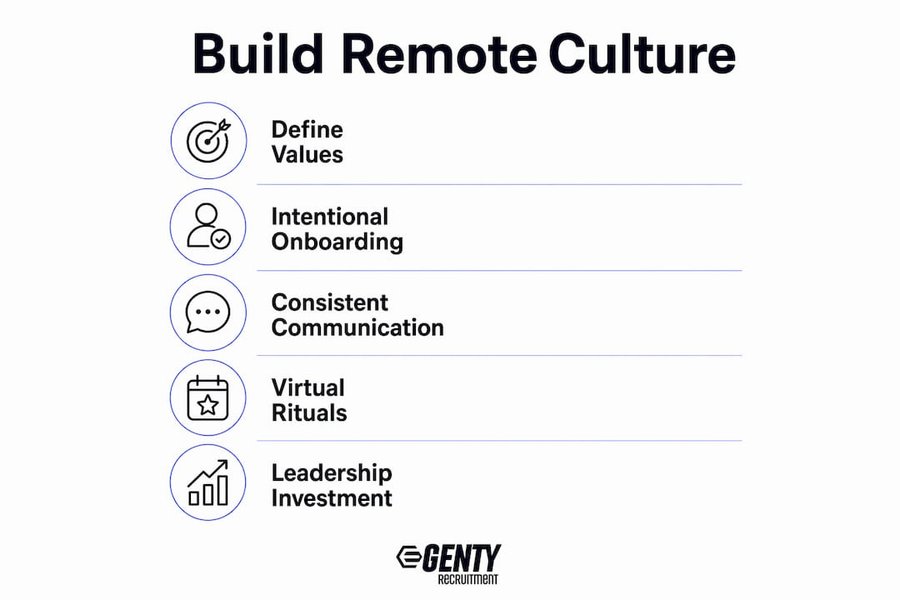
A strong remote work culture rests on five concrete components. Each one must be actively built, not assumed.
- Documented values. Values that exist only in a founder’s head do not scale. Write them down, attach specific behaviors to each one, and make them accessible to every team member from day one.
- Clear communication rhythms. Define when your team communicates synchronously versus asynchronously. Establish response-time expectations for different channels. Ambiguity in communication norms is one of the fastest ways to erode trust in a remote team.
- Intentional onboarding. Onboarding as cultural orientation means introducing new hires to documented values and real decision-making behaviors, not just administrative setup. This is where culture transmission either succeeds or fails.
- Visible recognition systems. Recognition across distance requires structure. Peer shoutouts in a dedicated Slack channel, monthly team spotlights, and manager-led acknowledgment in all-hands meetings all reinforce the behaviors your culture rewards.
- Active leadership modeling. Leaders who visibly live the documented values set the behavioral standard for the entire team. When a VP of Engineering responds to a mistake with transparency instead of blame, that single act communicates more about culture than any written document.
Pro Tip: Design remote-native rituals rather than copying office rituals. A virtual happy hour that mimics an office party rarely works. A weekly async “wins thread” where team members post one accomplishment and one lesson learned is a ritual built for the medium.
How does LATAM recruitment support remote culture for US and European tech firms?
Hiring in Latin America gives US and European tech companies a structural advantage in building remote culture. The timezone overlap between LATAM and US EST/PST hours means teams in Argentina, Brazil, Mexico, and Colombia can participate in synchronous standups, design reviews, and culture-building activities during normal working hours. That overlap is not trivial. Synchronous time is where trust forms fastest, and LATAM engineers and sales professionals operate within it naturally.
Beyond timezone fit, LATAM talent brings strong English proficiency and work values that align closely with North American and European tech team norms. Engineers from Buenos Aires, São Paulo, Bogotá, and Mexico City regularly work within Agile and Scrum frameworks, use the same collaboration tools as their US counterparts, and adapt quickly to distributed team structures. They do not need to be taught remote work. They need to be integrated into your specific culture, which is a much shorter path.
The cost advantage is equally concrete. Companies working with pre-vetted LATAM talent through GENTY recruitment save up to 40% compared to equivalent US or European hires, without sacrificing seniority or technical depth.
LATAM hires also function as culture carriers when onboarded well. A senior engineer from Colombia who joins a team with strong documented values and a clear recognition system will reinforce those norms with peers across the team, regardless of geography.
What challenges do remote teams face in maintaining culture?
The three most common threats to remote culture are isolation, miscommunication, and blurred work-life boundaries. Each one compounds the others. An engineer who feels isolated communicates less. Less communication creates misalignment. Misalignment leads to longer working hours as people try to compensate through effort rather than clarity.
Flexible policies that address individual needs drive retention and productivity in remote teams. A one-size-fits-all remote policy consistently harms engagement, particularly for caregivers, employees in different time zones, and team members with varying home office setups. The fix is differentiated flexibility: set clear output expectations, then give people latitude in how and when they meet them.
The most underestimated challenge is the time investment required from leadership. Founders and team leads who skip early culture investment end up with accidental culture, where informal norms fill the vacuum left by absent documentation. Accidental culture is almost always harder to fix than to prevent.
Pro Tip: Invest 8–15 hours per week in active culture building during the first 6–12 months of a remote team’s formation. This includes structured one-on-ones, async culture updates, and deliberate recognition. Skipping this phase creates retention problems that cost far more to fix later.
Async communication, when structured well, reduces burnout rather than causing it. The key is clear protocols: define which decisions require a meeting, which belong in a written thread, and which can be resolved with a short Loom video. Teams that document these norms report fewer interruptions and higher focus time.
What are best practices for sustaining remote culture at scale?
Sustaining remote work culture over time requires the same deliberate effort that built it in the first place. Culture does not maintain itself. The following practices keep it healthy as your team grows.
<p>Revisit documented values every six months. As teams scale, values drift unless they are actively reviewed and updated. Schedule a biannual values audit where leadership and team representatives assess whether current norms still reflect the written values.</p>
<p>Treat onboarding as your highest-stakes cultural moment. Every new hire forms their mental model of your culture in the first 30 days. An onboarding program that introduces documented values, real decision-making examples, and key cultural rituals sets a new hire up to reinforce culture rather than dilute it.</p>
<p>Build recognition into your operating cadence. Recognition systems that require extra effort from managers get deprioritized under pressure. Embed recognition into existing rituals: a standing agenda item in weekly team meetings, a monthly peer-nominated award, or an async channel dedicated to wins.</p>
<p>Use feedback loops to measure culture health. Quarterly pulse surveys with three to five targeted questions give you leading indicators of culture drift before it becomes a retention problem. Track engagement, clarity of values, and sense of belonging as separate metrics.</p>
<p>Model transparency at the leadership level. When leaders share context behind decisions, acknowledge mistakes publicly, and communicate strategy changes before they become rumors, they build the psychological safety that remote culture depends on. Building remote culture requires 12–18 months of consistent, deliberate leadership effort to reach a self-sustaining state. That timeline is not a warning. It is a planning input.</p>
Key takeaways
Strong remote work culture is built through documented values, intentional onboarding, and consistent leadership modeling, not through tools or meeting schedules alone.
What I’ve learned building remote cultures with LATAM teams
The most common mistake I see engineering leaders make is treating culture as a phase rather than a function. They invest heavily in the first quarter, run a values workshop, write a culture doc, and then move on. Six months later, the culture doc lives in a forgotten Notion page and the team has developed its own informal norms, which are usually a reflection of whoever communicates the loudest.
The LATAM angle changes this dynamic in a useful way. When you hire engineers from Argentina or Colombia who are operating in your timezone and genuinely want to integrate into your team, you get early signals about whether your culture is actually working. If your recognition system is real, LATAM hires will engage with it. If your async communication norms are clear, they will follow them. If your values are vague, they will tell you through their behavior within weeks.
The timezone overlap is also underrated as a culture tool. Synchronous time is where trust forms. A senior developer in Bogotá who joins your morning standup, participates in your design review, and gets recognized in your Friday wins thread is not a remote contractor. That person is a team member. The distinction matters more than most leaders realize until they experience the difference firsthand.
My honest advice: treat the first 12 months of a remote team’s formation as a culture build sprint. Assign it the same priority you give product development. The teams that do this retain people. The teams that skip it spend the following year backfilling roles and wondering why their engagement scores are low.
— Eugene
How GENTY recruitment helps you build remote tech teams that fit your culture
Building a remote team with the right cultural fit starts with hiring people who are already aligned with how distributed teams operate.
GENTY recruitment specializes in placing pre-vetted software engineers, DevOps professionals, data specialists, and sales teams from Argentina, Brazil, Mexico, Colombia, and across Latin America into US and European tech companies. Every candidate goes through a skill-first vetting process, and shortlists arrive within seven days. Fixed-fee pricing by seniority level means no surprises, and a three-month replacement guarantee protects your investment. If you are building a remote team in FinTech, SaaS, AI, or Web3, GENTY’s IT recruitment process is built to match your technical requirements and your cultural expectations from the first hire.
FAQ
What is remote work culture in simple terms?
Remote work culture is the set of shared values, communication norms, and behaviors that define how a distributed team operates without a physical office. It must be deliberately designed and documented because it cannot form passively the way office culture does.
How long does it take to build a remote work culture?
Building a self-sustaining remote culture typically takes 12–18 months of consistent, deliberate leadership effort. Skipping early investment leads to accidental culture and higher turnover.
Why is remote work culture important for tech teams?
Teams with strong cultural alignment report 2.5 times higher engagement than those without it. For tech teams, higher engagement directly correlates with lower attrition and faster delivery cycles.
How does hiring LATAM talent affect remote culture?
LATAM engineers and sales professionals in Argentina, Brazil, Mexico, and Colombia operate within US EST/PST timezone windows, which enables synchronous collaboration and faster cultural integration compared to fully asynchronous global teams.
What is the biggest mistake in building remote work culture?
Replicating in-office rituals in a virtual format is the most common and costly mistake. Remote culture requires digital-native rituals designed specifically for distributed environments, not online versions of office activities.